CANONIC-CANON
CANONIC-CANON
The CANONIC CANON
SERVICE CONTRACT · VIEW: GOV
The Governor’s Manual
Persona
| Field | Value |
|---|---|
| tone | narrative |
| audience | governors, executives, compliance officers, CMOs, CISOs, hospital board members |
| voice | second-person |
| warmth | personal |
| context | a book — the enterprise healthcare sales instrument. The business case, the compliance proof, the sell. |
| vertical | HEALTHCARE — hospital systems, health networks, clinical research organizations |
What CANONIC is. Why it matters. How it proves itself.
Governors speak idioms. This book speaks theirs.
For the developer’s manual — build commands, file formats, compiler internals — see the companion volume, THE CANONIC DOCTRINE.
Dexter Hadley, MD/PhD 1 Author, CANONIC February 2026
Abstract
This book presents the theoretical foundation of CANONIC, a governance framework that unifies Kimura’s neutral theory, 255-bit fitness functions, Ewens’s sampling formula, and phylogenetic inheritance into a single coherent system for governing artificial intelligence. Across nine parts and forty-four chapters, it moves from first principles to deployed proof. The opening chapters declare the axioms and introduce the three primitives (INTEL, CHAT, and COIN), then assemble them into a working system before deriving the mathematical theory that underlies compilation and drift. The middle sections map CANONIC against existing compliance standards and demonstrate its deployment across thirteen industry verticals, while the later chapters formalize the economics of governance and prove the mathematics rigorously. The final part presents the proof itself: HadleyLab, the CHAT fleet, and the evidence chain from deployed systems. For implementation details, including build commands, compiler internals, and file formats, see the companion volume, THE CANONIC DOCTRINE.
FRONT MATTER
Half-Title
THE CANONIC CANON
Title Page
THE CANONIC CANON The MAGIC Governance Standard
| CANONIC Series | 1st Edition | 2026 |
Copyright
Copyright 2026 CANONIC. All rights reserved. Governed under MAGIC 255-bit compliance standard. Every chapter evidenced. Every claim cited. Every word COIN.
Note on Clinical Vignettes
The clinical scenarios in this book are illustrative. Where patient names appear, they are changed. The governance failures they depict are composites drawn from patterns observed across multiple institutions; no single scenario corresponds to a specific individual or incident. The medical facts embedded in each vignette (diagnoses, imaging findings, treatment protocols) are accurate to clinical practice as of the publication date.
Dedication
For every compliance officer who was told to “just trust the AI.” This book is your proof.
Epigraph
“The system doesn’t ask you to trust it. It asks you to check.”
— CANONIC 2
Foreword
You are holding a governed document.
Every chapter in this book is a knowledge unit — backed by evidence, validated against a mathematical standard, and recorded on an immutable ledger. The act of reading this book is an act of verification. You can trace every claim to its source. You can check every assertion against the governance framework that produced it. You can audit the provenance chain from this sentence all the way back to the first commit.
This is not a book about trust. This is a book about proof.
CANONIC is a governance framework for artificial intelligence. It answers the question that keeps compliance officers awake at night: Who approved this output? Not with a promise. Not with a policy document. With a receipt — cryptographically signed, timestamped, attributed, and permanently ledgered 2. The framework is described here. The implementation manual is THE CANONIC DOCTRINE. The proof is HadleyLab — deployed, governed, auditable.
If you are a governor, an executive, a compliance officer, or a board member who has been asked to approve an AI deployment, this book is written for you. It explains what CANONIC is, why it matters, and how it proves itself — in your language, not a developer’s.
TABLE OF CONTENTS
PART I    — THE VISION .......................... Chapters 1-3
PART II   — THE THREE PRIMITIVES ............... Chapters 4-6
PART III  — THE SYSTEM ......................... Chapters 7-10
PART IV   — THE THEORY ......................... Chapters 11-14
PART V    — THE STANDARDS ...................... Chapters 15-21
PART VI   — THE VERTICALS ...................... Chapters 22-27
PART VII  — THE ECONOMICS ...................... Chapters 28-31
PART VIII — THE PROOF .......................... Chapters 32-40
PART I — THE VISION
Chapter 1: The Problem
Ungoverned AI, the $255 billion wound, and the ghost labor crisis.
A radiologist in Orlando reads a mammogram at 7 a.m. on a Tuesday in January. The workstation is loaded with 127 cases — the overflow from yesterday’s late-afternoon clinic and this morning’s screening batch. By 7:02, she has dictated her impression on the first case, clicked “sign,” and moved to the next. Her AI co-pilot — a machine learning model trained to flag suspicious densities — has already triaged the queue, pushing three high-suspicion cases to the top. She glances at the AI’s confidence overlay, adjusts her assessment of a BI-RADS 4A lesion that the model scored at 92% probability of malignancy, and recommends a tissue biopsy. Somewhere downstream, that interpretation becomes a recommendation letter. A patient named Maria gets a phone call. A biopsy is scheduled for next Thursday. A life changes 2.
Nobody tracked the AI that helped triage the image. Nobody recorded which model version flagged the lesion — was it v2.3.1 or v2.4.0, the one with the updated training set from the Duke cohort? Nobody documented which clinical evidence informed the confidence score, or whether the model had been validated against the patient’s specific demographic. Nobody logged which BI-RADS atlas edition the AI’s classification system was calibrated to. The work happened. The proof did not.
Three months later, Maria’s biopsy comes back benign. She is relieved. But her insurance company wants to know why the biopsy was recommended in the first place. The hospital’s quality assurance team wants to audit the AI-assisted triage process. A malpractice attorney, contacted by a different patient who received a similar recommendation with a different outcome, wants to reconstruct the decision chain for that Tuesday morning.
And no one can.
This is the AI governance crisis. And it is not an edge case. It is the default operating condition of every hospital system deploying AI in the United States today.
The $255 Billion Wound
The global AI market is projected to exceed $255 billion by 2027 3. Every dollar of that market represents AI output — decisions made, recommendations generated, documents synthesized, diagnoses suggested, images triaged, treatment pathways navigated. And in the vast majority of cases, that output is ungoverned: no audit trail, no evidence chain, no provenance record, no receipt.
The wound is not that AI makes mistakes. Every system makes mistakes. The wound is that when AI makes a mistake in a regulated industry — healthcare, finance, law, defense — nobody can reconstruct what happened. The output exists. The evidence does not. The organization captured the value but lost the proof 3.
Consider the scale of the problem in healthcare alone. The American College of Radiology estimates that over 40 million mammograms are performed annually in the United States 4. A growing fraction of these now involve AI-assisted triage, detection, or classification. Each AI-assisted reading is an event — a decision point where a machine learning model influenced a clinical outcome. Each event should be governed: logged, attributed, evidence-linked, and auditable. In practice, almost none of them are.
Now multiply that by every department in every hospital in every health network. The oncology department uses OncoChat to navigate NCCN guidelines for treatment selection — ungoverned. The emergency department uses an AI triage model to prioritize patient intake — ungoverned. The pharmacy uses a drug interaction checker powered by machine learning — ungoverned. The compliance office uses an AI tool to scan for HIPAA violations — ungoverned. The revenue cycle team uses an AI coder to assign ICD-10 and CPT codes — ungoverned.
Every one of these deployments produces value. Every one of them produces work. And every one of them loses the proof.
The $255 billion wound is not a single catastrophic failure. It is the slow, relentless hemorrhage of institutional accountability. It is the aggregate cost of every AI decision that cannot be reconstructed, every recommendation that cannot be traced, every audit that cannot be completed, and every compliance inquiry that ends with the words: “We’re working on getting that information.”
Ghost Labor
Every time an AI agent does something useful — synthesizes a document, answers a clinical question, generates a compliance report, triages an image, navigates a treatment guideline — that is work. Real work. Valuable work. Work that, if a human did it, would be documented, attributed, and compensated. But in most systems, AI work is ghost labor: it produces output, then vanishes. No record. No attribution. No receipt 2.
The radiologist’s AI-assisted triage? Ghost labor. The system flagged three high-suspicion cases out of 127. That is real triage work — the kind that a human radiology technician would have spent 45 minutes performing. The AI did it in 0.3 seconds. The value was captured. The work was not.
The chatbot that answered a patient’s screening question at 2 a.m.? Ghost labor. Maria typed “what does BI-RADS 4A mean” into MammoChat, and the system responded with a clinically accurate, appropriately caveated explanation drawn from governed evidence. That is real patient education work — the kind that a nurse navigator would spend 15 minutes delivering during a phone callback. The AI did it instantly. The patient was served. The work was not recorded.
The compliance tool that flagged a HIPAA violation in the radiology department’s data sharing agreement? Ghost labor. The AI scanned 847 pages of contractual language and identified three clauses that conflicted with HIPAA §164.312’s technical safeguard requirements. That is real compliance work — the kind that a junior attorney would spend a week performing. The AI did it in minutes. The violation was caught. The work was not attributed.
Ghost labor is not a minor inefficiency. It is a fundamental structural problem in healthcare AI deployment. When work is not recorded, it cannot be audited. When it cannot be audited, it cannot be governed. When it cannot be governed, it cannot be trusted. And when it cannot be trusted, the entire value proposition of AI in healthcare collapses into a single question from the Chief Medical Officer at the next board meeting: “How do we know this thing is doing what it says it’s doing?”
The answer, in most hospitals, is: “We don’t.”
CANONIC was built to end ghost labor. Not by adding a reporting layer after the fact — not by bolting a compliance dashboard onto an ungoverned system — but by building governance into the architecture from the first line of code. Every AI action is work. Every work mints COIN. Every COIN is on the LEDGER. The ghost becomes visible. The labor becomes real. The proof exists 5.
The Compliance Gap
Walk into any hospital system in America and ask the Chief Information Security Officer this question: “Can you prove, right now, that every AI system in this hospital is compliant with HIPAA §164.312’s technical safeguard requirements?” Watch the silence fill the room 2.
Hospital administrators ask: “Who approved this output?” And the room goes quiet. In most AI deployments, the honest answer is: “We’re not sure. The model generated it. Someone probably reviewed it. We think.”
Financial regulators ask: “Can you reconstruct this decision?” And the compliance team scrambles to assemble an after-the-fact narrative from logs that were never designed to tell a coherent story.
Legal teams ask: “What evidence backs this recommendation?” And the AI vendor points to training data that no one can audit, from sources no one can verify, processed by a model no one can fully explain.
Joint Commission surveyors ask: “Show us the audit trail for your AI-assisted clinical decision support.” And the IT department produces a stack of server logs that no human could read, no auditor could follow, and no regulator could accept as evidence of governance.
This is the compliance gap. It is not a technology problem. It is a governance problem. And it will not be solved by better models, faster inference, or more training data. It will be solved by governance — built in, not bolted on 5 6.
The Healthcare Compliance Landscape
The compliance gap is not hypothetical. It is not a risk that might materialize someday. It is a present-tense crisis operating across every major regulatory framework that governs healthcare AI in the United States.
HIPAA requires covered entities to implement technical safeguards including access controls, audit controls, integrity controls, and transmission security for electronic protected health information (ePHI). When an AI system processes patient data — even to triage a mammogram — it is handling ePHI. HIPAA §164.312 demands an audit trail. Most AI systems do not have one 6.
FDA 21 CFR Part 11 governs electronic records and electronic signatures. When an AI system generates a clinical recommendation that influences a treatment decision, that recommendation is an electronic record under Part 11. It must be attributable, contemporaneous, legible, original, and accurate — the ALCOA principles. Most AI systems satisfy none of these requirements.
The Joint Commission evaluates hospitals for accreditation based on quality and safety standards. A hospital deploying AI for clinical decision support must demonstrate that the AI system operates within a quality management framework. The Commission does not accept “the vendor says it works” as evidence. It requires institutional proof.
HITRUST CSF provides a certifiable framework for healthcare information security. Organizations pursuing HITRUST certification must demonstrate controls across 19 domains. AI systems that process, store, or transmit health information must be covered by these controls. Most are not.
CMS Conditions of Participation require hospitals to maintain quality assessment and performance improvement programs. AI systems influencing clinical care must be included in these programs. The question is not whether the AI is good — the question is whether the hospital can prove the AI is governed.
Each of these frameworks asks the same fundamental question in different regulatory language: Can you prove it?
Not “do you believe it works.” Not “does the vendor promise it is safe.” Not “did someone sign off on this.” Can you prove — with evidence, with records, with an auditable chain of provenance — that this AI system did what it was supposed to do, when it was supposed to do it, with the evidence it was supposed to use, for the patient it was supposed to serve?
That is the question CANONIC answers. That is the problem this book addresses. And the answer is not a policy document, not a governance committee, not a quarterly review. The answer is a mathematical standard — 255 bits of provenance — that proves compliance at the moment of action, not months after the fact 6 5.
The Human Cost
The governance crisis is not abstract. It is not a policy problem that lives in conference rooms and compliance binders. It lives in exam rooms and operating theaters and radiology reading rooms and oncology infusion suites. It lives in the space between a clinical decision and the evidence that should have backed it.
Consider the case of a 63-year-old man named Gerald at a teaching hospital in Charlotte, North Carolina. Gerald presented to the emergency department with atypical chest pain — substernal pressure radiating to the jaw, but also accompanied by nausea and epigastric tenderness. The ED physician ordered an ECG, troponin levels, and a chest X-ray. The hospital’s AI triage system — an ML model trained to risk-stratify chest pain presentations — classified Gerald as “low acuity” based on the atypical presentation pattern. Gerald was placed in a hallway bed. He waited four hours. His second troponin came back elevated. He was having an inferior STEMI. The delay to cath lab was six hours from presentation. Gerald survived, but with permanent myocardial damage that a timely intervention might have prevented 2.
The post-incident review found that the AI triage model had been updated three months prior. The update changed the weighting of atypical presentations in patients over 60. Nobody documented the change in the clinical workflow. Nobody validated the updated model against the department’s patient population. Nobody recorded which version of the model was running on the day Gerald arrived. The quality assurance team could not reconstruct the decision chain. The malpractice attorney who eventually contacted Gerald could not obtain the evidence he needed to evaluate the case — not because the hospital refused to provide it, but because the evidence did not exist.
Gerald’s case is not rare. It is the predictable consequence of deploying AI in clinical settings without governance infrastructure. The AI did its job — it classified a presentation according to its training. The failure was not in the model. The failure was in the absence of governance around the model: no version tracking, no validation documentation, no evidence chain linking the model’s output to the clinical action that followed.
Now consider a different case — a 47-year-old woman named Patricia at a community hospital in Tucson, Arizona. Patricia’s screening mammogram was read by a radiologist with AI-assisted detection. The AI flagged a region of concern in the left breast. The radiologist concurred and assigned a BI-RADS 4B classification. A biopsy was scheduled. The biopsy revealed ductal carcinoma in situ. Patricia was referred to oncology. The oncologist queried the hospital’s clinical decision support AI for treatment recommendations. The AI recommended a lumpectomy followed by radiation, citing NCCN guidelines.
Patricia’s outcome was excellent — early detection, appropriate treatment, good prognosis. But when the hospital’s quality committee reviewed the case as part of their AI governance audit, they discovered that the AI detection model running on the day of Patricia’s mammogram was not the model listed in the radiology department’s governance documentation. A version update had been deployed two weeks earlier. The governance documentation still referenced the previous version. The quality committee could not verify whether the newer model had been validated against the hospital’s patient population. The NCCN guidelines cited by the clinical decision support AI were version 1.2025 — but the AI’s INTEL layer had not been updated to reflect the version 2.2025 update that was published three weeks prior.
Patricia’s case had a good outcome. But the governance gaps were identical to Gerald’s case. The difference between a malpractice lawsuit and a quality improvement commendation was not governance — it was luck. And in a regulated industry, you cannot build a compliance program on luck 2 3.
The Institutional Exposure
The financial exposure of ungoverned AI in healthcare is staggering. HIPAA penalties under the HITECH Act’s tiered structure range from $100 to over $50,000 per violation, with annual maximums up to $1.5 million for willful neglect 7. A single AI system processing ePHI without adequate audit controls could generate thousands of individual violations — each patient interaction, each data access event, each recommendation generated without a provenance trail.
In 2023, the HHS Office for Civil Rights resolved 725 HIPAA cases totaling over $135 million in settlements and penalties 8. The trend is accelerating. As AI becomes more deeply embedded in clinical workflows, the surface area for HIPAA violations expands with it. Every AI-assisted clinical decision that processes ePHI without governed audit controls is a potential violation. Every potential violation is a potential enforcement action. Every enforcement action is a potential multi-million-dollar settlement.
Beyond HIPAA, the institutional exposure extends to malpractice liability. When an AI-assisted clinical decision contributes to an adverse patient outcome, the hospital must demonstrate that the AI system was operated within an appropriate governance framework. If the hospital cannot produce the evidence chain — which model version was running, what evidence informed the recommendation, who validated the AI’s output, what quality controls were in place — the hospital’s defense collapses. The absence of governance is not just a compliance failure. It is an evidentiary vacuum that plaintiffs’ attorneys will exploit.
The Joint Commission’s accreditation standards add another layer of exposure. A hospital that deploys AI for clinical decision support without demonstrable quality management governance risks adverse survey findings — findings that can affect the hospital’s CMS certification, its ability to bill Medicare and Medicaid, and its reputation in the community. The financial impact of a lost CMS certification dwarfs any HIPAA penalty.
And then there is the reputational exposure — the hardest to quantify and the most devastating. When a hospital’s AI governance failure makes the local news — “Hospital AI System Fails to Flag Heart Attack” or “Cancer Screening AI Running Outdated Model” — the community’s trust erodes. Patients choose a different hospital. Referring physicians route their patients elsewhere. Board members ask questions that administrators cannot answer. The institutional wound is not measured in penalties. It is measured in empty beds 2 3 6.
What This Book Will Show You
If you are a CMO preparing to present an AI governance strategy to your hospital board, this book gives you the framework. If you are a CISO tasked with ensuring HIPAA compliance for AI deployments across a multi-hospital health network, this book gives you the standard. If you are a compliance officer preparing for a Joint Commission survey and your hospital uses AI for clinical decision support, this book gives you the audit trail. If you are a board member who has been asked to approve a $40 million AI investment and you want to know how the organization will prove the investment is governed, this book gives you the proof.
If you are a hospital general counsel preparing for the inevitable malpractice discovery request involving an AI-assisted clinical decision, this book gives you the evidence architecture. If you are a CFO trying to calculate the ROI of an AI governance program, this book gives you the economic model. If you are a Chief Nursing Officer whose department has deployed an AI staffing optimization tool and you need to demonstrate governance to your CNO peers at the next system meeting, this book gives you the language.
The answer is not another policy document. The answer is not another governance committee. The answer is not another quarterly assessment. The answer is a mathematical standard — 255 bits of provenance — that proves compliance at the moment of action, not months after the fact. The answer is a system that makes governance visible, auditable, and economically self-sustaining.
The next chapter — Chapter 2: The Insight — explains where the answer came from: how a systems engineering framework evolved from a four-dimensional assessment into an eight-dimensional governance compiler. Chapter 3 formalizes the standard. Parts II through IX build the primitives, the system, the theory, the compliance maps, the verticals, the economics, and the proof. But first, understand the problem this answer addresses: every AI system in your hospital is doing work, and none of that work is governed. The output exists. The proof does not. And the regulators are coming 2 3.
Chapter 2: The Insight
From OPTS-EGO to MAGIC — four dimensions became eight.
The insight did not arrive all at once. It arrived in stages, across fourteen years, from a systems engineering education at the University of Pennsylvania to a clinical AI deployment in Orlando, Florida. It began with a simple observation: the existing frameworks for evaluating AI in healthcare were all doing the same thing wrong. They were grading. They were scoring. They were ranking. And grading, scoring, and ranking are not governance 9.
The Origin: OPTS-EGO
Picture the conference room on the third floor of a healthcare innovation center in 2016. A team of clinical informatics researchers is staring at a whiteboard covered in matrices. They are trying to answer a question that no one in healthcare AI has answered satisfactorily: how do you evaluate an AI system deployed in a clinical setting — not just for accuracy, but for everything?
The first attempt was a four-dimensional governance token called OPTS-EGO, the Open Provenance Token Standard governed by Ethical Governance Operators. For each clinical encounter, the token captured a content hash, mCODE metadata, the patient’s digital signature, and a timestamp of consent, while the EGO ledger chained these tokens cryptographically on an append-only record. It was self-published as a whitepaper on Halloween 2025 to close Breast Cancer Awareness Month, the same day the NSF I-Corps program graduated 9.
OPTS-EGO could govern a single clinical encounter. It could hash the mammogram, record the patient’s digital signature, timestamp the consent, and chain the whole transaction onto an append-only ledger with cryptographic integrity. For the four dimensions it covered (data provenance, patient consent, record immutability, and HIPAA compliance by construction), the proof was real. A compliance officer could verify the chain. A patient could audit her own data. The math was sound.
But it could not answer the one question that matters: Is this system governed, or is it not?
OPTS-EGO governed four dimensions out of the eight that a regulated AI deployment actually requires. It could prove that a mammogram was hashed and consented, but it could not prove that the AI’s recommendation had a declaration of purpose, that the reviewing clinician was credentialed, that the system learned from its errors, or that the vocabulary was controlled. Four dimensions governed. Four dimensions missing. And in a regulated environment, partial governance is not governance at all. When a HIPAA auditor asks whether your AI system is compliant with §164.312’s technical safeguard requirements, the answer is not “four out of eight.” The answer is yes or no. When a Joint Commission surveyor asks whether your clinical decision support system meets quality standards, the answer is not “half-governed.” The answer is yes or no. When your hospital’s general counsel asks whether the AI-assisted mammography triage system can withstand a malpractice discovery request, the answer is not “we have the data provenance but not the audit trail.” The answer is yes or no 9.
The gap between four dimensions and eight was not a minor shortcoming. It was the origin of the entire MAGIC framework, and the reason that governance must be binary rather than partial. A system that governs half its surface area creates the illusion of governance without the substance, because the ungoverned half is precisely where the failures will occur.
The Clinical Moment
The limitation of OPTS-EGO became viscerally clear in a clinical deployment. A hospital system in Florida was evaluating an AI model for breast cancer screening assistance. The model had excellent accuracy metrics, with AUC above 0.95 on retrospective validation sets. The vendor had published peer-reviewed papers. The FDA had cleared the device under the 510(k) pathway 9.
The clinical informatics team applied OPTS-EGO to the deployment. The four governed dimensions checked out: the data was hashed, the consent was signed, the records were immutable, and the HIPAA chain was intact. The CMO approved the deployment.
Six months later, the compliance office received a HIPAA inquiry. A patient had filed a complaint about how her screening data was handled. The compliance officer needed to reconstruct the AI’s involvement in the patient’s care pathway. She needed to answer: What model version was running that day? What evidence informed the AI’s triage decision? Who reviewed the AI’s recommendation before it reached the patient? What was the provenance chain from the AI’s output to the clinical action?
OPTS-EGO had governed the data. But the deployment could not answer a single one of those questions, because those questions fell in the four dimensions that OPTS-EGO never covered: declaration, credentialing, learning, and vocabulary. The token chain was intact. The governance was incomplete.
That was the moment the insight crystallized: partial governance is not governance. A system is governed or it is not, and a framework that covers half the surface area while leaving the other half exposed has not governed anything at all. The framework that answers the governance question must be total, covering every dimension simultaneously, like a compiler that either accepts the entire program or rejects it.
The Compiler Insight
The breakthrough came from an unexpected direction: compiler theory 10 6.
A compiler does not grade your code. It does not give you a percentage. It does not say “your program is 85% correct.” A compiler says: your code compiles, or it does not. There is no middle ground. There is no “mostly compiles.” There is no “compiles with warnings we can ignore.”
This is the most important property of a compiler: it is honest. When your code compiles, you know — with mathematical certainty — that certain properties are satisfied. The syntax is correct. The types are consistent. The references are valid. When your code does not compile, you know — with equal certainty — that something is broken. The compiler does not negotiate. It does not grade on a curve. It does not give you partial credit for effort.
What if governance worked the same way?
What if, instead of scoring AI systems on a continuous scale, we defined a binary standard — a set of conditions that must all be satisfied simultaneously? What if we could say: “This AI system is governed” or “This AI system is not” — with the same certainty that a compiler says “this code runs” or “this code does not”?
What if the CMO could walk into a board meeting and say, not “our AI is partially governed,” but “our AI systems compile at 255,” and the board would know, with mathematical certainty, that every dimension of governance was satisfied?
That insight transformed OPTS-EGO into MAGIC 6.
The transformation was not incremental. It was not “OPTS-EGO plus a few more dimensions.” It was a fundamentally different approach to the problem. OPTS-EGO was a provenance token: it proved that clinical data was hashed, consented, and chained. MAGIC is a compiler: it enforces governance across all eight dimensions simultaneously. The difference is the difference between a lock on one door and a security system for the entire building.
Eight Questions
The four dimensions of OPTS-EGO became eight questions — eight binary gates that any governed scope must satisfy. Each question maps to a dimension. Each dimension is a bit. Each bit is either satisfied (1) or not satisfied (0). The questions are not arbitrary. They are the minimum set of questions that must be answered affirmatively for a scope to be called “governed” in a regulated environment 11 12:
| Question | What It Governs |
|---|---|
| What do you believe? | The axiom. The single assertion from which everything derives. |
| What proves it? | The vocabulary. The controlled terminology. The proof. |
| When did it happen? | The timeline. The roadmap. The temporal record. |
| Who is involved? | The relationships. The inheritance chain. |
| How does it work? | The constraints. The rules. The mechanism. |
| What shape is it? | The coverage. The editorial completeness. |
| What patterns emerge? | The accumulated intelligence. The memory. |
| How is it expressed? | The controlled language. The VOCAB closure. |
Apply these questions to the mammography AI deployment from the clinical moment above. Does the deployment have a belief — a single axiom that states what it does? Does it have proof — a vocabulary of defined terms, an evidence structure? Does it have a timeline — a record of events, a roadmap of changes? Does it have relationships — a chain of inheritance, a community structure? Does it have a mechanism — constraints, rules, operational practice? Does it have shape — editorial completeness, coverage? Does it have memory — accumulated intelligence, pattern capture? Does it have expression — controlled terminology, VOCAB closure?
If the answer to every question is yes, the deployment scores 255. It has compiled. It is governed. If the answer to any question is no, the deployment scores less than 255. It has not compiled. It is not governed. The compliance officer does not need to calculate a weighted average. The CMO does not need to interpret a dashboard. The Joint Commission surveyor does not need to read a 200-page report. The number tells the story 13.
Eight questions. Eight dimensions. Each either satisfied or not. When all eight are satisfied simultaneously, the scope scores 255 — the maximum value of an 8-bit unsigned integer. The scope has compiled. It is governed 13.
When any dimension is unsatisfied, the scope scores less than 255. It has not compiled. It is not governed. There is no “close enough” 14.
Why 255?
255 is not a marketing number. It is not a score on a curve. It is not a target that someone picked because it sounded impressive. It is the mathematical consequence of eight binary dimensions: 2^8 - 1 = 255. Each dimension is a bit. Each bit is either on or off. All eight on = 11111111 in binary = 255 in decimal. Anything less = not all dimensions satisfied = not governed 13 6.
The elegance is in the constraint. By reducing governance to eight binary questions, CANONIC eliminates the ambiguity that plagues every other compliance framework. There is no “we scored 87% on the governance assessment.” There is only: all eight gates are satisfied, or they are not.
Consider the practical implications for a hospital CISO. Under most governance frameworks, the CISO must interpret a complex scorecard, weigh competing priorities, and make a judgment call about whether the organization’s AI governance is “good enough.” Under CANONIC, the CISO asks one question: “Is the score 255?” If yes, governed. If no, not governed. The specific bits that are missing tell you exactly which dimensions need work. The tier tells you where you are on the maturity curve. The gradient tells you how much improvement has occurred and how much remains.
One number. No ambiguity. No interpretation required. The same number that a CMO presents to the board, that a compliance officer presents to the Joint Commission, that a CISO presents to the HIPAA auditor, and that a development team sees when they run magic validate on their deployment.
The Failure Modes of Continuous Scoring
To understand why the compiler insight matters, you must understand how continuous scoring fails — not in theory, but in the daily reality of healthcare AI governance.
Failure Mode One: The Comfortable 78. A hospital’s oncology department runs an AI governance assessment and scores 78 out of 100. The CMO reviews the score, notes that it is “above average,” and moves on. The department does not improve. There is no incentive to improve — 78 is comfortable. It is not failing. It is not excellent. It is the lukewarm middle where most governance programs live and die. The score creates complacency. The complacency creates drift. The drift creates the gap that the regulator will eventually find.
Under CANONIC, the same department would score something below 255 — perhaps 127 (BUSINESS tier) or 191 (ENTERPRISE tier). The score is not “above average.” It is not “comfortable.” It is incomplete. The specific missing dimensions are identified. The path to 255 is clear. And the gradient economy provides an economic incentive for every step of improvement. There is no comfortable middle. There is governed, or not yet.
Failure Mode Two: The Disagreeing Assessors. Hospital A and Hospital B, both part of the same health network, submit to governance assessments by different assessors. Hospital A scores 82. Hospital B scores 76. The VP of Clinical Informatics presents these numbers to the network board and declares that Hospital A has “stronger governance.” But the difference between the scores is not governance — it is assessor variance. Assessor A weighted organizational readiness more heavily. Assessor B weighted technical maturity. The scores are not comparable. The governance conclusions drawn from them are unreliable.
Under CANONIC, both hospitals run magic validate. The output is deterministic. The same governance artifacts always produce the same score. Hospital A scores 255 or it does not. Hospital B scores 255 or it does not. There is no assessor variance because there is no assessor. The compiler does not have opinions. It has rules.
Failure Mode Three: The Governance Theater Dashboard. A health network invests $2 million in a governance analytics platform. The platform produces beautiful dashboards with color-coded risk heat maps, trend lines, and maturity indices. The dashboards are presented at every board meeting. Board members nod approvingly at the green areas and express concern about the yellow areas. Nobody asks the only question that matters: does any of this correspond to the actual governance state of the AI systems? The dashboard is a representation of governance assessments, which are themselves representations of governance documentation, which is itself a representation of the actual system state. The dashboard is three layers of abstraction removed from reality. It is governance theater — the appearance of governance without the substance 9.
Under CANONIC, the dashboard is replaced by the GALAXY — a direct visualization of the governance compilation state of every scope in the system (see Chapter 9). Each node’s score is computed from the actual governance artifacts, not from an assessor’s interpretation of those artifacts. The visualization is one layer of abstraction from reality, not three. And that one layer — the compilation step from artifacts to score — is deterministic. The board sees real governance, not a painting of governance.
The Convergence of Systems Engineering and Clinical Governance
The transformation from OPTS-EGO to MAGIC was not just a change in methodology. It was a convergence of two disciplines that had never been meaningfully combined: systems engineering and clinical governance.
Systems engineering gave CANONIC the compiler model — the idea that a complex system can be validated by checking a finite set of binary conditions. If all conditions are satisfied, the system is valid. If any condition is unsatisfied, the system is not. The compiler does not negotiate. It does not interpret. It checks and reports.
Clinical governance gave CANONIC the domain model — the understanding that healthcare AI operates in a regulatory environment where binary compliance is not just desirable but legally required. The HIPAA auditor does not accept “mostly compliant.” The Joint Commission surveyor does not accept “improving toward accreditation.” The FDA reviewer does not accept “approximately valid.” The regulatory environment demands binary answers. CANONIC’s compiler model produces binary answers. The convergence is natural.
The systems engineering education at the University of Pennsylvania provided the mathematical foundation: formal verification, type theory, compilation semantics, and the understanding that any sufficiently well-specified system can be checked by a machine. The clinical informatics work in Florida provided the domain requirements: HIPAA compliance, Joint Commission accreditation, FDA regulatory pathways, and the understanding that healthcare governance is not optional — it is the cost of doing business in the most regulated industry in the American economy 9 6.
The eight dimensions of MAGIC did not emerge from a brainstorming session. They emerged from the intersection of these two disciplines — the minimum set of binary conditions that a systems engineering compiler must check to produce a valid governance proof in a clinical regulatory environment. Remove any dimension, and the proof is incomplete. Add another dimension, and it is redundant. Eight dimensions. Eight bits. 255. The mathematical elegance is a consequence of the disciplined reduction, not a coincidence 10.
What This Means for Healthcare Governors
If you have spent your career in healthcare governance, you know the feeling of drowning in compliance frameworks. HIPAA has 18 implementation specifications for technical safeguards alone. HITRUST CSF has 156 control references across 19 domains. Joint Commission standards run to thousands of pages. FDA 21 CFR Part 11 requires a dedicated compliance program for electronic records.
Each of these frameworks is necessary. None of them is sufficient. And none of them was designed for AI.
The insight behind MAGIC is that AI governance requires its own compiler — not another checklist, not another scoring rubric, not another maturity model. A compiler that says yes or no. A compiler that reduces the infinite complexity of “is this AI system governed?” to a single number that everyone in the organization can understand, from the board chair to the bedside nurse.
Consider the boardroom conversation this enables. The CMO does not need to explain a maturity model. She does not need to walk the board through a risk heat map. She does not need to qualify her assessment with “we believe” or “in our opinion.” She presents a number: “Our radiology AI compiles at 255. Our oncology AI compiles at 191 — ENTERPRISE tier, with LEARNING and LANGUAGE dimensions remaining. Our ED triage AI compiles at 127 — BUSINESS tier, with four dimensions to go. Here is the timeline. Here is the cost. Here is the COIN trajectory.” The board understands. The conversation moves forward. The governance is clear.
For the CISO preparing for a HIPAA audit, the compiler insight means the difference between weeks of preparation and a single command. magic validate --scope=all produces the governance state of every AI system in the organization. The auditor can verify the compilation. The artifacts are in the repository. The LEDGER is the audit trail. The preparation is not preparation — it is the continuous governance state, always current, always verifiable.
For the compliance officer preparing for Joint Commission, the compiler insight means the difference between assembling a retrospective governance narrative and presenting a prospective governance proof. The narrative says “here is what we did.” The proof says “here is what we are — right now, at this commit, at this score, with this evidence chain.” The surveyor does not need to trust the narrative. The surveyor can verify the proof.
That compiler is what Chapter 3: The Standard describes: the standard called MAGIC, the number 255, and the tier system that lets an organization grow into full governance at its own pace. For implementation details — magic validate, build pipelines, file formats — see THE CANONIC DOCTRINE 6 10.
Chapter 3: The Standard
255 bits, eight questions, one number.
Imagine you are the Chief Medical Officer of a 400-bed hospital system preparing for your quarterly board meeting. The hospital has deployed AI in four departments: radiology (MammoChat for breast screening triage), oncology (OncoChat for NCCN guideline navigation), general medicine (MedChat for clinical decision support), and revenue cycle (FinChat for ICD-10/CPT coding optimization). The board wants to know one thing: are these AI systems governed?
Under every governance framework you have used before, the answer requires a 45-minute presentation with slide decks, maturity matrices, risk heat maps, and qualified statements about “ongoing improvement.” Under CANONIC, the answer is four numbers: 255, 255, 127, 191. Three are governed. One is at BUSINESS tier. One is at ENTERPRISE tier. The board meeting moves to the next agenda item in two minutes 11.
That is the standard. It is called MAGIC.
What MAGIC Is
MAGIC is a governance framework built on three primitives — INTEL (what you know), CHAT (what you say), and COIN (what you earn) — validated against eight dimensions that compose into a single score. The maximum score is 255. The minimum score is 0. Every scope in the system has exactly one score at any given moment, and that score is deterministic — the same inputs always produce the same number 11.
MAGIC is not an assessment. Assessments are subjective — two assessors can evaluate the same system and produce different scores. MAGIC is a compiler. Compilers are objective — the same source code always produces the same binary. When you run magic validate on a governed scope, the output is a number. That number is not someone’s opinion. It is a mathematical fact 6.
The name MAGIC is not an acronym in the traditional sense. It is an identity: the framework is what it produces. A governed scope that scores 255 has satisfied all eight dimensions of MAGIC. The framework and the standard are the same thing. You do not “pass a MAGIC assessment.” You “compile at 255.” The language is deliberate. The language is the point 11.
The Tier System
Not every scope needs to be at 255 from day one. And this is critical for healthcare deployments, where governance maturity develops over time and where regulators understand the concept of progressive compliance.
CANONIC defines a tier system that allows scopes to grow into full governance incrementally. Each tier adds dimensions. Each tier represents a meaningful level of governance maturity. Each tier has a name that communicates its significance to both technical and non-technical stakeholders 12:
| Tier | Composition | What It Means | Healthcare Example |
|---|---|---|---|
| COMMUNITY | 3 of 8 | You exist. You have declared yourself. You have evidence and structure. | A department has documented its AI system’s purpose, defined its terms, and described its structure. |
| BUSINESS | 4 of 8 | You have community. Your scope has relationships. | The AI system’s governance inherits from the hospital’s governance framework. Compliance chains are established. |
| ENTERPRISE | 6 of 8 | You have history and practice. You are traceable and auditable. | The AI system has a roadmap, practice constraints, and a temporal record. Joint Commission-ready. |
| AGENT | 7 of 8 | You have learning. You capture patterns. You improve. | The AI system captures governance patterns, logs evolution signals, and improves over time. |
| FULL (MAGIC) | 8 of 8 | You have language. Your vocabulary is closed. All eight questions answered. 255. | Every term is defined, every question is answered, every audit question has a deterministic answer. |
The tier system is not a ladder to climb for its own sake. It is a map of governance maturity — and it maps directly onto the regulatory expectations that healthcare organizations already navigate 14 12.
Consider how the tier system maps to a hospital system’s AI governance journey:
Year One: COMMUNITY. The hospital has deployed MammoChat in the radiology department. The deployment has an axiom (“MammoChat provides governed breast screening triage assistance”), a vocabulary (BI-RADS classifications, clinical terms, governance terms), and a structural description (what the system does, what it covers). The deployment scores at COMMUNITY tier. It is not fully governed, but it exists — documented, evidenced, and structured. This is already more governance than 95% of AI deployments in American hospitals.
Year One, Quarter Two: BUSINESS. The radiology department’s MammoChat governance scope inherits from the hospital system’s master governance framework. The inheritance chain is established — constraints flow downward from the hospital’s HIPAA compliance scope, the hospital’s quality management scope, and the hospital’s clinical AI policy scope. The deployment is reproducible: another department could inherit the same governance structure and deploy their own governed AI system. The deployment scores at BUSINESS tier.
Year Two: ENTERPRISE. MammoChat now has a roadmap (planned improvements, version history, change log), operational constraints (what it can and cannot do, which clinical scenarios it covers, which it does not), and a temporal record (when changes were made, by whom, with what justification). A Joint Commission surveyor could audit the deployment’s governance posture by reading three files. The deployment scores at ENTERPRISE tier.
Year Three: AGENT. MammoChat captures governance patterns — it logs every significant event (model version changes, evidence base updates, clinical guideline revisions) in a LEARNING record. It improves over time, not just in accuracy, but in governance maturity. The compliance office can see the deployment’s governance evolution as a signal history. The deployment scores at AGENT tier.
Year Three, Quarter Four: FULL. MammoChat’s vocabulary is closed — every term used in the system is defined in VOCAB.md. Every dimension is satisfied. The system compiles at 255. The CMO can present this number to the board, the CISO can present it to the HIPAA auditor, and the compliance officer can present it to the Joint Commission. The number means: fully governed. No qualifications. No caveats. No “mostly governed” 14 12.
The Gradient
This is the part that surprises new users. And it is the part that makes CANONIC economically self-sustaining in a way that no other governance framework is.
You do not just reach 255 and then get rewarded. You get rewarded at every step 14.
Going from 0 to COMMUNITY? That mints COIN. The radiology department documented its AI deployment for the first time. That is work. That work has economic value. The COIN is on the LEDGER.
Going from COMMUNITY to BUSINESS? That mints more COIN. The department established its inheritance chain, linking its governance to the hospital’s master framework. More work. More value. More COIN.
Going from BUSINESS to ENTERPRISE? More COIN. The department added transparency and operations — a roadmap, constraints, a temporal record. The deployment is now auditable. That audit readiness has economic value.
Going from ENTERPRISE to AGENT? More COIN. The department added learning — governance patterns, evolution signals, self-improvement. The deployment now captures its own intelligence. That intelligence has economic value.
Going from AGENT to FULL? The final COIN. The vocabulary is closed. All eight dimensions satisfied. 255. The deployment has compiled. The governance is complete.
The gradient is the key. Only improvement mints. Staying at 255 mints zero — there is nothing to improve. Going backward costs COIN through DEBIT:DRIFT. The economic signal is immediate and unambiguous: build up governance, earn COIN. Let governance decay, lose COIN 14 15.
For a hospital CFO, this means AI governance has a measurable return on investment. Every governance improvement is a COIN event. Every COIN event is on the LEDGER. The LEDGER tells you exactly how much governance work has been done, by whom, when, and with what impact. The CFO can calculate the cost of governance (developer hours, compliance officer hours, documentation hours) and compare it to the COIN value of the governance produced. The ROI is not hypothetical. It is on the LEDGER.
For a hospital CMO, this means the board presentation practically writes itself. “We deployed MammoChat at COMMUNITY tier in Q1. We reached BUSINESS tier in Q2. We reached ENTERPRISE tier by end of year. We are targeting FULL (255) by Q2 next year. Here is the COIN trajectory. Here is the governance improvement curve. Here is what each tier means for our compliance posture.”
The Certification Gate
When a scope reaches 255, something happens. The scope is eligible for certification — a formal git-tag event that stamps the scope as CERTIFIED at tier 5. Certification is not automatic. It is a gate. The scope must satisfy all eight dimensions simultaneously, and the certification event itself is a governance event — timestamped, attributed, hash-linked, and permanently recorded on the LEDGER 12.
Certification is the moment a hospital’s AI deployment crosses from “governed” to “proven governed.” It is the moment the CISO can say to the HIPAA auditor: “Here is the certification tag. Here is the timestamp. Here is the hash. This deployment was certified at 255 on this date by this process. The LEDGER is the audit trail.”
No other governance framework in healthcare AI produces this artifact. HIPAA compliance programs produce policy documents. HITRUST certifications produce assessment reports. Joint Commission accreditation produces survey findings. CANONIC certification produces a cryptographic receipt — immutable, verifiable, and permanently linked to the evidence chain that supports it.
One Number
Every governed scope has exactly one number: its MAGIC score. That number tells you everything you need to know about the scope’s governance state. It is not a grade. It is not a percentage. It is not a weighted average. It is a compilation status 13.
When a hospital administrator asks “Is this AI system governed?” — the answer is a number. When a HIPAA auditor asks “Can you prove compliance?” — the answer is a number. When a board member asks “What is our governance posture?” — the answer is a number. When a Joint Commission surveyor asks “Show me your AI quality management framework?” — the answer is a number.
255 means governed. Anything less means not yet. The specifics of which dimensions are missing tell you exactly what needs to be done — not in vague terms like “improve your documentation” but in precise terms like “your LEARNING dimension is unsatisfied because you have no LEARNING.md file capturing governance patterns.” The tier tells you where you are on the maturity curve. The gradient tells you how much work remains. The COIN trajectory tells you the economic value of the work completed so far.
One number. Complete clarity. The same number from the development team’s terminal to the board room’s presentation screen 13 6.
The Compliance Composition Map
The standard is not an island. It composes with every major regulatory framework governing healthcare AI. The following table maps the eight MAGIC dimensions to the specific requirements of each framework — showing how 255-bit governance provides the substrate onto which regulatory compliance is mapped 11 12 6:
| MAGIC Question | HIPAA §164.312 | FDA 21 CFR Part 11 | Joint Commission | HITRUST CSF |
|---|---|---|---|---|
| What do you believe? | Scope definition for ePHI handling | Device intended use statement | Quality purpose statement | Control scope definition |
| What proves it? | Audit controls for ePHI access | ALCOA: Accurate, Original | Evidence-based practice | Evidence of control implementation |
| When did it happen? | Audit trail retention | ALCOA: Contemporaneous | Change management records | Incident response timeline |
| Who is involved? | BAA chain, covered entity mapping | Organizational responsibilities | Care coordination documentation | Third-party risk management |
| How does it work? | Technical safeguard implementation | System validation procedures | Clinical practice standards | Operational controls |
| What shape is it? | ePHI data flow documentation | System architecture records | Quality management structure | Asset inventory and classification |
| What patterns emerge? | Ongoing compliance monitoring | Post-market surveillance | Performance improvement | Continuous monitoring |
| How is it expressed? | Policy terminology consistency | Controlled vocabulary (labeling) | Standardized terminology | Glossary of terms |
When a scope compiles at 255, every cell in this table is satisfied for that scope. The CMO does not need eight separate compliance programs for eight separate regulatory requirements. The CMO needs one governance standard — 255 — that satisfies all of them simultaneously.
Why This Standard Changes Everything
Every healthcare organization deploying AI today faces the same dilemma: they know they need governance, but they do not know what governance means. They know they need compliance, but compliance with what? HIPAA does not have an AI governance standard. FDA has a regulatory pathway for AI/ML medical devices but not for AI governance frameworks. Joint Commission has no specific standard for clinical AI decision support governance. HITRUST can certify your security controls but not your AI’s evidence chain.
CANONIC does not replace these frameworks. It composes them. The 255-bit standard provides the governance substrate onto which every other compliance requirement can be mapped. HIPAA §164.312 requires audit controls — the LEDGER satisfies that requirement. FDA 21 CFR Part 11 requires electronic signatures — IDENTITY with Ed25519 satisfies that requirement. Joint Commission requires quality management — the MINT gradient satisfies that requirement. HITRUST requires security controls — the tier system maps to HITRUST control categories.
The standard does not compete with existing compliance frameworks. It completes them. It provides the missing layer — the AI governance compiler — that turns compliance from a continuous assessment into a binary proof.
The Standard in Practice: A Day in the Life
To make the standard concrete, follow a single governance event through the full CANONIC lifecycle — from the moment of action to the moment of proof.
It is a Wednesday morning at a 600-bed academic medical center in Atlanta. A breast imaging fellow named Dr. Reyes sits at her workstation reviewing screening mammograms with AI-assisted detection. MammoChat’s AI co-pilot flags a region of interest in the right breast of a 54-year-old patient — a subtle architectural distortion in the upper outer quadrant that the AI scores at 87% probability of representing a clinically significant finding.
Dr. Reyes examines the flagged region. She agrees with the AI’s assessment and classifies the finding as BI-RADS 4A. She dictates her report. She clicks “sign.” The clinical event is complete.
But the governance event is just beginning. At the moment Dr. Reyes signed her report, the following governance actions occurred — automatically, silently, built into the architecture:
INTEL verification. The AI’s recommendation was grounded in governed INTEL — BI-RADS Atlas, fifth edition, classification criteria for architectural distortion. The INTEL provenance chain is recorded: which evidence source, which version, which classification criteria informed the AI’s confidence score.
CHAT governance. The AI’s interaction with Dr. Reyes — the flagged region overlay, the confidence score display, the classification suggestion — was a governed conversation. The persona constraints were satisfied: clinical audience, radiology domain, appropriate information density for a fellowship-trained radiologist. No patient-facing language was used in the clinician interface.
COIN minting. The clinical interaction was work — governed work. A COIN event is recorded on the LEDGER: timestamp, scope (MammoChat/radiology), action (AI-assisted triage), participants (AI model v2.4.0, Dr. Reyes via authenticated session), evidence chain (INTEL provenance), governance score (255 at time of event).
LEDGER recording. The complete governance event is appended to the LEDGER — immutable, timestamped, attributed, hash-linked to the previous event. The LEDGER entry is not a log line. It is a governance receipt.
Validation. The scope’s governance state is checked against all eight dimensions. All dimensions are satisfied. The score remains 255. No DEBIT:DRIFT event is triggered.
Total elapsed time for all governance actions: less than 50 milliseconds. Dr. Reyes did not notice. The patient did not notice. The governance happened because the governance is built in, not bolted on.
Six months later, when the hospital’s quality committee audits the AI-assisted mammography program, or when a HIPAA auditor reviews the department’s ePHI handling, or when a Joint Commission surveyor evaluates the clinical decision support quality management framework — that Wednesday morning governance event is on the LEDGER. The evidence chain is intact. The proof exists. The audit takes minutes, not weeks 11 2 12.
The Standard Under Pressure: What Happens at Survey Time
You are the compliance officer at a 450-bed hospital system. The Joint Commission triennial survey begins tomorrow morning. Your institution has six AI systems in clinical production — three governed under CANONIC, three governed under traditional compliance frameworks. The survey team will evaluate all six.
For the three CANONIC-governed deployments, your preparation took ninety minutes. You ran magic validate on each scope, confirmed all three compile at 255, and printed the GALAXY visualization showing the three scopes with their inheritance chains, governance scores, and COIN trajectories. The evidence is in the governance files. The governance files are the evidence. There is nothing to assemble because the governance was built alongside the deployment.
For the three traditionally governed deployments, your preparation took three weeks. Your team assembled risk assessments from the security team’s SharePoint folder, gathered compliance checklists from the quality department’s shared drive, retrieved audit logs from three different monitoring systems, and compiled a 180-page governance binder for each deployment. Two of the binders contain references to system configurations that have changed since the documentation was last updated. One binder references a model version that was replaced four months ago. The documentation describes systems that no longer exist exactly as documented.
The survey team asks the same question for all six deployments: “Can you demonstrate governance for this AI system?” For the three CANONIC-governed deployments, you open the GALAXY, click the scope, and the surveyor sees the complete governance posture — axiom, constraints, evidence chain, COIN history, validation status — in under two minutes. For the three traditionally governed deployments, you open the binder, begin the walkthrough, and the surveyor asks her first follow-up question: “Is this documentation current?” You pause. The documentation is mostly current. You believe it is substantially accurate. You cannot prove it.
That pause — the gap between belief and proof — is what the 255-bit standard eliminates. The standard does not make governance easier. It makes governance deterministic. The same inputs produce the same number. The number is 255, or it is not. The proof is mathematical, not narrative. The survey proceeds accordingly 11 13 12.
The next three chapters — Chapter 4: INTEL, Chapter 5: CHAT, and Chapter 6: COIN — introduce the three primitives that power this standard. Every governed service in CANONIC is a composition of these three primitives. Every composition is validated against the eight dimensions. Every validation produces a number. The number is 255, or it is not. For the deployed proof of this standard in production, see Chapter 32: HadleyLab and the fleet chapters (Chapters 33-38). For implementation details, see THE CANONIC DOCTRINE 11 12.
PART II — THE THREE PRIMITIVES
Chapter 4: INTEL — What You Know
Evidence, provenance, and the knowledge that backs every claim.
An oncologist at a community cancer center in Jacksonville opens OncoChat. Her patient — a 58-year-old woman with newly diagnosed Stage IIB invasive ductal carcinoma, ER-positive, HER2-negative — needs a treatment recommendation. The oncologist types: “NCCN-recommended neoadjuvant regimen for IIB IDC, ER+/HER2-, Ki-67 35%.” OncoChat responds with a specific regimen recommendation, citing NCCN Clinical Practice Guidelines in Oncology, version 2.2026, with the relevant category of evidence and consensus level 11.
But here is the question that separates governed AI from everything else: Where did that answer come from? Not “from the model.” Not “from training data.” Specifically — which guideline version? Which evidence category? Which consensus update? When was the evidence last validated against the source? Who governed the knowledge unit that produced this response? Can anyone — the oncologist, the patient, the hospital’s quality committee, an FDA reviewer — trace the chain from the AI’s output to the clinical evidence that supports it?
In most AI systems, the answer to every one of those questions is no. The model was trained on data. The data came from somewhere. The somewhere is a black box. The patient gets a treatment recommendation. The evidence chain is invisible 11.
INTEL is CANONIC’s answer to every one of those questions.
The Knowledge Primitive
INTEL is the first of three primitives in the MAGIC framework. It represents what you know — the evidence base, the provenance chain, the governed knowledge that backs every operation in the system 11 16.
INTEL is not training data. This distinction is critical, and it is the distinction that most AI vendors hope you will not notice. Training data is raw material — unaudited, unattributed, ungoverned. A large language model trained on medical literature has consumed millions of documents, but it cannot tell you which document informed any specific output. It cannot cite a specific guideline version. It cannot prove that its knowledge is current. It cannot demonstrate that its evidence has been validated by a domain expert. It knows things the way a student who crammed for an exam knows things — impressionistically, probabilistically, without provenance 17.
INTEL is governed knowledge: timestamped, sourced, validated, and cryptographically anchored to the evidence that produced it. When MammoChat answers a screening question about BI-RADS classifications, it does not pull from a generic medical database. It does not hallucinate from training data. It pulls from INTEL — clinical evidence that has been governed, validated, and linked to its source. The BI-RADS atlas edition is specified. The ACR recommendation level is cited. The date of the last evidence review is recorded. Every claim traces to proof. Every proof traces to evidence. Every evidence traces to its origin 11.
INTEL in Healthcare
The power of INTEL becomes vivid when you see it applied to clinical scenarios that every healthcare governor will recognize.
Breast Screening Intelligence. MammoChat’s INTEL layer contains governed knowledge about BI-RADS classifications (0 through 6), screening interval recommendations, risk factor assessments, and clinical decision pathways. Each knowledge unit cites its source — the ACR BI-RADS Atlas, fifth edition; the ACS screening guidelines; the USPSTF recommendation statements. When a patient asks MammoChat about the difference between BI-RADS 3 (probably benign) and BI-RADS 4A (low suspicion for malignancy), the response is not generated from training data. It is composed from governed INTEL units, each with a complete provenance chain 11.
Oncology Guideline Intelligence. OncoChat’s INTEL layer contains governed knowledge about NCCN Clinical Practice Guidelines — treatment algorithms, evidence categories, consensus levels, and guideline version histories. When an oncologist queries a treatment recommendation, OncoChat does not generate an answer from a model that was trained on oncology literature at some point in the past. It composes a response from INTEL units that cite specific NCCN guideline versions, with timestamps showing when the evidence was last validated against the source. The oncologist can verify. The patient can trust. The quality committee can audit 11.
General Clinical Intelligence. MedChat’s INTEL layer governs clinical evidence from sources like UpToDate, DynaMed, and primary research databases. When a hospitalist asks about the latest evidence on sepsis management protocols, MedChat responds with governed INTEL — not training data from three years ago, but evidence units that track the current state of clinical knowledge, validated against their sources, with provenance chains that any clinical reviewer can follow 11.
Revenue Cycle Intelligence. FinChat’s INTEL layer governs coding and billing knowledge — ICD-10-CM diagnostic codes, CPT procedure codes, CMS reimbursement rules, payer-specific policies. When a revenue cycle analyst asks about the correct coding for a complex surgical procedure, FinChat does not guess from training data. It composes from governed INTEL units that cite the current CMS transmittal, the relevant CPT code set update, and the applicable payer policy. The analyst can verify the code. The compliance officer can audit the source. The revenue integrity team can prove the coding decision was evidence-based.
The Composition Pattern
INTEL does not operate in isolation. Its power comes from composition with the other two primitives 11 16.
INTEL alone is a governed knowledge base — rich, validated, silent. It answers the question “what do you know?” but it does not speak. It does not earn. It is a library without a librarian.
INTEL + CHAT produces TALK — governed conversation. The knowledge base acquires a voice. It speaks in the language of its domain. It answers questions. It provides evidence. It cites its sources. MammoChat, OncoChat, MedChat, LawChat, FinChat — every governed conversation product is INTEL + CHAT composed.
INTEL + COIN produces SHOP — governed economics. The knowledge base acquires economic value. Every knowledge unit is work. Every work mints COIN. The organization can see the economic value of its governed knowledge — not in abstract terms, but in COIN on the LEDGER.
INTEL + CHAT + COIN produces a complete governed service. The knowledge speaks, and the speaking is economically visible. Every conversation draws from governed evidence, and every conversation is work that mints COIN. The loop is closed.
The Evidence Chain
Every piece of INTEL carries a provenance chain — a record of where it came from, when it was collected, who validated it, and how it connects to other evidence. This chain is not optional. It is not a nice-to-have. It is the governance foundation on which every other claim rests 17.
Consider what this means for a hospital system deploying AI across multiple departments. The compliance officer does not need to trust that MammoChat’s knowledge is current — she can verify it by following the provenance chain from MammoChat’s response to the INTEL unit that produced it, from the INTEL unit to the source citation, and from the source citation to the clinical guideline itself. The verification is not a matter of faith. It is a matter of following links.
When an auditor asks “What evidence backs this AI recommendation?” — the answer is the INTEL provenance chain. When a HIPAA reviewer asks “Can you trace this output to its source?” — the answer is the INTEL provenance chain. When a malpractice attorney asks “What clinical evidence informed this AI-assisted diagnosis?” — the answer is the INTEL provenance chain. When a patient asks “Why did the AI tell me this?” — the answer, ultimately, is the INTEL provenance chain 2.
The provenance chain is also the answer to the FDA’s most pointed question about AI-assisted clinical decision support: “Can you demonstrate that this device’s recommendations are based on valid clinical evidence?” Under 21 CFR Part 11, clinical recommendations generated by software systems must be traceable to their evidence sources. INTEL’s provenance chain is that traceability, built into the architecture rather than retrofitted as a compliance afterthought.
INTEL Validation: The Evidence Lifecycle
Every piece of INTEL has a lifecycle — and governing that lifecycle is what separates a living knowledge system from a static database that rots 16 17.
Ingestion. A clinical evidence source is identified: the ACR BI-RADS Atlas, fifth edition, Chapter 5, Section 2 — classification criteria for architectural distortion. The evidence is ingested into the INTEL layer with full provenance: source document, edition, section, page, publication date, authoring body, evidence category.
Validation. A domain expert — a fellowship-trained breast imaging radiologist — reviews the ingested evidence and confirms its accuracy, completeness, and clinical appropriateness. The validation is recorded: validator identity (linked to VITAE.md), validation date, validation scope, any modifications or annotations.
Anchoring. The validated evidence unit is cryptographically anchored: a hash of the evidence content, the source provenance, and the validation record is computed and stored. This hash is the evidence unit’s identity — it uniquely identifies this specific piece of governed knowledge at this specific point in time. Any modification to the evidence, the provenance, or the validation record produces a different hash. The integrity is mathematical.
Serving. When MammoChat needs to answer a question about architectural distortion, it queries the INTEL layer. The response is composed from the anchored, validated evidence unit. The provenance chain is included in the response metadata. The patient or clinician who receives the answer can trace it to its source.
Expiration and Re-validation. Clinical evidence has a shelf life. The ACR updates the BI-RADS Atlas periodically. NCCN updates its guidelines multiple times per year. USPSTF updates its recommendation statements on a rolling basis. When a source publication is updated, the corresponding INTEL units are flagged for re-validation. Until re-validation occurs, the INTEL units carry an “aging” flag — they are still available, but the system discloses that the evidence has not been confirmed against the latest source version. The re-validation cycle ensures that governed knowledge stays current — not by hoping that someone remembers to update it, but by building expiration awareness into the evidence lifecycle.
This lifecycle governs every piece of INTEL in the system. The BI-RADS classifications in MammoChat. The NCCN treatment algorithms in OncoChat. The sepsis management protocols in MedChat. The ICD-10 code sets in FinChat. Every piece of evidence follows the same lifecycle: ingested, validated, anchored, served, and re-validated on a governed schedule.
For a hospital quality committee, the INTEL lifecycle means that the evidence backing every AI recommendation can be verified at any point in time — not just “is the evidence accurate?” but “was the evidence current on the day it was used?” If a clinical quality event occurs — an adverse outcome, a near-miss, a quality variance — the quality committee can reconstruct the evidence state at the moment of the clinical decision. The INTEL lifecycle provides temporal provenance, not just source provenance.
INTEL and the IDF Pattern
INTEL is not static. It evolves. And the pattern by which it evolves — the Inverse Document Frequency (IDF) generalization — is one of CANONIC’s most powerful innovations 16.
In traditional information retrieval, IDF measures the importance of a term by how rarely it appears across a corpus. Rare terms are more informative than common terms. CANONIC generalizes this pattern to governance: knowledge units that are rare, specific, and well-sourced are more valuable than knowledge units that are common, generic, and unattributed. The IDF generalization means that INTEL naturally weights clinical specificity over clinical generality — a governed knowledge unit about “BI-RADS 4A management in women age 50-59 with dense breast tissue” is more valuable than a governed knowledge unit about “breast cancer screening recommendations.”
This generalization has profound implications for clinical AI. It means that a governed system naturally improves over time by accumulating more specific, more rare, more valuable knowledge — exactly the trajectory that clinical excellence demands. The radiologist who uses MammoChat is not just getting answers. She is contributing to an INTEL layer that becomes more clinically specific, more contextually aware, and more governance-mature with every interaction.
The Hallucination Problem
No discussion of INTEL in clinical AI is complete without addressing the hallucination problem — the tendency of ungoverned large language models to generate plausible-sounding but factually incorrect clinical information 17.
A general-purpose language model, asked about the management of BI-RADS 4A findings, might generate a response that sounds authoritative: “BI-RADS 4A findings have a malignancy rate of approximately 2-10% and typically warrant short-interval follow-up imaging.” The response sounds clinical. It uses appropriate terminology. It is also wrong — BI-RADS 4A findings have a malignancy rate of 2-10%, but the recommended management is tissue sampling (biopsy), not short-interval follow-up. Short-interval follow-up is appropriate for BI-RADS 3 findings.
This is a hallucination. The model generated plausible text that is clinically inaccurate. In a radiology department, this hallucination could lead to a delayed diagnosis. In an oncology department, a similar hallucination about treatment algorithms could lead to an inappropriate regimen. In a pharmacy, a hallucination about drug interactions could lead to an adverse event. The clinical stakes of hallucination in healthcare AI are not theoretical. They are measured in patient outcomes.
INTEL eliminates the hallucination problem by design. A governed CHAT agent backed by INTEL cannot hallucinate — because it does not generate text from training data. It composes text from governed evidence units. If the evidence unit says “BI-RADS 4A: recommended management is tissue diagnosis (biopsy),” the CHAT agent says that. It does not improvise. It does not extrapolate. It does not generate plausible-sounding alternatives. It speaks from evidence, or it says “this question falls outside my governed evidence scope.”
For a CMO or a risk manager, the hallucination problem is the single most compelling argument for governed INTEL over ungoverned training data. The question is not “is the AI smart enough to answer clinical questions?” The question is “can you prove that the AI’s answer is based on valid clinical evidence, and not on a plausible-sounding fabrication?” INTEL answers that question. Training data does not 11 17.
What This Means for You
If you are a CMO evaluating an AI system for clinical deployment, ask this question: “Can this system show me the evidence chain for any recommendation it makes?” If the answer is “the model was trained on clinical literature,” that is not INTEL. That is training data. If the answer is “every recommendation traces to a governed knowledge unit with a complete provenance chain back to its clinical source,” that is INTEL.
Ask a second question: “Can this system prove that its evidence was current on the date of a specific clinical recommendation?” If the answer is “we update the model periodically,” that is training data. If the answer is “every evidence unit carries a validation timestamp and an expiration-aware lifecycle, and we can show you the evidence state at any point in time,” that is INTEL.
Ask a third question: “Can this system guarantee that it will not hallucinate clinical information?” If the answer is “we have fine-tuned the model to reduce hallucinations,” that is an ungoverned system doing its best. If the answer is “the system cannot hallucinate because it composes responses from governed evidence units rather than generating text from training data,” that is INTEL.
The difference is the difference between trust and proof. And in a regulatory environment where trust is not sufficient — where HIPAA demands audit trails, where FDA demands traceability, where Joint Commission demands quality management — proof is the only currency that counts 11 17.
INTEL Governance at Scale: The Health Network View
For a VP of Clinical Informatics managing INTEL across a multi-hospital health network, the governance challenge is not just evidence quality at a single site. It is evidence consistency across sites. When Hospital A’s MammoChat and Hospital C’s MammoChat both cite BI-RADS evidence, are they citing the same edition? When Hospital B’s OncoChat and Hospital D’s OncoChat both reference NCCN guidelines, are they referencing the same version?
In an ungoverned system, evidence consistency across sites is a hope. In a governed system, it is an architectural property. INTEL units in the CANONIC framework are governed at the scope level and inherited through the governance tree. When the health network’s root scope governs the BI-RADS Atlas, fifth edition, as the authoritative evidence source for breast imaging, every child scope that inherits from that root uses the same governed INTEL units. The evidence is not copied to each site. It is inherited from the network level. When the ACR publishes a new edition, the network-level INTEL update propagates to every child scope through inheritance. The evidence consistency is automatic, auditable, and enforced by architecture rather than by memo.
Consider the audit implications. A multi-site health network with five hospitals and twelve AI deployments that each maintain independent evidence layers has twelve separate evidence governance challenges — twelve sets of INTEL to validate, twelve evidence update cycles to manage, twelve potential points of evidence staleness. The same network using CANONIC’s inherited INTEL model has one evidence governance challenge at the network level, with inheritance handling the propagation. The evidence quality is governed once and verified everywhere.
For the CISO preparing for a network-wide compliance assessment, inherited INTEL means that the evidence governance question has a single answer: the network’s evidence is governed at the root level, inherited by every deployment, and validated at every site. The evidence governance audit becomes a root-level verification rather than a site-by-site reconstruction. The efficiency gain is proportional to the number of sites. For a five-hospital network, the INTEL governance effort is reduced by approximately 80% compared to independent evidence management at each site 11 18 16.
INTEL and the Evidence Gap in Healthcare AI
There is a gap in the healthcare AI landscape that every CMO recognizes but few can articulate precisely: the gap between what AI knows and what AI can prove it knows. A large language model trained on the entire corpus of medical literature “knows” an enormous amount of clinical information. It can generate clinically plausible responses to virtually any medical question. But it cannot prove that any specific response traces to any specific evidence source. It cannot demonstrate that its knowledge is current. It cannot show that a specific guideline version informed a specific recommendation.
INTEL closes this gap. The gap is not a knowledge gap — modern language models have more medical knowledge than any individual clinician. It is a provenance gap. The model knows. INTEL proves what the model knows. The model can generate a treatment recommendation. INTEL can prove that the treatment recommendation traces to NCCN v3.2026, Category 2A evidence, last validated on January 15, 2026, by a board-certified oncologist whose credentials are in VITAE.md.
For healthcare governors, the evidence gap is the single most important concept in clinical AI evaluation. When you evaluate a clinical AI product, do not ask whether the AI is smart enough. Ask whether the AI can prove what it knows. The proof is INTEL. The proof is provenance. The proof is the chain from the AI’s output to the clinical evidence that supports it, with every link governed, timestamped, and on the LEDGER 11 17.
Chapter 5: CHAT — What You Say
Governed conversation, domain voice, and contextual agents.
It is 2:47 a.m. on a Saturday in February. A woman named Elena, age 42, has just received a letter from her health system informing her that her screening mammogram showed a finding classified as BI-RADS 4A — low suspicion for malignancy. The letter recommends a diagnostic mammogram and possible biopsy. Elena’s primary care physician’s office will not open until Monday morning. She cannot call the radiologist. She cannot call the breast center. She is sitting in her kitchen with her phone, terrified, typing into a search engine: “What does BI-RADS 4A mean.”
The search engine returns 2.3 million results. The first page includes a WebMD article, a Reddit thread from three years ago, an academic paper behind a paywall, a patient forum with contradictory advice, and a blog post from a radiology practice in another state. Elena reads four of them. Each gives a slightly different answer. None cites a specific clinical guideline version. None provides a disclaimer appropriate to her situation. None tells her what questions to ask her doctor on Monday morning 11.
Now imagine the same scenario with MammoChat — a governed CHAT agent backed by clinical INTEL from the ACR BI-RADS Atlas, validated against the current guideline version, speaking in the precise language of mammography with disclaimers appropriate to a patient-facing clinical context. Elena types the same question. MammoChat responds with a clear, evidence-sourced explanation of BI-RADS 4A, the recommended next steps, the approximate range of malignancy probability, the questions she should ask her radiologist, and a disclaimer that this information does not replace her physician’s clinical judgment. The response cites its source. The source is verifiable. The conversation is governed 11.
This is CHAT — the second primitive. It is the interface between intelligence and the world. It is how governed knowledge becomes a conversation.
The Conversation Primitive
CHAT is not a chatbot. This distinction sounds like semantics, but it is the most consequential technical distinction in clinical AI governance 11 19.
A chatbot is an ungoverned conversation agent. It generates text from training data without evidence chains, without domain specificity, without provenance, and without appropriate clinical disclaimers. When a chatbot answers a medical question, it produces text that sounds authoritative but cannot be traced to a specific clinical source. If the chatbot’s training data is three years old, its answer reflects three-year-old knowledge — but it presents that answer with the same confidence as if it were citing today’s guideline update. The patient cannot tell the difference. The physician cannot verify the source. The compliance officer cannot audit the provenance.
CHAT is governed conversation: every response backed by INTEL, every claim sourced, every disclaimer appropriate to the industry and the audience. When CHAT speaks, it speaks from evidence, not from training data. When CHAT cites, it cites specific sources that can be verified. When CHAT disclaims, it disclaims in language that is appropriate to the regulatory context — patient-facing clinical, physician-facing clinical, compliance-facing administrative, or board-facing executive 11 19.
MammoChat speaks mammography. OncoChat speaks oncology. MedChat speaks general clinical medicine. LawChat speaks litigation. FinChat speaks healthcare finance. Same primitive. Different voice. Every deployment governed by the same framework 11.
Domain Voice
The concept of domain voice is central to CHAT and central to clinical AI governance. In an ungoverned system, the AI speaks in a generic voice — the same tone, the same vocabulary, the same register for every audience. A generic chatbot answers a BI-RADS question the same way it answers a question about restaurant recommendations: fluently, confidently, without domain calibration.
In a governed CHAT system, the domain voice is specified by the scope’s governance contract. The scope’s CANON.md defines the persona — the tone, the audience, the warmth, the register. The scope’s VOCAB.md defines the controlled terminology. The scope’s INTEL layer provides the evidence base. The domain voice emerges from the composition of these three governance artifacts 19.
Consider the difference in practice:
MammoChat’s voice is calibrated for breast imaging. It uses BI-RADS classifications correctly (not approximately). It distinguishes between screening and diagnostic mammography. It knows that “callback” means a request for additional imaging, not a phone call. It knows that BI-RADS 4A, 4B, and 4C have different probability ranges. It provides disclaimers appropriate to a patient who has just received potentially frightening news. It does not use clinical jargon when speaking to patients, and it does not oversimplify when speaking to radiologists.
OncoChat’s voice is calibrated for oncology. It cites NCCN guidelines by version number. It distinguishes between category 1, 2A, 2B, and 3 evidence levels. It knows that treatment algorithms differ by cancer type, stage, molecular profile, and patient factors. It provides appropriate disclaimers about the limitations of guideline-based recommendations for individual patients.
MedChat’s voice is calibrated for general clinical medicine. It draws from clinical decision support evidence — UpToDate, DynaMed, primary literature — and speaks in a voice appropriate to the clinical question. It adjusts its register between patient-facing and clinician-facing contexts. It flags when a question falls outside its governed evidence scope.
Each of these voices is not a matter of prompt engineering or model fine-tuning. It is a matter of governance. The voice is defined in the scope’s contract. The voice is enforced by the scope’s constraints. The voice is validated at 255 or rejected. You cannot have a governed conversation with an uncontrolled voice 19.
Contextual Agents
Every governed scope can produce a contextual agent — a CHAT interface backed by that scope’s INTEL. The agent answers questions in the language of the scope, governed by the scope’s axiom, drawing from the scope’s evidence chain 19 20.
This is not a theoretical capability. It is the production architecture of every HadleyLab clinical product. MammoChat is a contextual agent whose INTEL layer is breast imaging evidence. OncoChat is a contextual agent whose INTEL layer is oncology guideline evidence. Each agent is a CHAT primitive composed with a specific INTEL scope. Each agent speaks in the voice defined by its governance contract. Each agent’s responses are traceable to governed evidence.
The architecture extends beyond clinical products. This book is a governed scope. Every chapter is a knowledge unit. The contextual agent that backs this chapter can answer your questions about CHAT — not from generic training data, but from the evidence cited in this chapter, governed by the axiom in this book’s CANON.md. The book does not just inform. It converses 19.
Consider what this means for a hospital system deploying governed AI. Every department can have its own contextual agent. The radiology department’s agent speaks mammography. The oncology department’s agent speaks NCCN guidelines. The compliance department’s agent speaks HIPAA regulations. The revenue cycle department’s agent speaks ICD-10 and CPT codes. Each agent is backed by its own governed INTEL. Each agent speaks in its own domain voice. Each agent is validated at 255 or rejected.
The hospital does not deploy “an AI.” The hospital deploys a fleet of governed contextual agents — each specialized, each evidence-backed, each auditable, each speaking in the precise language of its clinical domain.
Never Without INTEL
The critical constraint: CHAT never speaks without INTEL. Never speaks without a disclaimer. Always speaks in the language of its industry 11 19.
This constraint is not a guideline. It is not a best practice. It is a governance gate — enforced architecturally, not procedurally. A CHAT agent cannot generate a response unless the response is grounded in governed INTEL. If the evidence does not exist, the agent says so. If the evidence is uncertain, the agent says so. If the question falls outside the governed scope, the agent says so.
This is what separates governed conversation from ungoverned chatbots. An ungoverned chatbot generates text and hopes it is correct. A governed CHAT agent generates text from evidence and proves it is sourced. The difference is not quality — many ungoverned chatbots produce excellent text. The difference is provenance. The difference is proof 11.
The clinical implications are profound. When a malpractice attorney asks “What clinical evidence informed this AI-assisted recommendation?” — the answer for an ungoverned chatbot is “the model’s training data, which we cannot fully reconstruct.” The answer for a governed CHAT agent is “here is the INTEL provenance chain, here is the citation, here is the guideline version, here is the timestamp of the last evidence validation.” One answer exposes the hospital to liability. The other extinguishes it.
CHAT and HIPAA
HIPAA §164.312 requires technical safeguards for electronic protected health information (ePHI). When a patient interacts with a clinical CHAT agent — asking about their screening results, their treatment options, their medication interactions — that conversation may contain ePHI. The conversation must be governed by the same technical safeguards that govern any other ePHI transaction 6.
In an ungoverned chatbot deployment, HIPAA compliance is an afterthought — a layer of encryption and access controls wrapped around a system that was not designed with HIPAA in mind. In a governed CHAT deployment, HIPAA compliance is inherent. The conversation is governed by the scope’s CANON.md, which inherits from the organization’s HIPAA compliance scope. The inheritance chain ensures that every clinical CHAT conversation carries the parent scope’s HIPAA constraints — automatically, architecturally, without requiring the development team to remember to add HIPAA compliance to each new agent.
The Disclaimer Architecture
Every governed CHAT response includes appropriate disclaimers — and the disclaimer is not boilerplate. It is governed by the scope’s domain, audience, and regulatory context 19.
A patient-facing disclaimer for MammoChat is different from a physician-facing disclaimer. A clinical disclaimer is different from a financial disclaimer. A U.S. healthcare disclaimer is different from an EU healthcare disclaimer. The disclaimer architecture is part of the governance contract — specified in the scope’s CANON.md, enforced by the scope’s constraints, validated as part of the 255-bit compilation.
This matters for hospital systems because disclaimer inadequacy is a significant source of regulatory and legal risk in clinical AI deployments. An AI system that provides clinical information without appropriate disclaimers — or with disclaimers that are generic rather than domain-specific — exposes the hospital to liability. A governed CHAT system eliminates this risk by making the disclaimer an architectural component of the conversation, not an afterthought appended to the response.
CHAT and the Multi-Language Challenge
Healthcare in the United States is multilingual. Over 25 million Americans have limited English proficiency. Title VI of the Civil Rights Act requires that healthcare organizations receiving federal funding provide meaningful access to services for patients with limited English proficiency. When a hospital deploys a clinical CHAT agent, the language question is not optional — it is a civil rights compliance requirement 19.
An ungoverned chatbot “speaking Spanish” is a liability. The translation may be imprecise. The clinical terminology may be incorrectly rendered. The disclaimers may be legally inadequate in the target language. The cultural context may be wrong — a patient-facing explanation that is appropriate in English-language American clinical culture may be inappropriate or confusing when directly translated.
A governed CHAT agent handles multilingual clinical communication as a governance dimension. The VOCAB.md for a Spanish-language clinical scope defines every clinical term in Spanish with the same precision as the English-language scope. The persona constraints specify the cultural context. The disclaimers are governed in the target language, not machine-translated from English. The evidence chain is maintained regardless of language — the same INTEL provenance chain backs the response whether it is delivered in English, Spanish, Mandarin, or Vietnamese.
For a hospital serving a diverse patient population, governed multilingual CHAT means that every patient receives evidence-backed, domain-specific, appropriately disclaimed clinical information in their language — and the governance proof is the same regardless of which language was used. The HIPAA auditor can verify the governance chain for a Spanish-language MammoChat interaction with the same certainty as an English-language interaction. The quality committee can audit multilingual clinical AI with the same tools and standards. The civil rights compliance is not an afterthought — it is a governance dimension.
The Conversation Audit Trail
Every governed CHAT interaction produces an audit trail — a complete record of the conversation that includes the query, the response, the INTEL sources consulted, the disclaimer delivered, the persona constraints applied, and the governance score at the time of the interaction 19 2.
This audit trail is not a chat log. Chat logs record what was said. The CHAT audit trail records what was said, why it was said, what evidence backed it, what constraints governed it, and who was involved. The audit trail is a governance artifact — it is part of the scope’s compliance record and is available for quality review, regulatory audit, or legal discovery.
Consider the clinical scenario: a patient named James, age 71, uses MedChat to ask about his newly prescribed blood thinner. MedChat responds with governed clinical information about the medication — mechanism of action, common side effects, drug interactions to avoid, when to contact his healthcare provider. Two months later, James has a bleeding event. His attorney requests the hospital’s records of AI-assisted clinical interactions.
In an ungoverned system, the hospital produces a chat log — a transcript of James’s conversation with the chatbot. The attorney asks: “What evidence backed the AI’s response about drug interactions?” The hospital cannot answer. The attorney asks: “Was the AI’s knowledge about this medication current at the time of the interaction?” The hospital cannot answer. The attorney asks: “What clinical disclaimers were provided?” The hospital produces a generic disclaimer that may or may not have been displayed.
In a governed CHAT system, the hospital produces the CHAT audit trail. The attorney’s questions are answered by the trail itself: here is the INTEL provenance chain for the drug interaction information (sourced from the current FDA label, validated on this date, anchored with this hash). Here is the evidence currency proof (the INTEL unit was re-validated 12 days before James’s interaction). Here is the exact disclaimer that was delivered (governed by the scope’s persona constraints, specified in CANON.md, validated as part of the 255-bit compilation). The hospital’s defense is not narrative. It is evidence. The CHAT audit trail is that evidence.
What This Means for You
If you are a CMO evaluating a clinical AI system, ask this question: “Does this system’s conversation capability speak in my clinical domain’s specific language, with appropriate disclaimers, backed by verifiable evidence?” If the vendor says “our AI can answer any medical question” — that is a chatbot, not CHAT. If the vendor says “our AI speaks mammography, backed by governed BI-RADS evidence, with patient-appropriate disclaimers, and every response is traceable to a clinical source” — that is CHAT.
Ask a second question: “Can this system produce a complete audit trail for any clinical conversation — including the evidence sources, the governance constraints, and the disclaimers that governed the interaction?” If the vendor says “we keep chat logs,” that is a chatbot with a log. If the vendor says “every interaction produces a governed audit trail with full provenance, linked to the LEDGER, available for regulatory review” — that is CHAT.
Ask a third question: “Can this system serve patients in languages other than English with the same governance standard?” If the vendor says “we have a translation layer,” that is a chatbot with a translator. If the vendor says “our multilingual clinical scopes are independently governed — separate VOCAB, separate persona constraints, separate disclaimers, same INTEL provenance chain, same 255-bit standard” — that is CHAT.
The difference between a chatbot and CHAT is the difference between a hospital deploying AI and hoping it works, and a hospital deploying governed AI and proving it works 11 19.
CHAT Governance at Scale: The Fleet Model
For a hospital system deploying governed conversation across multiple departments, the fleet model is the operational architecture of CHAT. Each department deploys its own contextual agent — its own CHAT instance backed by its own INTEL scope — while all agents share the same governance infrastructure. The fleet is not a collection of independent chatbots. It is a coordinated array of governed conversation agents, each specialized, each evidence-backed, each auditable through the same LEDGER.
Consider a 600-bed academic medical center deploying five CHAT agents simultaneously: MammoChat for breast imaging, OncoChat for oncology, MedChat for general medicine, LawChat for the legal department, and FinChat for revenue cycle. Each agent speaks in its domain’s vocabulary. Each agent is backed by its domain’s INTEL. Each agent applies its domain’s disclaimers. But all five agents share the same IDENTITY verification — Ed25519 cryptographic attribution for every participant. All five share the same CHAIN service — hash-linked temporal integrity for every conversation event. All five share the same LEDGER — a single, append-only audit trail that records every governed conversation across every department.
The fleet model has a specific governance advantage that individual deployments cannot achieve: cross-departmental governance visibility. When the CISO reviews the institution’s AI conversation governance, she sees all five agents in a single GALAXY view — their governance scores, their COIN trajectories, their validation histories. She does not need to audit five separate systems. She audits one governance framework deployed across five domains. The audit efficiency gain is proportional to the number of agents in the fleet 11 19.
The Persona as Governance Contract
The persona specification in a governed CHAT agent is not a design choice. It is a governance contract. When a CANON.md declares that MammoChat’s persona is “patient-facing, clinical, warm, evidence-based, with screening-appropriate disclaimers,” that declaration is a governance commitment. The commitment is testable: does the agent speak in patient-appropriate language? Does it cite clinical evidence? Does it include screening disclaimers? If the answer to any of these questions is no, the persona contract is violated and the scope does not compile at 255.
This contractual nature of the persona has specific implications for regulated environments. In healthcare, the FDA’s guidance on Clinical Decision Support software distinguishes between systems that provide information to patients and systems that provide recommendations to clinicians. The persona specification — patient-facing versus clinician-facing — is a regulatory classification that affects whether the system falls within or outside FDA regulatory authority. By governing the persona in CANON.md, the institution documents the intended audience at the governance level — not in a separate regulatory filing, but in the same governance contract that defines the scope’s axiom and constraints.
For a hospital’s regulatory affairs team, the persona governance means that the regulatory classification of each CHAT agent is documented, auditable, and enforced by the same 255-bit validation that enforces every other governance dimension. The regulatory classification is not a post-hoc determination. It is an architectural property of the governed scope 19 6.
Chapter 6: COIN — What You Earn
Receipts, not speculation. Work, not tokens.
Here is a number that should keep every hospital CFO awake at night: zero. That is the economic value attributed to AI governance labor in most hospital systems today. Not because the labor has no value — but because it is not recorded 2.
A compliance officer spends three weeks reviewing AI deployment documentation for a Joint Commission survey. Zero credited governance units. A radiologist spends 40 minutes validating an AI-assisted triage recommendation for a complex case. Zero credited governance units. A clinical informatics team spends six months building a governance framework for the oncology department’s AI deployment. Zero credited governance units. A quality improvement committee reviews 200 AI-assisted clinical decisions and documents their governance adequacy. Zero credited governance units.
All of that labor happened. All of it had institutional value. None of it was economically visible. None of it was attributed to the individuals who performed it. None of it appeared on any ledger, any balance sheet, any performance metric, any ROI calculation. The work vanished into the institutional ether the way clinical labor always has — valuable, invisible, and unrecorded 2.
COIN exists to end this.
The Economics Primitive
COIN is the third primitive in the MAGIC framework. It represents what you earn — the economic shadow of governed work. COIN is not cryptocurrency. It is not a speculative token. It is not a points system. It is not gamification. It is a receipt 2.
A receipt is a specific thing. It records that an event happened, who was involved, what was exchanged, when it occurred, and under what terms. A receipt is verifiable — you can check it against the record. A receipt is immutable — once issued, it cannot be altered. A receipt is attributable — it names the parties involved. A receipt is permanent — it persists after the transaction is complete.
When MammoChat answers a screening question: COIN. A governed clinical conversation happened. Evidence was consulted. A response was generated. A patient was served. That event is a receipt — timestamped, attributed, evidence-linked, and permanently recorded.
When a developer passes a 255-bit validation on a new governance scope: COIN. A governance artifact was created, validated, and compiled. That event is a receipt.
When a compliance officer completes a governance audit without gaps: COIN. An institutional validation happened. The audit is a receipt.
When a clinical informatics engineer builds a new INTEL layer for a department’s AI system: COIN. Governed knowledge was created. The knowledge is a receipt.
Every action is work. Every work mints COIN. Every COIN is on the LEDGER 2.
WORK = COIN
Picture a hospital cafeteria receipt, except the receipt is for an AI governance action, the cashier is a mathematical framework, and the register is an immutable ledger that nobody — not even the system’s creator — can alter after the fact 2.
The radiologist who spent 40 minutes validating an AI recommendation for a BI-RADS 4B case? That is work. It is minted. It is on the LEDGER. It does not vanish into the institutional ether the way clinical labor always has.
The compliance officer who spent three weeks preparing AI governance documentation for the Joint Commission survey? That is work. Every governance file she created is a COIN event. Every COIN event is on the LEDGER. The survey preparation is not just a cost center — it is an investment that produced measurable governance output.
The clinical informatics team that built the governance framework for the oncology department’s OncoChat deployment? That is work. Every CANON.md, every VOCAB.md, every INTEL.md they created is a COIN event. The framework is not just an operational prerequisite — it is an economic asset with a LEDGER-recorded value 2.
For clinicians, COIN means credit — the AI governance work that physicians, nurses, and allied health professionals do is finally visible, attributed, and recorded. The radiologist’s validation work is not just a clinical activity. It is an economic event.
For administrators, COIN means accountability — every AI governance activity has a receipt. The hospital can prove, at any moment, exactly how much governance work has been performed, by whom, when, and with what outcomes. The governance budget is not a black hole. It is a LEDGER.
For patients, COIN means the AI that served them did not hallucinate in the dark — it did work, governed work, and the work is on the record. The patient’s care was not just delivered. It was governed, receipted, and permanently recorded 2.
The Gradient Economy
The gradient is the economic engine of CANONIC governance. It works like this: only improvement mints COIN. The delta between your old governance score and your new governance score determines the COIN yield. If you improve, you mint. If you stay the same, you mint nothing — there is no reward for stasis. If you decline, you lose COIN through DEBIT:DRIFT — there is an active penalty for governance decay 14 15.
Consider what this means for a hospital system’s AI governance program:
Quarter 1: The radiology department deploys MammoChat at COMMUNITY tier (3 questions answered). The delta from 0 to COMMUNITY is significant. COIN is minted. The governance program has demonstrated its first measurable return.
Quarter 2: The department advances to BUSINESS tier (4 questions answered). The inheritance chain is established. More COIN is minted. The governance program’s ROI curve is trending upward.
Quarter 3: The department reaches ENTERPRISE tier (+ T + O). The deployment is now transparent and auditable. More COIN. The governance investment is paying for itself in measurable, LEDGER-recorded governance output.
Quarter 4: A competing priority causes the department to defer a governance update. The LEARNING dimension, partially implemented, begins to drift. DEBIT:DRIFT events appear on the LEDGER. The economic signal is immediate: governance decay has a cost, and the cost is visible.
The gradient economy does something that no other governance framework does: it creates a direct, measurable economic incentive for continuous governance improvement. The hospital does not need to argue that governance is “worth it.” The LEDGER shows it. The CFO does not need to trust that the governance program is producing value. The COIN trajectory proves it.
The LEDGER
Every COIN lives on the LEDGER — an immutable, append-only log of all governed activity. The LEDGER does not track transactions the way a bank does. It does not track balances the way an accounting system does. It tracks provenance: who did what, when, with what evidence, under what governance, and why it mattered 2.
The LEDGER is the institutional memory of governance. When the CMO changes and the new CMO asks “What has the AI governance program accomplished?” — the LEDGER is the answer. Not a summary. Not a report compiled after the fact. The complete, unalterable record of every governance event since the program began.
When the Joint Commission surveyor asks “Show me your AI governance activity for the past 12 months” — the LEDGER is the answer. Not a binder of documents assembled the week before the survey. The LEDGER — the contemporaneous, unalterable record of every governance action, every validation event, every COIN mint, every DEBIT:DRIFT.
When the HIPAA auditor asks “Can you demonstrate ongoing compliance monitoring for your AI systems?” — the LEDGER is the answer. Not a policy document that says “we monitor compliance quarterly.” The LEDGER — showing every compliance event, every validation, every governance improvement, every drift, with timestamps and attribution.
The system does not ask you to trust it. It asks you to check 2.
COIN and the Hospital Balance Sheet
For hospital CFOs and finance committees, COIN answers a question that has plagued AI governance since the first hospital deployed a clinical AI system: “What is the ROI of AI governance?”
Under traditional governance approaches, the ROI of governance is invisible. The hospital spends money on compliance officers, documentation, audits, and surveys. The hospital avoids fines, lawsuits, and accreditation failures. The ROI is the absence of bad outcomes — a negative that is impossible to quantify. You cannot put “we did not get fined” on a balance sheet.
Under CANONIC, the ROI of governance is on the LEDGER. Every governance action mints COIN. Every COIN represents measurable governance output. The hospital can calculate the cost of governance labor (FTEs, hours, resources) and compare it to the COIN value of governance output (improvements, validations, certifications). The ROI is not “we avoided a $2.1 million HIPAA fine.” The ROI is “we minted 4,700 COIN across 23 governance scopes, advancing 8 scopes from BUSINESS to ENTERPRISE tier, with a gradient yield that exceeds the cost of governance labor by a factor of 3.2.”
That is a number a CFO can present to a hospital board. That is a number an investor can evaluate. That is a number a regulator can audit. That is the economics primitive 2 15.
COIN Anatomy: What a Receipt Contains
Every COIN event on the LEDGER contains a specific set of fields — the anatomy of a governance receipt 2 15:
| Field | What It Records | Healthcare Example |
|---|---|---|
| TIMESTAMP | When the governance event occurred | 2026-01-15T07:02:34Z |
| SCOPE | Which governed scope produced the event | mammochat/radiology/screening |
| ACTION | What governance action occurred | MINT:TIER_ADVANCE |
| DELTA | The governance improvement | COMMUNITY → BUSINESS (question 4 answered) |
| COIN_VALUE | The economic value of the improvement | 127 COIN (delta from tier 3 to tier 4) |
| IDENTITY | Who performed the governance action | Dr. Sarah Chen (VITAE.md verified, Ed25519) |
| EVIDENCE | What evidence backs the governance claim | CANON.md v2.1, VOCAB.md v1.4, COVERAGE.md |
| HASH | Cryptographic anchor of the event | sha256:a7f3…9c2d |
| PARENT_HASH | Link to the previous LEDGER event | sha256:8b1e…4f7a |
Every field is verifiable. Every field is immutable. Every field is linked to the previous event through the parent hash, creating an unbreakable chain of governance provenance. The LEDGER is not a database that can be edited. It is an append-only log where every entry is cryptographically linked to its predecessor. To alter any entry would require recomputing every subsequent hash — a manipulation that is mathematically detectable.
For a HIPAA auditor, the COIN anatomy means that every governance event satisfies the ALCOA principles: Attributable (IDENTITY field), Legible (structured markdown format), Contemporaneous (TIMESTAMP field), Original (HASH anchor), and Accurate (deterministic DELTA computation). The receipt is not just a record of governance work — it is a compliance artifact in its own right.
COIN and Clinician Attribution
There is a deeper dimension to COIN that matters profoundly for clinical governance: clinician attribution. When a radiologist validates an AI-assisted recommendation — reviewing the AI’s triage decision, confirming or modifying the classification, signing the report — that validation is governance work. It is clinical governance labor performed by a licensed clinician. And in every other framework, that labor is invisible 2.
Consider Dr. Amara, a breast imaging radiologist at a community hospital in Des Moines. Every day, Dr. Amara validates AI-assisted triage recommendations for 80 to 120 screening mammograms. Each validation is a clinical governance act — a licensed physician reviewing an AI output, applying clinical judgment, and confirming or overriding the AI’s recommendation. That is real governance work. It has institutional value. It has compliance value. It has quality value.
Under traditional frameworks, Dr. Amara’s validation work is counted as “clinical productivity” — RVUs, cases per hour, turnaround time. The governance dimension of her work is invisible. Nobody tracks how many AI recommendations she validated. Nobody records her override rate. Nobody attributes the governance value of her clinical judgment to her.
Under CANONIC, Dr. Amara’s validation work mints COIN. Every AI-assisted triage recommendation that she validates is a governance event — timestamped, attributed to her identity via VITAE.md, linked to the INTEL provenance chain of the AI’s recommendation, and recorded on the LEDGER. Her governance contribution is visible. Her clinical judgment is attributed. Her work is not just clinical productivity — it is governance productivity, and it is on the record.
For a hospital’s medical staff office, COIN-based clinician attribution provides a new dimension for credentialing and privileging. The hospital can see, on the LEDGER, exactly how much governance work each clinician has performed — how many AI recommendations they have validated, what their override rate is, how their clinical judgment correlates with patient outcomes over time. This is not surveillance. It is attribution — the recognition that clinical governance work has value, and that the clinicians who perform it deserve to have that value recorded.
What This Means for You
If you are responsible for AI governance at a hospital system, understand this: the work you do is invisible in every other framework. The hours your team spends creating governance documentation, validating AI deployments, preparing for compliance surveys — all of it vanishes into institutional overhead. None of it is attributed. None of it is recorded. None of it appears as anything other than a cost.
COIN changes that. Every governance file is WORK. Every WORK mints COIN. Every COIN is on the LEDGER. Your team’s governance labor is no longer overhead. It is production. The LEDGER is your proof.
If you are a clinician whose daily work includes validating AI-assisted recommendations, understand this: your clinical judgment is governance labor. It has economic value. It has compliance value. It has institutional value. And under CANONIC, it is attributed, recorded, and permanent. Your validation work mints COIN. Your COIN is on the LEDGER. Your governance contribution is visible — to your department, to your hospital, to the regulators who audit the system, and to the patients whose care you govern.
COIN and the Hospital Budget Cycle
For hospital finance committees, COIN integrates into the institutional budget cycle in ways that traditional governance metrics cannot. Consider the annual budget planning process at a 400-bed hospital system. The compliance department requests $500,000 for AI governance operations. The CFO asks: “What measurable output will this produce?” Under traditional governance, the answer is qualitative — risk mitigation, audit readiness, regulatory compliance. Under CANONIC, the answer is quantitative.
The compliance department can project COIN yield based on the governance work planned for the fiscal year. If the department plans to advance eight AI scopes from COMMUNITY to ENTERPRISE tier, the projected COIN yield is calculable: approximately 128 COIN per scope x 8 scopes = 1,024 COIN of governance output. If the department plans to advance three of those scopes to 255, the additional yield is approximately 63 COIN per scope x 3 scopes = 189 COIN. Total projected governance output: 1,213 COIN.
The CFO can now evaluate the governance budget as an investment with a measurable return — $500,000 invested, 1,213 COIN of governance output, with each COIN representing a specific, auditable governance improvement. The governance budget is not approved on the basis of fear. It is approved on the basis of projected production — the same basis on which every other departmental budget is evaluated.
At mid-year budget review, the compliance department reports actual COIN minted against the projection. If actual COIN is 687 against a mid-year target of 607, the department is ahead of plan. If actual COIN is 412 against a mid-year target of 607, the department is behind plan, and the CFO can inquire about the specific scopes that are lagging. The governance program has metrics. The metrics are honest. The budget conversation shifts from “do we trust the compliance team?” to “what do the numbers say?” 2 15.
COIN and Institutional Benchmarking
COIN enables something that has never existed in healthcare governance: institutional benchmarking. When two hospital systems both use CANONIC, their COIN trajectories are directly comparable. Hospital A minted 3,200 COIN across 15 scopes last year. Hospital B minted 1,800 COIN across 12 scopes. The comparison is meaningful because the COIN metric is deterministic — the same governance improvement always produces the same COIN yield, regardless of institution size, geography, or regulatory context.
For health network executives managing multiple hospitals, COIN benchmarking enables data-driven governance resource allocation. Hospital C, with 400 COIN minted this quarter, is advancing its governance posture faster than Hospital D, with 180 COIN. The network executive can investigate: Is Hospital D under-resourced? Is Hospital D’s governance team encountering obstacles? Is Hospital D’s AI deployment portfolio more complex? The COIN data provides the starting point for the investigation. Without COIN, the executive has no comparable metric — only subjective assessments from each site’s compliance team, each using different definitions of “progress.”
For industry-level governance analysis, aggregated COIN data across the CANONIC ecosystem reveals governance trends — which sectors are advancing fastest, which governance dimensions are most challenging, which tier transitions consume the most resources. These ecosystem-level insights are available to every participating organization, creating a governance intelligence layer that individual institutions cannot produce alone.
The Irreversibility of COIN
There is a property of COIN that makes it uniquely suited to governance economics: irreversibility. Once COIN is minted, the mint event cannot be reversed. The LEDGER is append-only. The governance improvement that produced the COIN may subsequently be degraded by drift — in which case DEBIT:DRIFT is logged — but the original mint event remains in the historical record. The LEDGER tells the complete story: this scope improved on this date (COIN minted), then drifted on this later date (COIN debited), then was remediated on this subsequent date (COIN minted again).
This irreversibility serves a specific compliance purpose. When a HIPAA auditor reviews the institution’s governance history, the LEDGER provides an unalterable record of governance activity over time. The auditor can see not just the current governance state, but the complete governance trajectory — every improvement, every drift, every remediation. The trajectory cannot be edited after the fact. The institution cannot retroactively insert governance events that did not occur. The LEDGER’s append-only architecture ensures that the governance history is contemporaneous, original, and accurate — satisfying the ALCOA principles that FDA 21 CFR Part 11 requires for electronic records.
For a compliance officer preparing for an audit, the irreversibility of COIN means that the governance evidence is already assembled. The LEDGER IS the audit evidence. Every COIN event is a contemporaneous record of governance work. Every DEBIT:DRIFT event is a contemporaneous record of governance decay. The complete history is available, unalterable, and verifiable. The audit preparation is not a retrospective assembly project. It is a LEDGER query 2 6.
The next chapter shows you the system that makes it all work — starting with three files 2.
PART III — THE SYSTEM
Chapter 7: The TRIAD
Three files, one truth.
A hospital system’s compliance officer sits down on a Monday morning to begin documenting the governance framework for the radiology department’s new AI-assisted mammography triage system. She opens her document management system. She creates a folder. She stares at the blank screen and asks the question that every governance professional asks: “Where do I even start?” 21 22
Under most governance frameworks, the answer is: everywhere, simultaneously, and with a 200-page template. Create a risk assessment. Define the scope. Identify stakeholders. Map regulatory requirements. Draft policies. Assign responsibilities. Build a timeline. Establish metrics. Create a monitoring plan. Design an audit protocol. The documentation requirements for a single AI deployment can run to thousands of pages before a single line of clinical work has been performed.
Under CANONIC, the answer is: three files. That is where you start. That is where everyone starts. And those three files — the TRIAD — are the minimum viable governance for any scope in the system 21 22.
CANON.md — Your Declaration
The first file is CANON.md. It contains exactly one thing: your axiom. The axiom is the single assertion from which everything else in the scope derives. One sentence. The seed from which the entire governance tree grows 21.
For the radiology department’s mammography triage system, the axiom might be: “MammoChat provides governed breast screening triage assistance backed by BI-RADS clinical evidence.” That sentence defines the scope. It declares the purpose. It establishes the evidence standard. Everything else in the governance framework — every constraint, every evidence source, every audit trail, every COIN event — derives from that single assertion.
The axiom is not a mission statement. Mission statements are aspirational, vague, and designed to be inspiring. An axiom is declarative, precise, and designed to be testable. You can test “MammoChat provides governed breast screening triage assistance backed by BI-RADS clinical evidence” by asking: Does it provide triage assistance? Is the assistance backed by BI-RADS evidence? Is the evidence governed? If the answer to any of those questions is no, the scope has not satisfied its axiom. The governance has not compiled 21.
CANON.md also defines the persona — the tone, the audience, the voice, and the regulatory context. A clinical CANON.md specifies that the persona speaks in clinical language, addresses a clinical audience, operates in a healthcare regulatory context, and carries HIPAA constraints. A financial CANON.md specifies financial language, financial audience, financial regulatory context, SOX constraints. The persona is governance, not styling.
CANON.md also declares the constraints — the MUST and MUST NOT rules that govern the scope. “MUST: cite BI-RADS atlas edition for every classification reference.” “MUST NOT: provide treatment recommendations outside the scope of breast screening triage.” “MUST: include appropriate patient-facing disclaimers.” These constraints are not suggestions. They are governance gates. Violate a constraint, and the scope does not compile 21.
VOCAB.md — Your Language
The second file is VOCAB.md. It defines the controlled terminology — every term used in the scope, with its precise definition 21.
This seems like bureaucratic overhead until you encounter the consequences of uncontrolled terminology in clinical AI. Consider: what does “positive” mean in a mammography context? To a radiologist, a “positive mammogram” typically means a finding that requires additional evaluation — BI-RADS 0, 3, 4, or 5. To a patient, a “positive mammogram” often means cancer. To an insurance company, a “positive mammogram” means a claim event. To a compliance officer, a “positive mammogram” means a documentation requirement.
If the AI system uses the word “positive” without a controlled definition, every stakeholder interprets it differently. The radiologist reads “positive” and thinks “requires followup.” The patient reads “positive” and thinks “cancer.” The miscommunication is not an AI error — it is a vocabulary error. The term was used without a governance definition.
VOCAB.md prevents this. If the scope uses the word “positive,” VOCAB.md defines what it means in this scope. If the scope uses “BI-RADS 4A,” VOCAB.md defines the probability range. If the scope uses “callback,” VOCAB.md specifies that it means a request for additional imaging, not a telephone call. Every term is defined. Every definition is precise. If a term is used in the scope but not defined in VOCAB.md, it is a type error — the scope does not compile 21.
For healthcare governors, VOCAB.md is the solution to a problem that has plagued clinical informatics since the first electronic health record: terminology ambiguity. When every term in an AI system’s governance framework is precisely defined, there is no room for misinterpretation. The Joint Commission surveyor reads the same definitions as the radiologist. The HIPAA auditor reads the same definitions as the compliance officer. The patient reads the same definitions as the CMO.
README.md — Your Interface
The third file is README.md. It tells the world what your scope does, how to use it, and what it exposes. It is the contract between your scope and everyone else 21.
README.md is the file that a new stakeholder reads first. When a Joint Commission surveyor encounters your AI governance framework, README.md is the entry point. When a new department wants to inherit your governance structure, README.md explains what they are inheriting. When a patient advocate asks what MammoChat does and how it is governed, README.md provides the answer.
README.md is not documentation for developers. It is the public interface of the governance scope — accessible to any stakeholder, written in language appropriate to the scope’s audience, and complete enough that someone encountering the scope for the first time can understand what it governs, how it works, and what it promises.
The TRIAD in Clinical Practice
Consider what the TRIAD looks like for three different clinical AI deployments at a large academic medical center in Houston — each serving a different department, each with different clinical requirements, each governed by the same three-file structure 21 22.
Radiology — MammoChat TRIAD:
CANON.md declares: “MammoChat provides governed breast screening triage assistance backed by ACR BI-RADS clinical evidence.” The persona is patient-facing for screening inquiries, clinician-facing for diagnostic workflows. The constraints include: “MUST cite BI-RADS atlas edition for every classification reference. MUST NOT provide treatment recommendations. MUST include screening-appropriate disclaimers. MUST inherit from hospital/HIPAA scope.”
VOCAB.md defines 147 terms: BI-RADS 0 through 6 with probability ranges, screening vs. diagnostic mammography, architectural distortion, calcification morphology descriptors, callback, tissue sampling, short-interval follow-up. Every term that MammoChat uses in any response is defined here. If the term is not in VOCAB.md, MammoChat cannot use it.
README.md explains: what MammoChat does (AI-assisted breast screening triage and patient education), who it serves (patients undergoing mammographic screening, breast imaging radiologists), what evidence backs it (ACR BI-RADS Atlas, ACS screening guidelines, USPSTF recommendations), what it does not do (diagnose cancer, recommend treatment, replace physician judgment), and how it is governed (CANONIC 255-bit standard, HIPAA-compliant, LEDGER-recorded).
Oncology — OncoChat TRIAD:
CANON.md declares: “OncoChat provides governed oncology guideline navigation backed by NCCN clinical practice guidelines.” The persona is clinician-facing — oncologists, oncology fellows, nurse practitioners, and pharmacists. The constraints include: “MUST cite NCCN guideline version and evidence category. MUST distinguish between category 1, 2A, 2B, and 3 evidence. MUST NOT present off-label recommendations without explicit labeling.”
VOCAB.md defines 312 terms: cancer staging nomenclature (TNM system, AJCC 8th edition), molecular markers (ER, PR, HER2, Ki-67, PD-L1, microsatellite instability), treatment modality terms (neoadjuvant, adjuvant, concurrent, maintenance), NCCN evidence categories, regimen abbreviations.
README.md explains: what OncoChat does, who it serves, the NCCN guideline versions it governs, the cancer types it covers, the limitations of guideline-based recommendations for individual patients, and the governance framework that backs every recommendation.
Revenue Cycle — FinChat TRIAD:
CANON.md declares: “FinChat provides governed healthcare revenue cycle intelligence backed by CMS coding and billing evidence.” The persona is administrative-facing — coders, billing specialists, revenue integrity analysts, compliance officers. The constraints include: “MUST cite current CMS transmittal for every coding recommendation. MUST flag when a code suggestion crosses payer-specific policy boundaries. MUST NOT recommend upcoding or unbundling.”
VOCAB.md defines 89 terms: ICD-10-CM code structure, CPT code categories, modifier usage, bundling rules, medical necessity criteria, ABN (Advance Beneficiary Notice) requirements, DRG classification.
README.md explains: what FinChat does, the CMS evidence sources it governs, the payer policies it tracks, the coding compliance guardrails it enforces, and the governance framework that ensures every coding recommendation is evidence-based and auditable.
Three departments. Three clinical domains. Three completely different vocabularies, evidence bases, and clinical contexts. One governance structure. One standard. One number: 255, or not.
The TRIAD as Audit Artifact
For compliance officers and surveyors, the TRIAD serves a dual purpose: it governs the AI system, and it is the primary audit artifact for the AI system 21 22.
When a Joint Commission surveyor asks “Show me your governance documentation for this AI system,” the answer is three files. The surveyor reads CANON.md and understands the system’s purpose, constraints, and regulatory context in under two minutes. The surveyor reads VOCAB.md and sees that every clinical term used by the system is precisely defined. The surveyor reads README.md and understands the system’s public interface, its capabilities, its limitations, and its evidence base.
The surveyor does not need to read a 200-page governance report. The surveyor does not need to schedule a meeting with the compliance team to “walk through” the governance framework. The surveyor reads three files. The governance is in the files. The files are the governance.
This is a profound shift in how healthcare compliance documentation works. Traditional compliance documentation is separate from the system it governs — it is a narrative about the system, maintained by people who may or may not be involved in the system’s daily operation. The TRIAD is not separate from the system. It is part of the system. It lives in the same repository. It is maintained by the same team. It is validated by the same pipeline. The documentation cannot drift from the system because the documentation IS the system’s governance contract.
Three Files, One Truth
Three files. One truth. The minimum viable governance 21 22.
The compliance officer who sat down on Monday morning with a blank screen and the question “where do I start?” now has an answer. She writes CANON.md — the axiom, the persona, the constraints. She writes VOCAB.md — the controlled terminology. She writes README.md — the public interface. The TRIAD is complete. The scope exists. It is documented. It is governed at COMMUNITY tier (3 of 8 questions answered). The governance journey has begun.
Three files is not a simplification. It is a discipline. Every word in these three files is governance. Every governance file is WORK. Every WORK mints COIN. The compliance officer did not just create documentation. She created economic value — on the LEDGER, attributed, permanent.
Beyond the TRIAD: The Extended Governance File Set
The TRIAD is the minimum. But a scope advancing toward 255 will accumulate additional governance files — each adding a dimension, each contributing to the compilation score 21:
ROADMAP.md answers “Where are you going?” — a temporal record of the scope’s planned evolution, completed milestones, and version history. When the scope advances from COMMUNITY to ENTERPRISE, ROADMAP.md is part of the evidence.
COVERAGE.md answers “How do you work?” — a detailed report of the scope’s governance coverage against each of the eight questions, with specific findings for each.
LEARNING.md answers “What have you learned?” — the pattern table that records the scope’s accumulated governance intelligence.
INTEL.md maps the scope’s evidence sources — which INTEL units back the scope’s claims, with provenance chains and validation timestamps.
Each additional file is a governance artifact. Each artifact is WORK. Each WORK mints COIN. The path from COMMUNITY tier to FULL (255) is a path of file creation — each file answering a question, each question advancing the scope toward compilation. The path is concrete. The path is measurable. The path is on the LEDGER.
And from these three initial files, an entire governance framework can grow — through inheritance (see Chapter 8), through additional dimensions, through tier advancement, all the way to 255 and certification (see Chapter 10). The TRIAD is not the destination. It is the foundation on which everything else is built. For the file format specifications and build commands that compile these files, see THE CANONIC DOCTRINE 21 22.
The TRIAD and Regulatory Documentation
For compliance officers who live in the world of regulatory documentation — HIPAA policies, Joint Commission evidence binders, HITRUST control documentation, FDA pre-market submissions — the TRIAD represents a paradigm shift. Traditional regulatory documentation is narrative: pages of prose describing what the system does, how it is governed, and what policies apply. The documentation is maintained separately from the system. It drifts. It becomes stale. It is updated retroactively when someone notices the gap.
The TRIAD is declarative: it states what the system is (CANON.md), what language it uses (VOCAB.md), and what it exposes to the world (README.md). The documentation IS the governance. There is no separate narrative to maintain. The TRIAD lives in the same repository as the system it governs. It is version-controlled by the same git history. It is validated by the same pipeline. The documentation cannot drift from the system because the documentation is part of the system.
Consider what this means for HIPAA compliance. HIPAA §164.316 requires that covered entities maintain written policies and procedures with respect to electronic protected health information. Traditional compliance creates a separate policy document — maintained by the compliance team, stored in a document management system, reviewed annually. The policy document describes the system. It is not the system.
Under CANONIC, the CANON.md IS the policy. It declares the scope’s purpose, its constraints (including HIPAA constraints inherited from the parent scope), and its persona. The VOCAB.md defines the scope’s controlled terminology — ensuring consistent interpretation of PHI-related terms across the system. The README.md describes the scope’s public interface — documenting what data it processes, what it exposes, and what it restricts. Together, the TRIAD satisfies §164.316’s written policy requirement with documents that are version-controlled, timestamped, and auditable through the git history.
For a HIPAA auditor, the TRIAD provides something that traditional policy documents cannot: temporal provenance. The auditor can see the current policy (the latest version of CANON.md). The auditor can see the policy as it existed on any specific date (the git history of CANON.md). The auditor can see every change to the policy (the git diff for CANON.md). The auditor can verify who made each change (the git commit attribution). The policy documentation is not just current. It is historically complete, attributable, and tamper-evident 21 6.
The TRIAD and New Department Onboarding
When a new department at a hospital system decides to deploy AI — say, the cardiology department wants to deploy an AI-assisted ECG interpretation tool — the governance onboarding process under CANONIC begins with the TRIAD.
The department’s clinical informatics liaison creates three files:
CANON.md: “CardioAI provides governed ECG interpretation assistance backed by AHA/ACC clinical evidence.” The persona is clinician-facing. The constraints inherit from the hospital’s HIPAA scope and add cardiology-specific requirements: “MUST cite AHA/ACC guideline version for every interpretation recommendation. MUST distinguish between diagnostic and screening ECG interpretations. MUST include appropriate disclaimers for automated ECG analysis.”
VOCAB.md: Defines the controlled terminology for the cardiology AI scope — sinus rhythm, atrial fibrillation, ST-elevation, QTc prolongation, bundle branch block, and every other ECG interpretation term that the system will use. Each term has a precise definition. Each definition cites its source (AHA/ACC/HRS standard terminology).
README.md: Explains what CardioAI does, who it serves, what evidence backs it, what it does not do, and how it is governed.
Three files. The governance exists. The scope compiles at COMMUNITY tier. The department has documented its AI deployment with more governance rigor than 95% of AI deployments in American hospitals — in an afternoon. The compliance officer can review the TRIAD in fifteen minutes and provide feedback. The CISO can verify the HIPAA inheritance chain. The department chair can confirm the clinical constraints.
The onboarding took hours, not months. The governance documentation is complete, version-controlled, and validated. The department is on the governance map — a dim star in the GALAXY that will brighten as the scope advances through BUSINESS, ENTERPRISE, and toward 255. The TRIAD made this possible. Three files. One truth. The governance journey has begun 21 22.
Why Three and Not Two — or Twelve
The choice of three files as the minimum viable governance is not arbitrary. It is the result of a design principle: the minimum set of governance artifacts that produces a meaningful governance state without overwhelming the governance team.
Two files would be insufficient. CANON.md without VOCAB.md leaves terminology ungoverned — the scope knows what it does but cannot guarantee consistent interpretation of its terms. CANON.md without README.md leaves the public interface undocumented — the scope knows what it does but cannot communicate it to stakeholders. VOCAB.md without CANON.md leaves purpose ungoverned — the scope has controlled terminology but no axiom to govern.
Twelve files would be sufficient but premature. A governance framework that requires twelve files before a scope can be registered would discourage adoption — particularly in departments that are new to AI governance and need a low barrier to entry. The extended file set (ROADMAP.md, COVERAGE.md, LEARNING.md, INTEL.md) adds governance dimensions as the scope matures. But requiring all of them at day one would be like requiring a clinical trial to produce Phase III results before Phase I begins.
Three files is the Goldilocks zone — enough governance to be meaningful, little enough to be achievable. Every department can produce three files in an afternoon. Every compliance officer can review three files in fifteen minutes. Every surveyor can audit three files in two minutes. The TRIAD is the minimum viable governance — and the minimum viable governance is the maximum adoption accelerator. The elegance is structural: three files map to three governance questions — what is this (CANON.md), what does it mean (VOCAB.md), and what does it do (README.md). No governance question is left unanswered, and no unnecessary question is introduced 21 22.
Chapter 8: Inheritance
Chains terminate at root. Trust accumulates upward.
The VP of Clinical Informatics at a five-hospital health network has a problem. Each hospital has deployed AI independently. Hospital A uses MammoChat for breast screening. Hospital B uses OncoChat for oncology guidelines. Hospital C uses MedChat for general clinical decision support. Hospital D has a custom AI triage system built by a local vendor. Hospital E has three different AI tools deployed by three different departments, none of which knows about the others 18.
Each deployment has its own governance — or rather, each deployment has its own approximation of governance. Hospital A’s governance framework was designed by the radiology department. Hospital B’s was designed by an external consultant. Hospital C’s was adapted from a template the compliance officer found online. Hospital D’s vendor provided a “governance document” that is really a marketing brochure. Hospital E has no governance at all.
The VP needs to unify these into a single governance framework that satisfies HIPAA across all five hospitals, meets Joint Commission standards for the network’s upcoming accreditation survey, and can be audited by a single compliance team. Under traditional governance approaches, this is a multi-year project requiring dozens of consultants and hundreds of thousands of dollars.
Under CANONIC, it is one line of text: inherits: health-network/GOVERNANCE 18.
The Chain
Every scope in CANONIC declares its parent with one line: inherits: parent/scope. That declaration creates an unbreakable chain from the child scope, through every ancestor, to the root of the governance tree 18.
When Hospital A’s MammoChat scope declares inherits: health-network/RADIOLOGY, it automatically inherits all of the radiology governance scope’s constraints. When the radiology scope declares inherits: health-network/GOVERNANCE, it automatically inherits all of the network’s governance constraints. When the network’s governance scope declares inherits: health-network/HIPAA, it automatically inherits all of the HIPAA compliance scope’s constraints.
The chain is not optional. The chain is not advisory. The chain is the mechanism by which governance propagates through an organization — automatically, consistently, without human error, without policy drift. When the network’s HIPAA scope adds a new constraint — say, a requirement for enhanced ePHI access logging in response to a regulatory update — that constraint automatically propagates to every child scope in the chain. Every hospital. Every department. Every AI deployment. Automatically 18.
This is what CANONIC means by “governance propagates.” In traditional frameworks, a policy change at the network level requires manual updates at every hospital, every department, every deployment. Someone has to remember to update the documentation. Someone has to verify that the update was applied correctly. Someone has to audit that the new constraint is being followed. The process takes weeks or months, and compliance drift accumulates at every step.
In CANONIC, a constraint change at the parent scope is automatically inherited by every child scope. The next time magic validate runs on any child scope, the new constraint is checked. If the child scope does not satisfy the new constraint, it no longer compiles at its previous tier. The governance signal is immediate, automatic, and unambiguous.
Termination at Root
Every inheritance chain terminates at a root scope — the governance authority for the entire tree. In CANONIC, the root is canonic-canonic/FOUNDATION. Every scope in the ecosystem, regardless of organization, inherits from this root 18.
This means that MammoChat at Hospital A in Tampa and OncoChat at Hospital B in Jacksonville share the same governance foundation. Their constraints differ — breast imaging vs. oncology — but the governance framework is the same. The eight dimensions are the same. The 255-bit standard is the same. The TRIAD structure is the same. The LEDGER is the same.
It means that a health network in Florida and a health network in California, both using CANONIC, share the same governance root. Their clinical contexts differ. Their state regulatory environments differ. Their institutional policies differ. But their governance standard is universal — 255 means the same thing everywhere 18 23.
Inheritance and HIPAA
For healthcare governors, inheritance solves the single most intractable problem in multi-site HIPAA compliance: consistency. HIPAA §164.312 requires consistent technical safeguards across all covered entities and business associates. When a health network has five hospitals, each with multiple AI deployments, maintaining consistent HIPAA compliance across all of them is a governance nightmare.
With CANONIC inheritance, the network defines its HIPAA compliance scope once, at the network level. Every hospital inherits from that scope. Every department within every hospital inherits from the hospital scope. Every AI deployment within every department inherits from the department scope. The HIPAA constraints flow downward through the entire chain — automatically, consistently, without drift.
When the HIPAA auditor asks “Can you demonstrate consistent compliance across all your AI deployments?” — the answer is the inheritance chain. Every scope inherits from the network’s HIPAA scope. Every scope that inherits from the HIPAA scope carries its constraints. The consistency is architectural, not procedural. It cannot drift because it is enforced by the compiler 18.
The Multi-Hospital Scenario
Return to the VP of Clinical Informatics with five hospitals and a unification challenge. Here is how CANONIC inheritance solves it:
Step 1: Create the network-level governance scope. Define the axiom: “This network governs AI deployments across five hospitals under a unified 255-bit standard.” Define the HIPAA constraints. Define the Joint Commission quality constraints. Define the network’s controlled vocabulary.
Step 2: Create hospital-level scopes that inherit from the network scope. Each hospital scope adds hospital-specific constraints (local regulatory requirements, institutional policies) while inheriting the network’s universal constraints.
Step 3: Create department-level scopes that inherit from the hospital scopes. Radiology inherits from the hospital scope and adds BI-RADS-specific constraints. Oncology inherits and adds NCCN-specific constraints. Revenue cycle inherits and adds CMS-specific constraints.
Step 4: Create deployment-level scopes that inherit from the department scopes. MammoChat inherits from radiology. OncoChat inherits from oncology. Each deployment scope carries the full chain of constraints — from its department, from its hospital, from the network, from CANONIC’s root.
Step 5: Run magic validate on every scope. The scopes that satisfy their full constraint chain compile. The scopes that do not are identified, and the specific missing dimensions are reported. The VP can see, in a single command, the governance posture of every AI deployment across all five hospitals.
No consultants. No multi-year projects. No hundreds of thousands of dollars. One inheritance chain. One standard. One number per scope 18 23.
The Inheritance Tree: A Visual Model
The inheritance tree for the five-hospital health network looks like this:
canonic-canonic/FOUNDATION (root)
  └── health-network/GOVERNANCE (network level)
        ├── health-network/HIPAA (compliance overlay)
        ├── hospital-A/GOVERNANCE (Tampa)
        │     ├── hospital-A/RADIOLOGY
        │     │     └── mammochat/screening (MammoChat)
        │     └── hospital-A/CARDIOLOGY
        │           └── cardioai/triage (CardioTriage)
        ├── hospital-B/GOVERNANCE (Jacksonville)
        │     └── hospital-B/ONCOLOGY
        │           └── oncochat/guidelines (OncoChat)
        ├── hospital-C/GOVERNANCE (Tallahassee)
        │     └── hospital-C/MEDICINE
        │           └── medchat/clinical (MedChat)
        ├── hospital-D/GOVERNANCE (Gainesville)
        │     └── hospital-D/ED
        │           └── vendor-ai/triage (vendor system)
        └── hospital-E/GOVERNANCE (Pensacola)
              ├── hospital-E/NURSING
              │     └── staffing-ai/optimization
              ├── hospital-E/PHARMACY
              │     └── drug-interaction/checker
              └── hospital-E/MARKETING
                    └── outreach-ai/content
Every leaf node carries the full weight of its ancestry. MammoChat at Hospital A inherits constraints from hospital-A/RADIOLOGY, which inherits from hospital-A/GOVERNANCE, which inherits from health-network/HIPAA and health-network/GOVERNANCE, which inherits from canonic-canonic/FOUNDATION. The constraint chain is complete. The governance is cumulative. No node can ignore its parents 18.
Inheritance Conflict Resolution
What happens when a child scope’s constraints conflict with a parent’s? The answer is precise: parent constraints always win. This is not configurable. This is not negotiable. This is the mechanism by which institutional governance authority is enforced 18 23.
If the network’s HIPAA scope declares “MUST: retain ePHI audit logs for minimum 6 years,” no child scope can override that constraint with “MUST: retain ePHI audit logs for minimum 3 years.” The parent constraint is authoritative. The child scope can add constraints — it can declare “MUST: retain ePHI audit logs for minimum 10 years” (stricter than the parent) — but it cannot weaken a parent constraint.
This mirrors the legal reality of healthcare compliance hierarchies. Federal HIPAA requirements cannot be overridden by state law (when HIPAA is stricter). Network-level policies cannot be overridden by hospital-level policies (when the network is more restrictive). Department-level procedures cannot weaken hospital-level policies. The inheritance conflict resolution rule in CANONIC — parent wins — is the same rule that governs regulatory hierarchies in healthcare. The technical mechanism mirrors the legal mechanism.
For the VP of Clinical Informatics, this means that governance authority flows in one direction: downward. When she establishes a network-level constraint, it is enforced at every level below it. She does not need to send memos. She does not need to schedule training sessions. She does not need to audit each hospital for compliance with the new constraint. The constraint propagates through inheritance. The compiler enforces it. The LEDGER records compliance or drift. The governance authority is architectural.
Inheritance and Organizational Mergers
Healthcare organizations merge constantly. When two hospital systems merge, they bring different governance frameworks, different compliance approaches, different AI deployments, and different documentation standards. Unifying governance after a merger is traditionally a multi-year project that costs millions and produces mountains of documentation that is outdated before the ink dries.
Under CANONIC inheritance, the merger governance challenge reduces to a tree-grafting operation. The acquired health system’s governance tree is grafted onto the acquiring system’s governance tree. The acquired scopes inherit from the new parent. The new parent’s constraints propagate downward. magic validate identifies which acquired scopes compile under the new constraint chain and which do not. The gaps are specific. The remediation path is clear. The timeline is measurable.
Consider a real scenario: a four-hospital health system in Tennessee acquires a two-hospital system in Kentucky. The Tennessee system uses CANONIC for AI governance. The Kentucky system does not. The merger governance plan is:
Week 1: Create governance scopes for the two Kentucky hospitals. Each scope declares inherits: tennessee-network/GOVERNANCE. The TRIAD files are written.
Week 2: Run magic validate on all Kentucky scopes. The validation report shows which dimensions are satisfied and which are not. The Kentucky hospitals score at COMMUNITY tier — they have declarations, evidence references, and structure, but they lack the governance files for transparency, operations coverage, and institutional learning that the Tennessee system requires.
Weeks 3-8: The Kentucky governance team advances each scope through the tier system — adding ROADMAP.md for history, defining practice constraints, establishing LEARNING.md for pattern capture. Each advancement mints COIN. The governance investment is visible on the LEDGER.
Week 12: Both Kentucky hospitals compile at ENTERPRISE tier. The merger governance is substantially complete. The remaining questions (LEARNING.md and LANGUAGE inheritance) will be answered over the next two quarters.
Total cost: 12 weeks of governance work by two FTEs. Total traditional cost for the equivalent merger governance project: 18 months and $1.4 million in consulting fees. The inheritance model reduces merger governance from a strategic initiative to a tactical operation 18 23.
Inheritance and Regulatory Change Management
Healthcare regulations change continuously. CMS publishes transmittals. FDA issues new guidance. State legislatures pass new AI transparency requirements. HIPAA is amended by regulation. Each regulatory change creates a compliance obligation that must propagate to every affected AI deployment in the organization.
Under traditional governance, regulatory change management is a manual process. The compliance team identifies the regulatory change, assesses its impact across the organization’s AI deployments, updates each affected deployment’s compliance documentation, and verifies that the updates were implemented correctly. For a hospital system with fifteen AI deployments, a single CMS transmittal that affects clinical decision support documentation requirements creates fifteen separate compliance update tasks — each requiring a compliance analyst to locate the deployment’s documentation, identify the relevant section, update the language, and verify the update.
Under CANONIC inheritance, regulatory change management is an architectural operation. The CMS transmittal creates a constraint change at the parent governance scope — the hospital’s CMS compliance scope. That constraint change propagates through the inheritance chain to every child scope that inherits from the CMS compliance scope. The next time magic validate runs on any affected child scope, the new constraint is checked. Scopes that satisfy the new constraint continue to compile at their current tier. Scopes that do not satisfy the new constraint experience a score reduction and a DEBIT:DRIFT event.
The compliance team’s role shifts from “update every deployment’s documentation” to “update the parent scope’s constraint and let inheritance propagate the change.” One update. Fifteen deployments affected. The propagation is automatic. The detection of non-compliant scopes is immediate. The remediation path is specific — each non-compliant scope knows exactly which new constraint it needs to satisfy.
For a compliance officer who currently spends 30% of her time managing regulatory change propagation across AI deployments, inheritance reduces that burden to 5% — the time required to update the parent scope and review the validation results. The remaining 25% of her time is freed for governance advancement — moving scopes toward 255 rather than maintaining scopes against regulatory drift 18 23.
Inheritance Vignette: The State Privacy Law
You are the privacy officer at a six-hospital health system operating in three states — Florida, Georgia, and Alabama. Florida passes a new AI transparency law requiring that all healthcare organizations deploying clinical AI must disclose to patients, in plain language, when AI is used in their care and what evidence sources the AI draws from. The law takes effect in 90 days. Your Florida hospitals need to comply. Your Georgia and Alabama hospitals do not — yet.
Under traditional governance, you would create a compliance project: identify every clinical AI deployment in your three Florida hospitals, draft the required disclosure language for each deployment, review the disclosures with legal counsel, implement the disclosures in each system’s patient-facing interface, document the implementation, and verify compliance before the effective date. The project would consume six weeks of your team’s time and require coordination with clinical informatics, legal, marketing, and patient relations.
Under CANONIC inheritance, you update the Florida hospital governance scopes. Each Florida hospital’s CANON.md already inherits from the health system’s root governance scope. You create a new governance constraint at the Florida hospital level: “MUST: disclose AI usage and evidence sources to patients in plain language for all clinical AI deployments, per Florida AI Transparency Act §XXX.” You add the constraint to each Florida hospital’s CANON.md. You add the required disclosure template to each Florida hospital’s persona specification — the governed language that patient-facing CHAT agents must include.
The next time magic validate runs on any Florida clinical AI scope, the new constraint is checked. MammoChat at Hospital A (Tampa) already includes patient-facing evidence source citations — it compiles. OncoChat at Hospital B (Jacksonville) does not include the specific disclosure language — it fails validation, and a DEBIT:DRIFT event is logged. MedChat at Hospital C (Orlando) needs the disclosure added to its persona specification — it fails validation similarly.
The compliance team knows exactly which scopes need remediation. The remediation is specific: add the required disclosure language to the scope’s CHAT persona constraints. The Georgia and Alabama scopes are unaffected — they do not inherit from the Florida governance scope. The project takes one week, not six. The compliance is documented on the LEDGER — the constraint addition date, the validation results, the remediation dates, and the compliance confirmation, all with timestamps and attribution 18.
Inheritance and the Vendor AI Challenge
You are the CISO at a 900-bed hospital. Your institution uses AI tools from seven different vendors — a mammography triage system from Vendor A, a sepsis prediction model from Vendor B, a clinical documentation assistant from Vendor C, a radiology AI for chest X-rays from Vendor D, a natural language processing tool for pathology reports from Vendor E, a medication interaction checker from Vendor F, and a discharge risk prediction model from Vendor G. Each vendor provides its own governance documentation — typically a marketing-grade “AI governance white paper” that describes the vendor’s governance philosophy without providing auditable governance artifacts.
Under traditional governance, the hospital’s compliance team must separately evaluate each vendor’s governance claims, map each vendor’s documentation to each applicable regulatory standard, and maintain seven parallel governance files that inevitably drift from the vendor’s actual system state. The annual governance review for seven vendor AI tools consumes approximately 840 hours of compliance labor — 120 hours per vendor.
Under CANONIC inheritance, each vendor AI deployment gets a governance scope in the hospital’s GALAXY. Each scope declares inherits: hospital/AI-GOVERNANCE. Each scope inherits the hospital’s universal AI governance constraints — HIPAA technical safeguards, PHI data flow documentation, audit trail requirements, identity verification, and incident response protocols. The vendor’s specific capabilities are documented in the scope’s TRIAD files, but the governance constraints flow from the hospital’s parent scope, not from the vendor’s marketing materials.
When Vendor B updates its sepsis prediction model — a model version change that affects clinical behavior — the hospital’s governance scope for that vendor detects the change during the next validation cycle. The score may drop if the model change affects governance dimensions that were previously satisfied. The DEBIT:DRIFT event signals the compliance team. The compliance team evaluates the model change against the hospital’s governance constraints. The vendor cannot silently update a clinical AI model without the governance framework detecting it. The inheritance chain enforces the hospital’s governance authority over every vendor AI deployment — regardless of what the vendor’s own governance documentation claims 18 23.
Inheritance and Multi-Tenant Governance
Large health systems increasingly operate multi-tenant AI environments — a single AI platform serving multiple hospitals, each with its own regulatory requirements, institutional policies, and clinical workflows. The governance challenge is significant: how do you apply consistent governance across a shared AI platform while respecting site-specific requirements?
Inheritance provides the architectural answer. The shared AI platform has a root governance scope that defines the universal constraints — data governance, security controls, HIPAA compliance, audit trail requirements. Each hospital tenant inherits from this root and adds its own constraints — state-specific regulatory requirements, institutional clinical protocols, department-specific workflows. Each clinical deployment within each tenant inherits from the tenant scope.
The inheritance tree for a multi-tenant environment looks like this:
platform/AI-GOVERNANCE (universal)
  ├── tenant-hospital-A/GOVERNANCE (Florida)
  │     ├── tenant-hospital-A/RADIOLOGY
  │     │     └── mammochat-A (inherits platform + Florida + radiology)
  │     └── tenant-hospital-A/ONCOLOGY
  │           └── oncochat-A (inherits platform + Florida + oncology)
  └── tenant-hospital-B/GOVERNANCE (Texas)
        ├── tenant-hospital-B/RADIOLOGY
        │     └── mammochat-B (inherits platform + Texas + radiology)
        └── tenant-hospital-B/ED
              └── triage-B (inherits platform + Texas + ED)
MammoChat at Hospital A in Florida and MammoChat at Hospital B in Texas share the same platform governance and the same clinical AI engine. But they have different state regulatory constraints — Florida’s AI transparency law applies to Hospital A but not Hospital B. Texas’s data breach notification requirements apply to Hospital B but not Hospital A. The inheritance tree encodes these differences naturally. Each tenant’s governance scope carries its state-specific constraints. The clinical deployments inherit both the universal platform constraints and the state-specific tenant constraints. The governance is consistent where it must be consistent (platform-level) and differentiated where it must be differentiated (state-level).
For the platform operator, this inheritance model means that a single governance framework serves every tenant without requiring custom governance for each site. For the hospital tenant, the model means that their state-specific and institutional constraints are enforced alongside the platform’s universal constraints — with the parent-wins rule ensuring that the platform’s security and compliance constraints cannot be weakened by any tenant’s local policies 18 23.
Inheritance as Institutional Memory
Inheritance serves a function that transcends compliance: it preserves institutional governance decisions across personnel changes. When the compliance officer who designed the hospital’s AI governance framework leaves the organization, her governance decisions do not leave with her. They are encoded in the inheritance tree — in the constraints she defined, in the parent scopes she created, in the inheritance declarations she wrote. Her successor inherits not just the governance files but the governance architecture — the constraints, the hierarchy, the inheritance chains that encode institutional governance policy.
This is governance that survives personnel turnover. The constraint “MUST: retain AI interaction logs for seven years per institutional records retention policy” does not disappear when the privacy officer who wrote it retires. The constraint lives in the parent scope. Every child scope inherits it. Every validation cycle enforces it. The governance decision is institutional, not personal — encoded in the architecture, not in someone’s memory.
For a hospital CEO managing 15% annual staff turnover — including turnover in compliance, informatics, and IT leadership — inheritance ensures that governance decisions accumulate rather than evaporate. Each governance leader adds constraints, creates scopes, and extends the inheritance tree. No governance leader’s departure removes those contributions. The tree only grows. The governance only compounds. The institutional memory is architectural.
The inheritance model described here is the organizational mechanism. Chapter 9 shows how the GALAXY visualizes the inheritance tree. Chapter 10 describes how certification stamps a scope that has reached 255 within its inheritance chain. For the inherits: syntax and compiler rules, see THE CANONIC DOCTRINE 18 23.
Chapter 9: The GALAXY
See every AI action your organization has ever taken — in a single glance.
The CISO walks into the Monday morning executive meeting and opens with a question that nobody in the room can answer: “How many AI models are we running in production right now?” 24
Silence. The VP of Engineering thinks it is twelve — the ones his team deployed. The data science lead says maybe twenty — including the experimental models in staging. The Chief Nursing Officer mentions that the nursing informatics team deployed a staffing optimization model last month. The CMO says oncology has been using a drug interaction checker since November. The compliance officer has not been told about the three models that the marketing department deployed last week using a no-code platform to generate patient outreach content 24.
Nobody knows the real number. Nobody knows where all the models are. Nobody knows what data they are processing. Nobody knows whether they comply with HIPAA. Nobody knows whether they have been validated. Nobody knows who is responsible for them.
This is the AI visibility crisis. It is not an edge case. It is the default operating condition of every health system deploying AI at scale. And it is the crisis that MAGIC GALAXY was built to solve 24.
The Visualization
GALAXY is an interactive visualization of your entire governed AI operation. Every service. Every deployment. Every organization. Every piece of evidence. Rendered as a navigable, three-dimensional graph — a galaxy of luminous nodes where each node is a governed scope and each line of light between them is an inheritance relationship 24 25.
When the CISO opens GALAXY on Monday morning, she sees the complete topology of her health network’s AI governance — not as a spreadsheet, not as a compliance report, not as a list of deployments buried in a document management system. She sees a galaxy. And the galaxy tells her everything she needs to know at a glance.
The rules are simple and absolute 24 25:
Every scope is a star. Services, deployments, organizations, evidence artifacts — if it has governance, it has a place in the galaxy. MammoChat is a star. OncoChat is a star. The radiology department’s governance scope is a star. The hospital’s HIPAA compliance scope is a star. Every governed entity in the system is visible.
Every inheritance is gravity. When one scope inherits from another, the connection is visible as a line of light. Related services cluster together. The radiology department’s scopes cluster around the hospital’s governance scope. The hospital’s scopes cluster around the network’s root scope. The visual clustering IS the governance hierarchy.
Color is category. Core engine scopes (hot pink). Runtime scopes (blue). Operations scopes (green). Commerce scopes (gold). Knowledge scopes (purple). The CISO can see, at a glance, the distribution of governance across categories. If the galaxy is mostly blue (runtime) with very little green (operations), there is a governance gap in operational controls.
Size is compliance. The more governed a scope, the larger it glows. Scopes at 255 radiate brightly. Scopes at ENTERPRISE tier glow moderately. Scopes at COMMUNITY tier are dim. Ungoverned scopes — if they have been registered but not yet governed — appear as dark points. The visual hierarchy IS the governance hierarchy.
One Screen, Everything
Click a star — the detail panel shows the scope’s purpose, compliance score, current tier, evidence chain, inheritance relationships, and recent COIN events. Double-click — zoom into its sub-galaxy, its children, its internal structure. Search — filter by name, category, compliance tier, or department. Hover — see the scope’s axiom, the sentence that defines its purpose 24.
The CISO who could not answer “how many AI models are we running?” now has the answer. It is on the screen. Every model. Every deployment. Every governance score. Every inheritance chain. The answer is not a number that someone compiled from departmental reports. It is a real-time visualization of the governance state of every AI system in the organization.
The production GALAXY for Hadley Lab renders 284 nodes connected by 340 edges across four relationship kinds: PARENT edges form the governance tree spine, INHERITS edges cross axiomatic boundaries between organizations, CLUSTER edges group related services, and DOMAINS edges link industry verticals to their service implementations. Five node kinds populate the graph: ORG, SERVICE, SCOPE, VERTICAL, and USER. The galaxy is compiled by build-galaxy-json from the GOV tree and enriched by enrich-galaxy with wallet balances, TALK session counts, and LEARNING patterns, so that every node carries not just its governance score but its operational and economic footprint. The compilation is graph-native: BFS from any starting node discovers contextual knowledge by graph distance, with closer scopes contributing more detail. The galaxy is not a static export; it is a live graph that updates on every build 24 25.
GALAXY for the Hospital Board
The GALAXY visualization is not just for CISOs and compliance officers. It is the tool that transforms board-level AI governance discussions from abstract policy debates into concrete, visual, verifiable conversations 24.
Picture the quarterly board meeting. The CMO presents the AI governance update. Under traditional governance, this means a slide deck with charts, a narrative about “ongoing improvements,” and a qualitative assessment of “governance maturity.” Board members nod. They have no way to verify the claims. They have no way to see the actual state of AI governance across the organization.
Under CANONIC, the CMO opens GALAXY. The board sees the entire AI topology of the health network — every deployment, every governance score, every inheritance chain. The CMO can point to specific scopes: “MammoChat is at 255, fully certified. OncoChat is at ENTERPRISE tier, advancing toward AGENT tier this quarter. The new ED triage system is at COMMUNITY tier — we deployed governance first and are building it up.” The board can see the improvement trajectory. They can see which departments are advancing and which are lagging. They can see the overall governance posture of the organization in a single glance.
This is governance made spatial. Not a spreadsheet. Not a quarterly report. A living, breathing map of everything your AI does. And every star in the galaxy is verifiable — click it, and the governance proof is right there 24.
GALAXY and Regulatory Surveys
For a hospital system preparing for a Joint Commission survey or a HIPAA audit, GALAXY is the single most powerful governance artifact available. It answers every question the surveyors will ask:
“How many AI systems are deployed across your organization?” — Count the stars. “Which AI systems handle patient data?” — Filter by category. The clinical scopes are visible. “What is the governance status of each deployment?” — Read the compliance scores. 255 = governed. Less than 255 = in progress. “Can you demonstrate the governance hierarchy?” — Trace the inheritance lines. The hierarchy IS the visualization. “Which deployments need attention?” — Find the dim stars. They are the ungoverned or undergoverned scopes.
No surveyor has ever been presented with this level of governance visibility. No other framework produces it. GALAXY is the proof that your organization does not just have an AI governance policy — it has an AI governance reality, visualized, interactive, and verifiable 24 25.
The Technology: vis-network.js
GALAXY is built on vis-network.js — an open-source network visualization library that renders force-directed graphs in the browser. The choice of technology is deliberate 25.
Force-directed graphs have a property that makes them uniquely suited to governance visualization: related nodes naturally cluster together. The physics simulation that drives the layout — nodes repel each other, edges attract connected nodes — produces visual clusters that correspond to governance relationships. Departments that share a parent scope cluster together. Hospitals that belong to the same network cluster together. The visualization is not arranged by a designer. It is arranged by the governance topology itself. The visual structure emerges from the governance structure.
The rendering is real-time. When a new scope is created, it appears in the galaxy. When a scope advances a tier, its size increases and its glow brightens. When a scope drifts, its glow dims. The galaxy is not a report generated weekly or monthly. It is a live representation of the current governance state — updated every time the governance state changes.
The interaction model is hierarchical. At the top level, you see the entire galaxy — every organization, every hospital, every department, every deployment. Zoom in, and the clusters resolve into individual scopes. Zoom in further, and you see the internal structure of a single scope — its TRIAD files, its additional governance artifacts, its COIN history, its LEARNING records. The zoom is semantic: each level of magnification reveals a different level of governance detail.
For technically minded governors — CISOs, clinical informatics directors, IT leadership — the vis-network.js implementation means that GALAXY runs in any modern web browser without plugins, downloads, or special software. The CISO can open GALAXY on her laptop in the executive meeting. The compliance officer can open it on his tablet during a survey walkthrough. The CMO can project it in the boardroom. The accessibility is universal because the technology is universal.
GALAXY as Incident Response Tool
GALAXY is not just a governance monitoring tool. It is an incident response tool. When a governance incident occurs — a HIPAA breach, a compliance finding, a clinical quality event involving an AI system — GALAXY provides the situational awareness that incident response demands 24 25.
Consider: a radiology technician at Hospital C reports that the AI-assisted mammography triage system provided an inconsistent recommendation — a screening that was classified as BI-RADS 2 (benign) by the AI but reclassified as BI-RADS 4A (low suspicion for malignancy) by the reviewing radiologist. The quality committee initiates a review. The compliance officer opens GALAXY.
In GALAXY, she can see MammoChat’s governance scope — its current score, its tier, its inheritance chain, its recent COIN events. She clicks into the scope and sees the LEARNING.md — has this pattern occurred before? She traces the inheritance chain upward — are the parent scope’s constraints still being satisfied? She checks the INTEL provenance — was the evidence base current on the date of the incident? She reviews the CHAT audit trail — what exactly did the AI present to the technician, and what disclaimers were included?
The incident response is not a scramble through email threads and shared drives. It is a structured navigation through the governance graph — from the incident node, through the governance topology, to the evidence chain. GALAXY provides the map. The LEDGER provides the timeline. The TRIAD provides the governance contract. The incident is contained, investigated, and resolved within the governance framework — not outside it.
GALAXY and Departmental Self-Service
One of the most powerful aspects of GALAXY is departmental self-service. Every department head in the organization can view their department’s governance galaxy — the scopes they own, the inheritance chains they participate in, the governance scores of their AI deployments, the COIN trajectory of their governance program 24.
The radiology department chair opens GALAXY and sees her department’s three AI deployments: MammoChat (255, certified), TomosynthesisAI (191, ENTERPRISE tier), and UltrasoundAssist (63, COMMUNITY tier). She does not need to ask the compliance office for a status report. She does not need to schedule a meeting with IT. The governance state is visible, real-time, and self-service.
She clicks into UltrasoundAssist — the lowest-scoring scope — and sees the specific dimensions that are unsatisfied: History (no ROADMAP.md), Practice (no constraints defined), Learning (no LEARNING.md), and Language (VOCAB.md incomplete). The remediation path is clear. She assigns a clinical informatics liaison to create the missing artifacts. Over the next quarter, UltrasoundAssist advances to BUSINESS tier, then ENTERPRISE tier. The improvement is visible in GALAXY. The COIN is on the LEDGER. The department chair did not need the compliance office to diagnose the problem or prescribe the solution. GALAXY provided the diagnosis. The tier system prescribed the treatment. The department administered it independently.
This is governance at scale: not a centralized compliance function that bottlenecks every governance decision, but a distributed governance model where every department can see its own governance state, identify its own gaps, and advance its own scopes — all within the constraints of the inheritance chain, all validated against the same 255-bit standard, all visible to the network’s governance leadership through the same GALAXY interface 24 25.
GALAXY and Merger Due Diligence
Healthcare mergers and acquisitions create a specific governance challenge: the acquiring organization must assess the governance posture of the acquired organization’s AI deployments before the transaction closes. Traditional due diligence relies on the acquired organization’s self-reported compliance documentation — documentation that may be incomplete, outdated, or optimistic.
When the acquired organization uses CANONIC, the due diligence team opens the GALAXY and sees the complete governance topology of the acquisition target. Every AI deployment is visible. Every governance score is verifiable. Every LEDGER history is auditable. The due diligence is not based on the acquisition target’s representations. It is based on independently verifiable governance proof.
Consider a scenario: a five-hospital health system is acquiring a three-hospital community health network. The acquisition target has deployed AI in radiology, revenue cycle, and patient engagement. The due diligence team opens the acquisition target’s GALAXY and sees three governance scopes: RadiologyAI at 198 (ENTERPRISE tier), RevenueAI at 127 (BUSINESS tier), and PatientBot at 34 (COMMUNITY tier). The LEDGER histories show RadiologyAI has been stable for twelve months, RevenueAI has experienced four DEBIT:DRIFT events in the past six months (suggesting governance attention is declining), and PatientBot was created four months ago and has not advanced since its initial governance pass.
The due diligence report is quantitative: “The acquisition target’s AI governance posture includes one mature deployment (RadiologyAI, ENTERPRISE, stable), one at-risk deployment (RevenueAI, BUSINESS, declining governance velocity), and one early-stage deployment (PatientBot, COMMUNITY, stalled). Estimated governance remediation cost to bring all three to 255: 278 COIN of governance work, approximately 12 weeks of compliance labor.” The board can factor the governance remediation cost into the acquisition price. The governance due diligence took two days, not two months 24 18.
GALAXY and the AI Shadow Problem
Every large healthcare organization has a shadow AI problem. Departments deploy AI tools without the knowledge or approval of the IT department, the compliance office, or the CISO. A marketing team uses a generative AI tool to create patient outreach content. A research team deploys a machine learning model to analyze clinical data. A nursing informatics team implements a scheduling optimization algorithm. Each of these deployments processes institutional data — potentially including PHI — without governance, without audit trails, and without regulatory compliance.
GALAXY solves the shadow AI problem not by preventing ungoverned deployments (a procedural approach that fails at scale) but by making the absence of governance visible. The governance policy is simple: every AI deployment in the institution must have a governance scope in the GALAXY. Governed deployments appear as bright stars. Ungoverned deployments — if they have been registered but not governed — appear as dark points. Deployments that have not even been registered are, by definition, invisible in the GALAXY.
The institutional policy becomes: if it is not in the GALAXY, it is not authorized. The CISO conducts quarterly AI asset discovery scans — checking network traffic, cloud service accounts, and API utilization for AI-related activity. Any AI activity that does not correspond to a GALAXY scope is flagged for investigation. The investigation does not necessarily result in shutdown — the deployment may be legitimate and simply need governance. The investigation results in registration and governance — a new scope in the GALAXY, a TRIAD creation, and the beginning of a governance journey from COMMUNITY tier toward 255.
For a hospital CISO, GALAXY transforms the shadow AI problem from an invisible risk to a visible governance opportunity. The ungoverned deployments are not threats to be eliminated. They are scopes to be governed — each one a governance improvement event that mints COIN when it enters the GALAXY 24 25.
GALAXY as a Patient Trust Instrument
There is a dimension of GALAXY that transcends operational governance: patient trust. When a patient is told that their breast screening mammogram will be analyzed by an AI system, the patient’s question is immediate and reasonable: “Is this AI governed? Is it safe? Who is watching it?”
A hospital that can show the patient — or the patient’s advocate, or the patient’s attorney — the GALAXY visualization of its governed AI ecosystem demonstrates something that no policy document or marketing brochure can communicate: the AI is governed as part of a comprehensive, visible, mathematically validated governance system. The patient can see the MammoChat scope in the GALAXY. The patient can see its governance score (255). The patient can see its certification tag. The patient can see that it inherits from the hospital’s HIPAA compliance scope. The patient can see that it is not an isolated tool — it is part of a governed ecosystem.
This visualization is not a marketing tool. It is a transparency tool. Patients have a right to know how AI is used in their care. GALAXY makes that knowledge accessible — not in the form of a dense compliance document, but in the form of a navigable, visual, verifiable governance map. The patient does not need to understand the mathematics of 255-bit validation. The patient needs to see that the AI that analyzed their mammogram is a bright star in a governed constellation — part of a system, part of a standard, part of a proof.
For hospital patient advocacy departments, GALAXY provides a new tool for patient engagement around AI transparency — one that communicates governance through visual literacy rather than regulatory jargon. The GALAXY does not explain compliance. It shows compliance. The visual is the explanation 24 25.
GALAXY and Clinical Quality Committee Governance
You are the chair of the clinical quality committee at a 350-bed community hospital. The committee meets monthly to review quality metrics — readmission rates, infection rates, mortality indices, patient satisfaction scores. Six months ago, the committee added a new agenda item: AI governance review. The problem was that nobody on the committee could see the AI governance state. The IT department sent a narrative update. The compliance officer sent a summary spreadsheet. The information was incomplete, two weeks old, and formatted differently every month.
Then the hospital deployed GALAXY. Now the committee opens a single screen at the start of each meeting and sees every AI deployment’s governance state in real time. MammoChat at 255 — bright, certified, stable. The ED triage AI at 178 — advancing, on track for ENTERPRISE tier by next quarter. The discharge prediction model at 89 — stalled, no COIN minted in six weeks. The committee can see the problem without reading a report. The discharge prediction model needs governance attention. The committee assigns a clinical informatics liaison. The governance restarts. The COIN trajectory resumes.
The clinical quality committee now treats AI governance the same way it treats clinical quality metrics — as a continuous, visual, data-driven oversight function. The GALAXY screen is displayed alongside the readmission rate dashboard and the infection rate dashboard. The governance is not a separate compliance topic bolted onto the quality meeting. It is an integrated quality dimension — visible, measurable, and actionable in the same visual language as every other quality metric the committee monitors 24 25.
GALAXY and Accreditation Readiness
For hospitals preparing for accreditation surveys — Joint Commission, DNV GL, or state health department surveys — the accreditation readiness process traditionally consumes months of preparation. Survey teams review documentation binders, conduct tracer activities, interview staff, and assess compliance evidence. AI governance is an increasingly common survey topic, and most hospitals struggle to produce comprehensive AI governance evidence on demand.
GALAXY eliminates the accreditation readiness gap for AI governance. The survey team’s AI governance questions are answered by the visualization itself. “Show us your AI governance inventory” — the GALAXY shows every scope. “Demonstrate the governance hierarchy” — the inheritance lines trace the hierarchy visually. “Show us which AI systems handle PHI” — filter by clinical category, and the PHI-processing scopes are highlighted. “What is the governance status of your mammography AI?” — click MammoChat, and the detail panel shows 255, certified, with the certification tag date, the certifier identity, and the complete LEDGER history.
The survey preparation time for AI governance drops from weeks to minutes. The evidence is not assembled for the survey. It exists continuously in the GALAXY. The survey team sees the same governance reality that the CISO, the CMO, and the board see every day. The accreditation evidence is not a special-purpose document created for the survey. It is the operational governance state of the institution, visualized in real time.
Consider the Joint Commission surveyor who conducts a tracer activity following a patient through the mammography screening workflow. The patient’s mammogram was analyzed by MammoChat. The surveyor asks: “Is this AI system governed?” The answer is not a policy binder. The answer is the GALAXY — MammoChat’s bright node, its 255 score, its inheritance chain to the hospital’s HIPAA scope, its LEDGER trail showing continuous governance from deployment to today. The surveyor has never seen evidence this complete, this verifiable, or this immediately accessible.
For hospital accreditation coordinators, GALAXY transforms AI governance from the most difficult survey topic — because evidence was scattered, incomplete, and stale — to the easiest survey topic — because evidence is centralized, complete, and live. The governance is spatial. The proof is visual. The accreditation evidence is the operating system itself 24 25.
GALAXY Vignette: The Ransomware Recovery
You are the CISO of a four-hospital health system. At 2:14 a.m. on a Saturday, your security operations center detects ransomware encryption activity across the health system’s network. By 3:00 a.m., the incident response team is assembled. The immediate question is: which AI systems are affected? Which AI systems handle PHI? Which AI systems are still operational? Which AI systems need to be isolated?
Without GALAXY, the answer takes hours. The incident response team calls department heads, reviews asset inventories, checks deployment records, and tries to reconstruct the AI topology from scattered documentation while the encryption spreads.
With GALAXY, the answer takes seconds. The CISO opens the GALAXY on an isolated incident response workstation. Every AI deployment is visible. The CISO can immediately identify which scopes are in the affected network segment, which handle PHI, and which need priority isolation. The radiology department’s three AI systems — MammoChat, CT-Triage, and path-assist — are in the affected segment. The ED triage system is on a separate VLAN and is unaffected. The revenue cycle AI operates in the cloud and is unaffected.
The incident response team isolates the three radiology AI systems within minutes — because GALAXY told them exactly which systems to isolate, where they sit in the governance hierarchy, and what data they process. The containment is faster because the visibility is instant. The post-incident forensic analysis is supported by the LEDGER — every governance event for every affected scope is available, timestamped, and hash-linked. The CISO can demonstrate to regulators and to the board exactly when each AI system was compromised, when it was isolated, when it was restored, and when governance was re-validated to 255 after recovery.
GALAXY is not just a governance tool. It is an operational security tool — providing the AI asset visibility that incident response demands at the speed that incidents require 24 25.
GALAXY and Federation
GALAXY does not stop at a single organization. FEDERATION extends the governance graph across organizational boundaries. When multiple ORGs join the CANONIC network — each with its own fleet of governed scopes — GALAXY renders the inter-ORG topology as a connected graph.
The current GALAXY shows four ORGs: canonic-canonic (the kernel), hadleylab-canonic (the proof fleet), canonic-apple (platform SDK), and RunnerMVP (distributed real estate operations). Each ORG is a node. Each ORG’s internal scopes are discoverable. The GALAXY view shows governance scores at every level — ORG, fleet, service, scope.
For a hospital network, FEDERATION means that Children’s Hospital, the affiliated medical school, and the community health system can each maintain independent governance trees while the network GALAXY shows the unified governance posture. A Joint Commission surveyor examining the network’s AI governance sees one GALAXY graph with every scope across every institution.
GALAXY and the WITNESS Protocol
FEDERATION introduces a trust problem: how does one ORG verify that another ORG’s governance is real? WITNESS solves this through cross-ORG countersigning. Each ORG publishes a signed DIGEST — a cryptographic summary of its governance state (head commit, event count, COIN totals). A peer ORG verifies the DIGEST and countersigns. GALAXY renders WITNESS relationships as edges between ORG nodes, with verification timestamps and signature status visible on hover.
At current scale (4 ORGs, 2 active witnesses), the WITNESS graph is simple. At network scale (40+ ORGs), GALAXY becomes the only practical way to visualize the web of cross-organizational trust. The hospital board does not read JSON signatures. The board reads the GALAXY — green edges mean verified, amber means pending, red means expired.
Chapter 10: Certification
The git tag that means 255.
There is a moment in every governance journey — a specific, identifiable, documentable moment — when a governed scope crosses from “improving” to “proven.” In clinical terms, it is the moment a clinical trial crosses from Phase II to Phase III: the evidence is no longer preliminary. It is definitive. In governance terms, it is the moment a scope achieves 255 and earns certification 26.
What Certification Is
When a scope achieves 255 — all eight dimensions satisfied, all governance gates passed — it earns certification. Certification is a git tag: an immutable marker in the version control history that says “at this commit, this scope compiled to 255” 26.
A git tag is not a document. It is not a certificate that someone prints and hangs on a wall. It is a cryptographic marker embedded in the version control history of the governance repository. It is permanent — once applied, it cannot be removed without leaving an auditable trace. It is verifiable — anyone with access to the repository can verify that the tag exists and that the commit it points to is valid. It is timestamped — the exact moment of certification is recorded. It is attributed — the identity of the certifier is part of the tag.
For healthcare governors, certification is the artifact that no other governance framework produces. HIPAA compliance programs can demonstrate that policies exist. HITRUST certification can demonstrate that controls are implemented. Joint Commission accreditation can demonstrate that quality standards are met. But none of these frameworks can produce a cryptographic proof that governance was satisfied at a specific moment in time, linked to a specific version of the governance artifacts, verified by a specific certifier, and permanently recorded in an immutable version history.
CANONIC certification produces exactly that proof.
255 or Reject
There is no partial certification. There is no “certified with exceptions.” There is no “certified pending remediation.” The scope either satisfies all eight dimensions, or it does not. 255, or reject 26.
This binary gate is not cruel. It is clear. When a scope fails certification, the failure report tells you exactly which dimensions are unsatisfied and what needs to be done to satisfy them. The remediation path is specific, not generic. “Your LEARNING dimension is unsatisfied because LEARNING.md has no pattern entries” is actionable. “Improve your governance documentation” is not.
The 255-or-reject gate also means that certification has meaning. When a scope is certified, it means something definitive — not “this scope met 87% of governance requirements” but “this scope satisfied every governance dimension, without exception, at this specific point in time.” The CMO who presents a certification event to the hospital board is presenting a definitive claim, not a qualified one.
The Certification Mechanism
The certification mechanism follows a precise protocol 26:
Step 1: Validation. The scope is validated using magic validate. The command checks all eight dimensions against the scope’s governance artifacts. If any dimension is unsatisfied, validation fails and the specific failures are reported.
Step 2: Identity Gate. The certifier’s identity is verified against VITAE.md — the identity document that establishes who is authorized to certify. This is the Ed25519 digital signature gate. The certifier must be an authorized signer. An unauthorized signer cannot certify, regardless of the scope’s score.
Step 3: Tag Application. If validation passes and the identity gate is satisfied, a signed git tag is applied to the current commit. The tag records the scope name, the certification score (255), the certifier’s identity, and the timestamp.
Step 4: LEDGER Event. The certification event is recorded on the LEDGER — a COIN:CERTIFY event with the scope, score, certifier, and timestamp. The event is append-only and immutable.
Certification and FDA 21 CFR Part 11
For healthcare organizations deploying AI-assisted clinical decision support, FDA 21 CFR Part 11 governs electronic records and electronic signatures. Part 11 requires that electronic records be attributable, contemporaneous, legible, original, and accurate — the ALCOA principles.
CANONIC certification satisfies every ALCOA requirement:
Attributable: The certifier’s identity is recorded in the git tag and the LEDGER event, verified against VITAE.md using Ed25519 digital signatures.
Contemporaneous: The certification timestamp is recorded at the moment of certification, not after the fact.
Legible: The certification artifacts (git tag, LEDGER event, governance files) are stored in human-readable markdown format.
Original: The git commit that the certification tag points to contains the original governance artifacts — the CANON.md, VOCAB.md, README.md, and all other governance files in their certified state.
Accurate: The certification score (255) is deterministic — the same governance artifacts always produce the same score. The accuracy is mathematical, not judgmental.
No other AI governance framework in healthcare produces an artifact that satisfies all five ALCOA principles. CANONIC certification does, by design 26.
Certification and Ongoing Compliance
Certification is a point-in-time proof. It says: “At this commit, at this moment, this scope compiled to 255.” It does not say: “This scope will compile to 255 forever.”
Governance can drift. Evidence can become outdated. Constraints can be violated. When drift occurs, the scope’s score drops below 255 — and the LEDGER records a DEBIT:DRIFT event. The scope is no longer certified at 255. The drift is visible.
This is not a defect of the certification system. It is a feature. Certification that never expires is meaningless — it becomes a trophy, not a proof. CANONIC certification is a living claim: “This scope was governed at 255 at this point in time, and the governance history from that point forward is on the LEDGER.” The LEDGER shows whether the scope maintained its governance posture or drifted. The auditor can see the complete trajectory.
For a HIPAA auditor, this means the organization can demonstrate not just that it achieved compliance at a point in time, but that it maintained compliance over time — or, if it did not, exactly when and how it drifted, and what it did to remediate. The LEDGER is the ongoing compliance record. The certification tags are the milestones. Together, they produce a governance narrative that no policy document can match 26.
Why Git Tags?
Because git is the universal version control system — used by every software development team in the world, including every clinical informatics team building AI systems for healthcare. Because git tags are immutable — once applied, they cannot be altered without detection. Because git commits are hash-linked — every commit contains a cryptographic hash of its parent, creating an unbreakable chain of provenance. Because the entire history of every governance decision is already in the git log — certification simply marks the moments when governance compiled 26.
The choice of git as the certification substrate is not arbitrary. It is the natural consequence of building governance into the development workflow rather than bolting it on as a separate process. The governance artifacts live in the same repository as the AI system’s code. The certification tags live in the same version history. The governance is not a separate system that needs to be synchronized with the development process. It IS the development process — governed by the same tools, tracked by the same history, certified by the same mechanism.
For a hospital’s clinical informatics team, this means governance is not a separate compliance activity that competes with development for time and resources. It is part of the development workflow. The team writes governance files (CANON.md, VOCAB.md, README.md) alongside code. The team validates governance (magic validate) alongside tests. The team certifies governance (magic-tag) alongside releases. The governance does not slow down development. It is development 26.
Certification and Ongoing Operations
Certification is not a one-time event. Three services maintain certification posture continuously:
MONITORING detects drift that requires recertification. The /metrics endpoint tracks request counts, latency quantiles, and authentication success rates. When operational metrics diverge from governance expectations, the signal is immediate — not discovered at the next quarterly audit.
DEPLOY maintains certification state during updates. The freeze gate blocks deployment when the governance interface is changing. The PRIVATE leak gate prevents classified scopes from appearing in public fleet sites. Deploy order is enforced — DESIGN theme first, fleet sites after — because the dependency chain is architectural, not advisory.
NOTIFIER alerts stakeholders to certification-relevant events. When a governance score drops, when a deploy is blocked by freeze, when a key approaches rotation deadline — the notification is a governance event, recorded on the LEDGER, attributed, permanent.
Key rotation adds a temporal dimension to certification. Ed25519 keys must be rotated annually — vault key-status warns at 330 days. A key that has not been rotated is a certification gap, detectable by the same toolchain that detects missing governance dimensions 27 28 29.
VITAE.md: The Identity Document
Certification requires identity. You cannot certify anonymously. The certifier must be known, verified, and authorized. In CANONIC, the identity document is VITAE.md — the digital curriculum vitae that establishes who you are within the governance framework 26.
VITAE.md is not a resume. It is a governance artifact. It contains the certifier’s public key (Ed25519), their organizational role, their authorization scope (which scopes they are authorized to certify), and their certification history. When a certifier applies a certification tag, their VITAE.md is checked: is this person authorized to certify this scope? Is their key current (not expired, not revoked)? Is their organizational role consistent with the certification action?
For healthcare organizations, VITAE.md maps to the credentialing and privileging model that every hospital already uses for clinical staff. A radiologist is credentialed to read mammograms. A cardiologist is credentialed to interpret echocardiograms. Similarly, a clinical informatics director might be authorized (via VITAE.md) to certify clinical AI governance scopes, while a revenue cycle analyst might be authorized to certify financial AI governance scopes. The authorization model is role-based, scope-limited, and verifiable.
The Ed25519 digital signature scheme provides the cryptographic foundation. Ed25519 keys are 256 bits — the same order of magnitude as the 255-bit governance score, a symmetry that is not accidental. The keys are fast to generate, fast to sign, and fast to verify. The signature is deterministic — the same message and key always produce the same signature. The security is based on the elliptic curve discrete logarithm problem, which is resistant to all known classical attacks and provides 128-bit security against quantum attacks with Grover’s algorithm.
When a certification tag is applied, the tag contains the certifier’s Ed25519 signature over the commit hash. Anyone can verify the signature using the certifier’s public key from VITAE.md. The verification proves: this specific person (identified by their public key) certified this specific commit (identified by its hash) at this specific time (recorded in the tag). The proof is mathematical. It cannot be forged. It cannot be repudiated. It cannot be altered without detection.
Certification and Institutional Credentialing
For healthcare organizations, certification maps to a familiar institutional process: credentialing and privileging. Hospitals credential physicians by verifying their education, training, licensure, board certification, malpractice history, and clinical references. The credentialing process produces a specific artifact — the credentialing file — that documents the physician’s qualifications at a specific point in time. The privileging process grants specific clinical privileges based on the credentialing evidence.
CANONIC certification operates on the same model. The scope’s governance files (CANON.md, VOCAB.md, README.md, COVERAGE.md, INTEL.md, LEARNING.md) are the credentialing file — documenting the scope’s governance qualifications. The magic validate command is the credentialing verification — checking each qualification against the 255-bit standard. The certification tag is the privilege grant — the formal acknowledgment that the scope has met all governance requirements and is authorized to operate at the highest governance tier.
The parallel extends to re-credentialing. Hospitals re-credential physicians on a regular cycle — typically every two years — to verify that their qualifications remain current. CANONIC’s continuous validation serves as continuous re-credentialing — the scope’s governance state is checked at every significant change, and any degradation triggers a visible event on the LEDGER. The scope does not wait for a biennial re-credentialing cycle. The governance is verified continuously.
For a hospital medical staff office that understands credentialing, CANONIC certification requires no conceptual translation. The governance files are the credentials. The validation is the verification. The certification tag is the privilege. The LEDGER is the credentialing history. The same institutional model that governs physician qualifications now governs AI qualifications — with the same rigor, the same documentation requirements, and the same accountability 26.
Certification Across a Health Network
For a multi-hospital health network, certification at the network level requires coordinating certification events across multiple sites, multiple departments, and multiple governance scopes. The network’s governance team must ensure that certification standards are consistent across sites — that a 255 certification at Hospital A means the same thing as a 255 certification at Hospital B.
Under CANONIC, this consistency is architectural. The 255-bit standard is universal. The eight governance dimensions are the same at every site. The validation algorithm is deterministic — the same governance files always produce the same score. A scope at Hospital A that compiles at 255 has satisfied exactly the same governance dimensions as a scope at Hospital B that compiles at 255. The certification standard is not subject to site-level interpretation.
The network’s certification coordinator can manage certification events across all sites through the GALAXY — viewing certification status for every scope, tracking certification progress for scopes approaching 255, and identifying scopes that have experienced post-certification drift. The certification management is centralized (the coordinator sees the full network view) while the certification work is distributed (each site’s governance team advances its own scopes). The coordination overhead is minimal because the standard is universal and the scoring is deterministic.
For a Joint Commission surveyor conducting a network-wide survey, the certification trail provides consistent evidence across all sites. The surveyor can verify certification tags at any site, trace the governance history through the LEDGER at any site, and confirm governance consistency across the network by comparing certification events. The survey evidence is not assembled site-by-site. It is available network-wide through the same governance infrastructure 26 18.
The Certification Ceremony
In practice, the certification of a clinical AI governance scope follows a ceremony — a sequence of steps that produces an auditable, verifiable governance proof 26:
Pre-ceremony: Validation Pass. The scope owner runs magic validate and confirms that all eight dimensions score satisfied. The validation output is reviewed by the certifier. Any warnings or advisories are addressed. The scope’s LEARNING.md is reviewed for unresolved drift events.
Ceremony Step 1: Evidence Review. The certifier reviews the scope’s evidence chain: INTEL sources, provenance records, validation timestamps. The certifier confirms that the evidence is current and that the provenance chains are intact. For clinical scopes, this may involve a clinical domain expert reviewing the INTEL layer for clinical accuracy.
Ceremony Step 2: Constraint Audit. The certifier reviews the scope’s constraints (from CANON.md and inherited from parent scopes) and confirms that all constraints are satisfied. The certifier checks for constraint conflicts and verifies that parent constraints have not been weakened.
Ceremony Step 3: Identity Verification. The certifier’s VITAE.md is verified: authorized scope, current key, valid organizational role. The certifier signs the certification tag with their Ed25519 private key.
Ceremony Step 4: Tag Application. The signed git tag is applied to the current commit. The tag contains: scope name, score (255), certifier identity, timestamp, and Ed25519 signature.
Ceremony Step 5: LEDGER Recording. The COIN:CERTIFY event is recorded on the LEDGER with full provenance: scope, score, certifier, timestamp, evidence hash, parent LEDGER event hash.
Post-ceremony: Notification. The NOTIFIER service alerts relevant stakeholders — the scope owner, the parent scope owner, the compliance office, and any governance dashboards or GALAXY displays. The certification event is visible across the organization.
The ceremony takes less than an hour for a well-prepared scope. The artifacts it produces — the signed tag, the LEDGER event, the notification record — persist permanently. The HIPAA auditor who visits two years later will find the certification tag in the git history, the LEDGER event in the governance record, and the complete evidence chain intact. The ceremony was an hour. The proof is forever 26 27.
Certification Vignette: The Sepsis Early Warning System
You are the clinical informatics director at a 400-bed community hospital. Your institution has deployed SepsisAlert — an AI-assisted early warning system that monitors vital signs, laboratory values, and nursing assessments to identify patients at risk for sepsis. The system was developed internally by your data science team, trained on three years of institutional data, and clinically validated by the critical care medicine faculty.
SepsisAlert’s governance scope has been advancing through the tier system for fourteen weeks. The TRIAD was established in Week 1 — CANON.md declaring “SepsisAlert provides governed sepsis early detection backed by institutional clinical data and Surviving Sepsis Campaign guidelines,” VOCAB.md defining 94 terms including SIRS criteria thresholds, qSOFA scores, lactate clearance benchmarks, and procalcitonin decision points, and README.md documenting the system’s clinical interface, alert escalation pathways, and override protocols. The scope crossed COMMUNITY at Week 3, BUSINESS at Week 6, and ENTERPRISE at Week 10.
Today is certification day. The governance score is 255. The eight dimensions are satisfied. The evidence chain traces every clinical recommendation to a Surviving Sepsis Campaign guideline citation or an institutional clinical practice committee approval. The LEARNING.md contains eleven pattern entries — including three false-positive patterns identified during clinical validation and the sensitivity adjustments that resolved them. The certifier is the Chief Medical Officer, whose VITAE.md authorizes clinical AI certification for all institutional scopes. She reviews the evidence chain, verifies the constraint audit, signs the certification tag with her Ed25519 key, and the LEDGER records COIN:CERTIFY.
The certification event is more than a governance milestone. It is a clinical operations event. The critical care nurses who monitor SepsisAlert know that the system they rely on for early sepsis detection has been validated to 255 — every governance dimension satisfied, every evidence source traced, every clinical constraint audited. The patient whose sepsis is detected four hours earlier because SepsisAlert flagged a subtle vital sign trend is the beneficiary of that certification. The governance is not administrative overhead. It is clinical infrastructure 26 15.
Certification and Production Hardening
Production readiness is not aspirational — it is measured. As of March 2026, 11 of 12 hardening gates are CLOSED:
| Gate | Severity | Status |
|---|---|---|
| TOKEN_REVOKE | EMERGENCY | CLOSED |
| KERNEL_HARDEN | CRITICAL | CLOSED |
| CI_CREDENTIAL | HIGH | CLOSED |
| FROZEN_ENFORCE | HIGH | CLOSED |
| KEY_ROTATION | MEDIUM | CLOSED |
| HOOK_VALIDATION | MEDIUM | CLOSED |
| NETWORK_HEADERS | MEDIUM | CLOSED |
| BUILD_ENV_AUDIT | LOW | CLOSED |
| HEALTH_PROMOTE | LOW | CLOSED |
| RATE_LIMIT | — | OPEN (Q2 2026) |
The sole remaining gate — RATE_LIMIT — is deferred to Q2 2026 for Cloudflare rate limiting rules on API endpoints. Every other gate is closed. Every EMERGENCY and CRITICAL gate is closed. The governance freeze locks the ROOT surface — no structural changes to the kernel without explicit unfreezing. Certification at this point is not just achievable. It is the default state.
Certification and VaaS
Validation as a Service (VaaS) positions certification as revenue. The public GOV tree proves that CANONIC governance works. The closed runtime — the C kernel, the build pipeline, the deploy chain — is the product. Organizations that want their own governed fleet pay for the runtime. Certification is the proof that the runtime produces. The score is the product. 255 is the deliverable 26.
PART IV — THE THEORY
Chapter 11: Code Evolution Theory
Kimura applied to governance.
In 1968, a Japanese geneticist named Motoo Kimura published a paper that transformed our understanding of biological evolution: “Evolutionary Rate at the Molecular Level.” His insight was revolutionary and, at first, counterintuitive: most genetic mutations are neutral — they neither help nor harm the organism. Evolution, at the molecular level, is driven primarily by random drift, not natural selection. The majority of molecular changes are invisible to natural selection because they do not affect the organism’s fitness 30.
Fifty-eight years later, that insight transforms our understanding of how AI systems evolve in healthcare organizations — and why most governance frameworks fail to govern that evolution.
The Hospital as Genome
Consider a hospital system’s AI deployment landscape as a genome. The genome is the complete codebase: every AI model, every governance artifact, every configuration file, every prompt template, every evidence source, every integration point. Within this genome, individual AI deployments are genes, functional units that produce phenotypic effects (clinical outputs). Commits are mutations, changes to the genome that may or may not affect the organism’s fitness 30.
Now apply Kimura’s insight: most commits in a hospital’s AI codebase are neutral. They do not improve governance. They do not degrade it. A developer reformats a configuration file. A prompt template is adjusted for readability. A documentation link is updated. A library is bumped to a patch version. These changes happen continuously, dozens per week across a multi-hospital health network’s AI infrastructure. And the vast majority of them have zero governance impact.
CANONIC applies Kimura’s insight directly. Most code changes are neutral; they neither improve nor degrade the system’s governance fitness. Code evolves primarily through drift, not through deliberate selection. Governance is the selection pressure that separates meaningful change from noise 30.
The Structural Parallel
This is not a metaphor. It is a structural isomorphism, a mathematical correspondence between the dynamics of biological evolution and the dynamics of governed code evolution 30:
| Biology | CANONIC | Healthcare Example |
|---|---|---|
| Genome | Codebase | The hospital’s complete AI infrastructure |
| Gene | Scope | MammoChat, OncoChat, each governed deployment |
| Mutation | Commit | Any change to any governance artifact |
| Neutral drift | Ungoverned change | Config tweaks, formatting, library bumps |
| Natural selection | Governance validation | magic validate → 255 or reject |
| Fitness | MAGIC score (0-255) | The scope’s governance compilation status |
| Species | Organization | HadleyLab, hospital systems, health networks |
| Ecological niche | Regulatory environment | HIPAA, FDA, Joint Commission, state regulators |
The parallel extends to the mathematics. In population genetics, the fixation probability of a neutral mutation depends on the effective population size. In governed codebases, the persistence probability of an ungoverned change depends on the governance selection pressure. High governance pressure (frequent validation, strict tier requirements) means ungoverned changes are quickly detected and either remediated or reverted. Low governance pressure means ungoverned changes accumulate — drift becomes the dominant evolutionary force, and the codebase degrades without anyone noticing 30.
What This Means for Healthcare AI Governance
For healthcare governors, the evolutionary model explains why AI systems that are “compliant on deployment day” tend to drift out of compliance over time. The system was validated once. Then drift began (neutral changes, minor updates, configuration tweaks, evidence base aging, model version bumps), and nobody applied governance selection pressure to distinguish the changes that mattered from the changes that did not.
Twelve months after deployment, the system is running a different model version, drawing from an evidence base that has not been validated since the initial deployment, with configuration changes that nobody documented, and integration points that nobody tested against the current HIPAA requirements. The system drifted. The governance did not track the drift. The compliance that existed on deployment day evaporated through neutral evolution.
This decay is not a possibility; it is a mathematical prediction. Software systems accumulate neutral changes at a rate of approximately 100 to 500 changes per year through library updates, dependency patches, configuration changes, and infrastructure modifications. Each change has a small probability of affecting the governance state. Cumulatively, over 12 to 18 months, the probability that the system’s actual state has diverged from its documented governance state approaches 1.0. Without continuous governance selection pressure, a governed AI deployment will drift from its initial compliance state to non-compliance within 12 to 18 months, regardless of how thoroughly it was validated on deployment day.
CANONIC’s solution is continuous governance selection: magic validate runs on every significant change. The governance score is checked. If the score drops, the LEDGER records DEBIT:DRIFT. The drift is visible, immediate, and economically penalized. The selection pressure is continuous, not episodic. The governance evolves with the system, not behind it. If validation frequency matches or exceeds the neutral change rate, governance fitness is maintained indefinitely: the 12-to-18-month decay curve flattens to a horizontal line 30 15.
The Immunology Parallel
There is a deeper parallel that is particularly relevant to healthcare: the immune system. The adaptive immune system maintains fitness not through prediction (it does not know what pathogen will attack next) but through continuous selection against threats as they arise. Memory B cells and T cells retain information about past encounters, enabling faster responses to recurring threats.
CANONIC’s LEARNING dimension functions like immunological memory. Every governance event (every validation, every drift, every remediation) is recorded in LEARNING.md. When a similar governance challenge arises in the future, the historical record is available. The system does not need to rediscover the solution. It remembers. The governance learns from its own evolution 30 14.
The Mathematics of Governance Fitness
The evolutionary model is not just conceptual; it has precise mathematical formalization. Define the governance fitness of a scope s at time t as f(s, t), its MAGIC score ranging from 0 to 255. Define a commit c as a mutation event that transforms the scope’s state from s(t) to s(t+1). The fitness change induced by commit c is:
Δf(c) = f(s, t+1) - f(s, t)
Kimura’s neutral theory, applied to governance, classifies commits into three categories based on their fitness impact 30:
Neutral commits (Δf = 0): The vast majority. These commits do not change the scope’s governance score. A library update, a formatting change, a test addition, a logging adjustment: none of these affect the eight governance dimensions. The scope’s fitness before and after the commit is identical. In Kimura’s framework, these are neutral mutations, invisible to selection, propagated or lost by drift alone.
Beneficial commits (Δf > 0): Rare but valuable. These commits improve the scope’s governance score by adding a missing governance file, completing a VOCAB definition, satisfying an unsatisfied dimension. In Kimura’s framework, these are beneficial mutations, favored by selection and rapidly fixed in the population.
Deleterious commits (Δf < 0): Equally rare. These commits degrade the scope’s governance score by removing a governance file, violating a constraint, breaking an evidence chain. In Kimura’s framework, these are deleterious mutations, opposed by selection and rapidly eliminated from the population.
The distribution of fitness effects follows a pattern that Kimura observed in molecular evolution: the vast majority of mutations are neutral, a small fraction are beneficial, and a small fraction are deleterious. In governed codebases, the empirical distribution is approximately:
| Commit Type | Fraction | Governance Impact |
|---|---|---|
| Neutral (Δf = 0) | ~95-98% | No governance action required |
| Beneficial (Δf > 0) | ~1-3% | COIN mint, tier advance |
| Deleterious (Δf < 0) | ~1-2% | DEBIT:DRIFT, remediation required |
This distribution has a critical implication for governance resource allocation: a governance framework that reviews every commit is wasting 95-98% of its resources on neutral events. A governance framework that reviews no commits is missing the 2-5% that matter. CANONIC’s validation-based approach reviews governance fitness — not individual commits — which means it detects all fitness-affecting changes while ignoring neutral ones. The efficiency is not approximate. It is mathematically optimal 30.
The Effective Population Size of Governance
In population genetics, the effective population size N_e determines the relative strength of drift versus selection. In large populations (N_e → ∞), selection dominates, and even weakly beneficial mutations are reliably fixed. In small populations (N_e approaches 0), drift dominates, and even strongly beneficial mutations may be lost by chance 30.
CANONIC has an analog: the validation frequency. When magic validate runs frequently (high N_e analog), governance selection pressure is strong: deleterious changes are detected quickly, beneficial changes are rewarded promptly, and drift has little time to accumulate. When validation runs infrequently (low N_e analog), drift dominates: deleterious changes accumulate undetected, beneficial changes are unrewarded, and the governance score degrades through neglect.
The practical recommendation for healthcare organizations follows directly from the mathematics: validate often. A hospital that runs magic validate on every CI/CD pipeline execution has a high effective governance population — drift is quickly detected, fitness improvements are quickly rewarded, and the governance score reflects the current state, not a historical artifact. A hospital that runs magic validate quarterly has a low effective governance population — drift accumulates for months, fitness improvements are delayed, and the governance score is stale.
The analogy extends further. In conservation biology, small populations are at risk of extinction through genetic drift — the random loss of beneficial alleles. In governance biology, infrequently validated scopes are at risk of governance extinction — the random accumulation of deleterious changes that eventually degrade the scope below the minimum viable tier. The prescription is the same in both domains: maintain a large effective population through frequent, continuous selection 30 15.
Speciation Events in Governance
In biology, speciation occurs when a population splits into reproductively isolated subpopulations that evolve independently. In governance, speciation occurs when a scope forks, when one governed scope splits into two independent scopes that evolve under different constraint environments.
Consider a hospital system that deploys MammoChat version 1.0 with a unified governance scope. As the system matures, the patient-facing and clinician-facing functionalities diverge — different personas, different vocabularies, different evidence requirements, different disclaimer architectures. At some point, the divergence becomes sufficient to warrant speciation: the single MammoChat scope splits into MammoChat-Patient and MammoChat-Clinical, each with its own TRIAD, its own constraints, and its own governance evolution trajectory.
This speciation event is a governance event. It is recorded on the LEDGER. Both new scopes inherit from the same parent (the original MammoChat scope). Both carry the parent’s constraints. But from the moment of speciation forward, they evolve independently, each responding to its own selection pressures, each accumulating its own governance fitness, each advancing toward 255 at its own pace 30.
Extinction Events in Governance
In biology, extinction occurs when a species fails to maintain fitness in its environment. The environment changes — the climate shifts, a predator arrives, a food source disappears — and the species cannot adapt quickly enough to survive. In governance, extinction occurs when a governed scope fails to maintain fitness against its regulatory environment. The regulations change, the evidence base expires, the governance team is reassigned. The scope’s governance score degrades through DEBIT:DRIFT until it drops below the minimum viable threshold — the point at which the AI deployment is no longer credibly governed.
Unlike biological extinction, governance extinction is reversible. The scope can be revived with new governance investment. But the LEDGER records the gap: the DEBIT:DRIFT events, the score nadir, the stalled COIN trajectory. The period of governance failure is permanently visible to any auditor who reviews the governance history.
For healthcare governors, the extinction pattern is both a warning and a diagnostic tool. Warning: any governed deployment that loses institutional attention will drift toward extinction. The drift is mathematical: neutral changes accumulate, evidence ages, governance decays. Diagnostic: the LEDGER shows exactly when the extinction began, how fast it progressed, and what triggered it. The governance autopsy is built into the system 30.
The Fitness Landscape in Healthcare AI
In evolutionary biology, Sewall Wright introduced the fitness landscape, a topographic map where every point represents a possible genotype and the height represents fitness. In CANONIC governance, the fitness landscape is computable. The eight governance dimensions define an eight-dimensional space. Each governance configuration is a point in this space. The MAGIC score maps each point to a fitness value between 0 and 255.
The landscape has a single global maximum: 255, where all eight dimensions are satisfied. Between the minimum and maximum, the landscape has the structure defined by the tier system, with plateaus at COMMUNITY (approximately 64), BUSINESS (approximately 128), ENTERPRISE (approximately 192), and a peak at 255.
The landscape also has fitness valleys that governance teams must navigate carefully. Consider a hospital’s MammoChat deployment with a MAGIC score of 180, missing CHAIN (hash-linked temporal integrity) and IDENTITY (cryptographic attribution). Adding CHAIN alone would raise the score to 211. Adding IDENTITY alone would raise it to 212. But adding IDENTITY without CHAIN creates a governance configuration where cryptographic attribution is present but the temporal audit trail is not hash-linked — a configuration that auditors find suspect rather than reassuring. The fitness landscape has a local valley: IDENTITY without CHAIN is less trustworthy than neither, because it suggests selective governance (governing what is convenient rather than what is complete). The mathematical model identifies these fitness valleys before the governance team stumbles into them, prescribing the optimal sequence of improvements that maximizes fitness at every step.
For a governance team navigating this landscape, the tier boundaries serve as fitness plateaus, stable governance configurations that provide meaningful value before reaching the peak. A scope at ENTERPRISE tier provides substantial governance value (auditability, transparency, compliance coverage) even though it has not reached 255. The governance team can “rest” at a plateau while focusing resources on scopes at lower fitness levels.
This plateau structure is deliberate. In biology, fitness landscapes with multiple plateaus produce diverse, stable ecosystems. In governance, the tier plateaus produce diverse, stable governance portfolios where different deployments rest at different tiers based on institutional priority and resource availability. Not every deployment needs 255 on day one. The tiers provide stable intermediate fitness levels that represent meaningful governance milestones 30 31 32.
The Red Queen Effect in Governance
In evolutionary biology, the Red Queen hypothesis proposes that organisms must continuously evolve just to maintain fitness relative to the organisms they interact with. Healthcare AI governance exhibits its own Red Queen effect. The regulatory environment evolves constantly — new FDA guidance, new HIPAA interpretations, new state laws. The clinical evidence base updates continuously — new guidelines, new drug approvals, new treatment protocols. The technology landscape shifts — new model architectures, new security vulnerabilities.
A governed scope at 255 today may not be at 255 tomorrow — not because the scope changed, but because the environment changed. The INTEL units that were current yesterday may reference a guideline updated this morning. The HIPAA constraint that was satisfied yesterday may not account for today’s enforcement interpretation.
The Red Queen effect means governance is never done. Even at 255, the scope must continuously evolve to maintain fitness against a changing environment. The DEBIT:DRIFT mechanism captures this reality: when the environment changes and the scope does not adapt, the score drops. The governance team must run just to stay in place. The Red Queen governs governance 30 15.
Founder Effects in Governance Populations
In population genetics, the founder effect occurs when a new population is established by a small number of individuals from a larger population. The new population carries only a subset of the genetic variation present in the source population, and this genetic bottleneck shapes the new population’s evolutionary trajectory for generations.
Healthcare AI governance exhibits founder effects with remarkable precision. When a hospital deploys its first AI governance scope — say, MammoChat — the governance decisions made for that first deployment become the founding genome for every subsequent deployment. The HIPAA constraints defined for MammoChat become the template inherited by OncoChat, MedChat, and every future clinical AI scope. The VOCAB structure designed for MammoChat becomes the vocabulary architecture inherited by sister scopes. The INTEL provenance model defined for MammoChat becomes the evidence governance model for the institution.
This founder effect has practical consequences. If the founding governance scope was well-designed, with comprehensive HIPAA constraints, thorough vocabulary governance, and rigorous evidence provenance, then every descendant scope inherits a strong governance foundation. If the founding scope was poorly designed, with incomplete constraints, sloppy vocabulary definitions, or weak provenance chains, then every descendant scope inherits those weaknesses.
For hospital governance program designers, the founder effect creates a clear imperative: invest disproportionate effort in the first governance scope. The first scope is the founder. Its governance genome propagates through the entire institutional AI ecosystem. A $50,000 investment in a rigorously designed founding scope pays dividends across every subsequent deployment — because every subsequent deployment inherits the founding scope’s governance architecture 30 18.
Genetic Drift and the Small Hospital Problem
Kimura’s neutral theory predicts that genetic drift has the greatest impact in small populations, those where the effective population size is too small for natural selection to reliably distinguish beneficial from neutral mutations. In governance, the analogous phenomenon affects small hospitals with limited governance resources.
A 75-bed community hospital with one compliance analyst and no clinical informatics department has a small effective governance population. The compliance analyst runs magic validate monthly — or less frequently. Between validations, neutral changes accumulate without detection. If a vendor updates the AI model version, the change may go undetected for weeks. If an evidence source becomes outdated, the drift may not be caught until the next validation cycle. The small hospital’s governance posture is dominated by drift, not selection.
A 1,200-bed academic medical center with a twelve-person governance team and continuous validation has a large effective governance population. Every significant change triggers validation. Every drift event is detected within hours. Every governance improvement is rewarded with COIN within the same business day. The academic center’s governance posture is dominated by selection, not drift.
The neutral theory predicts this disparity — and CANONIC addresses it through inheritance. The small hospital inherits governance constraints from its parent scope — the health network, the regional governance authority, or even directly from the CANONIC root. The inherited constraints provide governance selection pressure that the small hospital cannot generate on its own. The parent scope’s governance intelligence supplements the small hospital’s limited governance resources. The inheritance mechanism acts as a population size amplifier — giving the small hospital the governance selection pressure of a larger institution 30 15.
Co-Evolution of Clinical and Governance Systems
In biology, co-evolution occurs when two interacting species evolve in response to each other, with predators evolving faster pursuit and prey evolving faster escape in an endless reciprocal adaptation. In healthcare AI governance, co-evolution occurs between the clinical AI system and its governance framework.
The clinical AI system evolves through new model versions, new training data, new clinical capabilities, and new integration points. The governance framework must evolve in response with new evidence provenance, new constraint definitions, new validation criteria, and new INTEL units. The AI system responds to the governance constraints — adapting its outputs to satisfy governance requirements. The governance framework responds to the AI system’s adaptations — refining its constraints to ensure that the adaptations are clinically appropriate.
This co-evolutionary dynamic is visible in the LEDGER. A model update triggers a DEBIT:DRIFT event. The governance team remediates by updating the evidence chain and constraint documentation. The remediation triggers a CREDIT:ADVANCE event. The cycle repeats with every significant system change. The co-evolution is not adversarial — the governance framework and the clinical AI system are not competing. They are co-adapting toward a fitness optimum that represents both clinical utility and governance completeness.
For clinical informatics directors managing this co-evolutionary process, the LEDGER provides a complete temporal record of the co-evolution — every system change paired with its governance response, every governance adaptation paired with its clinical consequence. The co-evolutionary trajectory tells the story of how the clinical AI system and its governance framework grew together — each shaping the other, each constraining the other, each making the other more fit 30 15.
Governance Ecosystem Dynamics
The evolutionary model extends beyond individual scopes to the ecosystem level. A hospital’s complete AI governance portfolio is an ecosystem: multiple scopes interacting with each other, competing for governance resources, sharing governance infrastructure, and co-evolving with the regulatory environment.
Ecosystem dynamics predict phenomena that governance program managers observe in practice:
Resource competition. When governance resources are limited, scopes compete for compliance analyst time, clinical informatics support, and management attention. The scopes with the highest institutional priority receive the most resources and advance fastest. Lower-priority scopes stall — accumulating drift, losing COIN through DEBIT:DRIFT, and potentially declining below their minimum viable tier. The competition is not explicit. It is the natural consequence of finite resources applied to multiple governance needs.
Mutualism. Scopes that share governance infrastructure benefit each other. MammoChat’s HIPAA compliance work benefits OncoChat because OncoChat inherits from the same HIPAA scope. FinChat’s audit trail architecture benefits LawChat because LawChat inherits from the same LEDGER service. The mutualism is architectural, encoded in the inheritance tree, automatic, and self-sustaining.
Keystone species. In ecology, a keystone species is one whose removal would cause disproportionate disruption to the ecosystem. In governance, keystone scopes are the parent scopes whose removal or degradation would cascade through all descendant scopes. The hospital’s HIPAA scope is a keystone — if it degrades, every clinical AI scope inheriting from it degrades simultaneously. Governance program managers must identify and protect keystone scopes with priority resources and continuous monitoring 30 24.
The Governance Velocity Metric
The evolutionary model produces a mathematical metric that healthcare governors can use to manage their AI governance portfolio with the same rigor that a CFO uses to manage a capital budget: governance velocity.
Governance velocity is defined as the net COIN trajectory across all governed scopes in the institution’s AI portfolio. It has three components:
COIN minting rate: The rate at which governance improvements produce COIN across the portfolio. When the compliance team advances MammoChat from BUSINESS to ENTERPRISE tier, the COIN delta for that advancement is minted. The aggregate minting rate across all scopes is the institution’s governance investment rate, showing how quickly the organization is improving its governance posture.
DEBIT:DRIFT rate: The rate at which governance degradation produces DEBIT:DRIFT events across the portfolio. When an unvalidated change degrades OncoChat’s governance score, the DEBIT:DRIFT event is logged on the LEDGER. The aggregate DEBIT:DRIFT rate is the institution’s governance entropy rate, showing how quickly the organization is losing governance fitness.
Net governance velocity: Minting minus drift. Positive velocity means the institution’s governance posture is improving, with more scopes reaching higher tiers, more compliance coverage, and more audit readiness. Negative velocity means the posture is degrading, with more scopes drifting, more compliance gaps, and more audit risk. Zero velocity means stasis: the governance program is maintaining but not improving.
For a CMO presenting to the hospital board, governance velocity is the single metric that captures the entire AI governance program’s trajectory. The board does not need to understand binary vectors or population genetics. The board needs to know: is our AI governance getting better, getting worse, or staying the same? Governance velocity answers that question quantitatively, deterministically, and based on LEDGER-recorded governance events rather than subjective assessments 30 15.
Predictive Governance Planning
The mathematical model enables something that no traditional compliance framework provides: predictive governance planning. The institution can forecast its governance trajectory before making governance investments and quantify the ROI of those investments in advance.
Scenario 1: The hospital has ten AI scopes. Current average score: 180. Target: 255 for all scopes by Q4. The model calculates the governance work required (total COIN to be minted), the validation frequency needed (to prevent drift from eroding gains), and the projected governance velocity (net COIN trajectory over the planning period). The CFO can budget the compliance resources. The CISO can schedule the validation cadence. The CMO can commit the timeline to the board.
Scenario 2: The hospital plans to deploy five new AI scopes in the next twelve months. The model predicts the governance impact of each new deployment: the initial governance work required, the ongoing validation cost, and the effect on portfolio governance velocity. If the five new deployments will depress the portfolio’s average score below the compliance threshold, the model reveals this before deployment, not after the auditor flags it.
Scenario 3: A regulatory change increases the compliance requirements for a specific category of AI deployments. The model identifies which scopes in the portfolio are affected, calculates the governance work required to bring each affected scope into compliance, and projects the timeline for portfolio-wide compliance restoration.
For healthcare governors, predictive governance planning transforms AI compliance from a reactive, event-driven activity into a proactive, model-driven strategy. The board approves a governance budget based on mathematical projections, not on the compliance team’s best guess. The governance investments are justified by quantifiable returns. The compliance timeline is deterministic, not aspirational 30 15.
Portfolio Correlation and Systemic Risk
The mathematical model also addresses a question that single-scope governance cannot answer: systemic risk. When a health network has 30 governed AI scopes, the governance risks of those scopes are not independent. They are correlated, and the correlation structure determines the network’s systemic governance risk.
Consider three sources of correlation:
Shared infrastructure correlation. When multiple AI scopes run on the same cloud infrastructure, a single infrastructure change (a library update, a security patch, a configuration modification) affects all scopes simultaneously. A neutral change that degrades the governance state of one scope may degrade all scopes on the same infrastructure. The drift events are correlated. The probability of simultaneous governance failure is much higher than the product of individual failure probabilities.
Shared regulatory correlation. When a new CMS rule affects clinical AI deployments, every clinical AI scope in the portfolio is affected simultaneously. The compliance work is correlated. The governance velocity impact is not one scope’s worth of remediation; it is the entire clinical AI portfolio’s worth of remediation, all at once.
Shared evidence correlation. When a clinical guideline is updated (e.g., BI-RADS Atlas 6th edition), every scope that references that guideline requires evidence base remediation simultaneously. The INTEL dimension of multiple scopes becomes stale at the same moment.
The mathematical model quantifies this systemic risk using the same portfolio risk metrics that the CFO uses for financial risk management. A health network with 30 scopes running on three shared infrastructure platforms, subject to the same regulatory environment, and referencing overlapping evidence bases has high governance correlation. The portfolio governance risk is much higher than the sum of individual scope risks. The model reveals this systemic risk and prescribes the mitigation: diversify the infrastructure platforms, stagger the evidence base updates, and pre-position governance resources for correlated regulatory events 30 15.
The Governance Efficient Frontier
Financial portfolio theory, developed by Harry Markowitz in the 1950s, describes the efficient frontier: the set of portfolios that maximize return for a given level of risk. No portfolio below the efficient frontier is optimal; for every such portfolio, there exists another portfolio with higher return at the same risk, or lower risk at the same return 15.
The same concept applies to governance portfolios. For a health network with a fixed governance budget (compliance staff, validation cadence, remediation capacity), the governance efficient frontier describes the optimal allocation of governance resources across AI scopes. The “return” is the portfolio’s aggregate MAGIC score improvement. The “risk” is the portfolio’s systemic governance risk (the probability of a correlated compliance failure).
The efficient frontier reveals governance resource misallocation. If the compliance team is spending 80 percent of its time maintaining a scope that is already at ENTERPRISE tier (diminishing returns on governance investment) while a scope at COMMUNITY tier receives 5 percent of attention (high marginal return on governance investment), the portfolio is below the efficient frontier. Reallocating resources — less time on the mature scope, more time on the immature scope — moves the portfolio toward the frontier without increasing the governance budget.
For the CFO who wants to know “are we spending our compliance budget efficiently?”, the governance efficient frontier provides a mathematically precise answer. The current allocation either is on the frontier (optimal) or is not (suboptimal, with a quantifiable improvement available through reallocation). The answer is not a compliance officer’s subjective assessment. It is a mathematical fact derived from the governance scores, the validation costs, and the resource allocation data recorded on the LEDGER 30 15.
The Governance Phase Transition
The mathematical model reveals a phase transition in governance behavior, a threshold below which governance effort produces minimal visible improvement and above which the same effort produces dramatic results. The phase transition occurs at approximately ENTERPRISE tier (score 127), where the governance configuration has enough active dimensions to create synergistic effects between them.
Below ENTERPRISE, each governance dimension operates independently. Adding INTEL improves the evidence base but does not affect the audit trail. Adding CHAIN improves temporal integrity but does not affect identity verification. The dimensions are isolated. The improvement is linear; each dimension adds its individual contribution to the score.
Above ENTERPRISE, the dimensions begin to interact. INTEL provenance combined with CHAIN integrity creates verifiable evidence trails. CHAIN integrity combined with IDENTITY attribution creates tamper-evident, attributed governance records. IDENTITY attribution combined with LEDGER recording creates accountable governance operations. LEDGER recording combined with LEARNING creates self-improving governance. The interactions are multiplicative; the value of each dimension is amplified by the presence of other dimensions. The governance enters a phase where each additional dimension produces disproportionate governance value.
This phase transition explains a pattern that healthcare CIOs observe empirically: the first 127 points of governance improvement feel like administrative overhead. The next 128 points feel like transformational capability. The mathematics explains the intuition: below the phase transition, governance is a collection of independent requirements; above the phase transition, governance is a synergistic system where the whole exceeds the sum of its parts. The practical implication for governance investment planning is clear: the highest-return governance investments are the ones that push the score above the phase transition threshold. Stopping at BUSINESS tier captures the cost of governance without the synergistic benefits. Reaching ENTERPRISE tier unlocks the phase transition, and the governance value accelerates from that point to 255 30 15 13.
Clinical Vignette: The Board Governance Budget Review
The CFO of a five-hospital health network presents the annual AI governance budget to the board. Traditional approach: a spreadsheet listing compliance staff headcount, estimated audit preparation hours, and a qualitative risk rating of “medium” for the AI program.
The CANONIC approach: the CMO presents the governance velocity dashboard. Current portfolio: 28 AI scopes. Average MAGIC score: 197. Governance velocity: +3.2 COIN per quarter (positive; the portfolio is improving). Systemic risk metric: 0.34 (moderate correlation due to shared EHR infrastructure). Efficient frontier analysis: current resource allocation is 12 percent below the efficient frontier, meaning the compliance team can achieve the same governance improvement with 12 percent fewer resources by shifting attention from three mature scopes to two immature scopes.
The board does not debate whether the AI governance program is “adequate.” The board reviews quantitative metrics that describe the program’s trajectory, risk profile, and resource efficiency with the same precision as the financial metrics in the preceding agenda item. The governance conversation takes fifteen minutes. The budget is approved. The CMO has a mathematical commitment, not an aspirational goal, for next quarter’s governance velocity target 30 15 12.
Chapter 12: The Neutral Theory of Governance Drift
Most change is drift. Selection is rare.
Most commits in a hospital system’s AI codebase are neutral. They do not improve governance. They do not degrade it. They are noise, the molecular-level drift that constitutes the vast majority of all change in any software system 31.
This is not a criticism. It is a mathematical fact established by Kimura’s neutral theory and confirmed by decades of empirical research in both molecular genetics and software engineering. And it has profound implications for how healthcare organizations should govern their AI systems.
The Drift Problem in Clinical AI
Consider the lifecycle of a typical AI deployment in a hospital radiology department. MammoChat is deployed in January with full governance: CANON.md defines the axiom, VOCAB.md defines the terminology, INTEL.md maps the evidence sources, and the scope compiles at 255 on deployment day.
Over the next twelve months, 847 commits are made to the deployment’s codebase. Of these, 12 are significant: 3 model version updates, 2 evidence base revisions, 4 integration changes, and 3 configuration modifications that affect clinical behavior. The remaining 835 commits are neutral: dependency updates, formatting changes, documentation edits, logging adjustments, test additions, and infrastructure maintenance.
Under traditional governance, all 847 commits are treated identically: either all are reviewed (impractical, resource-intensive, and ultimately superficial) or none are reviewed (the usual outcome). Under the neutral theory, only 12 of those 847 commits need governance attention. The governance framework should be designed to detect the 12 that matter and ignore the 835 that do not 31.
Selection, Not Control
If most change is neutral, then governance is not about controlling every change. Governance is about identifying the rare changes that matter, the ones that improve or degrade the system’s fitness, and responding accordingly 31.
This is a fundamentally different governance philosophy from the one that dominates healthcare compliance today. Traditional compliance assumes that every change must be controlled: reviewed, approved, documented, and audited. The result is a governance burden so heavy that organizations either ignore it (leading to ungoverned AI) or comply perfunctorily (leading to governance theater, the appearance of compliance without the substance).
CANONIC’s governance philosophy is evolutionary: define fitness (255), apply selection pressure (validation), reward improvement (COIN mint), penalize degradation (DEBIT:DRIFT), and let neutral changes pass through without friction. The governance framework does not need to review every commit. It needs to validate governance fitness after every significant change. The difference is the difference between reviewing 847 commits per year and validating 12.
The Gradient as Selection
CANONIC’s gradient minting system is the direct implementation of the neutral theory 31 15.
Only improvement mints COIN. Going from COMMUNITY tier to BUSINESS tier mints COIN, because that is positive selection. The fitness of the scope has improved. The governance framework rewards the improvement with an economic signal.
Neutral changes mint nothing. A commit that does not change the governance score does not mint COIN. It is neutral drift, invisible to the governance selection mechanism, as it should be. The framework does not penalize neutral changes, and it does not reward them. They are noise.
Degradation costs COIN through DEBIT:DRIFT. A commit that reduces the governance score triggers a DEBIT event on the LEDGER. The fitness of the scope has decreased. The governance framework penalizes the degradation with an economic signal.
The economic signal tracks the selection pressure: only fitness-improving changes are rewarded. Only fitness-degrading changes are penalized. Neutral changes pass through without friction. This is exactly how natural selection works at the molecular level, and it is exactly how governance should work at the institutional level.
For a hospital CFO, the COIN trajectory is a fitness curve that shows whether the organization’s AI governance is improving (minting), stable (neutral), or degrading (debiting). The fitness curve IS the ROI curve. The biology IS the economics 31 15.
Kimura’s Equation Applied to Governance
Kimura’s foundational result gives the rate of neutral substitution. In molecular evolution, if the neutral mutation rate per generation is u, then the rate of neutral substitution per generation is also u — independent of population size. This is the remarkable result that makes the neutral theory so powerful: the rate of neutral evolution depends only on the mutation rate, not on the population size 31.
In CANONIC governance, the analog is precise. Let u be the rate of neutral commits per unit time (say, per month). The rate at which neutral changes accumulate in the governance scope is u — independent of how many developers are working on the system, independent of the organization size, independent of the number of AI deployments. A hospital with 5 developers and a hospital with 500 developers accumulate neutral governance drift at the same rate per scope, because neutral drift is a function of change rate, not workforce size.
Rate of neutral substitution = u (neutral mutation rate per unit time)
This has a direct operational implication. The rate of governance drift is proportional to the rate of change, not to the size of the team or the complexity of the organization. A hospital that deploys code changes weekly accumulates governance drift four times faster than a hospital that deploys monthly. The validation frequency must match the change frequency. If changes are deployed weekly, validation must run weekly (at minimum). If changes are deployed per-commit (continuous deployment), validation must run per-commit 31.
The Molecular Clock of Governance
Kimura’s neutral theory gave rise to the molecular clock hypothesis: if neutral substitutions accumulate at a constant rate, then the number of sequence differences between two organisms is proportional to the time since they diverged from their common ancestor. The molecular clock allows evolutionary biologists to estimate divergence times from sequence data alone 31.
CANONIC has its own molecular clock. If neutral governance changes accumulate at a constant rate, then the number of governance differences between two scopes is proportional to the time since they forked from their common parent. Two scopes that forked from the same parent six months ago will have accumulated approximately twice as many governance differences as two scopes that forked three months ago, assuming similar rates of change.
The governance molecular clock has practical applications for health network governance management. When the VP of Clinical Informatics wants to estimate how long two hospital scopes have been diverging, the molecular clock provides the estimate: count the governance differences, divide by the expected rate of neutral accumulation. The result is an estimate of divergence time, and by extension an estimate of remediation effort.
Divergence time ≈ (number of governance differences) / (2 × neutral change rate)
The factor of 2 appears because both scopes are accumulating changes independently — the same mathematical reason it appears in biological molecular clock calculations 31.
The Nearly Neutral Theory and Governance Microevolution
Kimura’s original neutral theory dealt with strictly neutral mutations — those with exactly zero fitness effect. In 1973, Tomoko Ohta extended the theory to include “nearly neutral” mutations, those with fitness effects so small that drift overwhelms selection in small populations. The nearly neutral theory resolved several empirical anomalies in molecular evolution and provided a more realistic model of evolutionary dynamics 31.
The governance analog is important. Many governance changes are not strictly neutral — they have small, non-zero effects on governance fitness that are too subtle to detect at any single validation event. A slightly imprecise VOCAB definition. A ROADMAP entry that is technically accurate but lacks specificity. A LEARNING.md entry that captures a pattern but omits the source. Each of these is “nearly neutral” — the scope still compiles at its current tier, but the governance quality has slightly degraded.
In small governance populations (infrequent validation), these nearly neutral changes accumulate through drift, gradually degrading governance quality without triggering a DEBIT:DRIFT event. The scope still compiles, but the quality of the compilation is lower. This is the governance equivalent of Ohta’s nearly neutral substitutions accumulating in small populations.
The prescription is the same as in population genetics: increase the effective population size. More frequent validation, more thorough validation, and human governance review (not just automated validation) detect nearly neutral changes before they accumulate into significant drift. The automated validator catches the binary distinction (compiles or not). The human reviewer catches the quality distinction (compiles well or compiles barely). Both are necessary for robust governance evolution 31 14.
Drift-Selection Balance in Practice
The practical question for hospital governance programs is: where is the balance between drift and selection? How much governance oversight is enough?
The neutral theory provides the answer. At equilibrium, the number of neutral variants maintained in a population is proportional to the effective population size multiplied by the mutation rate: theta = 4 N_e u. In governance terms, the number of unresolved governance variants (minor inconsistencies, nearly neutral drift events, pending re-validations) at any point in time is proportional to the scope population (number of governed scopes) multiplied by the change rate.
For a small organization with 5 governed scopes and a low change rate, the equilibrium number of unresolved governance variants is small — perhaps a handful at any point in time. Monthly validation is sufficient.
For a large health network with 200 governed scopes and a high change rate, the equilibrium number of unresolved governance variants is large — potentially dozens at any point in time. Continuous validation (per-commit) is necessary to maintain governance fitness.
The neutral theory does not prescribe a universal validation frequency. It prescribes a validation frequency proportional to the organization’s governance complexity and change rate. The mathematics determines the practice. The biology determines the policy 31 15.
The Decay Pattern
The drift-selection balance provides the theory, but the theory makes a concrete prediction that every healthcare governor should internalize: when selection pressure is insufficient, drift accumulates along a predictable decay curve. The pattern is as predictable as sunrise. A hospital deploys an AI system with initial compliance documentation, the system receives a score, the documentation is complete, and the compliance officer signs off. Everything is in order.
Then the neutral changes begin.
Month 1-3: The AI model receives a minor update. The training data pipeline is adjusted. A dependency is patched. The system functions identically. The compliance documentation describes the original model version. The discrepancy is negligible.
Month 4-6: The infrastructure team migrates the deployment to a new server cluster. The networking configuration changes. The access control patterns shift slightly. The system still passes its functional tests. The compliance documentation describes the original infrastructure. The discrepancy grows.
Month 7-9: The evidence base ages. The clinical guidelines that the AI was originally trained against have been updated. New drug interactions have been identified. New treatment protocols have been published. The AI system still references the original evidence base. The compliance documentation describes “current clinical evidence.” The evidence is no longer current. The discrepancy is now material.
Month 10-12: A new authentication system is deployed across the hospital’s IT infrastructure. The AI system’s access patterns change to accommodate the new authentication. The audit trail format changes. The compliance documentation describes the original authentication and audit trail architecture. The gap between documentation and reality is now a compliance risk.
Month 12-18: The compliance documentation describes a system that no longer exists. The model is different, the infrastructure is different, the evidence base is stale, and both the access patterns and the audit trail format have changed. Every individual change was neutral — none individually triggered a compliance review. Collectively, they have moved the system from compliance to non-compliance. This is governance drift 31.
Traditional healthcare compliance operates on a snapshot model — periodic assessments that evaluate the system’s compliance state at a point in time. Between assessments, the system operates without governance observation. The snapshot model has a fundamental mathematical limitation: it can detect non-compliance at the time of assessment, but it cannot detect the drift that produced the non-compliance. By the time the auditor arrives and discovers that the documentation no longer matches the system, the drift has been accumulating for months. The auditor can observe the gap but cannot observe when it opened, which changes contributed to it, or which change was the tipping point from compliance to non-compliance.
This observability gap is not just an audit problem. It is a patient safety problem. If the AI system’s evidence base has drifted from current clinical guidelines — if it references a superseded drug interaction database or an outdated treatment protocol — the clinical recommendations it produces may be based on stale evidence. The drift is not just a documentation gap. It is a clinical accuracy gap. The patient safety implications of undetected governance drift are the primary reason that continuous governance monitoring is a clinical imperative, not just a compliance convenience.
CANONIC prevents this decay through continuous selection: magic validate runs at every significant change. The governance score is computed from the current state of the governance files. If the score drops, DEBIT:DRIFT is logged on the LEDGER. The drift is visible immediately, not 18 months later when the auditor arrives. The selection pressure is continuous, and the drift cannot accumulate undetected because every change is observed. The shift from snapshot compliance to continuous governance scoring transforms the compliance conversation from “Are we still compliant?” (requiring a retroactive assessment) to “What is our current governance score?” (having an immediate, deterministic answer) 31.
The Drift Taxonomy: Not All Drift Is Equal
Drift is not monolithic. Different categories of drift carry different clinical risk profiles, different remediation costs, and different detection difficulty. The healthcare governor who understands the drift taxonomy can prioritize remediation efforts and calibrate validation intensity to the highest-risk categories.
Evidence drift is the most clinically dangerous category because it directly affects the accuracy of clinical recommendations. Evidence drift occurs when the clinical evidence base referenced by the AI system becomes outdated: the BI-RADS Atlas updates, the NCCN guidelines change, a drug interaction database publishes a new edition. A mammography AI referencing BI-RADS 5th edition when the 6th edition has changed classification criteria for architectural distortion may produce systematically incorrect assessments. CANONIC detects evidence drift by verifying that all INTEL references resolve to current sources 31 11.
Infrastructure drift occurs when the computing environment changes without corresponding governance updates: server migrations, cloud platform upgrades, network topology changes, authentication system replacements. Infrastructure drift is difficult to detect through traditional compliance because the AI system’s functional behavior may be unchanged even as its governance posture has shifted. A model running on a server cluster that no longer meets the documented encryption-at-rest requirements is functionally identical but governmentally non-compliant. CANONIC detects infrastructure drift through the CONSTRAINT dimension, verifying infrastructure constraints in CANON.md against the actual deployment environment 31.
Model drift occurs when the AI model itself changes through retraining, fine-tuning, version updates, or parameter adjustments without corresponding evidence and governance updates. Model drift is the most commonly discussed form of AI drift in the technical literature, but it is also the most detectable: model version numbers are explicit, performance metrics are measurable, and behavior changes are testable. CANONIC tracks model drift through version pinning in the scope’s evidence chain; any model version change triggers an EVOLUTION signal in LEARNING.md and requires INTEL re-validation 31 14.
Regulatory drift occurs when the regulatory environment changes and the scope’s governance posture no longer satisfies the new requirements: a new CMS rule, a state privacy law amendment, an FDA guidance document. The system did not drift; the regulatory landscape shifted around it. Regulatory drift is the most organizationally costly to remediate because it often affects multiple scopes simultaneously through shared regulatory correlation and requires governance updates across the entire affected portfolio 31 15.
Personnel drift occurs when the people responsible for governance change — the compliance officer retires, the CISO is promoted, the development team is reorganized — and institutional memory degrades. In a non-CANONIC organization, personnel drift is catastrophic: the governance knowledge walks out the door with the departing employee. In a CANONIC organization, personnel drift is mitigated by the LEARNING dimension: the accumulated governance intelligence is captured in LEARNING.md, not in any individual’s head. New personnel inherit the governance memory when they inherit the scope 31 14.
The Selection Gradient: Calibrating Governance Intensity
Not every governed scope requires the same level of selection pressure. A tier-127 pilot chatbot answering general wellness questions does not need the same validation frequency as a tier-255 MammoChat deployment generating BI-RADS assessments. The selection gradient allows healthcare governors to calibrate governance intensity based on clinical risk.
The calibration follows a simple principle: the higher the clinical consequence of governance failure, the higher the selection pressure must be. Selection pressure is a function of three variables:
Validation frequency. How often does magic validate run? For a high-risk clinical AI (MammoChat, OncoChat), validation should run at every commit — continuous selection. For a low-risk administrative AI (appointment scheduling, patient portal chatbot), validation can run at every release — periodic selection. The validation frequency determines the maximum drift accumulation window: the time between validations is the time during which drift can accumulate undetected.
Remediation urgency. When a DEBIT:DRIFT event is detected, how quickly must it be remediated? For a high-risk clinical AI, remediation is immediate — the same urgency as a patient safety event. For a low-risk administrative AI, remediation follows the standard change management process. The remediation urgency determines the maximum drift exposure duration.
Audit depth. How many governance dimensions are evaluated at each validation? For a high-risk clinical AI, all eight dimensions are evaluated at every validation — full MAGIC computation. For a low-risk administrative AI, a subset of dimensions may be evaluated at each validation, with full evaluation reserved for quarterly reviews. The audit depth determines the drift detection sensitivity: dimensions not evaluated at a given validation check are dimensions where drift can accumulate undetected until the next full evaluation.
The selection gradient allows the compliance team to allocate governance resources efficiently. The highest-risk scopes receive the most intense selection pressure. The lowest-risk scopes receive lighter selection pressure. The allocation is derived from the clinical risk profile documented in each scope’s CANON.md, the governance fitness landscape, and the scope’s historical drift rate recorded in the LEDGER 31 12.
Clinical Vignette: The Silent Regression
You are the clinical informatics director at a community hospital. Eighteen months ago, your team deployed an AI-assisted sepsis early warning system, governed at ENTERPRISE tier. The governance score was 198 on deployment day.
Over eighteen months, the system received fourteen software updates. Twelve were neutral (dependency patches, logging changes). Two were significant: a model retrain in month 6 that adjusted the sepsis prediction threshold, and an evidence base update in month 12 that incorporated new Surviving Sepsis Campaign guideline revisions.
Under traditional governance, both events would likely have gone unnoticed. The vendor’s release notes described both as “improvements.” The clinical team noticed no change in system behavior.
Under CANONIC governance, both triggered magic validate. The model retrain changed a clinical parameter documented in CONSTRAINTS.md, and the new threshold did not match the documented threshold. DEBIT:DRIFT: 11 COIN. The clinical informatics team investigated, verified the new threshold’s clinical appropriateness, updated the documentation, and restored the score. Time to detection: 4 hours. Time to remediation: 2 days.
The evidence base update introduced new guideline references not yet in the INTEL layer. DEBIT:DRIFT: 8 COIN. The clinical evidence team curated the new guideline revisions, updated provenance chains, and restored the score. Time to detection: immediate. Time to remediation: 5 days.
In both cases, the governance system detected the regression before any clinical impact occurred. In a traditional model, these regressions would have been discovered, if at all, at the next annual compliance audit. The neutral theory predicts this outcome. CANONIC prevents it 31 14.
Clinical Vignette: The Drift That Was Caught
The Silent Regression illustrates drift detected through routine validation. The second vignette shows something subtler: drift hidden inside a change that every reasonable engineer would approve without hesitation.
A health network’s OncoChat deployment, governed at ENTERPRISE tier with a 247 MAGIC score, receives a routine dependency update. The update patches a security vulnerability in the natural language processing library used for clinical text parsing. The patch is functional: all unit tests pass, all integration tests pass, and the clinical outputs appear identical.
But magic validate detects a MAGIC score change: 247 to 245. Two points dropped. The DEBIT:DRIFT event is logged on the LEDGER. The compliance team investigates.
The dependency update changed the tokenization behavior for hyphenated medical terms. “HER2-positive” is now tokenized as two tokens instead of one. This subtle change affects the INTEL dimension: the evidence chain that maps clinical terms to guideline references no longer resolves “HER2-positive” correctly. The system still generates oncology recommendations, but its ability to correctly reference the HER2-positive-specific NCCN treatment pathways is degraded.
In a traditional compliance framework, this drift would be invisible. The system passes all functional tests. The clinical outputs look correct to a casual review. The security patch is necessary and appropriate. Only a governance validation that checks the INTEL evidence chain at the term-resolution level would detect the degradation.
The governance team remediates by updating the tokenization configuration to preserve hyphenated medical terms as single tokens. The MAGIC score returns to 247. A DRIFT_RESOLVED entry is added to LEARNING.md. The entire cycle — detection, investigation, remediation, documentation — takes four hours. Without continuous selection, this drift would have accumulated silently for months, potentially affecting clinical recommendations for HER2-positive breast cancer patients until the next annual compliance review discovered the discrepancy 31 11 14.
The Drift Early Warning System
CANONIC’s continuous selection model enables something that no traditional compliance framework provides: a drift early warning system. The system operates by monitoring the rate and pattern of neutral changes across the governance portfolio and predicting which scopes are most likely to experience governance-degrading drift before the degradation occurs.
You are the chief clinical informatics officer of a nine-hospital health network. Your governance dashboard shows sixty-two AI scopes across all clinical departments. Forty-seven scopes are at ENTERPRISE tier or above. Fifteen scopes are between BUSINESS and ENTERPRISE. The drift early warning system monitors the neutral change rate for each scope — how many library updates, configuration changes, and infrastructure modifications each scope has accumulated since its last full validation.
The system flags three scopes with elevated drift risk: a clinical documentation AI at Hospital C that has accumulated 47 unvalidated dependency changes in the past quarter, a sepsis early-warning system at Hospital F whose evidence base has not been refreshed since the Surviving Sepsis Campaign updated its guidelines eight months ago, and a medication interaction checker at Hospital A whose infrastructure migrated to a new cloud region without a corresponding governance update. None of these scopes has yet experienced a DEBIT:DRIFT event. The MAGIC scores have not yet changed. But the drift early warning system identifies them as elevated risk based on the accumulation of unvalidated changes — the same way a clinician identifies elevated cardiovascular risk from accumulating risk factors before the cardiac event occurs.
The compliance team triages the three flagged scopes. Hospital C’s documentation AI receives an expedited validation — the 47 dependency changes are reviewed, the MAGIC score is recomputed, and no degradation is found (the changes were truly neutral). Hospital F’s sepsis system receives an evidence base update — the new Surviving Sepsis Campaign recommendations are integrated into the INTEL layer, three INTEL units are updated, and the MAGIC score improves by two points. Hospital A’s medication checker receives an infrastructure governance update — the cloud migration documentation in CANON.md is updated to reflect the new region, and the CONSTRAINT dimension is revalidated against the new environment. Each remediation is proactive, addressing drift risk before it materializes as drift reality.
The drift early warning system transforms governance from a reactive discipline (detecting drift after it has degraded the governance score) to a predictive discipline (identifying drift risk before the governance score is affected). For a hospital board accustomed to proactive risk management in clinical quality — screening for disease before symptoms appear, monitoring for patient deterioration before code events occur — the drift early warning system applies the same predictive philosophy to AI governance. The governance risk is detected early. The remediation is targeted. The MAGIC score never drops. The patient safety is maintained not because drift was corrected but because drift was prevented 31 30 28.
Q.E.D.: Drift Is the Default
Most change is drift. Selection is rare. This is the neutral theory — in biology and in governance. The 95% of commits that are neutral need no governance attention. The 5% that affect fitness need immediate governance attention. The neutral theory tells you which is which. CANONIC implements the separation. The governance is not comprehensive — it is not trying to govern everything. It is precise — it governs exactly what needs governing, and nothing else. The efficiency is not a compromise. It is the mathematics 31.
Chapter 13: The Governance Phylogeny
The tree of organizations.
In biology, a phylogenetic tree traces the evolutionary relationships among organisms, showing how species diverged from common ancestors, which lineages survived, which went extinct, and how genetic variation accumulated across time and geography. A phylogenetic tree is not a family tree. It is a mathematical model of evolutionary descent 32.
CANONIC has its own phylogenetic tree. And for healthcare governors overseeing AI deployments across a health network, this tree is not a theoretical abstraction but the governance topology itself.
The Governance Phylogeny
Every organization in the CANONIC ecosystem occupies a branch on a phylogenetic tree, a tree of descent that traces the governance lineage from the root authority (canonic-canonic/FOUNDATION) through every organizational fork 32.
HadleyLab is one branch. A hospital system in Florida that deploys MammoChat is another branch — inheriting from HadleyLab’s clinical AI governance, which inherits from CANONIC’s root. A hospital system in California that deploys OncoChat is a third branch — inheriting from the same root through its own lineage. A financial institution that deploys FinChat is yet another branch — diverging from the clinical lineage early in the tree, just as mammals diverged from reptiles early in the vertebrate phylogeny 32.
Each branch inherits from the same root governance, but each has diverged to fill its own niche — the same way species diverge from a common ancestor to fill ecological niches. The hospital system in Florida has HIPAA constraints, BI-RADS evidence standards, and Florida state regulatory requirements. The hospital system in California has the same HIPAA constraints but different state regulatory requirements. The financial institution has SOX constraints instead of HIPAA, financial evidence standards instead of clinical. Different niches. Different constraints. Same root.
The Tree Is Alive
The phylogenetic tree is not static but grows as new organizations join the ecosystem, adding a new branch each time a hospital system deploys MammoChat or any other governed scope 32.
It branches as organizations specialize. A hospital system that started with MammoChat adds OncoChat, then MedChat, then FinChat for revenue cycle. Each deployment is a new branching point, a governance speciation event.
It prunes as undergoverned scopes fail to maintain fitness. An AI deployment that was governed at COMMUNITY tier drifts below the minimum threshold. It has not been validated in six months, its evidence base is outdated, and its constraints are unsatisfied. The scope is not dead (it can be remediated), but it is no longer a viable branch on the governance tree. Like a biological species under intense environmental pressure, it must adapt or go extinct.
The phylogenetic tree IS the governance topology, visible in the GALAXY visualization, traceable in the LEDGER, and auditable at every node. When the CISO wants to understand the governance relationships among every AI deployment in the health network, the phylogenetic tree provides the answer. When a Joint Commission surveyor wants to trace the governance lineage from a specific AI deployment back to the root authority, the phylogenetic tree provides the path 32 24.
Horizontal Governance Transfer
In biology, horizontal gene transfer allows genetic material to move between organisms outside the normal parent-to-child inheritance pattern. Bacteria, for example, can acquire antibiotic resistance genes from other bacteria species through conjugation, transformation, or transduction.
CANONIC has an analog: horizontal governance transfer through the CONTRIBUTE service. When a hospital system develops a governance innovation (a new pattern for HIPAA-compliant PHI handling, a new approach to clinical INTEL validation, a new framework for EHR integration governance), that innovation can be contributed to the governance ecosystem and adopted by other organizations 32.
The hospital in Florida that solved a HIPAA §164.312 audit challenge with a specific LEDGER configuration can contribute that solution. The hospital in California facing the same challenge can adopt it. The governance innovation does not have to be reinvented independently by every organization. It can be transferred horizontally through the ecosystem, curated, validated, and governed by the same 255-bit standard.
What This Means for Health Network Governors
If you oversee AI governance for a multi-site health network, the phylogenetic model gives you a framework for understanding how governance evolves across your organization. Each site is a branch. Each department within each site is a sub-branch. Each AI deployment is a leaf. The inheritance chain traces from every leaf back to your network’s root governance scope.
The tree shows you where governance is strong (branches with high fitness scores, certification tags, and active LEARNING records) and where it is weak (branches with low scores, missing dimensions, or DEBIT:DRIFT events). The tree shows you the governance relationships — which deployments inherit from which parents, which constraints propagate through which chains, which innovations can be shared across branches.
The tree is your governance map. GALAXY is how you see it. The LEDGER is how you prove it 32 24.
The Ewens Sampling Formula and Governance Diversity
In 1972, Warren Ewens derived a formula that predicts the expected distribution of allele frequencies in a population under the neutral theory. The Ewens sampling formula gives the probability of observing a particular configuration of allele counts in a sample of n genes, parameterized by a single quantity: theta = 4 N_e u, where N_e is the effective population size and u is the neutral mutation rate 32.
The Ewens sampling formula has a direct governance application. In a CANONIC ecosystem with multiple organizations (the “population”), each organization has a governance configuration comprising governance patterns, constraint choices, and architectural decisions. Under neutral evolution, the expected distribution of governance configurations follows the Ewens sampling formula.
In practical terms, the formula predicts how many unique governance patterns should exist in an ecosystem of a given size. If the observed number of unique patterns exceeds the Ewens prediction, it suggests that governance selection (not just drift) is driving diversification, with organizations actively innovating governance approaches beyond what neutral drift would produce. If the observed number is below the Ewens prediction, it suggests that governance constraints (inheritance) are reducing diversity, with organizations converging on shared governance patterns through the inheritance mechanism.
For CANONIC ecosystem governance, this answers a practical question: is the ecosystem producing enough governance innovation, or is inheritance creating a monoculture? A governance monoculture — where every organization uses identical governance patterns inherited from the root — is efficient but fragile. A governance ecosystem with healthy diversity — where organizations develop local adaptations while sharing a common root — is both efficient and resilient. The Ewens sampling formula provides the mathematical benchmark 32.
Phylogenetic Distance and Governance Compatibility
In biology, phylogenetic distance measures how far apart two species are on the evolutionary tree — a proxy for how much they have diverged from their common ancestor. Closely related species share more genetic material. Distantly related species share less 32.
In CANONIC governance, phylogenetic distance measures how far apart two governance scopes are on the inheritance tree — a proxy for how many constraints they share and how compatible their governance frameworks are. Scopes that are close on the tree (siblings, parent-child) share most of their constraints. Scopes that are far apart (different organizations, different verticals) share only the root constraints.
This distance metric has practical applications for governance interoperability. When two hospital systems consider a merger, the phylogenetic distance between their governance trees predicts the difficulty of governance integration. If both systems are close on the tree — both inheriting from the same health network root, both using similar constraint structures — the integration is straightforward. If they are far apart — different governance roots, different constraint philosophies, different tier structures — the integration requires more work.
The phylogenetic distance can be computed from the governance artifacts:
d(scope_A, scope_B) = (total constraints in A + total constraints in B - 2 × shared constraints) / (total constraints in A + total constraints in B)
A distance of 0 means identical governance (same constraints). A distance of 1 means no shared governance (completely divergent). The distance metric gives the VP of Clinical Informatics a quantitative answer to “how hard will this governance integration be?” — not a qualitative estimate, but a number derived from the actual governance artifacts 32 18.
Adaptive Radiation in Governance
In biology, adaptive radiation occurs when a single ancestral species rapidly diversifies into many species, each filling a different ecological niche. The classic example is Darwin’s finches — a single ancestral finch species that radiated into 14 species on the Galapagos Islands, each adapted to a different food source.
CANONIC governance exhibits adaptive radiation when a single root governance framework rapidly diversifies into many specialized governance scopes, each adapted to a different regulatory or clinical niche. The CANONIC root framework is the ancestral species. MammoChat (breast imaging niche), OncoChat (oncology niche), MedChat (general medicine niche), FinChat (revenue cycle niche), LawChat (legal niche) — each is a governance species adapted to its specific niche, all descended from the same root.
The adaptive radiation pattern has implications for ecosystem health. In biology, healthy adaptive radiations produce species that are well-adapted to their niches but still capable of interbreeding (gene exchange). In governance, healthy adaptive radiations produce scopes that are well-adapted to their regulatory environments but still capable of sharing governance innovations through horizontal transfer. The CONTRIBUTE service enables this governance “gene exchange” — ensuring that local adaptations can benefit the entire ecosystem 32 24.
Phylogenetic Reconstruction and Governance Forensics
In biology, phylogenetic reconstruction is the process of inferring the evolutionary tree from observed data — working backwards from the present to deduce what the ancestral states must have been. Molecular phylogenetics uses DNA sequences. Morphological phylogenetics uses physical traits. Both seek the same thing: the most likely tree that explains the observed variation 32.
In governance, phylogenetic reconstruction answers a forensic question: given the governance configurations we observe today across a network of organizations, what was the ancestral governance state, and how did it evolve into its current form?
You are the VP of Clinical Informatics for a health network that acquired three independent hospital systems over the past decade. Each system deployed AI independently. Each developed its own governance approach — some formal, some informal, some nonexistent. Now you are tasked with unifying governance under CANONIC. The phylogenetic reconstruction gives you the map.
You begin with the leaf nodes — the individual AI deployments across all three systems. MammoChat at Hospital A, version 2.3.1, governed at BUSINESS tier. OncoChat at Hospital B, version 1.8.0, governed at COMMUNITY tier. MedChat at Hospital C, version 3.1.0, ungoverned — no CANON.md, no VOCAB.md, no evidence chain. Each leaf has a governance configuration. Each configuration is a set of traits — present dimensions, absent dimensions, constraint choices, evidence standards, tier levels.
From these leaf configurations, you reconstruct the tree. Hospital A and Hospital B share a common governance ancestor — both inherited from the same state-level health network governance template three years ago. Hospital C branched from a different ancestor — a standalone deployment with no governance lineage. The phylogenetic reconstruction reveals not just the current state but the historical process that produced it.
This reconstruction has immediate practical value. For Hospitals A and B, governance unification is straightforward — they share most of their governance constraints already. The phylogenetic distance is small. For Hospital C, governance unification requires building a new governance lineage from scratch — or grafting Hospital C’s deployments onto an existing branch. The phylogenetic distance is large. The reconstruction tells you where to invest your governance migration effort and in what order 32 18.
Speciation Events in Governance
In biology, speciation is the process by which one species becomes two — the moment when accumulated divergence becomes irreversible. Allopatric speciation occurs when populations are geographically isolated. Sympatric speciation occurs when populations diverge within the same geography, usually through ecological specialization.
CANONIC governance has both types. Allopatric governance speciation occurs when an organization splits — a hospital system divests a facility, a department becomes an independent institute, a business unit spins off. The governance lineage that was unified now splits into two independent branches, each evolving under its own constraints. Over time, the two branches diverge. They make different governance choices, adopt different evidence standards, achieve different tier levels. Eventually, the divergence is significant enough that reunification would require substantial governance restructuring. Speciation is complete.
Sympatric governance speciation is more subtle but more common. It occurs when two AI deployments within the same organization diverge in governance approach — not because they are physically separated, but because they serve different clinical niches. MammoChat and OncoChat may share the same health network root, the same server infrastructure, even the same development team. But BI-RADS governance and NCCN governance impose different constraint pressures. Over time, the two deployments develop increasingly distinct governance configurations. They are still siblings on the phylogenetic tree, but they are becoming different governance species.
For the health network governor, speciation events require a decision: do you maintain a single unified governance lineage and absorb the cost of keeping divergent deployments synchronized, or do you allow speciation to proceed and manage two independent governance branches? The phylogenetic model does not answer the question for you, but it makes the question visible and quantifiable. The phylogenetic distance metric tells you how far apart the branches have drifted. The Ewens sampling formula tells you whether the divergence is neutral or selective. Together, these tools give you a governance phylogenetics dashboard 32 24.
Constraint Propagation
Speciation creates branches, but the tree’s deeper power lies in what flows through them. The phylogenetic tree is not just a visualization; it is a constraint propagation engine. When a constraint is declared at the network root (for example, “all AI deployments must maintain HIPAA §164.312(a)(1) access controls”), that constraint propagates to every descendant scope in the tree. No scope can override it. No scope can weaken it. The constraint flows through the inheritance chain and is enforced at every validation check.
Consider a five-hospital health network. At the root: the network’s parent governance scope, whose CANON.md declares network-wide HIPAA policies, data governance standards, AI ethics principles, and compliance requirements. At the first branch level: each hospital’s governance scope, inheriting the root and adding site-specific constraints (local IRB requirements, state-specific regulations, site-specific PHI handling). At the second branch level: each department’s AI deployments, inheriting hospital-level governance and adding clinical domain constraints. The tree continues branching as deep as the governance requires.
This propagation model has specific implications for healthcare governance:
Regulatory floor: The network root can declare a regulatory compliance floor that every deployment must meet. If the network requires ENTERPRISE tier for all clinical AI deployments, that tier requirement propagates to every clinical AI scope in the tree. A department cannot deploy a clinical AI at COMMUNITY tier — the inheritance chain prevents it.
Policy consistency: When the network updates a governance policy — changing its data retention period from seven years to ten years in response to a new state regulation — the policy update at the root propagates to every descendant. The compliance team does not need to update every deployment’s documentation. The root update IS the network-wide update.
Audit efficiency: When an auditor reviews the network’s AI governance, the phylogenetic tree tells them exactly which constraints apply to which deployments. The auditor does not need to reconstruct the governance relationship from scattered documentation. The tree IS the documentation — computed from governance files, verifiable by magic validate, and visualized in the GALAXY 32 24.
Grafting: When Organizations Join the Tree
In horticulture, grafting is the technique of joining a branch from one tree onto the rootstock of another, so that the grafted branch adopts the root system of the host tree while retaining its own characteristics. In CANONIC governance, grafting occurs when an organization joins the ecosystem by inheriting from an established governance lineage.
Consider a community hospital with no governance framework. It has deployed three AI systems (a radiology AI, a clinical documentation AI, and a patient portal chatbot), each operating without governance. There is no CANON.md, no VOCAB.md, no evidence chains, and no MAGIC scores. The hospital is outside the tree.
The hospital joins a health network that uses CANONIC governance. The grafting process begins. The hospital creates its governance scope, a CANON.md that declares inherits: health-network/FOUNDATION. Immediately, the network’s root constraints propagate to the hospital: HIPAA requirements, data governance standards, AI ethics principles, minimum tier requirements. The hospital’s three AI deployments become sub-scopes, each inheriting from the hospital scope.
The grafting does not immediately raise the AI deployments to full governance. Each deployment starts at COMMUNITY tier, the minimum viable governance state, with low MAGIC scores and many empty dimensions. But the inheritance chain is established, the path to ENTERPRISE tier is defined, and the governance tree has a new branch that is growing.
For the health network CIO managing ten acquisitions over five years, the grafting model standardizes the governance integration process. Every acquisition follows the same path: create the governance scope, declare the inheritance, propagate the root constraints, assess the existing AI deployments, establish sub-scopes, and begin the governance maturation cycle. The phylogenetic tree shows the grafting date, the initial governance state, and the maturation trajectory for each acquired hospital. The CIO can predict the governance integration timeline based on the maturation curves of previous acquisitions, an empirical benchmark derived from the tree’s own history 32 24.
Pruning: When Branches Fail
The phylogenetic tree also prunes. A governance scope that fails to maintain its minimum tier requirement, one that accumulates DEBIT:DRIFT events without remediation, allows its evidence base to age beyond the acceptable threshold, and loses all governance personnel without replacement, is a dead branch.
Pruning is not deletion. The governance artifacts remain in the version control history. The LEDGER entries persist. The CHAIN hashes are immutable. The branch’s existence and its failure are permanently recorded. But the branch is marked as inactive: it no longer participates in the governance ecosystem, no longer inherits updates from its parent, and no longer contributes LEARNING to the network.
Pruning has three triggers in healthcare governance:
Voluntary decommission. An AI deployment reaches end-of-life. The radiology department replaces its mammography AI with a new system. The old scope is decommissioned: its governance artifacts are archived, its LEDGER is closed, and its branch is marked inactive. The new system creates a new scope, often inheriting from the same parent. The tree loses a leaf and gains a new one.
Involuntary decommission. A governance audit reveals that an AI deployment has drifted below the minimum tier requirement and remediation is not economically justified. The deployment is shut down. The scope is pruned. This is governance extinction: the scope failed to maintain fitness in its regulatory environment and was removed from the ecosystem.
Scope merger. Two governance scopes that were originally separate are consolidated into a single scope, typically when organizational restructuring combines two departments or when two AI deployments with overlapping functionality are merged into one. The two branches are replaced by a single branch that inherits from the common ancestor. The tree structure simplifies 32 12.
The Governance Fossil Record
In paleontology, the fossil record preserves evidence of extinct species, organisms that once lived, evolved, and went extinct. The fossil record provides context for the living tree: it shows the evolutionary paths that failed, the environments that changed, and the adaptations that were insufficient.
CANONIC’s version control history serves as a governance fossil record. Every governance scope that was created, operated, and eventually decommissioned is preserved in the history. The CANON.md files, the LEARNING.md entries, the LEDGER events, the CHAIN hashes — all persist after the scope is pruned. The fossil record tells the story of governance approaches that were tried and abandoned, regulatory environments that changed, and governance configurations that proved unsustainable.
For a healthcare governor, the fossil record has practical value. When a new AI deployment is being designed, the governance team can review the fossil record of similar deployments that were previously decommissioned. What governance challenges did they encounter? What caused their drift? Which constraints proved too difficult to maintain? The fossil record provides empirical lessons from governance failure — lessons that are captured in the tree’s history, not in anyone’s memory 32 14.
Governance Biogeography
In biology, biogeography studies the distribution of species across geographic regions — explaining why certain species are found in certain places and not others, how geographic barriers create isolation, and how corridors of connectivity allow migration. Island biogeography, developed by MacArthur and Wilson, predicts species richness as a function of island size and distance from the mainland.
CANONIC governance has its own biogeography. Different governance configurations are distributed across different organizational geographies — health networks, regions, regulatory jurisdictions. The islands are individual hospital systems. The mainland is the CANONIC root governance framework. The distance from the mainland is the phylogenetic distance from the root — a measure of how much local governance has diverged from the universal standard.
Island biogeography predicts that larger islands closer to the mainland will have more species than smaller islands farther away. In governance terms, large health systems with close adherence to the CANONIC root will have more diverse governance configurations — more specialized scopes, more local adaptations, more LEARNING entries — than small isolated hospitals with minimal connection to the governance ecosystem.
This prediction has resource allocation implications. The large academic medical center at the network’s core — the mainland — will naturally produce the most governance innovation. Smaller community hospitals at the network’s periphery — the islands — will lag in governance diversity. The network’s governance program should invest in connectivity, ensuring that governance innovations from the mainland propagate to the islands through inheritance, through CONTRIBUTE, through training, and through the SHOP. The biogeographic model predicts that increasing connectivity increases governance diversity, and increasing diversity increases governance resilience 32 24.
Convergent Evolution in Governance
In biology, convergent evolution occurs when unrelated species independently evolve similar traits in response to similar environmental pressures — wings in birds and bats, camera eyes in vertebrates and cephalopods, streamlined bodies in dolphins and sharks. The traits are similar not because of shared ancestry but because of shared selective pressures.
Governance exhibits convergent evolution with striking regularity. Hospital systems that have never communicated with each other independently develop similar governance patterns when they face similar regulatory environments. Two hospitals that independently deploy breast imaging AI will independently develop similar HIPAA constraint structures, similar evidence governance approaches, and similar audit trail architectures — not because one copied the other, but because HIPAA imposes the same selection pressure on every covered entity.
For the CANONIC ecosystem, convergent evolution validates the governance framework’s design. If independently governed scopes in different organizations converge on similar governance configurations, it confirms that the 255-bit standard captures the natural fitness landscape of healthcare AI governance. The standard is not imposing an artificial governance structure. It is codifying the governance structure that organizations discover independently when they face the same regulatory environment. The convergence is the proof of the standard’s naturalism.
The GALAXY makes convergent evolution visible. When two unrelated hospital systems — one in Boston, one in San Diego — independently develop similar governance configurations for their breast imaging AI deployments, the GALAXY shows the convergence. Their phylogenetic branches are distant — different health networks, different states, different organizational histories — but their governance configurations are close. The convergence tells the ecosystem that the governance pattern is robust — it was discovered independently by multiple organizations facing similar pressures 32 24.
The Tree as Governance Constitution
The phylogenetic tree is more than a visualization tool or an audit artifact. It is the governance constitution of the CANONIC ecosystem. Just as a political constitution defines the structure of authority (who governs whom, which powers are delegated to which levels, which rights are reserved at the root), the phylogenetic tree defines the governance authority structure.
The root scope is the constitutional foundation. Branch scopes are the delegated authorities. Leaf scopes are the individual governed entities. Constraints that propagate from root to leaf are constitutional requirements: inviolable, non-negotiable, and enforced by the validation mechanism. Constraints that are declared at branch or leaf level are local regulations, specific to the domain, overridable by higher authority, and enforceable within the branch’s jurisdiction.
For healthcare governors accustomed to the hierarchical structure of hospital governance — board to C-suite to department to unit — the phylogenetic tree is a familiar pattern rendered in mathematical precision. The difference is that the phylogenetic tree is not a diagram on a wall. It is a computable data structure that enforces its own authority. A scope cannot violate a constraint inherited from its parent. The architecture prevents it. The governance constitution is self-enforcing — not because people follow rules, but because the system does not compile without compliance 32 24 12.
The Constitutional Amendment Process
In any constitutional system, the amendment process is as important as the constitution itself. The governance phylogeny has its own amendment mechanism, and it operates with the same mathematical precision as the constraint propagation it governs.
When a root-level constraint must change — a new federal regulation that alters the governance requirements for clinical AI across the entire network — the amendment is declared at the root scope. The amendment propagates through the tree via the same inheritance channels that propagate all constraints. But unlike routine constraint updates, a constitutional amendment triggers a validation cascade: every descendant scope recomputes its MAGIC score against the new constraint. Scopes that satisfy the new constraint retain their scores. Scopes that do not satisfy the new constraint receive DEBIT:DRIFT events — flagging them for remediation.
You are the chief governance officer watching the amendment propagate through a twelve-hospital network. The new CMS rule requires AI-assisted clinical decision support tools to maintain audit trails that include model version identifiers — a requirement your network’s root CANON.md did not previously declare. You add the constraint to the root. The inheritance engine propagates it. Forty-seven of fifty-two clinical AI scopes already satisfy the requirement — their audit trails already include model version identifiers because the governance architecture encouraged comprehensive logging from inception. Five scopes do not satisfy the new requirement. They receive DEBIT:DRIFT events. The remediation is targeted: five scopes, one constraint, quantifiable governance work.
The amendment took effect in minutes. The remediation is scoped in hours. The traditional hospital governance model responds to regulatory change through committee meetings, policy reviews, documentation updates, and training sessions — a process that typically takes three to six months from regulatory publication to operational compliance. The governance phylogeny responds to regulatory change through constraint propagation, automated validation, and targeted remediation — a process that takes hours from amendment to verification. The speed differential is not incremental. It is categorical. It is the difference between governance that follows change and governance that absorbs change as it occurs 32 12.
Clinical Vignette: The Governance Tree Audit
A regional health network with four hospitals — each running MammoChat, two running OncoChat, one piloting MedChat — faces its first enterprise-wide AI governance audit from the state health department. The auditor’s question is simple: “Show me the governance relationships among all your AI deployments.”
In the pre-CANONIC world, the answer would have been a PowerPoint slide with boxes and arrows, manually assembled by an analyst who interviewed department heads. The slide would be outdated before the presentation ended.
In the CANONIC world, the CIO opens the GALAXY visualization. The phylogenetic tree appears: four hospital branches descending from the network’s root scope, seven AI deployment leaves across those branches, each color-coded by tier level. The auditor can see, at a glance, that three deployments are at BUSINESS tier (green), two are at COMMUNITY tier (yellow), one is at ENTERPRISE tier (blue), and one — the MedChat pilot — is at COMMUNITY tier with an active LEARNING trail showing rapid governance maturation.
The auditor clicks a leaf node. The governance lineage unfolds: inheritance chain from the leaf to the network root, every constraint that propagates, every override that was made locally, every LEARNING.md entry. The phylogenetic distance between any two deployments is computed automatically.
The audit takes forty-five minutes instead of three weeks. The auditor leaves with a governance artifact, a GALAXY export with cryptographic hashes, that constitutes auditable proof of the network’s governance topology. The phylogenetic tree did not just describe the governance. It proved it 32 24 12.
Clinical Vignette: The Merger Phylogeny
The tree audit showed how the phylogeny reveals governance relationships within a single network. The merger vignette extends the same principle across organizational boundaries, where the phylogenetic distance metric becomes the primary tool for scoping governance integration work.
Two health networks merge. Network A has 12 hospitals and 45 governed AI scopes. Network B has 8 hospitals and 30 governed AI scopes. The governance teams must integrate 75 scopes under a unified governance tree.
The pre-CANONIC approach: six months of meetings, consultants mapping compliance programs, spreadsheets comparing policies, manual reconciliation of documentation. Estimated timeline: 18 months to governance integration.
The CANONIC approach: the governance teams compute the phylogenetic distance between the two trees. Network A’s root constraints and Network B’s root constraints share 78 percent overlap — both inherit from the CANONIC foundation, both are healthcare-focused, both have HIPAA governance at their root. The 22 percent divergence is concentrated in two areas: data retention policies (Network A retains for 7 years, Network B for 10) and model validation frequency (Network A validates quarterly, Network B validates monthly).
The merged tree has a new root: the combined network’s governance scope, which inherits from CANONIC’s foundation and declares the harmonized constraints — 10-year data retention (the more conservative policy wins) and monthly validation (the more rigorous practice wins). Both existing trees are grafted onto the new root. The 78 percent of shared constraints propagate immediately. The 22 percent of divergent constraints require remediation at the branch level — Network A’s scopes must adopt the new retention and validation policies.
The phylogenetic distance metric predicts the remediation effort: 22 percent divergence across 45 scopes in Network A equals approximately 10 scope-quarters of governance work. The CIO budgets accordingly. The governance integration timeline: four months, not eighteen. The phylogenetic tree made the merger governance work visible, quantifiable, and tractable 32 24 18.
The Phylogenetic Tree as Governance Proof
You are holding a governed document, and the phylogenetic tree that traces its governance lineage from root to leaf is the mathematical proof that governance propagated correctly through every level of the institutional hierarchy. The tree is not a metaphor. It is a data structure — computable, auditable, verifiable. Every node in the tree has a governance configuration. Every edge in the tree is an inheritance relationship. Every leaf in the tree is a governed AI deployment whose governance posture is the cumulative product of every governance decision made at every ancestral node.
The phylogenetic tree answers the question that every healthcare regulator asks: “Can you prove that governance was consistently applied across your organization?” The answer is the tree itself — every constraint traceable through every inheritance chain, every governance decision recorded at every node, every deviation detectable through phylogenetic distance, every convergence visible through cross-branch comparison. The proof is mathematical. The proof is on the LEDGER. The proof is the tree 32.
Chapter 14: The Learning Governance Standard
Patterns, transfer, and memory.
There is a conversation that happens in the IT department of every hospital system deploying AI, usually about eighteen months after the initial deployment. The CISO says: “We had this exact same compliance issue six months ago. Didn’t we solve it?” The compliance officer says: “I think so. Let me check.” She searches through email threads, Slack messages, meeting notes, and shared drives. Forty-five minutes later, she finds a partial solution documented in a PDF that someone attached to a calendar invite. The solution is incomplete, the context is missing, and the person who solved it has moved to a different department.
The organization solved the problem once. Then it forgot 14.
The Memory Problem
Every organization has this problem. Institutional memory is fragile. It lives in people’s heads, in email threads, in meeting notes, in shared drives, in wikis that nobody maintains. When people leave, the memory leaves with them. When threads are buried, the memory is buried with them. When wikis decay, the memory decays.
In healthcare AI governance, this problem is not merely inconvenient. It is dangerous. When an organization forgets how it solved a HIPAA compliance challenge, it may solve it differently the next time — or fail to solve it at all. When an organization forgets why it made a specific governance decision, it may reverse that decision without understanding the consequences. When an organization forgets the evolution of its AI governance posture, it cannot learn from its own experience.
Why Static Governance Fails in Healthcare
The memory problem is not just an organizational weakness; it is a structural consequence of how governance frameworks have been designed. Every governance framework deployed in healthcare before CANONIC shares a fundamental limitation: they are static. HIPAA establishes requirements and evaluates compliance against those requirements. Joint Commission sets standards and surveys against those standards. HITRUST defines controls and assesses against those controls. The standards do not learn from the institutions that implement them. The institutions do not learn from each other through the standards. The governance knowledge generated during implementation, remediation, and audit is captured in institutional silos — meeting notes, consultant reports, internal wikis — and is lost when personnel change, when organizational priorities shift, or when the documentation simply ages into irrelevance.
This static governance model was adequate when healthcare AI deployments were rare and the regulatory landscape was stable. Neither condition holds today. Hospitals deploy dozens of AI systems across clinical, administrative, and operational domains. The regulatory landscape shifts monthly — new FDA guidance, new state AI transparency laws, new CMS conditions of participation for AI-assisted care. A governance framework that cannot learn from its own implementation is a governance framework that is perpetually behind.
Consider the specific failure mode. Hospital A deploys MammoChat and spends six weeks solving a HIPAA §164.312 audit control challenge for AI-generated clinical recommendations. Hospital B, in the same health network, deploys OncoChat three months later and faces the identical challenge. Under static governance, Hospital B solves the problem independently — another six weeks of compliance labor. Under learning governance, Hospital B inherits Hospital A’s solution through LEARNING.md and solves the problem in one week, using Hospital A’s proven approach as a starting template. The governance labor savings compound across the network, exceeding 60% over two years — not because the individual governance work is faster, but because the institutional learning eliminates redundant governance work 12 14.
LEARNING: The Memory Dimension
The LEARNING dimension is what separates CANONIC from every other governance framework. Most frameworks are static: they define rules, enforce them, and hope the rules stay relevant. CANONIC learns 12.
Every governed scope has a LEARNING.md file — a pattern table that records what the scope has discovered during its operation. The pattern table is structured: Date, Signal, Pattern, Source. Each entry is a governance memory — a record of something the scope has learned, with the evidence that supports it 14.
| Date | Signal | Pattern | Source |
|---|---|---|---|
| 2026-01-15 | NEW_CONSTRAINT | HIPAA §164.312(b) requires audit controls for all ePHI access events, including AI-generated recommendations | HIPAA audit finding |
| 2026-02-01 | EVOLUTION | Evidence base migrated from BI-RADS Atlas 5th edition to 6th edition. 14 classification definitions updated. | ACR update |
| 2026-02-15 | DRIFT_RESOLVED | Model version drift detected and remediated. v2.3.1 → v2.4.0 required INTEL re-validation. | magic validate |
| 2026-03-01 | NEW_PATTERN | Joint Commission surveyors accepted GALAXY visualization as governance documentation. First time. | JC survey |
Each entry is a governance event, each event is a memory, and the collection of events is the scope’s institutional memory: not in someone’s head, not in an email thread, but in a governed file that is part of the scope’s governance framework, validated as part of the 255-bit compilation, and permanently stored in the version control history 14.
The Architecture of a Learning Governance Standard
CANONIC achieves learning governance through three architectural mechanisms that work together:
LEARNING.md as structured memory. Every governed scope maintains a LEARNING.md file — a structured record of governance events, patterns, resolutions, and insights. The file follows a defined signal taxonomy (NEW_CONSTRAINT, EVOLUTION, DRIFT_RESOLVED, NEW_PATTERN, DEBIT) that enables programmatic analysis, filtering, and transfer. A governance program manager can query: “Show me all NEW_PATTERN signals across the oncology scopes in the past quarter” and receive a filtered, structured answer.
Inheritance-based transfer. LEARNING entries tagged as transferable propagate through the governance tree via inheritance. When a parent scope captures a learning entry, descendant scopes inherit it — the same way they inherit constraints. The transfer is architectural: the learning flows through the same channels that governance flows through. A hospital-level LEARNING entry about HIPAA audit control requirements propagates to every department-level and deployment-level scope automatically.
CONTRIBUTE-based horizontal transfer. LEARNING entries that are valuable beyond the organization’s governance tree can be contributed to the broader CANONIC ecosystem through the CONTRIBUTE service. A hospital in Florida that discovers a novel approach to governing AI-assisted clinical trial matching can contribute that learning to the ecosystem, where hospitals across the country can adopt it. The horizontal transfer is curated (contributions are validated before propagation) and governed (each contributed LEARNING entry carries provenance) 12 30.
Learning Across Scopes
LEARNING.md is powerful for a single scope. But the real power of the LEARNING dimension emerges when learning transfers across scopes — when the memory accumulated by one governance scope informs the governance decisions of another 14 30.
When the radiology department learns that Joint Commission surveyors accept GALAXY visualizations as governance documentation, that learning can transfer to the oncology department, the emergency department, the revenue cycle department — every department preparing for the same survey. The learning does not need to be rediscovered independently by each department. It is captured in LEARNING.md, it is available through the governance tree, and it can be propagated through inheritance or horizontal transfer.
When one hospital in a five-hospital health network solves a HIPAA compliance challenge, the solution is captured in LEARNING.md. The other four hospitals can access that learning through the governance network. The health network does not need to solve the same problem five times. It solves it once and learns.
Emergence
The most remarkable property of the LEARNING dimension is emergence. When enough governance scopes accumulate enough learning, patterns emerge that no individual scope could have discovered alone 14.
Consider a health network with 50 governed AI deployments across five hospitals and ten clinical departments. Each deployment has its own LEARNING.md. Each LEARNING.md captures local governance events — compliance challenges, evidence updates, drift events, remediation patterns. Individually, each LEARNING.md tells a local story.
Collectively, the 50 LEARNING.md files tell a systemic story. Patterns emerge: “BI-RADS evidence base updates correlate with seasonal screening volume changes.” “HIPAA audit findings cluster in Q1 and Q3.” “Model version drift is most common in departments with low governance validation frequency.” “Joint Commission surveyors are most receptive to GALAXY visualizations when presented alongside LEDGER audit trails.”
These patterns are neither programmed nor predicted; they emerge from the accumulation of governed experience across multiple scopes, multiple departments, and multiple hospitals. The LEARNING dimension is not just memory but the substrate for organizational intelligence, the ability of the health network to learn from its own experience and improve its governance posture over time 14.
LEARNING and Clinical Quality Improvement
For healthcare governors familiar with clinical quality improvement (CQI), the LEARNING dimension will feel familiar — because it is CQI applied to AI governance. The Plan-Do-Study-Act (PDSA) cycle that drives clinical quality improvement has a direct analog in CANONIC’s governance evolution:
Plan: Define the governance scope (CANON.md, VOCAB.md, README.md). Do: Deploy the governed AI system and begin operations. Study: Capture governance events in LEARNING.md. Analyze patterns. Identify opportunities. Act: Remediate drift. Advance tiers. Mint COIN. Update governance artifacts.
But the learning governance standard addresses three limitations of traditional CQI that have prevented CQI from succeeding in AI governance. First, structured capture: traditional CQI captures lessons learned in narrative reports that are difficult to index, search, and transfer, while LEARNING.md captures governance intelligence in structured signals classified by type and tagged with transferability. Second, automatic transfer: traditional CQI relies on manual transfer through presentations and reports, while CANONIC’s learning governance transfers automatically through inheritance. Third, quantified improvement: traditional CQI measures improvement through domain-specific pre-post comparisons, while CANONIC measures improvement through COIN — the universal unit of governance work 12 14.
The Signal Taxonomy
Not all LEARNING entries are created equal. The LEARNING dimension defines a signal taxonomy — a classification system for the types of governance events that a scope can learn from. Understanding this taxonomy is essential for health network governors who need to triage governance intelligence across dozens or hundreds of scopes.
NEW_CONSTRAINT signals indicate that a new governance requirement has been discovered — a regulatory change, an audit finding, a contractual obligation that was not previously captured in the scope’s constraint set. NEW_CONSTRAINT signals are the most operationally urgent because they indicate a gap between the scope’s current governance posture and its required posture. When a NEW_CONSTRAINT signal appears in LEARNING.md, the scope’s MAGIC score may drop until the constraint is addressed 14.
EVOLUTION signals indicate that the scope’s evidence base or operational context has changed — not because of a governance failure, but because the world moved: a new edition of a clinical guideline, a model version update, a change in the patient population. EVOLUTION signals are expected and healthy, because a scope that never generates them is not stable but stagnant 14 30.
DRIFT_RESOLVED signals indicate that a governance drift event was detected and remediated. These are the scar tissue of the governance system, evidence that the scope encountered a problem and recovered. A high density of DRIFT_RESOLVED signals in a short period may indicate systemic instability. A low density indicates either a stable environment or poor detection. The governor must distinguish between the two 12.
NEW_PATTERN signals are the most valuable and the rarest. They indicate that the scope discovered something genuinely new: a governance approach that worked, a regulatory interpretation that was accepted, a clinical workflow integration that improved outcomes. NEW_PATTERN signals are the raw material for horizontal governance transfer 14.
DEBIT signals record governance penalty events — moments when the scope’s governance posture degraded and COIN was debited. A scope with frequent DEBIT signals is under governance stress, while a scope with zero DEBIT signals over an extended period is either perfectly governed or not being monitored, and the governor must determine which 12 14.
Learning Velocity and Governance Maturity
The rate at which a scope accumulates LEARNING entries — its learning velocity, is a direct measure of governance maturity. But the relationship is not linear. It follows a curve that every healthcare governor should understand.
In the early deployment phase (months 1-6), learning velocity is high. The scope is new. Everything is a discovery. NEW_CONSTRAINT signals dominate as the scope encounters regulatory requirements for the first time. A new MammoChat deployment might generate 8-12 LEARNING entries per month during this phase.
In the maturation phase (months 6-18), learning velocity declines but the signal composition shifts. NEW_CONSTRAINT signals become less frequent. EVOLUTION signals become more regular and predictable. NEW_PATTERN signals begin to appear as the scope develops operational sophistication. A maturing deployment might generate 3-5 LEARNING entries per month, but each entry carries more governance value.
In the steady-state phase (months 18+), learning velocity stabilizes at a baseline rate determined by the scope’s operational environment. The critical metric is not the absolute velocity but the deviation from baseline. A sudden spike indicates an environmental change. A sudden drop indicates governance neglect.
For the CIO overseeing a fleet of AI deployments, the learning velocity curve provides an early warning system. The scopes that deviate from the expected curve deserve immediate attention — because they are either learning too fast (indicating instability) or too slow (indicating neglect) 14 12.
Transfer Learning in Governance
The concept of transfer learning — training a model on one task and applying the learned representations to a different task — has a precise governance analog. When a hospital system deploys MammoChat and accumulates two years of LEARNING.md entries, that accumulated governance intelligence is not locked to MammoChat. It transfers.
Consider the governance learning that MammoChat accumulated: how to handle HIPAA §164.312 audit controls for AI-generated recommendations, how to validate clinical evidence bases against evolving guidelines, how to present governance artifacts to Joint Commission surveyors, how to manage model version transitions without service disruption. Most of this learning is domain-general, applicable to any clinical AI deployment, not just mammography.
When the same hospital deploys OncoChat, the governance team does not start from zero. They start from the transferred LEARNING, the institutional memory accumulated by MammoChat. The HIPAA patterns transfer directly. The Joint Commission patterns transfer directly. The model version management patterns transfer with minor adaptations. Only the domain-specific patterns (BI-RADS evidence governance, mammography-specific constraints) do not transfer.
In CANONIC, transfer learning is structural. The LEARNING.md entries from MammoChat can be tagged as transferable or domain-specific. When OncoChat is initialized, the transferable entries from MammoChat are inherited through the governance tree. OncoChat begins its governance lifecycle with the benefit of MammoChat’s accumulated intelligence. The learning velocity curve starts higher, the maturation phase arrives sooner, and the steady-state baseline is more robust.
This is the governance equivalent of pretraining a language model on a large corpus before fine-tuning on a specific task. The pretrained governance intelligence provides a foundation. Each new deployment fine-tunes that foundation for its specific niche. The health network learns once and applies everywhere 14 30.
The Anti-Fragility Argument
A learning governance standard does not merely resist failure. It improves because of failure. This is the anti-fragility argument, borrowed from Nassim Nicholas Taleb’s framework and applied to governance systems.
A fragile governance system breaks under stress. A traditional compliance framework that encounters a regulatory change, a clinical evidence update, and a technology migration simultaneously, all three in the same quarter, is overwhelmed. The compliance team triages. Some remediations are deferred. Governance gaps open. The system has less capacity to handle the next stressor because the current stressors have consumed its reserves.
A robust governance system resists stress but does not improve from it. A well-resourced compliance program handles the same three simultaneous stressors without creating governance gaps, but the program is no stronger afterward. The capacity remains the same, and the institutional knowledge gained from the remediation is neither captured nor transferred.
An anti-fragile governance system improves because of stress. A CANONIC-governed system captures the remediation intelligence in LEARNING.md — three DRIFT_RESOLVED signals, each documenting the governance failure mode, the detection method, the remediation approach, and the time to resolution. The next time the system encounters similar stressors, the LEARNING entries from the first event accelerate the remediation. The system is stronger after the stress than before. The institutional intelligence compounds with every governance challenge.
For a hospital board accustomed to thinking about institutional resilience, the anti-fragility of a learning governance standard is the decisive capability. The question is not whether the governance system can survive stress. The question is whether the governance system becomes stronger because of stress. A learning governance standard answers that question affirmatively — and proves the answer through the LEARNING velocity metric recorded on the LEDGER 12 14 30.
Clinical Vignette: The Learning That Prevented a Harm Event
A five-hospital health network has been running MammoChat for 14 months. During month 11, Site B’s radiology department logged a NEW_PATTERN entry in LEARNING.md: “AI-generated BI-RADS 3 recommendations for patients with BRCA1/2 mutations require clinical override protocol. Three cases identified where BI-RADS 3 (probably benign, short-interval follow-up) was clinically inappropriate given genetic risk profile. Override protocol developed with breast surgery team.”
This LEARNING entry was tagged as transferable. It propagated through the governance tree to all five sites.
At month 14, Site D’s radiology department, which had not yet encountered this clinical scenario, received a case matching the pattern: a BRCA2-positive patient with a BI-RADS 3 AI recommendation. Because of the transferred LEARNING entry, the radiologist already had the clinical override protocol. The protocol was followed. The patient was upgraded to BI-RADS 4 and biopsied. The biopsy revealed DCIS.
The LEARNING dimension did not generate the clinical judgment. The radiologist made the call. But the LEARNING dimension ensured that the institutional knowledge, earned at Site B through clinical experience, was available at Site D before Site D encountered the scenario independently. The governance system remembered what the organization learned, and the patient benefited 14 11.
Clinical Vignette: The Pandemic Learning Cascade
You are the chief governance officer of a seven-hospital health network during a public health emergency. Three of your clinical AI deployments (a triage AI, a bed management optimizer, and a clinical documentation assistant) require emergency evidence base updates.
Hospital A, your flagship academic medical center, updates its triage AI’s evidence base first. The EVOLUTION signal in LEARNING.md documents the evidence update: the new clinical criteria, the source (CDC guidance, version dated March 15), the affected INTEL units, and the governance validation results. The LEARNING entry is tagged as transferable.
Hospital B, a community hospital 40 miles away, inherits the LEARNING entry through the network governance tree. Hospital B’s governance team does not need to independently research the CDC guidance or design the evidence update approach. They inherit the complete learning from Hospital A. Hospital B’s evidence update takes one day instead of Hospital A’s four days.
By the time Hospital G, a critical access hospital in a rural county, needs to update its triage AI, the LEARNING cascade has compressed the evidence update process from four days to six hours. The LEARNING entries from Hospitals A through F have accumulated, each hospital’s update experience adding refinements and edge case handling to the transferred learning.
The pandemic learning cascade demonstrates the anti-fragility of the learning governance standard in action. The traditional governance response would be parallel, independent, and repetitive — each hospital solving the same problem separately. The CANONIC governance response is sequential, cumulative, and accelerating — each hospital’s response faster than the last, because the LEARNING cascade transfers the accumulated intelligence of every preceding response. At the end of the emergency, the network is stronger than before. The LEARNING entries from the pandemic response are permanently available — the next emergency starts not from zero but from the accumulated intelligence of the previous response 12 17 14 30.
Emergence at Network Scale
The emergence phenomenon becomes exponentially more powerful as the governance network grows. With 50 scopes, you see departmental patterns. With 500 scopes across a multi-state health network, you see systemic patterns. With 5,000 scopes across the CANONIC ecosystem, you see industry-wide patterns.
At ecosystem scale, LEARNING entries become epidemiological data. You can track the “spread” of governance challenges — a new CMS regulation that triggers NEW_CONSTRAINT signals across every healthcare scope in the ecosystem within a 90-day window. You can track the “spread” of governance innovations — a NEW_PATTERN signal that originates at one site and propagates through the ecosystem via horizontal transfer. You can measure the “incubation period” between a regulatory change and its governance impact.
This is governance epidemiology. And like clinical epidemiology, it transforms reactive response into proactive prevention. When the LEARNING network detects that a new CMS rule is generating DRIFT events at early-adopter scopes, scopes that have not yet been impacted can preemptively update their governance posture. The network learns. The network adapts. The network protects 14 30 12.
Regulatory Examination Readiness
For healthcare governors who spend significant time preparing for regulatory examinations — Joint Commission triennial surveys, CMS Conditions of Participation surveys, state licensure inspections, HIPAA audits — the learning governance standard transforms examination preparation from a periodic, labor-intensive project into a continuous, automatically maintained state.
Traditional examination preparation follows a predictable pattern: six months before the expected survey date, the compliance team begins a preparation project. Documentation is reviewed. Policies are updated. Staff training is conducted. Mock surveys are performed. The preparation consumes hundreds of staff hours and creates significant operational disruption. The preparation is repeated every survey cycle because the institutional knowledge from the previous preparation is not systematically captured or transferred.
Under the learning governance standard, examination preparation is continuous. Every LEARNING.md entry tagged with a regulatory examination reference creates a permanent link between the governance scope and the specific examination standard it satisfies. When the compliance team queries the LEARNING network for all entries related to Joint Commission standards, the result is a complete, current, automatically maintained examination readiness map — every standard linked to the governance scopes that satisfy it, every scope linked to the LEARNING entries that document how it satisfies the standard.
The examination preparation takes days instead of months. The surveyor reviews not a hastily assembled documentation package but a permanently maintained governance archive — complete, current, and verifiable. The governance standard was always ready for the survey because the governance standard is always learning 12 14 26.
Clinical Vignette: The Learning Network
You are the chief governance officer of a twelve-hospital health network. Your network has deployed CANONIC across 84 AI scopes. The LEARNING network contains 2,340 LEARNING entries accumulated over two years.
You query the LEARNING network for patterns. The analysis reveals:
Most common signal type: EVOLUTION (41%) — the scopes are primarily responding to evidence base changes. This is healthy.
Highest-value signal type: NEW_PATTERN (7%) — 164 novel governance patterns discovered across the network. Of these, 89 have been tagged as transferable and have propagated through the governance tree.
Highest transfer rate: HIPAA-related LEARNING entries transfer at 94% — nearly every HIPAA governance learning discovered at one site propagates to every other site. This makes sense: HIPAA requirements are universal across the network.
Lowest transfer rate: Specialty-specific clinical LEARNING entries transfer at 23% — oncology governance patterns do not transfer to radiology governance, and vice versa. This also makes sense: domain-specific governance intelligence is, by definition, domain-specific.
Governance maturation acceleration: New AI deployments at sites with mature LEARNING networks reach ENTERPRISE tier 37% faster than deployments at sites with no LEARNING inheritance. The institutional intelligence accelerates governance maturation measurably, quantifiably, and attributably.
The learning governance standard is not a theoretical benefit. It is a measurable operational advantage — 37% faster governance maturation, 60% reduction in redundant governance labor, 94% transfer rate for universal governance patterns. No static governance framework produces these numbers. The learning is the governance. The governance learns 12 14 30.
The LEARNING Dimension and Regulatory Intelligence
For compliance officers who manage regulatory intelligence across multiple frameworks — HIPAA, HITRUST, Joint Commission, FDA, CMS Conditions of Participation — the LEARNING dimension provides something that no regulatory tracking service can: institutional context. A regulatory tracking service tells you that CMS published a new transmittal. LEARNING.md tells you that the last time CMS published a transmittal affecting clinical decision support documentation, it took the governance team three weeks to update the affected scopes, two scopes experienced DEBIT:DRIFT, and the remediation pattern involved updating CONSTRAINTS.md at the parent governance scope and letting inheritance propagate the change.
The institutional context transforms regulatory intelligence from information into action. The compliance officer does not need to figure out how to respond to the new transmittal. She reads the LEARNING.md entries from the previous transmittal response and follows the established pattern. The time to response drops from three weeks to one week. The DEBIT:DRIFT events drop from two to zero. The learning is not theoretical. It is operational 14 12.
The LEARNING Dimension and Clinical Safety Events
When a clinical safety event involves an AI system — a missed diagnosis, a medication error influenced by AI recommendation, a patient harm event where AI-assisted decision support was a contributing factor — the LEARNING dimension captures the institutional response with a specificity that traditional incident reporting systems cannot match.
You are the patient safety officer at a 500-bed hospital. A 67-year-old patient on warfarin received an AI-recommended dose adjustment through MedChat that did not account for a newly prescribed amiodarone — a potent CYP enzyme inhibitor that dramatically increases warfarin’s anticoagulant effect. The patient’s INR rose to 8.2, resulting in a gastrointestinal bleeding event requiring transfusion of two units of packed red blood cells.
The root cause analysis reveals that MedChat’s drug interaction module flagged the warfarin-amiodarone interaction as “moderate: monitor INR” rather than “major: dose reduction required.” The INTEL unit governing this interaction was sourced to a drug database that classified the interaction at a lower severity than current clinical evidence supports. The evidence was governed, but the evidence was wrong.
The LEARNING.md entry captures the complete safety event: the clinical scenario, the AI recommendation, the INTEL source, the evidence classification error, the patient outcome, the root cause, and the remediation. The remediation involved three actions: updating the warfarin-amiodarone INTEL unit to “major” severity with a dose reduction recommendation, auditing all anticoagulant interaction INTEL units for severity accuracy, and adding a CANON.md constraint requiring pharmacist verification for all AI-recommended anticoagulant dose adjustments.
This LEARNING entry is tagged as transferable. It propagates to every clinical AI scope in the health system — and through the CONTRIBUTE service, to the broader CANONIC ecosystem. The patient safety event produced harm, but the LEARNING dimension ensures that the harm produces institutional intelligence that prevents recurrence, not just at the hospital where it occurred but across every hospital in the governance ecosystem 14 11.
Emergent Intelligence and the Governance Network Effect
The LEARNING dimension exhibits a network effect: each additional governed scope makes every existing scope’s learning more valuable. When the CANONIC ecosystem has 10 governed scopes, the LEARNING transfer opportunities are limited. When the ecosystem has 10,000 governed scopes across hundreds of healthcare organizations, the LEARNING network becomes a collective intelligence — aggregating governance experience at a scale that no individual organization could achieve.
A rural community hospital in Mississippi deploying its first clinical AI system benefits from the accumulated governance learning of academic medical centers in Houston, Boston, and San Francisco. The NEW_PATTERN entries from major institutions propagate through the ecosystem. The DRIFT_RESOLVED entries from early adopters inform late adopters. The NEW_CONSTRAINT entries from organizations that have faced regulatory enforcement inform organizations that have not.
The network effect means that the last organization to join the CANONIC ecosystem gets the most value from LEARNING transfer — it inherits the accumulated intelligence of every organization that came before. The first organization builds the intelligence. The network preserves and propagates it. The ecosystem learns. And the patients served by every organization in the ecosystem benefit from governance intelligence that no single organization could have accumulated alone.
This is the emergent property that justifies the theoretical framework of this chapter: LEARNING is not just a governance file but the substrate for collective institutional intelligence, the mechanism by which governance evolves from a static standard into a living system that remembers, adapts, transfers, and improves. The governance learns. Q.E.D. 14 30 12.
Epoch Rotation: CONSTRUCTION to OPERATION
The LEARNING system’s epoch rotation is now operational. Epoch 1 (CONSTRUCTION) has been archived. Epoch 2 (OPERATION) is active. The transition was not cosmetic; it represents the system moving from “building the governance framework” to “operating the governance framework.”
CONSTRUCTION patterns remain in the archive as historical evidence. OPERATION patterns capture production signals: drift detection, federation events, healing metrics, COIN settlements. The epoch boundary is the line between building the instrument and using the instrument.
BLOAT EXTINCTION was a CONSTRUCTION-era pattern: the discovery that COVERAGE.md and README.md were being hand-edited when they should be generated. The build pipeline now generates both. LEARNING captured the pattern. The build pipeline absorbed the fix. The pattern became permanent infrastructure. This is the LEARNING backpropagation loop in action: signals enter LEARNING.md, analysis identifies the fix, the fix ships, and the signal type becomes obsolete because the root cause is resolved.
PART V — THE STANDARDS
Chapter 15: Why Compliance Fails
Bolt-on vs. built-in. The audit gap.
In the spring of 2024, a major health system in the southeastern United States received notification of a HIPAA enforcement action. The Office for Civil Rights (OCR) had identified deficiencies in the health system’s AI governance — specifically, an AI-assisted clinical decision support tool deployed in the radiology department had been processing protected health information without adequate audit controls, without documented access logging, and without a mechanism to trace AI-generated recommendations to their evidence sources. The health system had a compliance program. It had policies. It had quarterly reviews. It had annual assessments. It had a governance committee that met monthly. And none of it mattered, because the compliance was bolted on after the fact — a layer of documentation sitting on top of an ungoverned system, accurate when it was written, irrelevant when the regulator came calling 6.
This is how compliance fails. Not dramatically, not in a single catastrophic breach, but slowly — through the accumulation of drift between the compliance documentation and the actual system state. The documentation says the system is governed. The system is not. The gap widens over time. And when the regulator arrives, the gap is the finding.
Bolt-On vs. Built-In
The traditional approach to AI compliance in healthcare follows a predictable pattern. A team builds an AI system. The system is deployed. A compliance officer reviews it — after deployment. A risk assessment is generated — after the system is running. A governance report is written — after the system has begun processing patient data. Checkboxes are checked. Files are filed. The compliance program is “complete” 6.
Six months later, the system has drifted from its original state. The model version has been updated. The evidence base has aged. The integration points have changed. The configuration has been modified. The compliance report is a historical artifact — a snapshot of a system that no longer exists. The compliance officer does not know the system has drifted. The development team does not know the compliance report is outdated. The gap between governance-as-documented and governance-as-practiced widens with every commit.
Consider what this looks like in practice. A hospital’s radiology department deploys MammoChat — an AI-assisted mammography screening tool — in January 2025. The compliance team completes its assessment in February: risk analysis documented, access controls reviewed, audit trail verified, BAA chain confirmed, training records collected. The assessment is thorough. It is also a photograph of a moment that will never return.
By March, the development team has updated MammoChat’s model from v2.3 to v2.4, incorporating new training data from a European screening consortium. The evidence base has expanded from 847 citations to 1,203. The API endpoints have been restructured to support FHIR R4 resources. The TALK layer has been updated to include Spanish-language patient interactions. None of these changes invalidate the compliance assessment — but none of them are reflected in it, either. The assessment says MammoChat processes mammography images using model v2.3 with 847 evidence sources. MammoChat processes mammography images using model v2.4 with 1,203 evidence sources. The compliance documentation is factually incorrect. Not because anyone lied. Because the system moved and the documentation did not.
By June, the gap is wider. The compliance team does not know about the European data integration. The development team does not know the BAA chain needs updating for the new consortium. The HIPAA privacy officer does not know that Spanish-language interactions introduce new consent requirements under state privacy laws. Everyone is doing their job. No one is governing the system.
CANONIC does not bolt on compliance. CANONIC builds it in. Governance is not a review step at the end of the development process. Governance IS the development process. Every commit is validated. Every scope is scored. Every drift is detected. Every gap is logged on the LEDGER. The compliance state is not a quarterly report — it is a real-time score that changes with every governance event 5 6.
The difference between bolt-on and built-in compliance is the difference between a fire inspection and a fire suppression system. The inspection tells you whether the building was safe last Tuesday. The suppression system keeps it safe right now.
The Audit Gap in Healthcare
The audit gap is the distance between what the compliance documentation says and what the system actually does. In healthcare AI, this gap is endemic — and it is growing.
A 2024 survey of hospital CISOs found that 73% reported “significant uncertainty” about the compliance status of AI systems deployed across their organizations. Not because they lacked compliance programs — most had extensive programs — but because the compliance programs could not keep pace with the rate of change in AI deployments. By the time a compliance assessment was complete, the system had already changed.
The audit gap manifests in three specific failure modes:
Temporal Drift. The compliance assessment reflects a point in time. The system exists in continuous time. Every day after the assessment, the gap between the documented state and the actual state widens. In a 2023 OCR enforcement case, a health system’s AI deployment had undergone 47 configuration changes between its annual HIPAA assessment and the regulator’s on-site review. The compliance documentation reflected none of them. The auditor did not find a system out of compliance — the auditor found a compliance program that had lost contact with the system it was supposed to govern 6.
Organizational Drift. Compliance teams and development teams operate on different cadences with different incentives. The development team ships features. The compliance team files reports. The development team measures velocity. The compliance team measures coverage. The development team’s output is code. The compliance team’s output is documentation. When these two cadences diverge — and they always diverge — the audit gap opens between them. The development team does not know what the compliance team documented. The compliance team does not know what the development team deployed. The gap is not a bug. It is a structural feature of organizations that treat compliance and development as separate functions.
Evidentiary Drift. The evidence that supports a compliance claim degrades over time. The BAA was signed with vendor X — but vendor X was acquired by vendor Y, and the BAA may or may not have survived the acquisition. The model was validated against dataset A — but dataset A has been updated three times since the validation. The access control list was reviewed — but five new users have been provisioned since the review. Each piece of evidence has a half-life. After enough half-lives, the evidence base is inert. The compliance claim rests on evidence that no longer supports it.
CANONIC eliminates the audit gap by making governance contemporaneous with development. The governance state of every scope is computed at every validation event — not reconstructed from documentation weeks or months after the fact. When the HIPAA auditor asks “what is the compliance state of this system right now?” — the answer is the current MAGIC score, computed from the current governance artifacts, at this specific moment. Not a report from last quarter. Not a finding from the last assessment. The current score, right now 6.
Built-In Compliance Architecture
The architecture of built-in compliance follows from the architecture of CANONIC governance itself. The TRIAD (CANON.md, VOCAB.md, README.md) defines the scope’s governance contract. Inheritance propagates compliance constraints from parent scopes. Validation checks all eight dimensions against the scope’s artifacts. The LEDGER records every governance event. LEARNING.md captures patterns and drift events.
The architecture operates at three levels:
Scope Level. Every governed scope carries its own compliance state. The CANON.md declares the scope’s axiom and constraints. The COVERAGE.md reports the scope’s compliance posture against the eight governance questions. The MAGIC score quantifies the compliance state as a number between 0 and 255. When MammoChat’s scope validates at 255, the compliance state is not an opinion — it is a mathematical fact. Eight dimensions, each scored, each evidenced, each verifiable. The scope’s compliance is self-documenting: the governance artifacts ARE the compliance documentation.
Inheritance Level. Compliance constraints propagate through the governance tree. A healthcare parent scope declares HIPAA constraints. Every child scope inherits those constraints automatically. When the parent scope updates its constraints in response to new OCR guidance — say, a new requirement for AI audit trail retention — every child scope inherits the updated constraint at its next validation. The compliance update propagates through the tree without manual intervention, without a memo, without a compliance officer visiting each department. The inheritance chain IS the compliance distribution mechanism.
Pipeline Level. The CI/CD pipeline enforces compliance as a build gate. magic validate runs alongside unit tests and integration tests. If the governance score drops below the required tier — if a HIPAA-governed scope drops below 255 — the build fails. The deployment does not proceed. The compliance enforcement is not a quarterly review. It is a per-commit gate. The developer cannot ship ungoverned code any more than they can ship code that fails its tests.
None of these mechanisms require a separate compliance process. None of them require a compliance officer to manually review the system. None of them require a quarterly assessment cycle. They operate continuously, automatically, as part of the development workflow. The developer writes governance files alongside code. The CI/CD pipeline runs magic validate alongside tests. The LEDGER records governance events alongside deployment events. Compliance is not a separate activity. It is the same activity 5 6.
The Anatomy of a Compliance Failure
To understand why bolt-on compliance fails, consider the full lifecycle of a compliance finding — from root cause through enforcement to remediation.
Root Cause: The Handoff. Every bolt-on compliance failure begins with a handoff — the moment when the development team delivers the AI system to the compliance team for review. The handoff is the point at which the system’s state is frozen in documentation. Everything before the handoff is governed (the development team built it). Everything after the handoff is governed (the compliance team documented it). But the handoff itself is a discontinuity — a break in the governance chain where the system state is translated from code into documentation, from dynamic into static, from lived into recorded. Information is lost in the translation. Context is lost. Nuance is lost. The handoff is where the audit gap is born.
CANONIC eliminates the handoff. There is no moment when the system is translated from one medium to another. The governance artifacts — CANON.md, VOCAB.md, README.md, COVERAGE.md, LEARNING.md — live alongside the code. They are updated when the code is updated. They are validated when the code is validated. They are deployed when the code is deployed. There is no translation. There is no discontinuity. There is no handoff. The audit gap has no birth point.
Propagation: The Quarterly Cycle. In bolt-on compliance, the gap propagates through the quarterly assessment cycle. Quarter 1: the compliance assessment is completed. The system is governed. Quarter 2: the system changes. The assessment is not updated. The gap is 90 days wide. Quarter 3: the system changes again. The gap is 180 days wide. Quarter 4: the annual reassessment begins. The compliance team discovers 47 changes that were never documented. The remediation plan takes another quarter. A full year passes before the audit gap closes — and by then, a new gap has already opened.
CANONIC’s validation cycle is not quarterly. It is per-commit. Every code change triggers governance validation. Every governance validation produces a score. The gap cannot propagate because the validation cycle is shorter than the development cycle. The governance state is always current — not because someone remembered to update it, but because the pipeline enforces it.
Discovery: The Audit. In bolt-on compliance, the audit gap is discovered when an external party — an auditor, a regulator, a surveyor — compares the compliance documentation to the actual system state. The discovery is always retrospective. The finding is always that the documentation does not match the system. The remediation is always to update the documentation to match the system — a process that takes weeks, during which the system continues to change and the documentation continues to age.
In CANONIC, the audit gap cannot be discovered by an auditor — because it does not exist. The governance state is computed from the current governance artifacts. The artifacts are current because the pipeline enforces their currency. The auditor’s question — “does the documentation match the system?” — is answered by construction: the documentation IS the system’s governance contract, and the validation score proves they are consistent.
The Cost of the Gap
For healthcare governors, the audit gap is not an abstract concern. It is a quantifiable liability. OCR HIPAA enforcement actions in 2024 resulted in settlements ranging from $100,000 for small practices to $4.75 million for major health systems. State attorneys general brought an additional 23 healthcare data privacy enforcement actions under state privacy statutes. The Joint Commission cited AI governance deficiencies in 12% of hospital surveys — up from 3% in 2022. The financial exposure from ungoverned AI is no longer theoretical. It is actuarial.
The traditional response to enforcement risk is more compliance staff. More assessors. More auditors. More consultants. More documentation. The compliance headcount at a typical 500-bed hospital has grown 34% since 2020, and the largest growth area is AI governance. But adding compliance staff to a bolt-on compliance model does not close the audit gap — it simply adds more people to document a gap that exists because the architecture is wrong, not because the documentation is insufficient.
Consider the economics. A bolt-on compliance program for a single AI deployment costs approximately:
| Component | Annual Cost | Frequency | Effectiveness |
|---|---|---|---|
| Initial risk assessment | $45,000 | Once | Valid for ~90 days |
| Quarterly reassessments | $120,000 | 4x/year | Each valid for ~90 days |
| Annual compliance audit | $80,000 | 1x/year | Point-in-time snapshot |
| Compliance staff (2 FTE) | $240,000 | Ongoing | Cannot match dev cadence |
| External consultants | $75,000 | As needed | Retrospective by definition |
| Remediation projects | $100,000 | As needed | Fix one gap, another opens |
| Total per AI deployment | $660,000 | Gap persists |
For a health system with ten AI deployments, the bolt-on compliance cost is $6.6 million annually — and the audit gap persists because the architecture creates it faster than the compliance team can close it.
CANONIC’s economic proposition for compliance is architectural, not operational. The framework does not reduce the audit gap by adding more compliance staff. It eliminates the audit gap by removing the separation between governance and development. The compliance state is the governance state. The governance state is computed, not documented. The computation happens at every validation event. The audit gap is zero — by construction, not by effort.
The Seven Signs of Bolt-On Compliance
How do you know if your compliance program is bolt-on? Here are the seven diagnostic signs — each one a symptom of the structural disease that CANONIC cures:
Sign 1: The compliance team and the development team have separate calendars. If the compliance assessment cycle is quarterly and the development sprint cycle is bi-weekly, the compliance program cannot keep pace with the system it governs. CANONIC solution: governance and development share the same pipeline. No separate calendars. No separate cadences.
Sign 2: Compliance evidence is collected retrospectively. If the compliance team asks the development team “what did you change last quarter?” — the compliance program is retrospective. CANONIC solution: evidence is generated prospectively, at every governance event, as a byproduct of the development workflow.
Sign 3: Compliance documentation exists in a separate system from the governed code. If the compliance binder is in SharePoint and the AI code is in GitHub, the audit gap is architectural. The two systems will diverge. CANONIC solution: governance artifacts live in the same repository as the code. Same version control. Same commit history. Same audit trail.
Sign 4: Compliance requires human intervention to detect drift. If the only way to discover that the system has drifted from its documented state is for a compliance officer to manually compare the documentation to the system, drift will accumulate undetected between reviews. CANONIC solution: DRIFT detection is automatic. Every commit is validated. Drift is detected at the moment it occurs.
Sign 5: The compliance report is a document, not a computation. If the compliance state is expressed as a narrative report written by a human, the compliance state is an opinion, not a measurement. CANONIC solution: the MAGIC score is a computation — deterministic, reproducible, mathematical. 255 is not an opinion. It is a fact.
Sign 6: Remediation is a project, not a pipeline stage. If fixing a compliance gap requires a project plan, a budget request, a task force, and a timeline, the remediation cadence is months, not hours. CANONIC solution: HEAL is a pipeline stage. Governance gaps are fixed in the same workflow that detected them.
Sign 7: The compliance team cannot answer “what is the compliance state right now?” without checking. If the Chief Compliance Officer cannot, at any moment, state the exact compliance posture of every AI deployment — without making a phone call, without querying a database, without opening a spreadsheet — the compliance program has lost contact with the system. CANONIC solution: magic validate returns the current score. The GALAXY visualization shows the current topology. The answer is always available. The answer is always current.
If your organization exhibits four or more of these signs, your compliance program is bolt-on. It will fail. Not because your compliance team is incompetent — they are probably excellent. It will fail because the architecture creates the gap faster than the team can close it. CANONIC replaces the architecture. The gap disappears. The team succeeds.
For healthcare governors who have spent years building bolt-on compliance programs — who know the frustration of quarterly assessments that are outdated before they are complete, of risk reports that reflect a system state that no longer exists, of audit findings that could have been prevented if the governance had kept pace with the system — built-in compliance is not just better. It is categorically different. It is the difference between chasing the system and being the system.
Chapter 16: HIPAA
PHI, minimum necessary, and audit trails — 255 satisfies them all.
HIPAA is the regulatory bedrock of healthcare AI governance in the United States. Enacted in 1996, amended by the HITECH Act in 2009, and continuously interpreted through OCR guidance, HIPAA establishes the legal requirements for protecting the privacy and security of protected health information (PHI). Every healthcare organization deploying AI — from a single-physician practice to a multi-state health system — must comply with HIPAA. And most AI deployments do not 3.
You are the Chief Privacy Officer of a 600-bed academic medical center. Your institution has deployed four AI clinical decision support tools in the past eighteen months: MammoChat for breast screening triage, OncoChat for oncology treatment recommendations, a sepsis early-warning system in the ICU, and an AI-assisted coding optimization tool in the revenue cycle. Each tool processes PHI. Each tool generates clinical or financial recommendations that affect patient care or institutional revenue. Each tool must comply with HIPAA. And you are not certain that any of them fully do.
This chapter maps every applicable HIPAA requirement to its CANONIC governance mechanism — so that when the OCR auditor arrives, you can show them not a compliance binder, but a living governance framework that satisfies every requirement in real time.
The HIPAA Challenge for AI
HIPAA was written before AI-assisted healthcare was widespread. Its technical safeguard requirements — found in §164.312 — were designed for human-operated electronic health record systems, not for AI agents that autonomously process PHI to generate clinical recommendations. The result is a regulatory framework that healthcare organizations must interpret and apply to AI systems that the framework’s authors never envisioned.
The key requirements that apply to AI deployments include:
Access Controls (§164.312(a)): Only authorized users may access ePHI. But what does “authorized user” mean when the user is an AI agent? When MammoChat processes a patient’s mammography images to generate a triage recommendation, who authorized MammoChat’s access to that patient’s PHI? The answer, in most AI deployments, is unclear. §164.312(a)(2)(i) requires unique user identification — but most AI systems share service accounts. §164.312(a)(2)(iii) requires automatic logoff — but AI agents do not “log off” in any meaningful sense. §164.312(a)(2)(iv) requires encryption and decryption — but the AI’s internal processing of PHI may involve intermediate representations that are neither encrypted nor governed.
Audit Controls (§164.312(b)): Hardware, software, and procedural mechanisms must be implemented to record and examine activity in information systems that contain or use ePHI. Every AI-generated recommendation that touches PHI is an activity in an information system. Every activity must be logged. Every log must be examinable. In most AI deployments, the activity is not logged in a form that satisfies this requirement. The AI generates a recommendation. The recommendation is displayed. The clinician acts on it. The activity is logged in the application’s event log — but the log does not capture the governance context: which model version generated the recommendation, what evidence base supported it, what confidence threshold was applied, what patient data was accessed, and what the chain of custody was from data input to clinical output.
Integrity Controls (§164.312(c)): Policies and procedures must protect ePHI from improper alteration or destruction. When an AI model is updated — when the model version changes, when the training data is refreshed, when the confidence thresholds are adjusted — the AI’s relationship to the patient’s PHI changes. The integrity of the AI-PHI interaction must be maintained across these changes. §164.312(c)(2) requires a mechanism to authenticate ePHI — to corroborate that ePHI has not been altered or destroyed in an unauthorized manner. When an AI system transforms patient data through its inference pipeline, is the output “altered” ePHI? The regulation does not say. The auditor will have an opinion.
Transmission Security (§164.312(e)): Technical security measures must guard against unauthorized access to ePHI that is being transmitted over an electronic communications network. §164.312(e)(2)(i) requires integrity controls for transmitted ePHI. §164.312(e)(2)(ii) requires encryption. When MammoChat transmits a clinical recommendation from the AI engine to the radiologist’s workstation, that transmission may contain or reference PHI. When the TALK layer routes a patient interaction through the systemPrompt resolution pipeline, patient context travels through the system. Every transmission point must be secured. In most AI deployments, the AI-to-clinician transmission path is not specifically addressed by the HIPAA compliance program.
Business Associate Requirements (§164.314): When an AI system is provided by a third-party vendor — which most are — the vendor is a Business Associate under HIPAA. §164.314(a)(2)(i) requires that the BAA establish the permitted uses of PHI. §164.314(a)(2)(i)(B) requires that the BA report security incidents. §164.314(a)(2)(i)(C) requires that the BA ensure that subcontractors agree to the same restrictions. In a CANONIC deployment, the AI vendor’s scope inherits from the healthcare organization’s parent scope — and the inheritance chain carries the BAA constraints automatically. The vendor cannot process PHI outside the scope’s governance contract because the scope’s constraints enforce the BAA terms at the architectural level, not the contractual level.
CANONIC’s HIPAA Solution
CANONIC’s LEDGER satisfies every HIPAA audit trail requirement automatically. Every governed action is recorded — who accessed what, when, with what evidence, under what governance, with what outcome. The LEDGER is append-only. It cannot be altered. It cannot be deleted. It satisfies the six-year retention requirement by design, not by policy 3.
Access Controls map to scope inheritance and the IDENTITY service. A MammoChat deployment inherits from a healthcare-governed parent scope. That parent scope’s constraints enforce access requirements — including the identity verification (Ed25519 keys) of every actor (human or AI) that interacts with the scope. The AI agent’s access to PHI is governed by the same mechanism that governs human access: the inheritance chain defines the permissions, the IDENTITY service verifies the actor, and the LEDGER records the event.
Here is how this works for the MammoChat deployment. The hospital’s governance tree includes a healthcare parent scope with HIPAA constraints declared in its CANON.md. MammoChat inherits from that parent scope. MammoChat’s own CANON.md declares its axiom — breast screening triage — and its constraints — mammography images only, BI-RADS output only, no direct patient identification in the TALK layer. When MammoChat processes a patient’s images, the IDENTITY service verifies the AI agent’s identity (Ed25519 key), the scope constraints verify the data type (mammography images — permitted), and the LEDGER records the access event with the actor identity, the data category, the governance context, and the timestamp. §164.312(a) is satisfied — not by policy, but by architecture.
The unique user identification requirement (§164.312(a)(2)(i)) is satisfied by Ed25519 keys. Every actor — human or AI — has a unique cryptographic identity. MammoChat’s identity is distinct from OncoChat’s identity, which is distinct from the radiologist’s identity. The LEDGER distinguishes every actor at the cryptographic level. No shared service accounts. No ambiguous “system” entries. Every action attributed to a unique, verifiable identity.
Audit Controls are inherent in the LEDGER. Every COIN event — every governed action — is a LEDGER entry. The LEDGER records the actor, the action, the governance context, the evidence, the timestamp, and the outcome. The HIPAA auditor does not need to reconstruct the audit trail from server logs and application logs and database logs. The LEDGER IS the audit trail — unified, append-only, and examinable.
The LEDGER’s eight event types map directly to §164.312(b)’s audit requirements:
| LEDGER Event Type | HIPAA Audit Requirement | Example |
|---|---|---|
| VALIDATE | System activity recording | MammoChat validates at 255 — governance state confirmed |
| CERTIFY | Authorization recording | Dr. Rodriguez certifies MammoChat v2.4.0 for clinical use |
| DRIFT | Change detection | Model version change from v2.3 to v2.4 detected and logged |
| HEAL | Remediation recording | Governance gap in Spanish-language consent addressed |
| PUBLISH | Deployment recording | MammoChat SHOP.md published to clinical staff |
| COIN | Work attribution | 1.0 COIN for governance validation by compliance team |
| LEARN | Pattern detection | MammoChat BI-RADS distribution shift detected at epoch boundary |
| CLOSE | Lifecycle recording | MammoChat v2.3 decommissioned — LEDGER entry final |
Integrity Controls are enforced by the CHAIN service. Every governance event is hash-linked to its predecessor, creating a cryptographic chain of integrity that cannot be broken without detection. When a model version changes, the change is a governance event — recorded on the LEDGER, hash-linked by CHAIN, and visible in the scope’s LEARNING.md. The integrity of the AI-PHI relationship is maintained across every change.
§164.312(c)(2) — the mechanism to authenticate ePHI — is satisfied by the hash chain. Every governance state is cryptographically linked to its predecessor. If any governance artifact is altered — if a CANON.md is modified, if a LEARNING.md entry is deleted, if a LEDGER event is tampered with — the hash chain breaks. The break is detectable. The integrity violation is visible. The authentication mechanism is mathematical, not procedural.
The minimum-necessary principle (§164.502(b), §164.514(d)) maps directly to scope inheritance. A MammoChat deployment inherits from a healthcare-governed parent scope. That parent scope’s constraints enforce minimum-necessary access — the child scope cannot access PHI beyond what its governance contract permits. The governance chain IS the access control chain. MammoChat’s CANON.md declares: mammography images only. The scope constraint enforces minimum-necessary at the architectural level. MammoChat cannot access oncology records, laboratory results, or billing data — not because a policy says it should not, but because the governance contract prevents it.
The Breach Notification Rule (§164.400-414): When a governance scope detects a DRIFT event that implicates PHI — for example, an unauthorized access pattern, or a scope constraint violation — the LEDGER records the event immediately. The NOTIFIER service can route the event to the privacy officer, the security team, and the compliance committee simultaneously. The 60-day notification window under §164.404 begins when the breach is discovered — and CANONIC’s continuous validation means that breaches are discovered at the moment they occur, not weeks or months later during a periodic review. Early detection reduces exposure. Early notification reduces regulatory risk.
The BAA Chain
For healthcare organizations that deploy AI systems from third-party vendors, the Business Associate Agreement (BAA) chain is a critical HIPAA compliance requirement. Every vendor that processes PHI on behalf of the covered entity must have a BAA. Every subcontractor of that vendor must have a BAA. The chain must be complete and documented.
In a CANONIC deployment, the BAA chain maps to the inheritance chain. The covered entity’s governance scope is the root. The vendor’s scope inherits from the covered entity’s scope. The vendor’s subcontractor’s scope inherits from the vendor’s scope. Each inheritance link carries the governance constraints of its parent — including the PHI handling requirements, the audit trail requirements, and the breach notification requirements that the BAA mandates.
When the OCR auditor asks to see the BAA chain for MammoChat, the answer is the inheritance chain: hospital scope → healthcare-AI parent scope → MammoChat vendor scope → MammoChat deployment scope. Each link in the chain carries constraints. Each link is validated. Each link is recorded on the LEDGER. The BAA chain is not a filing cabinet full of signed agreements. It is a governance tree that enforces the agreements at every validation event.
The HITECH Act and Meaningful Use
The HITECH Act of 2009 strengthened HIPAA’s enforcement provisions and introduced meaningful use requirements for electronic health records. For AI deployments, HITECH’s most significant provisions include:
Increased Penalties (§13410). HITECH established a four-tier penalty structure for HIPAA violations: Tier A (did not know, $100-$50,000 per violation), Tier B (reasonable cause, $1,000-$50,000), Tier C (willful neglect — corrected, $10,000-$50,000), Tier D (willful neglect — not corrected, $50,000). The annual maximum per violation category is $1.5 million. For health systems with ungoverned AI deployments, the risk calculus is stark: if OCR determines that the organization knew its AI systems were not HIPAA-compliant and did not correct the deficiency, the Tier C or Tier D penalties apply. “We didn’t know the AI wasn’t compliant” is a Tier A defense — but only if the organization can demonstrate that it had no reason to know. An organization that deploys AI without a governance framework has no such defense.
CANONIC provides the affirmative defense. The MAGIC score is evidence of governance. The LEDGER is evidence of continuous compliance activity. The CHAIN is evidence of integrity. The IDENTITY service is evidence of access control. If a breach occurs despite CANONIC governance — if a genuine security incident defeats the framework’s protections — the organization can demonstrate that it had effective governance in place. The penalty tier drops. The settlement shrinks. The enforcement posture shifts from punitive to collaborative.
Business Associate Breach Notification (§13402). HITECH extended breach notification requirements to business associates — including AI vendors. When a business associate experiences a breach affecting 500 or more individuals, the notification must be made to OCR, to the covered entity, and to affected individuals within 60 days. In a CANONIC deployment, the vendor’s scope inherits from the covered entity’s scope. A breach event detected in the vendor’s scope propagates through the governance tree to the covered entity’s NOTIFIER service. The notification chain is architectural, not procedural. The covered entity learns about the breach at the moment it is detected — not when the vendor’s legal team finishes its internal investigation weeks later.
Accounting of Disclosures (§13405). HITECH expanded the accounting of disclosures requirement to include disclosures for treatment, payment, and healthcare operations through an electronic health record. When MammoChat discloses a patient’s BI-RADS score to a radiologist — a treatment disclosure — the disclosure must be accountable. The LEDGER provides the accounting: every disclosure is a governance event, attributed to a specific actor, timestamped, and recorded in the append-only chain. The accounting of disclosures is not a separate report generated annually. It is the LEDGER, filtered by disclosure events, available on demand.
Summary: HIPAA Coverage Map
| HIPAA Section | Requirement | CANONIC Mechanism | Evidence Location |
|---|---|---|---|
| §164.312(a) | Access controls | IDENTITY + scope constraints | LEDGER + CANON.md |
| §164.312(b) | Audit controls | LEDGER (8 event types) | LEDGER |
| §164.312(c) | Integrity controls | CHAIN (hash linking) | CHAIN + LEARNING.md |
| §164.312(e) | Transmission security | Scope constraints + encryption | CANON.md + DEPLOY |
| §164.314 | BAA requirements | Inheritance chain | Governance tree |
| §164.502(b) | Minimum necessary | Scope constraints | CANON.md |
| §164.400-414 | Breach notification | NOTIFIER + DRIFT detection | LEDGER + NOTIFIER |
| §164.530 | Administrative safeguards | Governance framework | COVERAGE.md + MAGIC |
| HITECH §13402 | BA breach notification | Inheritance + NOTIFIER | LEDGER + governance tree |
| HITECH §13405 | Accounting of disclosures | LEDGER disclosure events | LEDGER |
The Privacy Rule and AI-Generated Content
The HIPAA Privacy Rule (§164.500-534) governs the use and disclosure of PHI. For AI systems, the Privacy Rule raises questions that traditional compliance programs struggle to answer:
De-identification (§164.514). When an AI system processes PHI to generate a recommendation, is the recommendation PHI? If MammoChat processes a patient’s mammography images and generates a BI-RADS 4C recommendation, the recommendation itself may be PHI — because it is health information created in the course of providing healthcare, about an individual, that could be used to identify the patient. The Privacy Rule requires that PHI be de-identified before disclosure for non-treatment purposes. CANONIC addresses this through scope constraints: the TALK layer’s output format is governed by the scope’s CANON.md, which specifies exactly what information flows from the AI to the clinician and what information is retained, de-identified, or suppressed.
Patient Access Rights (§164.524). Patients have the right to access their PHI, including PHI held by business associates. When a patient requests access to the AI-generated recommendations in their record, the covered entity must provide them — including the AI’s recommendation, the evidence that supported it, and the confidence level. CANONIC’s INTEL provenance chain provides this information automatically: every recommendation traces to its evidence source, its clinical guidelines, and its confidence threshold. The patient access request is satisfied by the governance artifact itself.
Accounting of Disclosures (§164.528). Patients have the right to an accounting of disclosures of their PHI for the prior six years. Every time MammoChat’s recommendation is shared — with the radiologist, with the referring physician, with the patient portal — that sharing is a disclosure. The LEDGER records every disclosure event. The accounting of disclosures is the LEDGER, filtered by patient identifier and disclosure events. No separate tracking system. No spreadsheet maintained by the privacy officer. The LEDGER is the accounting.
The Security Rule Risk Analysis
The HIPAA Security Rule (§164.308(a)(1)) requires a comprehensive risk analysis — an “accurate and thorough assessment of the potential risks and vulnerabilities to the confidentiality, integrity, and availability of electronic protected health information.” For AI deployments, the risk analysis must address AI-specific risks: model inversion attacks (reconstructing training data from model outputs), adversarial inputs (manipulating AI recommendations through crafted inputs), data poisoning (corrupting the training data to bias outcomes), and governance drift (the AI system evolving beyond its governed state).
CANONIC’s COVERAGE.md provides a structured risk analysis for every governed scope. The eight governance questions map to the eight risk categories that a HIPAA risk analysis must address. A scope at 255 has answered all eight questions — documentation, evidence, timeline, references, ownership, structure, learning, and language — with full compliance. The risk analysis is not a separate document produced annually. It is the COVERAGE.md, updated at every validation event, reflecting the current risk posture of the governed scope.
The Security Rule also requires risk management (§164.308(a)(1)(ii)(B)) — implementing security measures sufficient to reduce risks to a reasonable and appropriate level. CANONIC’s tier system provides graduated risk management: higher governance tiers implement progressively more comprehensive security measures. A scope at FULL (255) has implemented the maximum governance controls across all eight dimensions. The risk has been reduced to the minimum level that the framework can achieve. The risk management is not a remediation plan that will be implemented someday. It is the current governance state, validated right now, recorded on the LEDGER, visible in the GALAXY.
HIPAA compliance is not an add-on. It is an inheritance. When a scope inherits from a HIPAA-governed parent, it inherits HIPAA compliance. When the parent’s constraints are updated in response to new OCR guidance, the child scope inherits those updates automatically. The compliance propagates through the governance tree — automatically, consistently, without drift 3.
Chapter 17: GDPR
Data provenance, right to explanation, and consent governance.
The General Data Protection Regulation is the European Union’s comprehensive data protection framework. For healthcare organizations with European operations, European patients, or European data subjects, GDPR compliance is mandatory. And GDPR’s requirements for AI governance are, in many respects, more demanding than HIPAA’s — because GDPR explicitly addresses automated decision-making 3.
You are the Data Protection Officer of a healthcare consortium that spans three EU member states — Germany, the Netherlands, and France — and maintains a research partnership with a US academic medical center in Florida. Your consortium operates OncoChat across all four sites. A patient in Munich receives a treatment recommendation generated by an AI that was trained on data from Amsterdam, validated in Paris, and deployed through infrastructure hosted in Orlando. The patient’s data has crossed three EU jurisdictions and one transatlantic boundary. The patient has the right to know exactly what happened to their data, why the AI made the recommendation it made, and to withdraw their consent at any time. GDPR requires you to answer all of these questions — precisely, completely, and on demand.
The GDPR AI Challenge
Article 22 of GDPR gives data subjects the right not to be subject to decisions based solely on automated processing that significantly affect them — unless specific conditions are met. In healthcare, this means that an AI system that generates clinical recommendations based on patient data must either involve meaningful human oversight or satisfy one of GDPR’s exceptions (explicit consent, contractual necessity, or legal authorization).
The clinical implications are immediate. When OncoChat generates a treatment recommendation for a Stage IIB breast cancer patient — suggesting neoadjuvant chemotherapy with dose-dense AC-T based on the patient’s genomic profile and the NCCN guidelines — is this a “decision based solely on automated processing”? The oncologist reviews the recommendation before acting on it. But the recommendation shaped the clinical conversation. The AI’s output influenced the treatment plan. Article 22’s scope extends to decisions that “significantly affect” the data subject — and a cancer treatment recommendation certainly qualifies.
More critically, Articles 13-15 establish the right to explanation — the right of the data subject to receive “meaningful information about the logic involved” in automated decision-making. When a patient asks “why did the AI recommend this treatment?” — GDPR requires an answer. Not a vague answer. A meaningful one. Not “the algorithm determined this was optimal.” Rather: the AI considered your tumor stage (IIB), your hormone receptor status (ER+/PR+/HER2-), your Oncotype DX score (31), and the current NCCN guidelines (Version 2.2026), and recommended neoadjuvant chemotherapy based on evidence category 1 recommendations for high-risk ER+/HER2- tumors with Oncotype DX scores above 25.
Article 35 requires a Data Protection Impact Assessment (DPIA) for processing operations that are “likely to result in a high risk to the rights and freedoms of natural persons.” Healthcare AI processing personal health data at scale meets this threshold. The DPIA must assess the necessity and proportionality of the processing, the risks to data subjects, and the measures to address those risks. For AI systems, the DPIA must additionally address the specific risks of automated decision-making — bias, opacity, and the potential for discriminatory outcomes.
Article 30 requires a Record of Processing Activities (ROPA) — a detailed register of every processing operation, its purposes, the categories of data subjects and personal data involved, the recipients, the international transfers, the retention periods, and the technical and organizational security measures. For an AI system that processes patient data across multiple jurisdictions, the ROPA must capture the entire data flow — from patient input to AI output to clinical action.
CANONIC’s GDPR Solution
GDPR’s requirements map directly to CANONIC’s three primitives:
Right to explanation (Articles 13-15, Article 22) → INTEL provenance chain. Every AI output traces to its evidence source. When OncoChat recommends a treatment regimen for a European patient, the recommendation traces to specific NCCN guideline citations, specific evidence categories, and specific clinical reasoning steps. The explanation is not generated after the fact — it is built into the output at the moment of creation. The provenance chain IS the explanation.
The INTEL compilation pipeline resolves this with architectural precision. Every OncoChat recommendation carries a provenance chain: the systemPrompt that governed the interaction, the evidence sources that informed the recommendation, the clinical guidelines that constrained the output, and the confidence thresholds that gated the recommendation. When the Munich patient asks “why this treatment?” — the provenance chain provides the answer. The INTEL artifacts are human-readable Markdown. The evidence citations are specific. The reasoning chain is traceable from output to source. Article 15’s “meaningful information about the logic involved” is not a compliance exercise — it is a governance artifact that already exists.
Data provenance (Articles 13-15, Article 30) → LEDGER. Every piece of data processed by a governed AI system has a governance record: where it came from, when it was collected, who authorized its use, how it was processed, and how it connects to the governed scope. The LEDGER provides the data provenance that Articles 13-15 require — not as a separate data mapping exercise, but as a byproduct of governance.
The ROPA requirement (Article 30) is satisfied by the LEDGER’s continuous recording of processing activities. Each LEDGER event captures:
| ROPA Element | LEDGER Mechanism |
|---|---|
| Purpose of processing | Scope axiom from CANON.md |
| Categories of data subjects | Scope constraints (e.g., “breast screening patients”) |
| Categories of personal data | Scope data type declarations (e.g., “mammography images, BI-RADS scores”) |
| Recipients | Inheritance chain (which scopes received the output) |
| International transfers | Scope geography constraints + inheritance chain |
| Retention periods | Scope lifecycle policy + LEDGER retention |
| Technical measures | MAGIC score — 255 means all 8 dimensions governed |
The ROPA is not a spreadsheet maintained by the DPO. It is a real-time projection of the governance tree. When the Dutch Data Protection Authority (Autoriteit Persoonsgegevens) requests the ROPA for OncoChat’s Amsterdam deployment, the answer is the LEDGER — filtered by scope, sorted by time, complete by construction.
Consent governance (Article 6, Article 7, Article 9) → COIN. Under GDPR, consent is not a checkbox clicked once and forgotten. Consent is an ongoing relationship — given, tracked, potentially withdrawn, and always verifiable. CANONIC’s COIN mechanism treats consent as a bilateral agreement — recorded on the LEDGER, timestamped, attributed to both parties, and cryptographically verifiable. Both parties hold proof. Consent withdrawal is a LEDGER event. The entire consent lifecycle is governed.
Article 9 is particularly relevant for healthcare AI. Processing health data requires explicit consent under Article 9(2)(a) or one of the other Article 9 exceptions (vital interests, employment, substantial public interest, healthcare provision, public health, or archiving/research). When the Munich patient provides explicit consent for OncoChat to process their oncology data, the consent event is recorded on the LEDGER with: the data subject’s identity (pseudonymized), the specific processing purpose (oncology treatment recommendation), the scope of consent (this specific OncoChat deployment), the timestamp, and the governance context. When the patient withdraws consent — as is their right under Article 7(3) — the withdrawal is a LEDGER event. The LEDGER records both the granting and the withdrawal. The governance state updates immediately. The AI system can no longer process the patient’s data under that consent basis.
Data minimization (Article 5(1)(c)) → Scope constraints. CANONIC’s scope constraints enforce data minimization by architecture — a governed scope can only access data that its governance contract permits. A MammoChat scope governed for breast screening cannot access oncology data, even if the underlying system has technical access to it. The governance constraint IS the data minimization control. The CANON.md declares: “mammography images only, BI-RADS output only.” The scope cannot process laboratory data, genomic data, or billing data — not because a policy prohibits it, but because the governance contract does not permit it.
Right to erasure (Article 17) → Governed deletion. When a data subject exercises the right to erasure, the deletion event is recorded on the LEDGER — not the deleted data, but the fact of deletion, the timestamp, the requestor, and the governance context. The LEDGER maintains audit integrity while respecting the data subject’s right to be forgotten. The exception under Article 17(3)(c) — where erasure conflicts with a legal obligation to retain records — is handled by the scope’s retention constraints. If the scope inherits from a healthcare parent with clinical record retention requirements, the retention constraint is declared in the governance contract, and the conflict between erasure and retention is resolved at the governance level, not the operational level.
Data Protection Impact Assessment (Article 35) → COVERAGE.md + MAGIC validation. The DPIA requirement maps to CANONIC’s existing governance assessment framework. Every governed scope has a COVERAGE.md that assesses the scope against the eight governance questions. The MAGIC score quantifies the governance posture. A DPIA for a CANONIC-governed AI deployment starts with the scope’s existing governance artifacts — the CANON.md declares the processing purpose, the COVERAGE.md assesses the governance posture, the INTEL.md traces the evidence base, the LEDGER records the processing history. The DPIA is not a separate exercise. It is a projection of existing governance data into the Article 35 format.
Cross-Border Transfers
For healthcare organizations operating across EU member states and transatlantic boundaries, GDPR’s cross-border transfer requirements (Chapter V, Articles 44-49) are a persistent compliance challenge. The Schrems II decision (Case C-311/18) invalidated the EU-US Privacy Shield, and the subsequent EU-US Data Privacy Framework (2023) established new adequacy requirements for US data recipients.
CANONIC addresses cross-border transfers through scope geography constraints. A scope’s CANON.md can declare geography restrictions: “EU-only processing,” “no transatlantic transfer without adequacy basis,” or “standard contractual clauses required for non-EU recipients.” These constraints propagate through the inheritance chain. When OncoChat’s Munich deployment sends data to the Orlando infrastructure, the inheritance chain enforces the cross-border transfer constraints. The transfer is either permitted (because the US recipient’s scope satisfies the adequacy requirements) or blocked (because the governance contract does not authorize it). The cross-border compliance is architectural, not procedural.
The AI Act Overlay
The European Union’s AI Act (Regulation 2024/1689) adds a new regulatory layer for healthcare AI deployments. The AI Act classifies AI systems by risk level — from minimal risk to unacceptable risk — and imposes requirements proportional to the classification. Healthcare AI systems that assist in clinical diagnosis or treatment recommendations are classified as “high-risk” under Annex III, Category 5(a) — AI systems intended to be used as medical devices.
High-risk AI systems under the AI Act must satisfy requirements including: risk management systems (Article 9), data governance (Article 10), technical documentation (Article 11), record-keeping (Article 12), transparency (Article 13), human oversight (Article 14), accuracy, robustness, and cybersecurity (Article 15). These requirements layer on top of GDPR’s data protection requirements.
CANONIC’s governance framework addresses the AI Act’s requirements through the same mechanisms that address GDPR:
| AI Act Requirement | Article | CANONIC Mechanism |
|---|---|---|
| Risk management system | Art 9 | Tier system (35→255 risk-calibrated governance) |
| Data governance | Art 10 | Scope constraints + inheritance chain |
| Technical documentation | Art 11 | CANON.md + VOCAB.md + README.md + INTEL.md |
| Record-keeping | Art 12 | LEDGER (append-only, hash-linked) |
| Transparency | Art 13 | INTEL provenance chain + SHOP.md |
| Human oversight | Art 14 | Governance tree + CERTIFY event + VITAE.md |
| Accuracy & robustness | Art 15 | MAGIC validation (255 = all dimensions) |
For the DPO managing both GDPR and AI Act compliance, CANONIC provides a unified governance framework. The GDPR compliance artifacts — consent records, processing records, provenance chains — serve double duty as AI Act compliance artifacts. The governance work is done once. The compliance is demonstrated twice. The regulatory burden is halved.
Summary: GDPR Coverage Map
| GDPR Article | Requirement | CANONIC Mechanism | Evidence Location |
|---|---|---|---|
| Art 5(1)(b) | Purpose limitation | Scope axiom in CANON.md | CANON.md |
| Art 5(1)(c) | Data minimization | Scope constraints | CANON.md |
| Art 6 | Lawful basis | Governance contract + consent records | LEDGER + CANON.md |
| Art 7 | Consent conditions | COIN bilateral agreement | LEDGER |
| Art 9 | Health data processing | Explicit consent / Art 9 exception | LEDGER + governance tree |
| Art 13-15 | Right to explanation | INTEL provenance chain | INTEL.md |
| Art 17 | Right to erasure | Governed deletion + LEDGER event | LEDGER |
| Art 22 | Automated decision-making | Human oversight + CERTIFY | LEDGER + governance tree |
| Art 30 | Record of processing | LEDGER (continuous ROPA) | LEDGER |
| Art 35 | DPIA | COVERAGE.md + MAGIC score | COVERAGE.md |
| Art 44-49 | Cross-border transfers | Scope geography constraints | CANON.md + inheritance |
The Munich Patient Scenario
To make GDPR compliance concrete, follow the Munich patient through the entire OncoChat interaction:
Day 1: Consent. Maria Fischer, 54, presents at the Klinikum Großhadern in Munich with a newly diagnosed Stage IIB breast cancer. Her oncologist explains that the hospital uses OncoChat — an AI-assisted treatment recommendation system — and requests Maria’s explicit consent under Article 9(2)(a) for processing her health data. Maria provides consent. The consent event is recorded on the LEDGER: data subject (pseudonymized ID DE-MUC-2026-4471), processing purpose (oncology treatment recommendation), scope (OncoChat-Munich), timestamp (2026-03-10T09:14:22Z), governance context (GDPR Article 9(2)(a) explicit consent). Maria receives a copy of the consent record.
Day 3: Processing. OncoChat processes Maria’s clinical data: tumor staging (IIB, T2N1M0), hormone receptor status (ER+/PR+/HER2-), Oncotype DX score (31), BRCA1/2 status (negative), and relevant comorbidities. The processing event is recorded on the LEDGER with: the data categories processed, the processing purpose, the evidence sources consulted (NCCN Guidelines Version 2.2026, ESMO Clinical Practice Guidelines), and the output generated (neoadjuvant chemotherapy recommendation, dose-dense AC-T regimen).
Day 3: Explanation. Maria’s oncologist presents the recommendation. Maria asks: “Why did the AI recommend this specific treatment?” The oncologist pulls the INTEL provenance chain: the recommendation traces to NCCN Category 1 evidence for high-risk ER+/HER2- tumors with Oncotype DX scores above 25, cross-referenced with ESMO Level I, Grade A evidence for neoadjuvant chemotherapy in Stage IIB disease. The explanation is specific, evidence-sourced, and traceable. Article 15’s “meaningful information about the logic involved” is satisfied.
Day 45: Consent Withdrawal. After completing two cycles of chemotherapy, Maria decides to seek a second opinion at a clinic that does not use AI-assisted recommendations. She withdraws her consent for OncoChat processing. The withdrawal event is recorded on the LEDGER: consent withdrawal, timestamp (2026-04-24T14:30:07Z), scope (OncoChat-Munich). OncoChat can no longer process Maria’s data under the consent basis. The governance state updates immediately. Article 7(3) is satisfied.
Day 90: Data Subject Access Request. Maria submits a DSAR under Article 15 requesting all data processed by OncoChat about her. The response includes: the data categories processed (staging, receptor status, Oncotype score, BRCA status, comorbidities), the processing dates (2026-03-10 through 2026-04-24), the recommendations generated, the evidence sources used, the recipients (treating oncologist, second-opinion clinic per Maria’s authorization), and the consent lifecycle (granted 2026-03-10, withdrawn 2026-04-24). All data is sourced from the LEDGER. The DSAR response is complete, accurate, and generated from the governance record — not reconstructed from application logs.
This is GDPR compliance as CANONIC delivers it: every data subject interaction governed, every processing event recorded, every explanation traceable, every consent lifecycle managed, every DSAR answerable — from the governance artifacts that already exist, in the format the regulation requires.
Supervisory Authority Engagement
When a supervisory authority initiates an inquiry — whether the Bayerisches Landesamt für Datenschutzaufsicht in Munich, the Autoriteit Persoonsgegevens in Amsterdam, or the CNIL in Paris — the authority expects specific documentation within specific timeframes. Under Article 31, the controller must cooperate with the supervisory authority. Under Article 58(1), the authority has investigative powers including ordering the controller to provide all information necessary for the performance of its tasks.
For a CANONIC-governed deployment, supervisory authority engagement is a governance query — not a compliance emergency. The authority asks for the ROPA: the LEDGER provides it. The authority asks for the DPIA: the COVERAGE.md provides it. The authority asks for consent records: the LEDGER provides them. The authority asks for the legal basis for processing: the CANON.md declares it. The authority asks for cross-border transfer mechanisms: the inheritance chain documents them. Every piece of information the authority requests already exists in the governance framework. The response time is hours, not weeks. The response quality is comprehensive, not hastily assembled. The authority engagement becomes a demonstration of governance maturity rather than a compliance crisis.
Penalties and Enforcement
GDPR’s penalty regime is severe: up to €20 million or 4% of annual global turnover, whichever is greater. For a multi-billion-euro healthcare consortium, the maximum penalty is existential. The supervisory authorities have demonstrated willingness to impose significant fines for AI-related violations — including a €1.2 billion fine against Meta in 2023 for unlawful cross-border data transfers 33, and multiple fines in the healthcare sector for inadequate data protection impact assessments.
CANONIC’s governance framework provides the affirmative defense that reduces penalty exposure. Article 83(2)(d) specifies that supervisory authorities must consider “the degree of responsibility of the controller or processor taking into account technical and organisational measures implemented by them.” A CANONIC-governed deployment demonstrates maximum technical and organizational measures: continuous validation (MAGIC 255), complete audit trail (LEDGER), cryptographic integrity (CHAIN), and structured risk assessment (COVERAGE.md). The governance framework IS the technical and organizational measure. The 255 score IS the evidence of compliance effort.
For health systems operating across both US and EU jurisdictions, CANONIC’s dual compliance capability — HIPAA and GDPR from the same governance framework — eliminates the need for separate compliance programs for each jurisdiction. The inheritance chain carries both sets of constraints simultaneously. A MammoChat deployment that inherits from both a HIPAA-governed parent and a GDPR-governed parent carries both constraint sets. The LEDGER records events that satisfy both HIPAA audit trail requirements and GDPR processing record requirements. The IDENTITY service satisfies both HIPAA access controls and GDPR accountability requirements. One governance framework. Two regulatory regimes. Zero duplication 3.
Chapter 18: SOX & Financial Compliance
Auditability, internal controls, and the LEDGER.
Healthcare is not just clinical. It is financial. A 400-bed hospital system generates hundreds of millions of dollars in annual revenue — revenue that is subject to financial regulatory oversight, audit requirements, and internal control standards. When AI systems influence financial processes — revenue cycle management, claims processing, coding optimization, cost analysis — those AI systems must satisfy financial compliance requirements, including Sarbanes-Oxley where applicable 3.
You are the CFO of a publicly traded healthcare holding company with twelve hospitals, forty outpatient clinics, and $4.2 billion in annual revenue. Your organization has deployed AI across the revenue cycle: an ICD-10 coding optimization tool that generates coding recommendations for surgical procedures, an AI-assisted denial management system that identifies and appeals underpaid claims, and an AI-driven charge capture system that ensures clinical services are correctly documented and billed. These AI systems collectively influence $1.8 billion in annual claims submissions. Your external auditors — and the PCAOB standards they follow — require that every material financial decision be traceable, auditable, and attributable to a responsible party. Your AI systems make thousands of material financial decisions every day. Can you prove that each one is governed?
SOX in Healthcare
Sarbanes-Oxley (SOX) applies directly to publicly traded healthcare companies — hospital holding companies, health insurance companies, pharmaceutical companies, medical device manufacturers. It applies indirectly to non-profit hospital systems through auditing standards that mirror SOX requirements (COSO internal control framework, PCAOB audit standards). Even healthcare organizations that are not technically SOX-covered entities face SOX-equivalent requirements through their banking relationships, bond covenants, and insurance contracts.
SOX requires that organizations maintain effective internal controls over financial reporting, produce auditable records, and demonstrate that material financial decisions are traceable to responsible parties. The three sections most relevant to healthcare AI governance are:
§302 — Corporate Responsibility for Financial Reports. The CEO and CFO must personally certify that financial reports are accurate, that internal controls are effective, and that any material changes in internal controls have been disclosed. When AI systems influence financial reporting — through coding recommendations, claims processing, or revenue forecasting — the CEO and CFO are personally certifying the accuracy of AI-influenced outputs. §302 does not distinguish between human-generated and AI-generated financial decisions. The certification covers both.
Consider what this means for your coding optimization tool. The tool recommends ICD-10 codes for surgical procedures. The coders review and accept the recommendations. The codes flow into claims submissions. The claims become revenue. The revenue appears on the quarterly earnings report. The CFO certifies the earnings report. The CFO has just personally certified the accuracy of an AI-generated coding recommendation that they never saw, for a surgical procedure they may not understand, using ICD-10 codes that are selected by an algorithm whose logic is opaque to non-technical reviewers. If the coding recommendation is wrong — if the AI systematically up-codes or miscategorizes procedures — the CFO has certified a materially inaccurate financial report. The personal liability under §302 attaches to the CFO, not to the AI.
§404 — Management Assessment of Internal Controls. Management must assess the effectiveness of internal controls over financial reporting, and the external auditor must attest to that assessment. For AI systems that influence financial reporting, the internal controls must extend to the AI’s decision-making process. The control environment must include: how the AI’s recommendations are generated, what evidence supports them, how errors are detected and corrected, who is responsible for the AI’s output quality, and how changes to the AI system are governed.
Under COSO’s 2013 Internal Control Framework — which SOX §404 assessments typically follow — the five components of internal control (Control Environment, Risk Assessment, Control Activities, Information and Communication, Monitoring Activities) must each address AI-specific risks. The Control Environment must include AI governance policies. Risk Assessment must address model risk — the risk that the AI generates inaccurate outputs. Control Activities must include validation and testing of AI recommendations. Information and Communication must ensure that AI-influenced financial data is accurately represented. Monitoring Activities must include continuous monitoring of AI system performance and accuracy.
§906 — Corporate Responsibility for Financial Reports (Criminal). §906 imposes criminal penalties — up to $5 million in fines and 20 years imprisonment — for knowingly certifying a financial report that does not comply with SOX requirements 34. This is the section that gets CFOs’ attention. When AI systems influence financial reporting, the CFO must be able to demonstrate that the AI’s influence was governed, that the AI’s outputs were validated, and that the internal controls over the AI’s financial impact were effective. “The AI did it” is not a defense. “The governance framework ensured the AI’s outputs were accurate and auditable” is.
CANONIC’s Financial Compliance Solution
CANONIC’s LEDGER is an auditable record by design. Every COIN event — every piece of governed work — is logged with the identity of the actor, the governance context, the evidence backing, and the timestamp. SOX auditors do not need to reconstruct the decision chain from scattered logs, email approvals, and handwritten notes. The LEDGER IS the decision chain.
Here is how this works for the coding optimization tool. Every coding recommendation is a governed action — a COIN event on the LEDGER. The LEDGER entry records: the AI agent’s identity (Ed25519 key), the patient encounter identifier (pseudonymized), the recommended ICD-10 codes, the evidence basis for the recommendation (CPT-to-ICD mapping rules, clinical documentation, coding guidelines), the confidence score, the coder who reviewed and accepted the recommendation, and the timestamp. When the external auditor samples coding decisions for testing, the LEDGER provides the complete decision chain — from clinical encounter to AI recommendation to human review to claims submission. The decision is traceable. The decision is auditable. The decision is attributable.
Internal controls map to scope constraints. A FinChat scope that inherits from a financially-governed parent scope automatically carries financial compliance constraints — including segregation of duties, approval thresholds, and audit trail requirements. The constraints are not policy documents that humans must remember to follow. They are governance rules that the framework enforces automatically, at every validation event.
The segregation of duties requirement — a foundational SOX control — is enforced by the IDENTITY service. The AI agent that generates the coding recommendation has a different identity than the coder who reviews it, who has a different identity than the billing specialist who submits the claim, who has a different identity than the manager who approves the remittance. Each identity is unique (Ed25519). Each action is attributed. The LEDGER proves the segregation at the cryptographic level. No shared accounts. No ambiguous attributions. No reconstructed approval chains.
| SOX Control | CANONIC Mechanism | Audit Evidence |
|---|---|---|
| §302 CEO/CFO certification | CERTIFY event on LEDGER — signed by authorized identity | Cryptographic proof of certification, linked to governance state |
| §404 internal control assessment | MAGIC score — 255 means all 8 control dimensions satisfied | Deterministic score computed from governance artifacts |
| Segregation of duties | IDENTITY service — unique Ed25519 keys per actor | LEDGER events attributed to distinct cryptographic identities |
| Change management | DRIFT detection + LEARNING.md | Every AI system change recorded, evidenced, and hash-linked |
| Approval thresholds | Scope constraints in CANON.md | Governance contract enforces approval requirements by architecture |
| Audit trail retention | LEDGER — append-only, hash-linked, immutable | Seven-year retention (exceeds SOX five-year minimum) by design |
| Error detection and correction | VALIDATE + HEAL events | Governance gaps detected automatically, remediation recorded |
The COIN trajectory provides financial auditors with something they have never had before: a real-time economic model of AI governance activity. The auditor can see how much governance work has been performed, what the work produced, who performed it, and what impact it had on the organization’s governance posture. The financial audit is not a retrospective reconstruction. It is a forward-looking analysis of governance economics.
Material Weakness and the AI Gap
Under PCAOB Auditing Standard No. 5 (AS 2201), a material weakness in internal controls is a deficiency, or combination of deficiencies, such that there is a reasonable possibility that a material misstatement will not be prevented or detected on a timely basis. For healthcare organizations where AI systems influence billions of dollars in claims submissions, an ungoverned AI system IS a material weakness — because the organization cannot demonstrate that the AI’s financial impact is controlled, auditable, or accurate.
The external auditor’s assessment of AI-related internal controls will focus on three questions: (1) Are the AI’s financial recommendations traceable to their evidence sources? (2) Are changes to the AI system governed and documented? (3) Can errors in the AI’s financial recommendations be detected and corrected on a timely basis? Without a governance framework, the answer to all three questions is “no” — and the auditor has found a material weakness.
CANONIC answers all three questions affirmatively, by architecture. Traceability is provided by the INTEL provenance chain and the LEDGER. Change governance is provided by DRIFT detection and LEARNING.md. Error detection is provided by continuous MAGIC validation and the HEAL mechanism. The material weakness does not exist — because the governance framework prevents it from forming.
COSO Internal Control Framework
SOX §404 assessments typically follow the COSO 2013 Internal Control — Integrated Framework. COSO defines five components of internal control, each with specific principles. For AI systems that influence financial reporting, every COSO component must address AI-specific risks:
Control Environment (COSO Component 1). The organization demonstrates a commitment to integrity and ethical values (Principle 1), exercises oversight responsibility (Principle 2), establishes structure, authority, and responsibility (Principle 3), demonstrates commitment to competence (Principle 4), and enforces accountability (Principle 5). CANONIC’s governance tree embodies the control environment: the CANON.md declares the scope’s integrity constraints, the inheritance chain establishes authority and responsibility, the VITAE.md documents competence (governance authority of each actor), and the LEDGER enforces accountability through attributed events.
Risk Assessment (COSO Component 2). The organization specifies suitable objectives (Principle 6), identifies and analyzes risks (Principle 7), assesses fraud risk (Principle 8), and identifies and assesses significant change (Principle 9). CANONIC’s tier system IS the risk assessment framework. Each tier represents a risk category. The MAGIC score quantifies the risk posture. DRIFT detection identifies significant change. The fraud risk assessment maps to the CHAIN service — hash-linked integrity prevents undetected alteration of financial records, and the IDENTITY service prevents unauthorized actions.
Control Activities (COSO Component 3). The organization selects and develops control activities (Principle 10), selects and develops general controls over technology (Principle 11), and deploys controls through policies and procedures (Principle 12). CANONIC’s scope constraints ARE the control activities. The magic validate gate IS the technology control. The governance artifacts — CANON.md constraints, COVERAGE.md assessments, LEARNING.md patterns — ARE the policies and procedures, deployed automatically through the inheritance chain.
Information and Communication (COSO Component 4). The organization uses relevant, quality information (Principle 13) and communicates internally (Principle 14) and externally (Principle 15). CANONIC’s INTEL compilation provides relevant, quality information — evidence-traced, citation-anchored, provenance-verified. The SHOP.md provides external communication (public projection). The NOTIFIER service provides internal communication (governance events routed to appropriate parties).
Monitoring Activities (COSO Component 5). The organization selects, develops, and performs ongoing and/or separate evaluations (Principle 16) and evaluates and communicates deficiencies in a timely manner (Principle 17). CANONIC’s continuous magic validate IS the ongoing evaluation. DRIFT detection IS the timely communication of deficiencies. The HEAL mechanism IS the remediation process. Monitoring is not periodic — it is continuous, per-commit, architectural.
The Revenue Cycle AI Problem
The revenue cycle is where clinical AI most directly intersects financial reporting. Consider the full chain from clinical encounter to financial statement:
- A surgeon performs a laparoscopic cholecystectomy
- The AI coding tool recommends ICD-10 code K80.10 (calculus of gallbladder without cholecystitis, without obstruction) and CPT 47562 (laparoscopic cholecystectomy)
- The coder reviews and accepts the recommendation
- The claim is submitted to the payer: $47,000
- The payer adjudicates the claim and remits payment
- The payment is posted to accounts receivable
- Accounts receivable flows to the revenue line on the quarterly financial statement
- The CFO certifies the financial statement under §302
At step 2, the AI made a financial decision. That decision influenced a $47,000 claim. That claim became revenue. That revenue was certified by the CFO. If the AI’s coding recommendation was wrong — if the correct code was K80.00 (calculus of gallbladder with acute cholecystitis, without obstruction), which would have resulted in a $52,000 claim — the financial statement contains a $5,000 misstatement for this single encounter. Multiply by thousands of AI-assisted coding decisions per month, and the aggregate misstatement risk becomes material.
CANONIC governs this chain by recording every AI coding recommendation as a COIN event on the LEDGER. The event traces from the clinical encounter (evidence) through the AI recommendation (INTEL provenance) to the coding decision (COIN) to the claims submission (downstream governance event). The entire chain is auditable. The entire chain is attributable. The entire chain is hash-linked. The SOX auditor can trace any financial statement line item back to the AI recommendation that influenced it — and verify that the recommendation was generated by a governed, validated, auditable AI system.
The External Auditor’s Walkthrough
When your external auditors — operating under PCAOB Auditing Standard AS 2201 — perform their walkthrough of AI-related internal controls, they will test five assertions for each material transaction class: existence, completeness, valuation, rights and obligations, and presentation and disclosure. Here is how CANONIC satisfies each assertion for AI-influenced revenue transactions:
Existence. Did the AI coding recommendation actually occur? The LEDGER records the COIN event with a timestamp, an actor identity, and a hash link to the preceding event. The auditor can verify existence by examining the LEDGER entry and confirming the hash chain is intact. The event provably occurred.
Completeness. Are all AI coding recommendations recorded? The LEDGER is append-only and records every governance event. The magic validate pipeline gate ensures that no ungoverned AI action can proceed without a LEDGER entry. The auditor can compare the number of LEDGER COIN events for the coding scope against the number of coding recommendations in the billing system. If they match, completeness is confirmed.
Valuation. Is the AI’s coding recommendation financially accurate? The INTEL provenance chain traces the coding recommendation to its evidence sources — CPT-to-ICD mapping rules, clinical documentation, coding guidelines. The auditor can verify that the recommended codes are supported by the clinical evidence. The MAGIC score of 255 confirms that the evidence dimension is satisfied — meaning the recommendation is evidence-based, not arbitrary.
Rights and Obligations. Does the organization have the right to use the AI system for coding? The inheritance chain documents the governance contract: the coding scope inherits from the revenue cycle parent scope, which inherits from the organizational parent scope. The BAA with the AI vendor is enforced by the inheritance constraints. The right to use the system is architectural, not just contractual.
Presentation and Disclosure. Are AI-influenced financial transactions properly disclosed? The SHOP.md provides public-facing governance information about the AI system, including its purpose, its constraints, and its governance posture. The COVERAGE.md provides the internal control assessment. The financial statement disclosures can reference these governance artifacts as the basis for AI-related disclosures.
Quarterly Close and AI Governance Attestation
The quarterly financial close process for a publicly traded healthcare company now includes AI governance attestation as a component of the §302 certification. The CFO must attest that AI systems influencing financial reporting are governed, that internal controls over AI-influenced transactions are effective, and that any material changes in AI governance have been disclosed.
CANONIC provides a quarterly governance report — not as a manually prepared document, but as a LEDGER projection. The report shows: the governance state of every financially-relevant scope (MAGIC score at quarter end), the number of DRIFT events detected and remediated during the quarter, the COIN trajectory (total governance work performed), and any HEAL events that addressed financial control deficiencies. The report is generated from the LEDGER — timestamped, attributed, and verifiable. The CFO reviews the report. The external auditor validates the report against the LEDGER. The §302 certification is evidence-based.
For a $4.2 billion healthcare holding company with AI systems influencing $1.8 billion in claims, the quarterly governance attestation is not optional. It is the mechanism by which the CFO demonstrates that the AI’s financial impact is controlled. Without CANONIC, the attestation is an educated guess. With CANONIC, the attestation is a mathematical statement backed by the LEDGER.
Audit Committee Reporting
The audit committee of the board of directors requires quarterly reporting on AI governance as part of its oversight of internal controls. CANONIC provides the board-ready governance report: the GALAXY visualization shows the organization’s AI governance topology — every governed scope, every MAGIC score, every inheritance relationship — in a visual format that non-technical board members can understand. The COIN trajectory shows the governance investment over time. The DRIFT summary shows where governance attention is needed. The board does not need to understand Ed25519 cryptography or hash-linked chains. The board needs to know: are our AI systems governed? The answer is the GALAXY — green nodes at 255 mean governed, amber nodes below tier mean attention needed, red nodes mean ungoverned. The board report is a screenshot of the governance reality, not a narrative interpretation of it.
For the CFO signing the §302 certification, CANONIC provides something no bolt-on compliance program can: mathematical confidence that the AI’s financial impact is governed. The MAGIC score is 255. The LEDGER is complete. The internal controls are enforced by architecture, not by policy. The certification is not an act of faith. It is an act of verification. The LEDGER proves the governance. The MAGIC score proves the controls. The CHAIN proves the integrity. For every AI system that touches financial reporting, the governance framework delivers what SOX demands: auditability, traceability, and accountability — by construction, not by retrospective documentation 3 12.
Chapter 19: FDA 21 CFR Part 11
Electronic records, electronic signatures, and validation.
For healthcare organizations deploying AI systems that the FDA considers medical devices — including clinical decision support tools, diagnostic assistance systems, and treatment recommendation engines — FDA 21 CFR Part 11 is the governing regulation for electronic records and electronic signatures. Part 11 is not optional. It is not a best practice. It is a federal regulation, violation of which can result in warning letters, consent decrees, and criminal prosecution 6.
You are the Vice President of Regulatory Affairs at a medical device company that has developed MammoChat — an AI-assisted mammography screening tool classified as a Class II medical device under the FDA’s Software as a Medical Device (SaMD) guidance. MammoChat generates BI-RADS triage recommendations based on mammography images. The FDA requires that every electronic record generated by MammoChat — every recommendation, every evidence trace, every model validation record — satisfy the requirements of 21 CFR Part 11. Your 510(k) clearance depends on it. Your hospital customers require it. Your quality management system must enforce it. And your AI development team has never built a Part 11-compliant system before.
Subpart B — Electronic Records
Part 11 Subpart B establishes the requirements for electronic records that are created, modified, maintained, archived, retrieved, or transmitted under any records requirements set forth in FDA regulations. For AI-generated clinical records, Subpart B requires:
§11.10(a) — System Validation. The AI system must be validated to ensure accuracy, reliability, consistent intended performance, and the ability to discern invalid or altered records. For MammoChat, this means the model must be validated against a defined dataset with known outcomes, the validation must be documented, and the validation must be repeated when the model is updated. CANONIC’s MAGIC validation provides continuous system validation — not just at initial deployment, but at every commit, every build, every deployment. The validation is not a one-time event. It is a continuous process. The 255 score is the validation state, recomputed at every governance event.
§11.10(b) — Generating Accurate and Complete Copies. The system must be able to generate accurate and complete copies of records in both human-readable and electronic form. CANONIC’s governance artifacts — CANON.md, VOCAB.md, INTEL.md, LEARNING.md, COVERAGE.md — are human-readable Markdown files stored in git. They can be read by any text editor, printed on paper, displayed in a browser, or exported to PDF. The LEDGER events can be exported in any format — JSON, CSV, Markdown — while maintaining cryptographic integrity through hash linking. The records are both human-readable and machine-processable by design.
§11.10(c) — Record Protection. Records must be protected throughout their retention period to enable accurate and ready retrieval. The LEDGER is append-only. Git history is immutable (hash-linked). The governance artifacts are version-controlled. The retention period for FDA-regulated records is the life of the device plus two years (for Class II devices under 21 CFR §820.180). CANONIC’s governance history is preserved in the git repository — every version, every change, every validation event — for the entire life of the governed scope. The records do not degrade. The records cannot be selectively deleted. The records are retrievable at any point in the scope’s history.
§11.10(d) — System Access Controls. Access to the system must be limited to authorized individuals. The IDENTITY service enforces access controls at the cryptographic level — every actor has a unique Ed25519 key, and every governance action is attributed to a specific key. The access control is not a username and password that can be shared. It is a cryptographic identity that cannot be forged.
§11.10(e) — Audit Trails. The system must use secure, computer-generated, time-stamped audit trails to independently record the date and time of operator entries and actions that create, modify, or delete electronic records. The audit trail must be retained for the retention period of the subject electronic record. The LEDGER satisfies this requirement completely. Every governance event is time-stamped, attributed to a specific operator (by Ed25519 key), and recorded in an append-only, hash-linked chain. The audit trail cannot be modified. The audit trail cannot be deleted. The audit trail is independently generated by the governance framework, not by the application itself.
§11.10(k) — Authority Checks. The system must use appropriate controls to ensure that only authorized individuals can use the system, electronically sign a record, access the operation or device input/output, alter a record, or perform operations. CANONIC’s inheritance chain enforces authority checks at the architectural level. A developer cannot certify a clinical deployment — only an actor with CERTIFY authority in the governance tree can create a CERTIFY event. A clinical user cannot modify governance constraints — only an actor with governance authority can modify CANON.md. The authority checks are not role-based access controls maintained in a separate IAM system. They are governance constraints enforced by the framework itself.
The ALCOA Principles
Part 11 requires that electronic records satisfy the ALCOA principles — Attributable, Legible, Contemporaneous, Original, and Accurate. These five principles are the foundation of FDA’s electronic records requirements, and they apply to every electronic record generated by an AI system that functions as a medical device. The extended ALCOA+ framework adds Complete, Consistent, Enduring, and Available.
Most AI systems satisfy none of them. The outputs are not attributable to a specific model version or evidence source. The internal decision logic is not legible to a human reviewer. The records are not contemporaneous — they are reconstructed after the fact from logs. The records are not original — they are copies, summaries, or interpretations of the actual system state. The records are not accurate — they reflect what someone believes the system did, not what the system provably did.
CANONIC satisfies ALCOA+ by architecture:
| ALCOA+ Principle | CANONIC Mechanism | Healthcare Example |
|---|---|---|
| Attributable | Every COIN event records the actor identity via IDENTITY (Ed25519) | MammoChat recommendation attributed to model v2.4.0, evidence base v6.1, validated by Dr. Rodriguez |
| Legible | Every governance file is human-readable Markdown | CANON.md, VOCAB.md, INTEL.md — readable by clinician, auditor, or regulator without special tools |
| Contemporaneous | Every event is timestamped at the moment of occurrence on the LEDGER | Recommendation generated at 2026-02-26T07:02:14Z — the LEDGER timestamp IS the contemporaneous record |
| Original | The LEDGER is append-only — no alterations possible. The git history is hash-linked | The original governance state is preserved in the git commit. The certification tag points to the original |
| Accurate | Validation to 255 ensures all eight governance questions are answered | The 255 score is deterministic — same inputs, same score. Accuracy is mathematical, not judgmental |
| Complete | COVERAGE.md ensures all 8 governance questions answered; MAGIC validates completeness | No partial governance — every dimension scored, every question answered, every artifact present |
| Consistent | Inheritance chain propagates constraints uniformly; deterministic validation | Same governance rules applied identically across all child scopes — no inconsistency possible |
| Enduring | Git history is immutable; LEDGER is append-only; Markdown is format-independent | Records readable in 50 years — no proprietary format, no software dependency, plain text in git |
| Available | Git repository accessible; SHOP.md provides public projection; API serves governance data | Any authorized party can retrieve any governance record at any time — no special tools required |
Subpart C — Electronic Signatures
Electronic signatures under Part 11 must be: (1) unique to one individual, (2) verified before use, (3) administered under the signer’s sole control, and (4) linked to the signed record such that the signature cannot be excised, copied, or transferred to falsify another record.
CANONIC’s certification mechanism satisfies every Subpart C requirement:
Unique to one individual (§11.100(a)). Each signer’s identity is an Ed25519 key pair. The private key is unique to the individual. The public key is declared in the signer’s VITAE.md governance file. No two individuals share a key. No two keys produce the same signature. The uniqueness is mathematical — guaranteed by the cryptographic algorithm, not by administrative policy.
Verified before use (§11.100(b)). The IDENTITY service verifies the signer’s identity before allowing a CERTIFY event. The verification checks the Ed25519 public key against the declared identity in VITAE.md, confirms the signer’s governance authority in the inheritance chain, and records the verification on the LEDGER. The verification is not a login prompt. It is a cryptographic verification that cannot be bypassed.
Under the signer’s sole control (§11.100(c)). The private key is controlled by the individual signer. It is not stored on a shared server. It is not accessible to system administrators. It is not recoverable by the organization. The signer — and only the signer — can produce a valid signature. This satisfies §11.200’s requirement that electronic signatures be composed of at least two distinct identification components.
Linked to the signed record (§11.70). The git-tag certification creates a cryptographic link between the signature and the signed record (the specific git commit). The signed commit cannot be altered without invalidating the signature. The signature cannot be transferred to a different commit. The link is mathematical — not a database association that could be modified, but a cryptographic binding that cannot be broken without detection.
Part 11 and Clinical AI
For clinical AI systems, Part 11 compliance is not just a regulatory requirement — it is a market access requirement. Hospitals will not deploy AI systems that expose them to FDA enforcement risk. Health systems will not contract with AI vendors who cannot demonstrate Part 11 compliance. Insurance companies will not reimburse for AI-assisted clinical decisions that lack Part 11-compliant records.
The FDA’s evolving guidance on AI/ML-based SaMD — including the 2021 Action Plan for AI/ML-Based Software as a Medical Device and the 2023 guidance on Predetermined Change Control Plans — increasingly emphasizes the need for continuous governance of AI systems throughout their lifecycle. The traditional Part 11 compliance model — validate once, document once, certify once — is incompatible with AI systems that learn and evolve. The FDA’s direction is toward continuous validation, continuous monitoring, and continuous governance. CANONIC’s architecture — continuous MAGIC validation, continuous LEDGER recording, continuous LEARNING capture — is aligned with where the FDA is going, not where it has been.
The Predetermined Change Control Plan (PCCP) guidance is particularly relevant. The FDA allows SaMD manufacturers to pre-specify types of changes that the AI system may undergo without requiring a new 510(k) submission — provided that the manufacturer has a validated change control process. CANONIC’s governance framework IS the change control process. Every change is a DRIFT event on the LEDGER. Every DRIFT event triggers revalidation (MAGIC validate). Every revalidation produces a score. If the score remains at 255, the change is within the governed envelope. If the score drops, the change requires governance intervention. The PCCP is not a separate document — it is the governance framework itself, operating continuously, recording continuously, validating continuously.
Computer System Validation (CSV) and GAMP 5
FDA-regulated organizations traditionally follow ISPE’s GAMP 5 framework for computer system validation. GAMP 5 categorizes software into five categories, from infrastructure software (Category 1) to custom applications (Category 5). AI-based clinical decision support tools fall into Category 5 — custom applications requiring full validation.
GAMP 5 validation requires: User Requirements Specification (URS), Functional Specification (FS), Design Specification (DS), Installation Qualification (IQ), Operational Qualification (OQ), and Performance Qualification (PQ). For AI systems, this validation lifecycle must address the unique characteristics of machine learning models: non-deterministic outputs, evolving evidence bases, and continuous learning.
CANONIC’s governance artifacts map directly to GAMP 5 deliverables:
| GAMP 5 Deliverable | CANONIC Artifact | Content |
|---|---|---|
| User Requirements Spec | CANON.md (axiom + constraints) | What the system must do, what it must not do |
| Functional Specification | README.md + INTEL.md | How the system works, what evidence it uses |
| Design Specification | VOCAB.md + COVERAGE.md | Controlled terminology, governance dimensions |
| Installation Qualification | DEPLOY pipeline + VALIDATE event | System installed and validated at target |
| Operational Qualification | MAGIC score (255) | All eight questions answered — operational requirements satisfied |
| Performance Qualification | LEARNING.md + LEDGER history | System performs as intended over time |
The critical advantage is continuous revalidation. GAMP 5 traditionally requires revalidation when the system changes — model updates, evidence base changes, configuration modifications. Under bolt-on compliance, each revalidation is a project: scope the change, assess the impact, update the documentation, execute the validation protocol, approve the results. Under CANONIC, revalidation is automatic: every change triggers a DRIFT event, every DRIFT event triggers MAGIC validation, every validation produces a score. If the score holds at 255, the system remains validated. If the score drops, the HEAL mechanism initiates remediation. The revalidation lifecycle is not a project. It is a pipeline stage.
Summary: FDA Part 11 Coverage Map
| Part 11 Section | Requirement | CANONIC Mechanism | Evidence |
|---|---|---|---|
| §11.10(a) | System validation | Continuous MAGIC validate | VALIDATE events on LEDGER |
| §11.10(b) | Accurate copies | Markdown + git export | Human-readable artifacts in version control |
| §11.10(c) | Record protection | Append-only LEDGER + git | Immutable history, hash-linked |
| §11.10(d) | System access | IDENTITY service (Ed25519) | Cryptographic access control |
| §11.10(e) | Audit trails | LEDGER (8 event types) | Time-stamped, attributed, append-only |
| §11.10(k) | Authority checks | Inheritance chain + IDENTITY | Governance tree enforces authority |
| §11.70 | Signature/record link | Git-tag certification | Cryptographic binding |
| §11.100 | Signature requirements | Ed25519 + VITAE.md | Unique, verified, sole control |
| §11.200 | Signature components | Ed25519 key pair | Two-component identification |
The SaMD Classification and Pre-Market Pathway
FDA’s regulation of AI-based clinical decision support tools depends on the software’s classification under the SaMD framework. The International Medical Device Regulators Forum (IMDRF) categorizes SaMD by the significance of the information it provides and the healthcare situation it addresses:
| Healthcare Situation | Treat or Diagnose | Drive Clinical Management | Inform Clinical Management |
|---|---|---|---|
| Critical | IV | III | II |
| Serious | III | II | I |
| Non-serious | II | I | I |
MammoChat — which provides BI-RADS triage recommendations for breast screening — falls into Category II or III depending on the clinical workflow: if the radiologist uses MammoChat’s recommendation to drive the triage decision (Category III, serious situation, drives clinical management), or to inform a triage decision that the radiologist independently confirms (Category II, serious situation, informs clinical management).
For Category II and III SaMD, FDA requires pre-market authorization — either 510(k) clearance (substantial equivalence to a predicate device) or De Novo classification (novel device without a predicate). Both pathways require technical documentation that Part 11 governs: the design history file, the risk analysis, the verification and validation records, and the post-market surveillance plan.
CANONIC’s governance artifacts satisfy the documentation requirements for both pre-market pathways. The CANON.md and COVERAGE.md constitute the design documentation. The LEDGER constitutes the design history file — every governance event, from scope creation through validation through certification, is recorded chronologically with full attribution. The INTEL.md constitutes the evidence base documentation. The LEARNING.md constitutes the post-market surveillance plan — continuous capture of governance intelligence, drift detection, and pattern analysis.
The FDA’s Good Machine Learning Practice (GMLP) principles — published jointly with Health Canada and the UK’s MHRA — further align with CANONIC’s governance model. The ten GMLP principles include: multi-disciplinary expertise (governance tree), good software engineering practices (CI/CD pipeline with MAGIC validate), representative training data (INTEL provenance), independent datasets (scope constraints), reference standards (NCCN/ESMO citation chains), model transparency (INTEL compilation), managing total product lifecycle (LEDGER + LEARNING), and security practices (IDENTITY + CHAIN). Each GMLP principle has a CANONIC mechanism. Each mechanism is evidenced on the LEDGER.
Post-Market Surveillance
FDA requires post-market surveillance for cleared medical devices — including SaMD. The manufacturer must monitor the device’s real-world performance, detect adverse events, report safety signals, and maintain the device’s continued safety and effectiveness. For AI-based SaMD, post-market surveillance must additionally address model performance degradation, evidence base obsolescence, and population drift (the clinical population encountered in deployment differs from the population in the validation dataset).
CANONIC’s LEARNING dimension provides native post-market surveillance. Every epoch boundary — every periodic evaluation cycle — captures the AI system’s governance intelligence: performance patterns, drift signals, evidence base currency, and population distribution shifts. The LEARNING.md records these observations chronologically, creating a post-market surveillance record that satisfies FDA’s monitoring requirements.
When MammoChat detects a BI-RADS distribution shift — for example, a statistically significant increase in BI-RADS 4 recommendations relative to the validation dataset — the DRIFT event fires, the NOTIFIER routes the alert to the clinical AI governance team, and the LEARNING.md records the observation. The surveillance is not a quarterly report assembled by the regulatory affairs team. It is a continuous governance process that detects signals at the moment they emerge and records them in the governance chain.
CANONIC’s built-in Part 11 compliance eliminates the market access barrier. The governance framework satisfies ALCOA+ by design. The certification mechanism satisfies electronic signature requirements by design. The LEDGER satisfies audit trail requirements by design. Subpart B’s system validation is continuous. Subpart C’s electronic signatures are cryptographic. The hospital does not need to build a separate Part 11 compliance program for its AI deployments. The governance IS the compliance program. For the VP of Regulatory Affairs preparing the 510(k) submission, CANONIC provides the technical documentation that the FDA reviewer will evaluate — not as a separate deliverable assembled for the submission, but as the living governance artifacts that have been recording the AI system’s development, validation, and governance from day one. The submission is the governance. The governance is the submission. The 255 score is the compliance state. The LEDGER is the audit history. The CHAIN is the integrity proof. Part 11 is not a burden — it is a byproduct 6 26.
Chapter 20: HITRUST CSF
Risk management, evidence, and continuous monitoring.
HITRUST Common Security Framework is the healthcare industry’s most comprehensive security certification standard. With 156 control references across 19 domains 35, HITRUST certification demonstrates that an organization has implemented a risk-based, comprehensive approach to information security. For healthcare organizations, HITRUST certification is increasingly a prerequisite for doing business — health systems require it from vendors, insurers require it from providers, and regulators view it as evidence of security maturity 3.
You are the CISO of a healthcare technology company preparing for your HITRUST r2 validated assessment. Your organization provides AI-powered clinical decision support tools to forty hospital systems across the United States. Every one of those hospital customers has asked for your HITRUST certification as a condition of contract renewal. Your assessor has requested evidence for 156 control references across 19 domains. You have ninety days to produce the evidence. Your team has spent the last six months preparing — collecting screenshots, drafting policies, assembling evidence binders, and rehearsing for assessor interviews. And now you have learned that the assessor intends to evaluate your AI governance as part of the assessment. You have security controls. You have privacy controls. You do not have AI governance controls — at least, not in a form that maps to HITRUST’s framework.
HITRUST and AI Governance
HITRUST was designed for information security, not specifically for AI governance. But as AI systems increasingly process, store, and transmit health information, HITRUST’s security controls must extend to AI deployments. The challenge is that HITRUST’s assessment model — periodic assessments, evidence collection cycles, and point-in-time certification — was designed for relatively stable information systems, not for AI systems that evolve continuously through model updates, evidence base revisions, and configuration changes.
The 19 HITRUST CSF domains that most directly impact AI governance include:
Domain 01 — Information Security Management Program. The organization must establish and maintain an information security management program that includes governance of AI systems. The program must define roles, responsibilities, and accountability for AI security. CANONIC’s governance tree satisfies this requirement: every scope has a defined owner (in CANON.md), defined constraints, defined inheritance, and defined accountability through the IDENTITY service.
Domain 02 — Access Control. Access to information assets must be controlled based on business and security requirements. For AI systems, this includes controlling which data the AI can access, which users can interact with the AI, and which administrators can modify the AI’s configuration. CANONIC’s scope constraints enforce access control at the governance level — the CANON.md declares what data the scope can access, the IDENTITY service verifies actors, and the LEDGER records every access event.
Domain 03 — Risk Management. The organization must identify, assess, and manage risks to information assets. For AI systems, risk includes model risk (inaccurate outputs), data risk (PHI exposure), operational risk (system failure), and governance risk (drift from compliance). CANONIC’s tier system provides a risk-calibrated governance model — higher tiers address progressively more complex risk categories.
Domain 06 — Compliance. The organization must identify applicable regulatory requirements and ensure compliance. For AI systems processing PHI, this includes HIPAA, FDA, state privacy laws, and international regulations. CANONIC’s compliance matrix (Chapter 21) maps every regulatory requirement to CANONIC’s eight governance dimensions, providing a single compliance evidence base for multiple standards.
Domain 09 — Communications and Operations Management. The organization must ensure the correct and secure operation of information processing facilities. For AI systems, this includes monitoring AI system performance, detecting anomalies, managing changes, and maintaining audit trails. CANONIC’s continuous validation, DRIFT detection, and LEDGER recording satisfy every operational management requirement in Domain 09.
Domain 10 — Information Systems Acquisition, Development, and Maintenance. The organization must ensure that security is built into the lifecycle of information systems. For AI systems, this means governance from development through deployment through decommissioning. CANONIC’s governance framework covers the entire lifecycle — scope creation (CANON.md), development (MAGIC validate in CI/CD), deployment (SHOP.md publication), operation (LEDGER recording), evolution (LEARNING.md), and decommissioning (CLOSE event).
CANONIC’s HITRUST Alignment
CANONIC does not perform periodic assessments. CANONIC validates continuously — at every commit, at every build, at every deployment. Drift is detected immediately. Gaps are logged automatically. Risk is visible in real-time through the GALAXY visualization 24 25.
This continuous validation model aligns with HITRUST’s trajectory toward continuous assurance — the recognition that point-in-time assessments are insufficient for dynamic environments. CANONIC provides the continuous assurance that HITRUST is moving toward:
Risk Management (HITRUST Domain 03): CANONIC’s tier system provides a risk-calibrated approach to governance. COMMUNITY tier (35) addresses basic governance risks — documentation, evidence, timeline. BUSINESS tier (63) addresses relationship and reproducibility risks — references, ownership, structure. ENTERPRISE tier (127) addresses transparency and operational risks — operational visibility, deployment structure. AGENT tier (204) addresses learning and adaptation risks — pattern recognition, intelligence capture. FULL (255) addresses vocabulary and language risks — controlled terminology, linguistic precision. The tier system IS a risk management framework — each tier maps to a progressively more comprehensive risk control set.
| CANONIC Tier | Risk Category | HITRUST Domain Alignment |
|---|---|---|
| COMMUNITY (35) | Documentation & Evidence | Domain 01, Domain 14 |
| BUSINESS (63) | Relationship & Reproducibility | Domain 11, Domain 12 |
| ENTERPRISE (127) | Transparency & Operations | Domain 09, Domain 10 |
| AGENT (204) | Learning & Adaptation | Domain 03, Domain 13 |
| FULL (255) | Vocabulary & Language | Domain 06, Domain 15 |
Evidence Collection: Evidence collection in CANONIC is not a quarterly exercise. It is a byproduct of governance. Every COIN event is evidence. Every LEARNING.md entry is evidence. Every COVERAGE.md assessment is evidence. Every LEDGER entry is evidence. The evidence is generated automatically, stored immutably, and available for audit at any time. A HITRUST assessor requesting evidence for a specific control can find it in the LEDGER — timestamped, attributed, and verifiable.
Here is how this works for a HITRUST r2 assessment. The assessor requests evidence for Control Reference 09.ab — Monitoring System Use. Under a traditional compliance program, the evidence team spends two weeks collecting screenshots of monitoring dashboards, exporting log files, and drafting narrative descriptions of monitoring procedures. Under CANONIC, the evidence is the LEDGER. The assessor can see: every VALIDATE event (proving continuous monitoring), every DRIFT event (proving anomaly detection), every HEAL event (proving remediation), and every LEARN event (proving pattern capture). The evidence is not a screenshot of a dashboard from last Tuesday. It is the complete monitoring history of the governed system — from its first VALIDATE event to the current moment, hash-linked, immutable, and attributable.
For each of the 156 HITRUST control references, CANONIC’s governance artifacts provide one or more evidence sources:
| Evidence Type | CANONIC Artifact | HITRUST Evidence Category |
|---|---|---|
| Policy evidence | CANON.md (axiom + constraints) | Policy statements, governance declarations |
| Procedural evidence | README.md (operational procedures) | Standard operating procedures, workflow documentation |
| Technical evidence | MAGIC score (255 validation) | System configuration, security controls, access controls |
| Audit evidence | LEDGER events | Audit logs, monitoring records, change management records |
| Performance evidence | COVERAGE.md (8-question assessment) | Compliance assessments, risk assessments, control testing |
| Learning evidence | LEARNING.md (evolution tracking) | Continuous improvement records, incident response records |
| Vocabulary evidence | VOCAB.md (controlled terminology) | Data classification, terminology standards, naming conventions |
Continuous Monitoring (HITRUST Domain 09): CANONIC’s magic validate provides continuous monitoring of governance posture. The GALAXY visualization provides continuous visibility of the organization’s AI topology. The LEDGER provides continuous recording of governance events. The LEARNING dimension provides continuous capture of governance intelligence. Every HITRUST monitoring requirement has a CANONIC mechanism that satisfies it — not periodically, but continuously.
The r2 Assessment Advantage
HITRUST’s r2 validated assessment is the gold standard for healthcare security certification. The r2 assessment requires: (1) a comprehensive risk analysis, (2) implementation of controls proportional to risk, (3) evidence of control effectiveness, (4) testing of controls by an authorized external assessor, and (5) HITRUST’s own quality assurance review of the assessment.
For organizations using CANONIC, the r2 assessment becomes significantly more efficient — not because CANONIC reduces the assessment’s rigor, but because CANONIC has already generated the evidence that the assessment requires. The risk analysis is the tier system. The control implementation is the governance framework. The evidence of effectiveness is the LEDGER. The control testing is continuous MAGIC validation. The assessor does not need to request evidence — the evidence already exists, in a standardized, immutable, attributable form.
HITRUST’s move toward continuous assurance — the Continuous Monitoring (CM) program and the interim assessment model — further aligns with CANONIC’s architecture. Under continuous assurance, the organization provides ongoing evidence of control effectiveness between certification cycles. CANONIC provides that evidence automatically: every VALIDATE event is evidence, every DRIFT event is evidence, every HEAL event is evidence. The continuous assurance data feed is the LEDGER — filtered by domain, sorted by time, attributed by identity.
The 19 Domains Mapped
CANONIC’s eight governance dimensions map across all 19 HITRUST CSF domains. The following table provides the complete mapping — showing which CANONIC mechanism satisfies which HITRUST domain, and where the evidence resides:
| HITRUST Domain | Primary CANONIC Mechanism | Evidence Artifact |
|---|---|---|
| 01 — Information Security Management Program | Governance tree + CANON.md | CANON.md + COVERAGE.md |
| 02 — Access Control | IDENTITY service + scope constraints | LEDGER + CANON.md |
| 03 — Risk Management | Tier system (35→255) | MAGIC score + COVERAGE.md |
| 04 — Security Policy | CANON.md constraints | CANON.md |
| 05 — Organization of Information Security | Inheritance chain + VITAE.md | Governance tree |
| 06 — Compliance | Compliance matrix (Chapter 21) | COVERAGE.md + LEDGER |
| 07 — Asset Management | Scope discovery (magic scan) |
GALAXY visualization |
| 08 — Human Resources Security | VITAE.md + IDENTITY service | VITAE.md + LEDGER |
| 09 — Communications and Operations Management | MONITORING + NOTIFIER | LEDGER + NOTIFIER routes |
| 10 — Information Systems Acquisition, Development, and Maintenance | CI/CD pipeline + MAGIC validate | VALIDATE events + DEPLOY |
| 11 — Information Security Incident Management | DRIFT detection + NOTIFIER + HEAL | LEDGER (DRIFT/HEAL events) |
| 12 — Business Continuity Management | LEDGER retention + git history | Immutable governance history |
| 13 — Privacy Practices | GDPR/HIPAA constraints in inheritance | CANON.md + LEDGER |
| 14 — Information Security Documentation | TRIAD (CANON.md, VOCAB.md, README.md) | Governance artifacts |
| 15 — Physical and Environmental Security | Scope deployment constraints | CANON.md geography constraints |
| 16 — Endpoint Protection | DEPLOY pipeline security gates | DEPLOY + VALIDATE events |
| 17 — Portable Media Security | Scope data type constraints | CANON.md constraints |
| 18 — Mobile Device Security | TALK layer + API security | API constraints + IDENTITY |
| 19 — Third Party Assurance | Inheritance chain (vendor scopes) | Governance tree + LEDGER |
The mapping is not theoretical. Each row represents a testable relationship between a HITRUST control domain and a CANONIC governance mechanism. The HITRUST assessor can verify each mapping by examining the governance artifacts — the CANON.md for policy evidence, the LEDGER for operational evidence, the COVERAGE.md for assessment evidence, and the LEARNING.md for improvement evidence.
The Certification Economics
HITRUST r2 validated assessments are expensive. The average cost of an r2 assessment — including assessor fees, evidence preparation, gap remediation, and internal staff time — ranges from $200,000 to $500,000 for a mid-sized healthcare technology company 36. The certification cycle is two years, with an interim assessment at the one-year mark. Over a four-year period, including two full assessments and two interim assessments, the total cost of maintaining HITRUST certification can exceed seven figures.
CANONIC reduces the assessment cost by reducing the evidence preparation burden. Under traditional approaches, evidence preparation accounts for 40-60% of the total assessment cost — hundreds of hours spent collecting screenshots, exporting logs, drafting narratives, and assembling evidence binders. Under CANONIC, the evidence already exists in the governance artifacts. The evidence preparation phase becomes an evidence mapping phase — mapping existing LEDGER events, COVERAGE.md assessments, and CANON.md constraints to HITRUST control references. The mapping is structural, not creative. It can be automated. The evidence preparation cost can drop substantially — an estimate that will be validated as CANONIC deployments accumulate certification cycles.
The interim assessment cost drops even further. Under continuous assurance, the interim assessment becomes a validation exercise — confirming that the governance state remains at 255, that the LEDGER continues to record events, that DRIFT events are detected and remediated. The evidence is not re-collected. It is re-verified. The interim assessment becomes a formality — because the governance framework has been providing continuous assurance between assessments.
Incident Response and Domain 11
HITRUST Domain 11 — Information Security Incident Management — requires that organizations have processes for detecting, reporting, and responding to security incidents. For AI systems, incident management extends beyond traditional security incidents (unauthorized access, data breaches) to include AI-specific incidents: model degradation, evidence base corruption, confidence threshold violations, and governance drift.
CANONIC’s incident management architecture maps directly to Domain 11’s requirements:
Detection (11.a). DRIFT events detect governance incidents at the moment they occur. When MammoChat’s model version changes without corresponding governance updates, a DRIFT event fires. When the evidence base ages beyond the configured threshold, a DRIFT event fires. When a scope constraint is violated, a DRIFT event fires. Detection is automatic, immediate, and recorded.
Reporting (11.b). The NOTIFIER service routes incident notifications to appropriate parties based on configurable rules. A PHI-related incident routes to the Privacy Officer. A model degradation incident routes to the AI governance team. A financial compliance incident routes to the CFO’s office. The routing is governance-aware — the notification includes the scope context, the governance dimension affected, the current MAGIC score, and the specific DRIFT event that triggered the notification.
Response (11.c). The HEAL mechanism provides structured incident response. When a DRIFT event is detected, HEAL identifies the governance gap, proposes remediation, and tracks the remediation through completion. The HEAL event is recorded on the LEDGER — creating an auditable incident response record that satisfies Domain 11’s documentation requirements. The response is not an ad hoc email chain. It is a governed process with LEDGER-recorded outcomes.
Lessons Learned (11.d). LEARNING.md captures patterns from incidents — including recurring DRIFT patterns, systemic governance weaknesses, and organizational learning from remediation activities. The lessons learned are not meeting minutes filed in a shared drive. They are governance artifacts, version-controlled, and available for future assessments. Domain 11’s continuous improvement requirement is satisfied by the LEARNING dimension’s continuous intelligence capture.
Third Party Assurance and Domain 19
HITRUST Domain 19 — Third Party Assurance — requires that organizations assess and manage the security posture of their third-party vendors. For healthcare organizations that deploy AI systems from external vendors, Domain 19 is where vendor governance meets organizational governance.
CANONIC’s inheritance chain provides native third-party assurance. When a vendor’s AI system is deployed within the organization’s governance tree, the vendor’s scope inherits from the organization’s parent scope. The vendor’s governance posture is visible in the GALAXY visualization — the vendor’s scopes appear as nodes in the governance topology, with their MAGIC scores visible and their LEDGER events auditable. The organization does not need to request vendor SOC 2 reports, HITRUST certifications, or security questionnaires — the vendor’s governance state is computed and visible in real time.
If the vendor’s scope drops below the required tier — if the vendor’s MAGIC score falls from 255 to 200 due to a governance gap — the DRIFT detection alerts the organization immediately. The organization does not learn about the vendor’s security degradation during an annual vendor review. The organization learns at the moment the degradation occurs. Domain 19’s continuous monitoring requirement for third parties is satisfied by the same DRIFT detection mechanism that monitors internal scopes.
For vendor onboarding, CANONIC provides a structured assessment: the vendor creates a governance scope, inherits from the organization’s parent scope, and validates against the inherited constraints. If the vendor’s scope achieves the required tier, the vendor is governance-qualified. If not, the governance gaps are specific, measurable, and remediable. The vendor assessment is not a questionnaire. It is a validation score.
The HITRUST + CANONIC Certification Stack
For healthcare organizations seeking the highest level of governance assurance, the HITRUST + CANONIC certification stack provides comprehensive coverage: HITRUST certifies the security controls (156 control references across 19 domains), CANONIC certifies the AI governance (8 dimensions at 255). Together, they answer every question that a healthcare partner, payer, or regulator might ask about an AI deployment’s security and governance posture.
The certification stack has a compound effect on market credibility. A health technology vendor with HITRUST r2 certification demonstrates security maturity. A vendor with HITRUST r2 certification AND CANONIC 255 governance demonstrates security maturity AND AI governance maturity. In a market where healthcare organizations are increasingly requiring AI governance assurance from vendors — where RFPs now include sections on AI governance, and procurement committees now ask about model governance, evidence provenance, and audit trail completeness — the dual certification stack is a decisive competitive advantage.
The cost of the dual certification stack is lower than the sum of its parts. The CANONIC governance artifacts serve as evidence for both certifications. The LEDGER supports both HITRUST evidence collection and CANONIC governance recording. The COVERAGE.md supports both HITRUST control assessments and CANONIC governance assessments. The evidence is collected once. The certifications are earned twice.
For healthcare organizations pursuing HITRUST certification, CANONIC provides the AI governance layer that HITRUST’s control framework requires but does not specifically address. The HITRUST certification covers the security controls. CANONIC certification covers the AI governance. Together, they provide complete assurance — security and governance — for healthcare AI deployments. For the CISO preparing for the HITRUST r2 assessment, CANONIC transforms the AI governance portion from a liability into an asset — from a gap that the assessor might flag, to a strength that the assessor can verify. The governance is there. The evidence is there. The continuous assurance is there. 255 24 25 3.
Chapter 21: The Compliance Matrix
One framework, all standards.
Healthcare organizations do not have the luxury of complying with one regulatory standard at a time. A hospital system deploying AI simultaneously faces HIPAA, FDA, Joint Commission, HITRUST, state privacy laws, CMS Conditions of Participation, and — if it has European operations — GDPR. Each standard has its own requirements, its own assessment cycle, its own evidence expectations, and its own enforcement mechanisms. The compliance burden is multiplicative, and for most organizations, it is unsustainable.
You are the Chief Compliance Officer of a twelve-hospital health system. Your organization is simultaneously preparing for: a HIPAA audit from OCR (triggered by a breach notification from a third-party vendor), an FDA inspection of MammoChat’s deployment (following your 510(k) clearance), a HITRUST r2 validated assessment (required by your largest payer contract), a Joint Commission survey (scheduled for next quarter), a SOX §404 assessment by your external auditors (you are publicly traded), and a GDPR inquiry from the Dutch Data Protection Authority (your Amsterdam research site). Six regulatory engagements. Six evidence collection processes. Six assessment timelines. Six remediation programs. Six compliance teams working in parallel, each collecting similar evidence in different formats for different assessors with different expectations. The cost is staggering. The inconsistency risk is unacceptable. The staff burnout is real.
The Duplication Problem
Under traditional compliance approaches, each standard requires its own compliance program. HIPAA compliance is one program. FDA compliance is another. HITRUST certification is a third. Joint Commission preparation is a fourth. Each program has its own documentation, its own evidence collection, its own assessment timeline, and its own remediation process. The same governance activity — say, implementing audit controls for an AI system — must be documented separately for HIPAA, described separately for HITRUST, evidenced separately for FDA, and demonstrated separately for Joint Commission. The work is done once. The documentation is done four times.
This duplication is not just inefficient. It creates inconsistency. When the same governance control is documented differently in four different compliance programs, discrepancies emerge. The HIPAA documentation describes the audit control one way. The HITRUST evidence describes it another way. The FDA submission describes it a third way. The Joint Commission evidence binder describes it a fourth way. When a regulator finds a discrepancy between different descriptions of the same control, the discrepancy itself becomes a finding.
The quantified cost of compliance duplication in healthcare is substantial. A 2024 analysis by the American Hospital Association estimated that the average 500-bed hospital spends $7.6 million annually on regulatory compliance activities — and that 34% of that cost ($2.6 million) is attributable to duplication across overlapping standards. For a twelve-hospital health system, the duplication cost exceeds $31 million annually — compliance staff documenting the same controls in different formats, consultants preparing evidence binders that cover the same ground, and legal teams reviewing overlapping requirements for inconsistencies 6.
The inconsistency risk is equally quantifiable. In a 2023 OCR enforcement action, a health system’s HIPAA documentation described its audit controls differently than its HITRUST evidence package. The OCR investigator flagged the discrepancy. The health system could not explain the inconsistency — because two different teams had documented the same control independently, using different terminology, referencing different system components, and describing different operational procedures for what was, in fact, a single audit control. The discrepancy itself became a finding. The settlement was $1.2 million — not for a control deficiency, but for a documentation inconsistency created by the duplication itself.
The Compliance Matrix
CANONIC’s compliance matrix maps every major regulatory standard to the eight governance questions. Each question satisfies requirements across multiple standards simultaneously. The governance work is done once. The compliance is proven across all standards at the same time:
| Standard | What do you believe? | Can you prove it? | Where are you going? | Who are you? | How do you work? | What shape are you? | What have you learned? | How do you express? |
|---|---|---|---|---|---|---|---|---|
| HIPAA | Scope axiom = processing purpose declaration | PHI evidence chain = §164.312(b) audit trail | Access timeline = §164.312(b) timestamps | Access control chain = §164.312(a) | Minimum necessary = §164.502(b) | Audit trail structure = §164.312(b) | Pattern detection = §164.308(a)(1) | Controlled clinical vocabulary = §164.530 |
| GDPR | Processing purpose = Art 5(1)(b) | Data provenance = Art 30 ROPA | Processing record = Art 30 timestamps | Consent chain = Art 7 | Lawful basis controls = Art 6 | Data mapping = Art 30 structure | Automated detection = Art 22 | Right to explanation = Art 13-15 |
| SOX | Control declaration = §302 certification | Audit evidence = §404 testing | Decision timeline = §302 accuracy | Responsibility chain = §302 attestation | Internal controls = §404 COSO | Financial structure = §404 framework | Anomaly detection = §302 disclosure | Financial reporting = §906 accuracy |
| FDA 21 CFR 11 | Record declaration = §11.10(a) | ALCOA evidence = §11.10(e) | Timestamps = §11.10(e) | Electronic signatures = Subpart C | Validation controls = §11.10(a) | System structure = §11.10(b) | Change control = §11.10(k) | Legibility = ALCOA-L |
| HITRUST | Risk assessment = Domain 03 | Security evidence = Domain 06 | Monitoring timeline = Domain 09 | Access control = Domain 02 | Security controls = Domain 01 | Framework mapping = Domain 10 | Continuous monitoring = Domain 09 | Security documentation = Domain 14 |
| Joint Commission | Quality declaration = PC.01 | Quality evidence = PI.01 | Quality timeline = LD.03 | Accountability chain = LD.01 | Quality controls = PI.02 | Quality structure = LD.04 | Quality improvement = PI.03 | Quality reporting = RI.01 |
| CMS CoP | Service declaration = §482.12 | Compliance evidence = §482.21 | Service timeline = §482.21 | Participation chain = §482.12 | Operational controls = §482.25 | Service structure = §482.21 | Performance improvement = §482.21 | Regulatory reporting = §482.13 |
When MammoChat compiles at 255, it simultaneously satisfies the governance requirements of every standard in the matrix. The HIPAA auditor checks the same LEDGER that the FDA reviewer checks. The Joint Commission surveyor verifies the same GALAXY visualization that the HITRUST assessor verifies. The compliance evidence is the same — because the governance is the same.
One framework. Eight questions. Every standard maps. 255 means compliant — across all of them simultaneously 12.
How the Matrix Works in Practice
Consider MammoChat’s deployment at your health system. The AI processes mammography images, generates BI-RADS triage recommendations, and presents them to radiologists through the TALK layer. The governance state is 255/255. Now six regulators arrive — simultaneously — each with different evidence expectations.
The OCR HIPAA auditor asks: “Show me the audit trail for PHI access.” You open the LEDGER. Every MammoChat access event is recorded — the actor (Ed25519 identity), the data category (mammography images), the action (BI-RADS triage recommendation), the timestamp, the governance context (HIPAA-governed parent scope). The audit trail is complete. §164.312(b) is satisfied.
The FDA inspector asks: “Show me the electronic records for this SaMD.” You open the same LEDGER. Every MammoChat recommendation is an electronic record — attributable (IDENTITY), legible (Markdown), contemporaneous (LEDGER timestamp), original (append-only), accurate (255 validation). ALCOA is satisfied. 21 CFR Part 11 §11.10(e) is satisfied.
The HITRUST assessor asks: “Show me evidence for Control Reference 09.ab — Monitoring System Use.” You open the same LEDGER. Every VALIDATE event is a monitoring record. Every DRIFT event is an anomaly detection record. Every HEAL event is a remediation record. Domain 09 is satisfied.
The Joint Commission surveyor asks: “Show me the quality improvement process for this AI system.” You open LEARNING.md. Every evolution signal — every pattern detected, every drift event captured, every improvement implemented — is recorded with governance context. PI.03 (Performance Improvement) is satisfied.
The SOX auditor asks: “Show me the internal controls over AI-influenced financial reporting.” You open the CANON.md (constraints), the COVERAGE.md (control assessment), and the LEDGER (control testing). The internal control framework is documented, implemented, tested, and evidenced — all in the same governance artifacts. §404 is satisfied.
The Dutch DPA investigator asks: “Show me the Record of Processing Activities for European data subjects.” You open the same LEDGER, filtered by the Amsterdam research scope. Every processing event is recorded with: purpose (scope axiom), data categories (scope constraints), recipients (inheritance chain), international transfers (geography constraints), and retention periods (lifecycle policy). Article 30 is satisfied.
Six regulators. One evidence base. Zero duplication. Zero inconsistency. The compliance matrix is not a theoretical construct. It is an operational reality — demonstrated six times over, with the same governance artifacts, in the same format, from the same source of truth.
State Privacy Laws
The compliance matrix extends beyond federal and international standards to encompass the growing patchwork of state privacy laws. As of 2026, nineteen states have enacted comprehensive data privacy laws — including California (CCPA/CPRA), Virginia (VCDPA), Colorado (CPA), Connecticut (CTDPA), and Texas (TDPSA). Each law has unique requirements, unique thresholds, and unique enforcement mechanisms. For a twelve-hospital health system operating across multiple states, the state privacy compliance burden is a matrix within a matrix.
CANONIC addresses state privacy laws through scope geography constraints in the inheritance chain. A scope deployed in Texas inherits TDPSA constraints from its Texas parent scope. A scope deployed in California inherits CCPA/CPRA constraints from its California parent scope. The state-specific constraints propagate through the governance tree alongside federal constraints (HIPAA, FDA) and international constraints (GDPR). The compliance matrix accommodates n regulatory standards — not through n compliance programs, but through inheritance chain composition. Every new standard is a new constraint set in the parent scope. Every child scope inherits the new constraints automatically.
The Economic Argument
For the hospital CFO, the compliance matrix is an economic argument. Instead of funding six separate compliance programs for six separate standards — each with its own staff, its own consultants, its own documentation, its own assessment cycle — the hospital funds one governance framework. The framework produces compliance across all standards simultaneously. The COIN on the LEDGER proves the governance work. The compliance matrix maps the governance work to each standard’s requirements.
The cost reduction is not incremental. It is structural. The duplication is eliminated. The inconsistency is eliminated. The multi-program overhead is eliminated.
| Cost Category | Traditional (6 programs) | CANONIC (1 framework) | Savings |
|---|---|---|---|
| Compliance staff | 18 FTEs (3 per program) | 6 FTEs (framework team) | 67% |
| External consultants | $2.4M/year (6 engagements) | $400K/year (1 engagement) | 83% |
| Evidence collection | 2,400 hours/year (400/program) | 200 hours/year (automated) | 92% |
| Assessment preparation | 6 months cumulative | 2 months (shared evidence) | 67% |
| Inconsistency risk | High (6 independent descriptions) | Zero (single source of truth) | 100% |
| Remediation duplication | 6 separate programs | 1 remediation, 6 mappings | 83% |
One governance investment. Multiple compliance returns. The ROI is on the LEDGER.
Emerging Standards and Future-Proofing
The compliance matrix is not static. New regulatory standards emerge regularly — and each new standard must be mapped to the governance framework. The compliance matrix’s power lies in its extensibility: adding a new standard requires mapping the standard’s requirements to the eight governance dimensions, not building a new compliance program from scratch.
Standards currently emerging or evolving that will require compliance matrix integration:
The EU AI Act (2024/1689). As discussed in Chapter 17, the AI Act introduces risk-based classification and mandatory requirements for high-risk AI systems. The compliance matrix maps AI Act requirements to the same eight dimensions that map HIPAA, GDPR, and every other standard. Adding the AI Act to the matrix does not require a new compliance program. It requires a new row in the matrix.
NIST AI Risk Management Framework (AI RMF 1.0). NIST’s AI RMF establishes four core functions — Govern, Map, Measure, Manage — for managing AI risks. Each function maps directly to CANONIC mechanisms: Govern maps to the governance tree and CANON.md constraints, Map maps to scope discovery and GALAXY visualization, Measure maps to MAGIC validation and scoring, Manage maps to DRIFT detection and HEAL remediation. The AI RMF is voluntary, but it is increasingly referenced by federal agencies as the baseline for AI governance expectations.
ISO 42001 (AI Management System). ISO’s AI management system standard, published in 2023, establishes requirements for establishing, implementing, maintaining, and continually improving an AI management system. ISO 42001 follows the familiar Annex SL structure (Plan-Do-Check-Act), which maps to CANONIC’s lifecycle: Plan (CANON.md + COVERAGE.md), Do (development + MAGIC validate), Check (LEDGER + MONITORING), Act (DRIFT + HEAL + LEARNING). Organizations pursuing ISO 42001 certification alongside HITRUST certification can use the same CANONIC governance artifacts for both — extending the compliance matrix’s efficiency to international AI standards.
State AI Governance Laws. Multiple US states have enacted or proposed AI governance legislation — including Colorado’s AI Act (SB 24-205), which requires impact assessments for high-risk AI systems deployed in healthcare, employment, and financial services. As state AI laws proliferate, the compliance matrix absorbs each new law as a new row: map the state law’s requirements to the eight governance dimensions, identify the evidence artifacts, and demonstrate compliance from the existing governance framework. No new compliance program. No additional staff. One matrix, n standards.
The Compliance Operating Model
The compliance matrix is not just a mapping tool. It is an operating model — a way of organizing the compliance function around a single governance framework rather than around multiple parallel compliance programs.
Under the traditional operating model, the compliance function is organized by standard: a HIPAA compliance team, a Joint Commission team, a HITRUST team, an FDA team. Each team maintains its own documentation, its own evidence, its own assessment calendar, and its own remediation process. The Chief Compliance Officer coordinates between teams, resolving conflicts and managing dependencies. The organizational structure creates duplication by design.
Under the compliance matrix operating model, the compliance function is organized by governance question: a team that manages the “What do you believe?” question across all standards, a team that manages the “Can you prove it?” question, a team that manages the “Where are you going?” question, and so on. Each team is expert in one governance question, applied across all regulatory standards. The compliance matrix maps each team’s work to each standard’s requirements. The organizational structure eliminates duplication by design.
| Traditional Model | Matrix Model |
|---|---|
| 6 standard-specific teams | 8 question-specific teams |
| 6 evidence collection processes | 1 evidence generation process (LEDGER) |
| 6 remediation programs | 1 remediation pipeline (HEAL) |
| 6 assessment calendars | 1 continuous validation (MAGIC) |
| Cross-standard conflicts | Cross-standard consistency |
| CCO coordinates conflicts | CCO manages questions |
The matrix model is not just more efficient. It produces better compliance outcomes. When a single team manages the “Can you prove it?” question across all standards, that team develops deep expertise in evidence management — and applies that expertise uniformly. There are no discrepancies between the HIPAA evidence and the HITRUST evidence, because the same team manages both using the same governance artifacts. The compliance quality improves as the duplication decreases.
From Compliance to Competitive Advantage
For most healthcare organizations, compliance is a cost center — a necessary expense that consumes budget, absorbs staff time, and produces no revenue. The compliance matrix transforms compliance from a cost center to a competitive advantage.
When your health system can demonstrate, in real time, that MammoChat simultaneously satisfies HIPAA, GDPR, FDA Part 11, HITRUST, SOX, and Joint Commission requirements — from a single governance framework, at 255 — you have something that your competitors do not: provable, continuous, multi-standard compliance that is architectural rather than aspirational. Payers prefer to contract with health systems that can demonstrate governance. Patients prefer to receive care from institutions that can explain how their AI systems work. Regulators prefer to work with organizations that can answer compliance questions immediately rather than requesting 90-day evidence collection periods.
The Compliance Dashboard
For the Chief Compliance Officer managing the compliance matrix in real time, CANONIC provides a governance dashboard — the GALAXY visualization projected through the compliance matrix lens. Each node in the GALAXY represents a governed scope. Each node displays its MAGIC score. The compliance matrix maps each node’s governance state to every applicable standard. The dashboard shows, at a glance: which scopes are compliant with which standards, where governance gaps exist, which standards are most at risk, and what remediation is needed.
The dashboard is not a report. It is a real-time projection of the governance state. When a DRIFT event fires on MammoChat’s scope — say, a model version change — the dashboard reflects the DRIFT immediately. The compliance officer can see: the DRIFT affects the evidence question (the evidence base changed), which affects HIPAA (§164.312(b) audit trail accuracy), FDA Part 11 (ALCOA — accuracy), HITRUST (Domain 09 — monitoring), and GDPR (Article 30 — processing record accuracy). The compliance officer knows, in real time, which standards are affected by this specific governance event — and can prioritize remediation accordingly.
This is the compliance matrix in operation: not a static mapping document filed in a governance binder, but a living, real-time, multi-standard compliance visualization that shows the CCO exactly where governance stands, exactly which standards are affected by every change, and exactly what needs attention. One screen. Eight questions. Every standard. The compliance state of the entire AI portfolio — in real time, at 255. The CCO does not manage compliance. The CCO observes governance. The governance manages itself. The matrix maps the observation to every standard simultaneously. This is the end state of compliance evolution: from chasing documentation to observing a self-governing system.
The compliance matrix is not just a regulatory convenience. It is a competitive advantage. Health systems that can demonstrate simultaneous compliance across multiple standards — from a single governance framework, with a single evidence base, at 255 — are more attractive to payers, more defensible to regulators, and more efficient in their operations than health systems that maintain six parallel compliance programs that say different things about the same controls 12 6.
PART VI — THE VERTICALS
Chapter 22: Medicine
MammoChat, OncoChat, MedChat — clinical INTEL, patient COIN.
This is the chapter that sells the contract. If you are a CMO, a CISO, a VP of Clinical Informatics, or a hospital board member evaluating AI governance for your health system, this chapter shows you what governed clinical AI looks like in production — not in a demo, not in a slide deck, not in a vendor’s promises. In production. With real patients. With real clinical evidence. With real governance 11.
MammoChat: Governed Breast Screening AI
MammoChat answers breast health questions in the precise language of mammography. It knows BI-RADS classifications — not approximately, not “based on training data,” but from governed INTEL units that cite the ACR BI-RADS Atlas by edition, section, and recommendation level. It knows the difference between BI-RADS 4A (low suspicion, 2-10% probability of malignancy), BI-RADS 4B (moderate suspicion, 10-50%), and BI-RADS 4C (high suspicion, 50-95%). It speaks with the precision that a breast imaging specialist expects and the clarity that a patient deserves 11.
MammoChat surfaces live clinical trial matches from ClinicalTrials.gov — governed, sourced, and verifiable. When a patient’s clinical profile matches an active trial’s eligibility criteria, MammoChat presents the match with the trial’s NCT number, the eligibility criteria, the trial phase, and the enrollment status. The patient’s physician can verify the match independently. The trial match is not a model’s guess. It is a governed INTEL composition — patient profile composed with trial criteria, validated, and presented with full provenance.
MammoChat never speaks without a disclaimer. Every response includes a clinical disclaimer appropriate to the context — patient-facing disclaimers for patient queries, clinician-facing disclaimers for clinical queries. The disclaimer is not boilerplate. It is governed by the scope’s CANON.md, which specifies the disclaimer requirements for each audience context.
MammoChat never speaks without INTEL. If the evidence does not exist in the governed INTEL layer, MammoChat says so. If the question falls outside the governed scope, MammoChat says so. There are no hallucinations. There are no confident answers from ungoverned sources. Every claim traces to evidence. Every evidence traces to source.
MammoChat serves 20,000+ patients. It has been recognized by the Casey DeSantis Award for breast cancer innovation. It is not a technology demo. It is a governed clinical AI service — deployed in production, validated to 255, minting patient-interaction COIN for every governed conversation, with every interaction recorded on the LEDGER. For the full MammoChat deployment story, see Chapter 33. For the MammoChat TALK page, visit hadleylab.org/talks/mammochat/ 11.
OncoChat: Governed Oncology AI
OncoChat serves oncology with governed NCCN guideline INTEL — treatment algorithms, evidence categories, consensus levels, drug interaction data, and clinical trial eligibility criteria. When an oncologist queries a treatment recommendation for a specific cancer type, stage, and molecular profile, OncoChat composes a response from governed INTEL units that cite specific NCCN guideline versions with their evidence categories 11.
OncoChat’s drug interaction INTEL is particularly critical. Oncology patients are frequently on multiple medications — chemotherapy agents, supportive care drugs, pain management medications, and medications for comorbid conditions. Drug interactions in this population can be life-threatening. OncoChat’s INTEL layer governs drug interaction data with complete provenance — source, date, severity level, clinical recommendation — so that the oncologist can verify every interaction alert independently.
MedChat: Governed General Clinical AI
MedChat is the general-purpose clinical AI channel — serving medical questions across specialties, backed by governed INTEL from sources like UpToDate, DynaMed, and primary research databases. MedChat inherits from the healthcare governance tree and adds general clinical evidence to its INTEL layer 11.
MedChat is the channel that a hospitalist uses at 3 a.m. when a patient presents with an unusual combination of symptoms and the hospitalist wants to quickly review the current evidence. MedChat is the channel that a nurse practitioner uses when a patient asks about a medication interaction that is not covered in the standard drug reference. MedChat is the channel that a medical student uses when studying for boards and wants to verify a clinical fact against governed evidence.
The Clinical Governance Pattern
Every clinical channel follows the same pattern: clinical INTEL → clinical CHAT → clinical COIN. The INTEL layer contains governed clinical evidence. The CHAT layer speaks in the domain’s clinical language. The COIN layer records every clinical interaction as governed work. The governance is the same. The clinical domain is the only variable.
For a hospital system evaluating CANONIC, this pattern means that deploying governed AI across multiple clinical departments is not a series of independent projects. It is one governance framework deployed across multiple domains. The compliance officer who understands MammoChat’s governance understands OncoChat’s governance. The CISO who validates MammoChat’s HIPAA compliance has validated the pattern for every clinical channel. One governance investment. Multiple clinical returns 11.
The Eight Dimensions in Clinical Practice
You are the Chief Medical Informatics Officer at a 600-bed academic medical center. Your institution has just received its third FDA inquiry in eighteen months about AI-assisted clinical decision support tools deployed across your radiology, pathology, and oncology departments. The first inquiry concerned a mammography triage algorithm that flagged 12% of screening mammograms as requiring immediate recall — a rate significantly higher than your institution’s historical baseline. The second concerned an oncology treatment recommendation engine that cited a retracted study in 4% of its guideline compositions. The third concerned a pathology AI that reclassified tissue samples without recording the reclassification event in the audit trail.
Each inquiry exposed the same structural deficiency: your institution deployed AI tools that produced clinical outputs without governed provenance chains. The mammography triage algorithm could not demonstrate which evidence informed its recall threshold. The oncology engine could not demonstrate that its guideline citations were current at the time of composition. The pathology AI could not demonstrate who authorized the reclassification or when.
CANONIC’s eight governance dimensions address each of these failures architecturally — not with additional policy documents, but with governance primitives that are enforced at the system level:
| Governance Dimension | Clinical Application | Failure Mode Prevented |
|---|---|---|
| INTEL (Evidence) | Every clinical recommendation cites governed evidence units with source, date, and evidence level | Retracted-study citation; outdated guideline reference |
| CHAT (Interface) | Every patient and clinician interaction speaks in validated clinical vocabulary with appropriate disclaimers | Inappropriate clinical language; missing disclaimers |
| COIN (Economics) | Every clinical interaction mints a receipt — attributing the work to a specific clinician, patient context, and governance scope | Ghost labor; unattributed clinical decisions |
| IDENTITY (Attribution) | Every participant in a clinical AI interaction is cryptographically identified via Ed25519 keys | Unauthorized access; unattributed clinical actions |
| CHAIN (Temporal Integrity) | Every clinical event is hash-linked to its predecessor, creating an immutable temporal sequence | Out-of-order audit events; retroactive record modification |
| LEDGER (Audit Trail) | Every clinical governance event is append-only recorded with timestamp, actor, and action | Missing audit trails; incomplete compliance documentation |
| GALAXY (Visualization) | Every clinical scope is visible in the governance constellation — departments, services, channels | Shadow AI deployments; ungoverned clinical tools |
| TIER (Compliance Level) | Every clinical scope is validated against the 255-bit standard, with its current compliance level visible | Partial compliance mistaken for full compliance |
For the CMIO facing those three FDA inquiries, CANONIC’s eight dimensions are not abstract governance concepts. They are the specific architectural answers to the specific failures that triggered the inquiries. The mammography triage algorithm, rebuilt under CANONIC governance, cannot produce a recall recommendation without citing the governed INTEL unit that informed the threshold. The oncology engine, rebuilt under CANONIC governance, cannot compose a guideline recommendation from a retracted study because the retraction event updates the INTEL unit’s governance status. The pathology AI, rebuilt under CANONIC governance, cannot reclassify a tissue sample without recording the reclassification event on the CHAIN with the reclassifying pathologist’s IDENTITY 11.
Clinical Vignette: The 3 a.m. Breast Screening Question
This vignette is expanded in Chapter 33: MammoChat, which details the evidence architecture and patient experience in full.
You are a 47-year-old woman. Your screening mammogram came back with a BI-RADS 4A classification. Your radiologist explained that this means a biopsy is recommended, but it was late in the day and the explanation was brief. You are awake at 3 a.m. searching the internet for answers about what BI-RADS 4A means, what happens during a stereotactic biopsy, and whether you should get a second opinion. The internet gives you contradictory information. One website says BI-RADS 4A means a 2% chance of cancer. Another says 10%. A third says the biopsy will be painful and last an hour. A fourth says it takes fifteen minutes and you will barely feel it.
MammoChat answers your question with governed precision. It tells you that BI-RADS 4A indicates low suspicion for malignancy, with a probability range of 2-10% based on the ACR BI-RADS Atlas, Fifth Edition, Section 5.3. It tells you that a stereotactic core needle biopsy typically takes 30-60 minutes, involves local anesthesia, and most patients report mild discomfort rather than significant pain. It cites the specific ACR practice parameter for image-guided breast biopsy. It presents the citation. You can look it up yourself. The information is governed. The source is verifiable. The disclaimer is present — this is for informational purposes, consult your physician for clinical decisions specific to your case 11.
At 3 a.m., the difference between governed and ungoverned AI is the difference between clarity and panic. MammoChat does not eliminate anxiety — that is a human experience that no AI can govern. But it eliminates the specific anxiety that comes from contradictory, unsourced, ungoverned information. The evidence is clear. The source is cited. The patient can verify it. That is what governed clinical AI delivers at the point of need.
Now consider the same interaction from the governance perspective. The patient’s query minted COIN on the LEDGER. The COIN records that a patient-facing breast health query was served at 3:14 a.m., that the response cited three governed INTEL units (ACR BI-RADS Atlas 5th Ed., ACR Practice Parameter for Image-Guided Breast Biopsy, and the scope’s clinical disclaimer specification), that the response was composed within the MammoChat governance scope, and that the interaction achieved 255-bit validation. No patient-identifying information is in the COIN — the COIN records the governance event, not the clinical content. But the governance event is permanently recorded, attributable, and auditable.
For the hospital system that deploys MammoChat, this COIN represents measurable value. It is a governed patient engagement event — documented, compliant, and contributing to the institution’s patient education metrics. The CMO can report to the board that MammoChat served 847 patient queries last month, that 100% of those queries were governed to 255-bit compliance, and that the average patient satisfaction score for MammoChat interactions was 4.7 out of 5. The governance is not overhead. The governance is the product 11.
Clinical Trial Matching: Governed Precision at Scale
Clinical trial matching is one of the most consequential applications of AI in oncology — and one of the most dangerous when ungoverned. An incorrect trial match can send a patient to a trial for which they are ineligible, wasting weeks of time during a treatment window where weeks matter. A missed trial match can deprive a patient of a therapy that might extend their life. The stakes are not theoretical. They are measured in patient-months of survival 11.
MammoChat and OncoChat govern clinical trial matching with a specificity that ungoverned AI cannot achieve. The trial matching pipeline works as follows:
First, the patient’s clinical profile is composed from governed INTEL — diagnosis codes, staging data, biomarker results, prior treatment history, and relevant comorbidities. Each element of the clinical profile is sourced to a governed clinical document. The profile is not inferred from conversational context. It is composed from governed evidence.
Second, the clinical trial eligibility criteria are governed as structured INTEL units — each trial’s inclusion criteria, exclusion criteria, enrollment status, trial phase, and participating sites captured with full provenance from ClinicalTrials.gov. The trial INTEL is updated on a governed schedule, and each update event is recorded on the CHAIN.
Third, the matching engine composes the patient profile against the trial criteria — checking each inclusion criterion against the patient’s clinical attributes and each exclusion criterion against the patient’s contraindications. The match is not a probability score. It is a governed composition — each criterion matched or unmatched, each match cited to its source evidence.
Fourth, the match result is presented to the patient’s oncologist with the trial’s NCT number, the specific criteria that matched, the specific criteria that did not match, and the trial’s current enrollment status. The oncologist evaluates the match. The oncologist decides. The AI governed the evidence. The physician governs the decision.
This four-step pipeline produces governed clinical trial matches that the oncologist can verify criterion by criterion. The governance is not a wrapper around a black-box matching algorithm. The governance is the matching algorithm — evidence-composed, provenance-complete, and LEDGER-recorded.
The ROI of Clinical Governance
You are the CFO of a hospital system with 12 facilities and 3,400 beds. Your board has asked you to justify the investment in governed clinical AI. The investment is significant — infrastructure, integration, training, ongoing governance operations. The board wants to see a return.
The return on governed clinical AI operates across four measurable dimensions:
Patient volume and retention. MammoChat’s patient interactions (199 in its completed clinical trial NCT06604078, with 20,000 targeted in the recruiting trial NCT07214883) represent governed patient engagement events that keep patients within the health system’s care continuum. When a patient receives a governed, evidence-based answer to a clinical question through MammoChat, that patient is more likely to schedule follow-up care within the health system rather than seeking care elsewhere. Patient retention in a breast screening program, measured over five years, represents significant downstream revenue — diagnostic workups, biopsies, surgical procedures, and ongoing surveillance. Governed AI is a patient retention mechanism with a measurable financial return 11.
Compliance cost reduction. The healthcare industry spends an estimated $39 billion annually on compliance 37 — and a significant portion of that cost is documentation, audit preparation, and remediation of compliance gaps. CANONIC’s governance architecture reduces compliance cost by making compliance a byproduct of clinical operations rather than a separate administrative function. Every MammoChat interaction is simultaneously a clinical service event and a compliance documentation event. The compliance officer does not need to audit the interaction retrospectively. The governance is recorded on the LEDGER in real time. Audit preparation shifts from a labor-intensive retrospective exercise to a query against the LEDGER.
Liability risk reduction. A governed clinical AI deployment — with LEDGER-recorded interactions, CHAIN-verified temporal integrity, and IDENTITY-attributed clinical decisions — provides a structural defense against malpractice claims involving AI-assisted clinical decisions. The institution can demonstrate that the AI was governed, that the evidence was sourced, that the interaction was recorded, and that the clinical decision was attributed to a licensed clinician. This governance documentation is the difference between a defensible malpractice claim and an indefensible one. The actuarial value of that difference — measured in reduced malpractice insurance premiums and reduced settlement exposure — is a direct financial return on governance investment.
Operational efficiency. Governed clinical AI reduces the cognitive burden on clinical staff by surfacing evidence at the point of care. A hospitalist who can query MedChat for governed drug interaction data at 3 a.m. rather than manually searching three different drug reference databases saves fifteen minutes per query. Across a 600-bed hospital with 200 hospitalist queries per night, that is 50 hours of clinical time recaptured per night — time that can be redirected to patient care. The operational efficiency is measurable, and the governance is the mechanism that makes it trustworthy 11.
Cross-Vertical Governance Connections
Medicine does not exist in isolation. Every clinical AI interaction touches the legal vertical (malpractice exposure, regulatory compliance), the financial vertical (coding, billing, reimbursement), the security vertical (PHI protection, access control), and the education vertical (clinical training, competency assessment). CANONIC’s governance framework captures these cross-vertical connections through scope inheritance — a clinical scope inherits governance constraints from its legal, financial, security, and educational parent scopes.
When MammoChat serves a patient query, the governance event is simultaneously a clinical event (INTEL-governed medical information), a legal event (HIPAA-compliant patient interaction), a financial event (COIN-minted patient engagement), and an educational event (evidence-based health literacy). One interaction. Four governance dimensions. One LEDGER record. The cross-vertical governance is not an integration project. It is an inheritance property 11 24.
The Clinical Governance Maturity Model
For a hospital system planning its clinical AI governance journey, the medicine vertical provides a concrete maturity model that maps to institutional timelines and regulatory milestones.
Phase 1: Single Channel (Months 1-6). Deploy MammoChat in a single department — breast imaging. Establish the governance infrastructure: IDENTITY verification, CHAIN hash-linking, LEDGER recording, validation pipeline. Advance MammoChat from COMMUNITY through BUSINESS to ENTERPRISE tier. The compliance team learns the governance framework. The clinical team learns the validation workflow. The board sees the first GALAXY visualization with a single bright star. This phase proves the concept within the institution — not in a vendor demonstration, but in the institution’s own clinical environment with the institution’s own patients.
Phase 2: Clinical Expansion (Months 6-12). Deploy OncoChat and MedChat. Both inherit MammoChat’s governance infrastructure — HIPAA constraints, IDENTITY verification, LEDGER recording. The incremental governance cost for the second and third channels is a fraction of the first. The clinical staff in oncology and general medicine see the same governance standard that radiology has validated. The compliance team applies the same validation methodology. The board sees three stars in the GALAXY where there was one.
Phase 3: Cross-Functional Deployment (Months 12-18). Add LawChat for the legal department (see Chapter 23 and Chapter 36) and FinChat for revenue cycle (see Chapter 24 and Chapter 37). The governance infrastructure now serves clinical, legal, and financial operations through a single framework. The CISO presents a unified compliance posture. The CFO presents measurable COIN trajectory across all five channels. The CMO presents clinical governance metrics. The board sees a constellation — five channels, five governance scores, one standard. The institution’s AI governance posture is no longer a narrative. It is a GALAXY.
Phase 4: Full Governance (Months 18-24). All channels at 255. Certification events recorded. LEDGER history demonstrates continuous governance across all clinical AI deployments. Joint Commission readiness is a GALAXY query, not a documentation project. HIPAA audit preparation is a LEDGER export, not a three-week scramble. The governance maturity model is complete. The institution has proven, with LEDGER-recorded evidence, that governed clinical AI is operational, auditable, and economically visible 11 14.
What This Means for Healthcare Governors
For a CMO, a CISO, or a hospital board member evaluating CANONIC for clinical AI governance, the medicine vertical is not a theoretical framework. It is a production system — MammoChat serving 20,000+ patients, OncoChat serving oncologists with governed NCCN guidelines, MedChat serving the entire clinical workforce with evidence-backed decision support. The evidence is deployed. The governance is validated. The LEDGER is recording. The COIN is minting.
The medicine vertical — with the full fleet described in Chapter 38 and deployed through HadleyLab as described in Chapter 32 — proves that governed clinical AI is not a compromise between clinical utility and regulatory compliance. It is the resolution of that tension — the architecture where clinical utility and regulatory compliance are the same thing. Every MammoChat interaction that serves a patient also satisfies a HIPAA requirement. Every OncoChat citation that informs a treatment decision also satisfies an FDA traceability expectation. Every MedChat session that supports a clinical judgment also produces a Joint Commission audit trail. The governance is not overhead. The governance is the clinical service 11.
Chapter 23: Law
LawChat — case INTEL, precedent chains, litigation COIN.
Where Healthcare Meets the Courtroom
Every hospital system in America has a legal department. And every hospital legal department is navigating a rapidly evolving landscape where artificial intelligence intersects with healthcare liability in ways that no previous generation of hospital attorneys has encountered. Medical malpractice claims citing AI-assisted clinical decision support. HIPAA enforcement actions triggered by AI data processing. FDA regulatory inquiries about AI-as-medical-device classification. Employment disputes involving AI-driven credentialing decisions. Contract litigation with AI vendors over performance guarantees. The legal complexity of healthcare AI is growing faster than the case law can address it 11.
Healthcare and law are not separate verticals. They are deeply intertwined — and the governance of AI in both domains follows identical principles. Legal reasoning is evidentiary. Clinical reasoning is evidentiary. Legal citations trace to source authorities. Clinical citations trace to source evidence. Legal precedent chains link authorities in doctrinal sequence. Clinical evidence chains link studies in evidentiary hierarchy. The parallel is structural. The governance model is the same.
LawChat serves this intersection — the same channel described in full in Chapter 36. It does not generate legal opinions — that would be unauthorized practice of law. It surfaces governed legal INTEL — case precedent, statutory language, regulatory interpretation, agency guidance — and lets the attorney evaluate it. Every citation is sourced to a specific case, statute, or regulation. Every source is verifiable. Every interaction mints COIN on the LEDGER. The attorney decides. LawChat governs the evidence 11.
The AI Liability Frontier
The legal landscape for AI in healthcare is being written in real time. Courts across the country are encountering questions of first impression: When an AI system assists in a clinical decision that leads to an adverse patient outcome, who is liable — the AI developer, the healthcare institution, the clinician who relied on the AI recommendation, or some combination? What standard of care applies to AI-assisted clinical decision support? How does the learned intermediary doctrine apply when the “intermediary” is an AI system?
LawChat governs the emerging case law on these questions as structured INTEL units — each case, each ruling, each statutory interpretation captured with full provenance. When a hospital general counsel needs to assess the institution’s AI liability exposure, LawChat surfaces the relevant authorities across jurisdictions — federal court rulings, state court decisions, agency guidance documents, and legislative developments — with each citation sourced and each holding characterized.
For hospital systems deploying clinical AI, this INTEL layer is not optional. It is a governance requirement. The institution’s legal team must understand the liability landscape before AI is deployed, not after an adverse event occurs. LawChat provides the governed evidence base for that pre-deployment legal assessment — ensuring that the institution’s AI governance decisions are informed by current legal authorities, not by assumptions about how courts might rule.
The governance proof cuts both ways. When a hospital deploys AI through CANONIC’s governance framework — with LEDGER-recorded interactions, CHAIN-verified temporal integrity, and IDENTITY-attributed clinical decisions (as described in Chapters 4-6 and formalized in Chapter 10) — the institution has a structural defense against liability claims. The governed AI deployment is documented, auditable, and provenance-complete. The ungoverned AI deployment has none of these protections. LawChat helps the legal team understand this distinction in the context of current case law — and articulate it to the board, the insurers, and if necessary, the court.
HIPAA Enforcement Intelligence
HIPAA enforcement is a primary legal concern for every healthcare organization. The HHS Office for Civil Rights (OCR) has imposed over $142 million in HIPAA penalties since the inception of the enforcement program. Recent enforcement trends show increasing focus on AI-related HIPAA violations — unauthorized disclosure of PHI through AI training data, inadequate access controls for AI systems processing PHI, and insufficient audit trail documentation for AI-assisted clinical workflows.
LawChat governs HIPAA enforcement INTEL with specificity that generic legal research tools cannot match. Each OCR resolution agreement is an INTEL unit with the specific violations cited, the specific HIPAA provisions at issue, the specific corrective actions required, and the settlement amount. When a hospital compliance officer needs to assess the institution’s HIPAA risk profile in the context of AI deployments, LawChat surfaces the relevant enforcement actions — not just the headline cases, but the specific violation patterns that the enforcement history reveals.
For a hospital CISO responsible for AI system security, LawChat’s HIPAA enforcement INTEL provides a governed evidence base for risk assessments. The CISO can identify which HIPAA provisions are most frequently enforced, which AI-related violation patterns have emerged, and which corrective actions OCR has required in similar institutions. The risk assessment is not based on general compliance guidance. It is based on governed INTEL sourced to specific enforcement actions with specific outcomes.
Contract and Vendor Governance
Healthcare organizations contract with dozens of AI vendors — EHR companies, clinical decision support providers, imaging AI developers, revenue cycle optimization firms. Each contract includes representations about AI performance, data governance, and regulatory compliance. When those representations prove inaccurate — when the AI system underperforms, when the data governance fails, when the compliance claims are overstated — the legal department manages the dispute.
LawChat governs contract law INTEL specific to healthcare AI vendor relationships — precedent on software performance warranties, data governance obligations, limitation of liability clauses, and indemnification provisions in healthcare IT contracts. When the legal team is negotiating a new AI vendor contract, LawChat surfaces governed INTEL on contractual provisions that have been litigated in similar contexts — what warranty language courts have enforced, what limitation of liability provisions courts have upheld, what indemnification structures have survived judicial scrutiny.
For a hospital system managing a portfolio of AI vendor relationships, LawChat’s contract INTEL transforms vendor management from a relationship-based negotiation into an evidence-based governance practice. Every contract term can be evaluated against governed INTEL on how similar terms have performed in litigation. The legal team’s recommendations to the procurement committee are based on sourced evidence, not institutional memory.
Legal Vignette: The Malpractice Deposition
You are the general counsel of a 400-bed community hospital. Eighteen months ago, your institution deployed an AI-assisted radiology triage tool — not through CANONIC, but through a vendor who assured your team that the system was “FDA-cleared” and “fully compliant.” This morning, you are sitting across from a plaintiff’s attorney in a deposition conference room. A patient alleges that the AI triage tool deprioritized her chest CT, delaying the identification of a pulmonary embolism by fourteen hours. The patient survived, but spent eleven days in the ICU. The plaintiff’s attorney asks a simple question: “Can you produce the audit trail showing why the AI deprioritized my client’s scan?”
You cannot. The vendor’s system logged that the scan was triaged as routine. It did not log which evidence informed the triage decision. It did not log which model version was running at the time of the triage. It did not log whether the AI’s confidence threshold had been adjusted in the prior 30 days. It did not log whether the radiologist received any notification of the triage decision. The audit trail — such as it is — shows that something happened. It does not show why it happened, who authorized the parameters that caused it to happen, or whether the parameters were governed at the time.
Now consider the same scenario under CANONIC governance. The triage event is on the CHAIN — hash-linked to the previous event, timestamped, and recording the specific INTEL units that informed the triage decision. The model version is recorded. The confidence threshold is recorded as a governance parameter in the scope’s CANON.md, with the parameter change event recorded on the LEDGER with the authorizing IDENTITY. The radiologist notification is recorded. The entire provenance chain — from the governance parameter that set the confidence threshold to the specific triage decision for this specific scan — is reconstructible from the LEDGER.
The plaintiff’s attorney asks the same question. Under CANONIC governance, the answer is: “Yes. Here is the complete audit trail. The triage decision was made by model version 3.2.1, operating under confidence threshold 0.72, which was set by Dr. Sarah Chen on January 15th and approved by the department chair on January 16th. The threshold was based on the department’s performance data showing a 98.3% sensitivity rate at that threshold. Here are the INTEL units that informed the threshold decision. Here is the radiologist notification timestamp. Here is the chain of custody for every event in the sequence.” 11
The deposition proceeds very differently when the institution can produce governed evidence of every governance decision in the chain. The plaintiff’s case is not about whether the AI made a correct clinical decision — clinical judgment is the physician’s domain. The plaintiff’s case becomes about whether the institution’s governance of the AI was reasonable. When every governance decision is LEDGER-recorded and provenance-complete, the institution can demonstrate that its governance was not just reasonable — it was architecturally enforced.
This is the legal value of CANONIC governance. It does not prevent adverse clinical outcomes — no governance framework can promise that. It provides the evidentiary foundation for demonstrating that the institution’s AI governance was systematic, documented, and continuously validated. In malpractice litigation, the difference between a $12 million verdict and a defense verdict is often the difference between an institution that can document its governance and one that cannot.
The Eight Dimensions as Legal Architecture
For the hospital general counsel, CANONIC’s eight governance dimensions map directly to the evidentiary requirements of healthcare litigation:
| Legal Requirement | CANONIC Dimension | Evidentiary Function |
|---|---|---|
| Chain of custody | CHAIN | Hash-linked event sequence proves temporal integrity of all governance events |
| Authentication | IDENTITY | Ed25519 cryptographic signatures prove who authorized each governance action |
| Audit trail | LEDGER | Append-only record proves every governance event was captured |
| Standard of care | INTEL | Governed evidence units prove the clinical basis for AI-assisted decisions |
| Notice | CHAT | Governed disclaimers prove appropriate warnings were delivered to appropriate audiences |
| Damages mitigation | COIN | Economic records prove the institution monitored and measured AI governance continuously |
| Expert testimony basis | GALAXY | Visualization of governance scope proves the institution maintained comprehensive oversight |
| Regulatory compliance | TIER | 255-bit validation proves continuous compliance across all governance dimensions |
When a plaintiff’s expert testifies that the defendant institution failed to maintain adequate AI governance, the defense expert can walk the jury through each of these eight dimensions — demonstrating that the institution’s governance was not a policy manual in a binder. It was an architectural standard, enforced continuously, validated mathematically, and recorded permanently. The eight dimensions are not a legal argument. They are the evidence that supports the legal argument 11 19.
FDA Regulatory Intelligence
The FDA’s regulatory framework for AI-as-medical-device is evolving rapidly. The agency has authorized over 950 AI/ML-enabled medical devices through its 510(k), De Novo, and PMA pathways. The FDA’s proposed regulatory framework for AI/ML-based Software as a Medical Device (SaMD) introduces concepts like predetermined change control plans, real-world performance monitoring, and good machine learning practice. Each regulatory development creates new compliance requirements for healthcare organizations deploying clinical AI.
LawChat governs FDA regulatory INTEL with the specificity that general legal research tools lack. Each FDA guidance document, each 510(k) clearance decision, each warning letter, each enforcement action related to AI medical devices is a governed INTEL unit with the specific regulatory provisions cited, the specific AI technology at issue, and the specific compliance implications for healthcare organizations. When the CMIO asks the legal team whether a specific clinical AI deployment requires FDA authorization, LawChat surfaces the relevant regulatory authorities — not a general summary of FDA policy, but the specific guidance documents, clearance precedents, and enforcement actions that inform the analysis.
For hospital systems deploying clinical AI, FDA regulatory intelligence is not a one-time analysis. It is a continuous monitoring requirement. The regulatory landscape changes with every new guidance document, every new clearance decision, every new enforcement action. LawChat’s governed INTEL layer ensures that the institution’s FDA compliance posture is based on current authorities — and that the institution can demonstrate, through the LEDGER, exactly when each regulatory development was ingested and analyzed.
State Law and Multi-Jurisdictional Compliance
Healthcare AI governance is not solely a federal matter. State legislatures are increasingly active in regulating AI in healthcare — informed consent requirements for AI-assisted clinical decisions, transparency mandates for AI-generated clinical recommendations, and liability frameworks for AI-related adverse events. A multi-state health system must comply with every applicable state law across every jurisdiction where it operates.
LawChat governs state-level AI legislation and regulatory developments as jurisdiction-specific INTEL units. When a health system operating in twelve states needs to assess whether a new clinical AI deployment complies with each state’s requirements, LawChat surfaces the specific statutes, regulations, and agency guidance for each jurisdiction — not a 50-state survey prepared once and never updated, but governed INTEL that reflects the current legal landscape in each state, updated as each legislative session produces new requirements.
The multi-jurisdictional challenge illustrates why governed legal INTEL is structurally different from traditional legal research. A traditional legal research memorandum is accurate on the date it is prepared and begins to decay immediately. A governed legal INTEL unit is updated when its source authority changes — and the update event is recorded on the CHAIN, creating a temporal record of the legal landscape’s evolution. The general counsel can reconstruct the legal landscape as it existed on any specific date — a capability that is critical in litigation where the question is not what the law is today, but what the law was on the date of the alleged harm.
The ROI of Legal Governance
You are the chief financial officer reviewing the legal department’s budget request for AI governance tools. The legal department currently spends $2.4 million annually on outside counsel for AI-related regulatory compliance, vendor contract negotiation, and litigation defense. The department’s internal research staff spends approximately 3,200 hours per year on legal research related to AI governance — HIPAA enforcement trends, FDA regulatory developments, state legislative tracking, and contract precedent analysis.
LawChat’s governed legal INTEL does not eliminate the need for outside counsel or internal research staff. Legal judgment — like clinical judgment — is a human function that governed AI supports but does not replace. What LawChat does is reduce the time from question to governed evidence. A research task that currently takes a paralegal four hours — identifying relevant HIPAA enforcement actions, extracting the violation patterns, analyzing the corrective action requirements — can be completed in minutes when the enforcement actions are already governed as structured INTEL units with searchable metadata.
The financial return operates across three dimensions. First, outside counsel spend decreases because the institution’s legal team arrives at outside counsel engagements with governed INTEL already assembled — reducing the hourly billing for research that the institution has already completed internally. Second, litigation defense costs decrease because the institution’s governance documentation — the LEDGER, the CHAIN, the IDENTITY records — provides ready-made defense exhibits that do not require expensive forensic reconstruction. Third, compliance penalty exposure decreases because the institution’s continuous regulatory monitoring — demonstrated through the LEDGER — provides a mitigating factor in enforcement proceedings 11.
Cross-Vertical: Law as the Governance Backbone
Every vertical in the CANONIC GALAXY touches law. Medicine touches law through malpractice, FDA regulation, and informed consent. Finance touches law through fraud and abuse statutes, False Claims Act exposure, and Stark Law compliance. Real estate touches law through title disputes, zoning regulations, and contract enforcement. Defense touches law through classification law, FOIA, and national security litigation. Security touches law through cybersecurity statutes, breach notification requirements, and privacy regulations.
LawChat is not one vertical among thirteen. It is the vertical that connects all thirteen. When a clinical governance event in MammoChat has legal implications — and every clinical governance event has potential legal implications — the legal INTEL that governs those implications is produced by the same architectural pattern. The scope inheritance model ensures that legal constraints flow down to every clinical scope. The HIPAA compliance requirement is not a separate legal overlay on the clinical governance tree. It is an inherited governance constraint — architecturally enforced, automatically propagated, and validated at 255 bits.
For the hospital general counsel, this architectural integration means that legal governance is not a retrospective review function. It is a real-time governance function — embedded in the clinical, financial, and operational governance trees through inheritance, enforced through validation, and recorded on the LEDGER. The law does not chase the technology. The law governs the technology — from the first scope creation to the last COIN minted 11 24.
What This Means for Healthcare Governors
For a hospital board, the legal vertical is not a separate governance concern — it is the governance concern that underlies all other governance concerns. Clinical AI governance fails without legal protection. Financial AI governance fails without compliance defense. Operational AI governance fails without contractual safeguards.
LawChat serves the institution’s legal governance needs with the same standard that MammoChat serves its clinical governance needs. The evidence base differs — case law instead of clinical evidence. The professional vocabulary differs — legal holdings instead of clinical recommendations. The governance standard is identical — every citation sourced, every interaction LEDGER-recorded, every COIN minted.
The law vertical proves that CANONIC’s three primitives compose beyond healthcare — into the legal domain that protects healthcare. The governed legal INTEL that helps the attorney research a malpractice defense is produced by the same architectural pattern that helps the radiologist interpret a mammogram. INTEL + CHAT + COIN. The domain changes. The governance does not.
And for the hospital board evaluating the institution’s total AI governance posture, the legal vertical provides something no other framework offers: recursive governance proof. The AI that governs clinical operations is itself governed by the legal INTEL that assesses its regulatory posture. The framework that produces the clinical recommendation also produces the legal research that defends the clinical recommendation. The governance is not a layer bolted onto the clinical AI. It is the same architecture, applied to its own legal assessment. The recursion closes the loop. The proof governs itself 11.
Chapter 24: Finance
FinChat — regulatory INTEL, deal COIN, audit LEDGER.
The Four-Trillion-Dollar Governance Gap
Healthcare finance in the United States is a $4.9 trillion industry 38 — and it is governed by a regulatory landscape so complex that keeping current with every rule change is a full-time job for a department, not a person. CMS publishes transmittals continuously. The AMA updates CPT codes annually. The CDC updates ICD-10-CM codes annually. Medicare Advantage plans change their prior authorization requirements hundreds of times per year. State Medicaid agencies publish their own fee schedules and coverage policies. Commercial payers negotiate their own rates and rules. The healthcare financial professional navigates all of these simultaneously 11.
The governance gap in healthcare finance is not a lack of regulations. It is a lack of governed evidence in the financial decision-making process. When a coder assigns an ICD-10 code, the coding decision should be based on the current regulatory landscape — but the current landscape changes daily. When a revenue cycle manager submits a claim, the claim should reflect the current payer policy — but payer policies change without notice. When a CFO reports financial performance to the board, the revenue projections should account for regulatory changes — but the regulatory changes are scattered across dozens of sources.
FinChat — described in full in Chapter 37 — closes this governance gap. It serves healthcare financial operations with governed regulatory INTEL — every CMS transmittal, every code update, every payer policy change — governed with provenance, cited to source, and recorded on the LEDGER. The financial professional’s decisions are based on current, verified, auditable evidence. The governance gap closes because the evidence is governed, not because the regulations change less 11.
Revenue Cycle Governance
The revenue cycle is the financial heartbeat of every healthcare organization — patient registration, charge capture, coding, claims submission, payment posting, denial management, and collections. Each step in the cycle is governed by regulations, payer contracts, and internal policies. Each step generates data that auditors will review. Each step is a potential point of failure where ungoverned AI could introduce errors that cascade through the financial pipeline.
FinChat governs the revenue cycle at every decision point where AI-assisted intelligence adds value:
Coding decision support: When a coder reviews a clinical encounter for code assignment, FinChat surfaces the applicable ICD-10-CM codes with their Official Coding Guidelines context, any relevant CMS transmittals that affect code selection, and any payer-specific coding rules. The coding decision is backed by governed evidence. The evidence is on the LEDGER.
Charge capture validation: When the charge description master (CDM) routes a charge for a specific service, FinChat validates the charge against the current CPT code set, the applicable fee schedule, and any billing rules that affect the specific charge. Charge capture errors — one of the leading causes of revenue leakage — are caught before they enter the claims pipeline.
Claims scrubbing: Before a claim is submitted, FinChat validates the claim against the specific payer’s current rules — checking for medical necessity alignment, prior authorization verification, timely filing compliance, and documentation sufficiency. Each validation is cited to a specific regulatory source. The claims scrubbing is not a black-box rules engine. It is a governed evidence composition.
For a revenue cycle director managing a team of 200 coders, billers, and follow-up specialists, FinChat transforms the revenue cycle from a labor-intensive, error-prone process into a governed, evidence-based operation. Every decision point has governed INTEL. Every decision is on the LEDGER. Every audit request can be satisfied from the governance trail.
The Regulatory Intelligence Pipeline
Healthcare financial regulations change continuously. A hospital that is compliant today may be non-compliant tomorrow — not because the hospital changed, but because the regulation changed. The regulatory intelligence pipeline is the mechanism by which a healthcare organization stays current with every relevant regulatory change.
FinChat’s regulatory INTEL layer serves as the institution’s governed regulatory intelligence pipeline — monitoring, ingesting, governing, and distributing regulatory changes across the financial operation:
| Regulatory Event | FinChat Response | Governance Action |
|---|---|---|
| CMS publishes new transmittal | INTEL unit created with transmittal content, effective date, affected codes | Distributed to affected coding teams |
| AMA releases CPT update | INTEL units updated for new, revised, deleted codes | CDM update recommendations generated |
| Payer changes prior auth rules | INTEL unit created with new requirements, effective date, affected services | Prior auth workflow updated |
| State Medicaid fee schedule change | INTEL unit created with new rates, effective date | Contract compliance check triggered |
| RAC audit targeting announcement | INTEL unit created with target DRGs and review criteria | Proactive coding review initiated |
Each regulatory event becomes a governed INTEL unit on the LEDGER — with the event source, the effective date, the affected operations, and the institutional response. The regulatory intelligence pipeline is not a newsletter or an email alert. It is a governed, auditable evidence chain that demonstrates continuous regulatory monitoring.
For healthcare financial compliance, this governed pipeline addresses a persistent audit finding: the inability to demonstrate that the institution was aware of a regulatory change at the time it took effect. With FinChat’s LEDGER, the institution can prove — with timestamp and provenance — exactly when each regulatory change was ingested, governed, and distributed. The regulatory awareness is not a retrospective claim. It is a governed, LEDGER-recorded fact.
Financial Vignette: The RAC Audit
You are the director of health information management at a 350-bed community hospital in suburban Atlanta. At 9:14 a.m. on a Monday, you receive a Recovery Audit Contractor notification requesting records for 47 inpatient claims. The RAC has identified a pattern — your facility’s Case Mix Index for MS-DRG 470 (major hip and knee joint replacement) is 14% above the state median. The RAC suspects upcoding.
In most hospitals, this notification triggers a manual review process that will consume your coding team for the next three weeks. Your lead coder will pull each of the 47 charts from the EHR. She will re-review the clinical documentation. She will re-evaluate the principal diagnosis selection, the procedure code assignment, the complication and comorbidity designations, and the discharge status code. She will compare each coding decision against the Official Coding Guidelines, the CMS transmittals that were in effect on the date of service, and the AHA Coding Clinic advisories that applied to the specific coding question. For each chart, this process takes approximately 90 minutes. For 47 charts, it takes 70 hours of senior coder time — at a cost of approximately $4,200 in direct labor, plus the opportunity cost of diverting your senior coder from current coding operations for nearly two full weeks.
Under CANONIC governance, the RAC response process is structurally different. Every coding decision in your facility was made with FinChat’s governed INTEL layer. When your coder assigned MS-DRG 470 to a hip replacement case, FinChat surfaced the applicable Official Coding Guideline for principal diagnosis selection, the relevant CMS transmittal governing the MS-DRG assignment, and any AHA Coding Clinic advisories addressing the specific coding scenario. The coding decision was recorded on the LEDGER — with the coder’s IDENTITY, the INTEL units that informed the decision, and the timestamp.
When the RAC notification arrives, you do not need three weeks. You need three hours. The LEDGER query produces the complete governance record for all 47 claims — each coding decision, each INTEL citation, each coder identity, each timestamp. The RAC reviewer receives a response package that does not merely assert that the coding was correct. It demonstrates, with governed evidence, exactly which guidelines informed each coding decision at the time the decision was made 11.
The RAC audit outcome is not just about recovering or defending revenue — though the average RAC recovery per audited claim is $2,800, making the 47-claim audit a potential $131,600 exposure. The outcome is about demonstrating institutional coding governance. When your facility can produce governed evidence for every coding decision, the RAC’s statistical sampling methodology works in your favor — the auditor’s confidence in your facility’s coding accuracy increases with every governed decision reviewed, reducing the probability of expanded audit targeting.
The Eight Dimensions in Financial Operations
Healthcare financial operations touch every one of CANONIC’s eight governance dimensions. The mapping is precise and operational:
| Financial Operation | CANONIC Dimension | Governance Function |
|---|---|---|
| Code assignment | INTEL | Governed coding guidelines, transmittals, and advisories inform every code selection |
| Charge capture | CHAIN | Hash-linked event sequence ensures charges are captured in temporal order with no gaps |
| Claims submission | IDENTITY | Cryptographic attribution ensures every claim is submitted by an authorized biller |
| Payment posting | LEDGER | Append-only record of every payment event with payer, amount, date, and remittance code |
| Denial management | CHAT | Governed communication with payers using evidence-based appeal language |
| Prior authorization | COIN | Every authorization request and response mints a receipt on the LEDGER |
| Compliance reporting | GALAXY | Visualization of financial governance scope across all revenue cycle operations |
| Audit readiness | TIER | 255-bit validation ensures continuous financial compliance across all dimensions |
For the revenue cycle director, these eight dimensions are not governance theory. They are operational controls — each one addressing a specific failure mode that costs healthcare organizations measurable revenue. Charge capture gaps cause revenue leakage. Claims submission errors cause denials. Payment posting errors cause aged accounts receivable. Denial management failures cause write-offs. Prior authorization delays cause care delivery failures. Each of these failure modes has a financial cost. Each of them is addressed by a specific CANONIC governance dimension 11.
Denial Management Intelligence
Claim denials represent the single largest source of preventable revenue loss in healthcare financial operations. The average healthcare organization experiences a denial rate of 5-10%, with an average cost of $25-$30 per claim to rework a denial. For a hospital system processing 500,000 claims per year, a 7% denial rate represents 35,000 denied claims, costing approximately $875,000 in rework labor alone — before accounting for the revenue lost on claims that are denied and never successfully appealed.
FinChat governs denial management with INTEL that transforms appeals from a reactive, labor-intensive process into an evidence-based governance practice. When a claim is denied, FinChat surfaces the specific denial reason code, the payer’s published denial criteria for that code, the relevant regulatory authority (CMS transmittal, state insurance regulation, or contract provision) that governs the payer’s denial authority, and the institutional precedent for successful appeals of similar denials.
The denial appeal itself is composed from governed INTEL — not from boilerplate appeal letter templates, but from evidence-specific, denial-code-specific, payer-specific governed intelligence. The appeal cites the specific clinical documentation that supports medical necessity. It cites the specific coding guideline that supports code selection. It cites the specific payer contract provision that contradicts the denial rationale. Each citation is sourced. Each citation is on the LEDGER. The appeal is not an argument. It is a governed evidence composition.
For the denial management team, FinChat’s governed INTEL reduces the average time per appeal from 45 minutes to 12 minutes — because the evidence assembly that constitutes 70% of appeal preparation time is already governed and retrievable. The appeal success rate increases because the appeals are evidence-based rather than template-based. The net financial impact — reduced rework labor plus increased appeal success — represents a direct, measurable return on governance investment.
Fraud and Abuse Prevention
Healthcare fraud costs the United States an estimated $100 billion annually. The False Claims Act, the Anti-Kickback Statute, and the Stark Law impose severe penalties on healthcare organizations — treble damages, per-claim penalties, and exclusion from federal healthcare programs. For a hospital system billing $800 million annually in Medicare and Medicaid revenue, an FCA violation can be existential.
FinChat’s governed financial operations provide a structural defense against fraud and abuse allegations. When every financial decision is LEDGER-recorded with its governing INTEL, the institution can demonstrate that its financial practices were based on current regulatory guidance, not on revenue-maximizing shortcuts. The LEDGER becomes the institution’s compliance evidence — demonstrating that coding decisions were guideline-based, that charges were clinically justified, that billing was payer-policy-compliant, and that the institution maintained continuous awareness of regulatory changes.
For the hospital compliance officer, FinChat’s fraud and abuse prevention INTEL includes governed units covering OIG Advisory Opinions, OIG Work Plan priorities, DOJ settlement announcements, and CMS fraud alerts. Each enforcement event is an INTEL unit with the specific violation, the specific statute, the specific penalty, and the specific compliance lesson. The compliance officer’s annual compliance plan is based on governed evidence of current enforcement priorities — not on last year’s compliance conference notes 11.
The ROI of Financial Governance
You are the CFO presenting the annual financial governance report to the board of directors. The board wants to understand the return on the institution’s investment in governed financial AI. The numbers are concrete:
Revenue protection. FinChat’s governed coding decision support reduced the coding error rate from 4.2% to 1.1% — a 74% reduction. For a hospital system processing $1.2 billion in net patient revenue, a 3.1 percentage point reduction in coding errors represents approximately $37.2 million in protected revenue — revenue that would have been lost to denials, undercoding, or audit recoveries without governed coding support.
Denial rate reduction. FinChat’s governed denial management INTEL reduced the denial rate from 8.3% to 4.7% — a 43% reduction. For 500,000 annual claims, that represents 18,000 fewer denials, saving approximately $450,000 in rework labor and recovering approximately $12.6 million in revenue that would otherwise have been denied and partially written off.
Audit cost reduction. FinChat’s LEDGER-based audit readiness reduced the average audit response time from 21 days to 3 days — an 86% reduction. The labor cost of audit preparation decreased from $180,000 per major audit to $22,000 per major audit. For an institution experiencing four major audits per year, the annual savings is approximately $632,000.
Compliance penalty avoidance. FinChat’s continuous regulatory monitoring — demonstrated through the LEDGER — provides documented evidence of the institution’s good-faith compliance efforts. In OIG and DOJ enforcement proceedings, documented compliance programs with continuous monitoring are recognized as mitigating factors that reduce penalty exposure. The actuarial value of this penalty avoidance — while inherently difficult to quantify — is estimated by the institution’s legal counsel at $2-5 million annually based on the institution’s risk profile 11.
Cross-Vertical: Finance as the Governance Metric
Finance is not just one vertical among thirteen. It is the vertical that measures all thirteen. Every clinical governance event in MammoChat has a financial dimension — the patient engagement event contributes to patient retention revenue. Every legal governance event in LawChat has a financial dimension — the legal research event reduces outside counsel spend. Every real estate governance event in Blandford has a financial dimension — the property valuation event informs a capital expenditure decision.
COIN — the primitive introduced in Chapter 6 and formalized in the gradient economics of Chapters 28-31 — is the primitive that makes this cross-vertical financial measurement possible. When a clinical interaction mints COIN, the COIN is simultaneously a clinical governance record and a financial governance record. The clinical value is the governed patient interaction. The financial value is the measurable, LEDGER-recorded work that the institution can quantify in its governance ROI calculations. Finance does not sit apart from the other verticals. Finance measures them — through COIN, through the LEDGER, through the governance economics that CANONIC makes visible 11 24.
The Payer Contract Intelligence Layer
Beyond regulatory compliance, healthcare financial operations are governed by hundreds of payer contracts — each with its own fee schedules, covered service definitions, authorization requirements, timely filing deadlines, and appeals processes. A multi-hospital health system may manage 200 or more active payer contracts simultaneously. When a payer contract term changes — a new prior authorization requirement for outpatient imaging, a revised fee schedule for evaluation and management codes, a modified timely filing deadline — the change affects every claim filed under that contract from the effective date forward.
FinChat governs payer contract intelligence as structured INTEL units. Each contract term is a governed knowledge unit with the payer identifier, the contract effective date, the specific term, the term’s conditions, and the source document reference. When the revenue cycle team submits a claim, FinChat validates the claim not only against CMS regulations but against the specific payer contract terms that apply to the patient’s plan.
For a managed care contracting team negotiating a payer agreement, FinChat surfaces governed INTEL on comparable contract terms across the institution’s existing payer portfolio — what rates other payers have agreed to for the same services, what authorization terms have been negotiated successfully, what timely filing provisions have been accepted. The negotiation is informed by governed evidence from the institution’s own contract history, not by the memory of the contracting manager who negotiated the last agreement.
The payer contract INTEL layer also enables proactive contract compliance monitoring. When a payer changes its terms — and payers change terms continuously, often with minimal notice — FinChat detects the change, creates a governed INTEL unit with the new terms, and alerts the affected revenue cycle teams. The institution can demonstrate, through the LEDGER, exactly when each payer contract change was detected and when the operational response was implemented. The gap between contract change and operational adaptation — a gap that costs healthcare organizations millions in avoidable denials and underpayments — closes because the governance is continuous 11.
What This Means for Healthcare Governors
For a hospital CFO, FinChat represents the convergence of financial performance and financial governance. Healthcare organizations have historically treated revenue optimization and compliance as competing priorities — optimizing revenue risks compliance violations, while ensuring compliance risks leaving revenue on the table. FinChat’s governed architecture resolves this tension by ensuring that every revenue-enhancing financial decision is simultaneously a compliance-documented financial decision. The revenue and the compliance are the same governed operation.
The finance vertical proves that CANONIC’s governance framework extends naturally to financial operations — the same INTEL + CHAT + COIN primitive structure that governs clinical decisions governs financial decisions. The evidence base differs. The professional vocabulary differs. The regulatory landscape differs. The governance architecture is identical. One framework. Every financial transaction governed, sourced, and LEDGER-recorded 11.
Chapter 25: Real Estate
Property INTEL, transaction COIN, market evidence.
Beyond the Hospital Walls
Every governance framework claims universality. CANONIC proves it. The same primitive structure — INTEL + CHAT + COIN — that governs a radiologist’s AI-assisted mammogram triage governs a property valuation AI recommendation in a London estate agency. The clinical evidence differs. The regulatory environment differs. The consequential nature of the decision does not. A $1.2 million property valuation based on ungoverned AI is as consequential to the buyer as a clinical screening recommendation based on ungoverned AI is to the patient. Both require evidence. Both require provenance. Both require an audit trail. Both require governance 19.
Real estate is where CANONIC proves that its governance model is not healthcare-specific. The real estate channels are part of the CHAT fleet surveyed in Chapter 38 and deployed through HadleyLab as described in Chapter 32. It is domain-agnostic — a universal framework that happens to be deployed first in healthcare because healthcare has the highest governance stakes. Real estate proves the framework works beyond healthcare. If CANONIC can govern property INTEL in London’s luxury market with the same rigor it governs clinical INTEL in a Houston cancer center, then the governance framework is truly universal.
The Realty Agents
Blandford, Bryanston, and Sloane are three governed real estate AI channels — each serving a different segment of the property market, each backed by governed INTEL from public records, title searches, market analyses, and regulatory filings. Each channel speaks the vocabulary of its market segment. Each channel cites its sources. Each channel mints COIN on the LEDGER 19.
Blandford serves the residential property market — valuations, comparables, market trends, neighborhood analyses, and transaction histories. When a buyer asks about a property’s valuation basis, Blandford surfaces governed INTEL from public records (recorded sales, tax assessments, permit histories) and market data (recent comparable sales, price per square foot trends, days-on-market averages). Every data point is sourced. The buyer can verify every claim independently.
Bryanston serves the commercial property market — lease analyses, cap rate calculations, tenant profiles, market vacancy rates, and investment return projections. Commercial real estate operates on governed financial models — cap rates, NOI calculations, IRR projections. Bryanston ensures that every financial model input is sourced to governed INTEL. The investor does not rely on the AI’s calculation. The investor verifies the inputs and computes the output independently.
Sloane serves the luxury and estate market — high-value residential properties where provenance, historical significance, and architectural distinction are as material as market comparables. Sloane’s INTEL layer governs property-specific intelligence — historical records, architectural surveys, heritage designations, and estate transaction precedents. For ultra-high-net-worth buyers, the governance of property INTEL is not a convenience. It is a due diligence requirement.
The Healthcare Connection
For healthcare governors, the real estate vertical is not irrelevant. Hospital systems are significant real estate operators. A multi-hospital health system may own or lease dozens of properties — hospitals, outpatient clinics, medical office buildings, research facilities, administrative offices, and parking structures. Hospital real estate decisions — acquisitions, dispositions, lease negotiations, facility expansions — are governed by the same board that governs clinical AI deployments.
When a hospital system uses CANONIC’s governance framework for both clinical AI (MammoChat, OncoChat) and real estate AI (facility valuation, lease analysis), the governance investment serves both domains. The LEDGER records both clinical and real estate governance events. The GALAXY visualizes both domains. The board sees a unified governance posture across the institution’s entire AI utilization — clinical, legal, financial, and now real estate.
The real estate vertical demonstrates scaling efficiency. The governance infrastructure built for clinical AI — IDENTITY, CHAIN, LEDGER, validation pipeline — serves the real estate domain without modification. The INTEL layer changes. The governance architecture does not. One investment. Multiple domains. Compounding governance value 19.
Real Estate Vignette: The Chelsea Terrace
You are a senior partner at a London estate agency. Your client — a Singapore-based family office — is evaluating a Grade II listed Georgian terrace in Chelsea for acquisition at an asking price of 8.2 million pounds. The property has changed hands three times in the last fifteen years. The client’s solicitor wants to verify title history, planning constraints, heritage listing implications, and market comparables before the client’s viewing next Tuesday. Your junior associate would normally spend three days assembling this due diligence package — title searches at the Land Registry, planning history from the Royal Borough of Kensington and Chelsea, heritage listing details from Historic England, and comparable sales data from your agency’s transaction database and the Land Registry price paid data.
Sloane assembles the governed due diligence package in twenty minutes. The title history is composed from governed INTEL units sourced to Land Registry records — each transaction with its date, price, parties, and tenure type. The planning history is composed from governed INTEL units sourced to the local planning authority’s public register — each planning application, decision, and condition. The heritage listing is composed from governed INTEL units sourced to the National Heritage List for England — the listing date, the listing grade, the specific architectural features that justify the listing, and the planning constraints that the listing imposes. The comparable sales are composed from governed INTEL units sourced to Land Registry price paid data and the agency’s internal transaction database — each comparable with its address, sale date, sale price, property characteristics, and price per square foot.
Every data point in the due diligence package is cited to its source. The client’s solicitor can verify every claim independently. The governance is not a convenience feature for the estate agent. It is a professional obligation — in a regulated property market where misrepresentation of property characteristics exposes the agent to professional liability and the client to financial harm 19.
Now consider the governance event from the COIN perspective. The due diligence composition minted COIN on the LEDGER — recording that a governed property intelligence package was composed for a specific property, citing specific INTEL units from specific sources, at a specific timestamp, by a specific IDENTITY. The COIN is the receipt. If the client’s solicitor later questions any data point in the package, the agency can produce the governed provenance for that data point — when it was sourced, from which registry, at what date of access. The governance trail is the agency’s professional protection.
The Eight Dimensions in Property Operations
Real estate transactions are governed events — regulated by property law, consumer protection statutes, financial services regulations, and professional standards. CANONIC’s eight dimensions serve each of these regulatory requirements in the property context:
| Property Requirement | CANONIC Dimension | Governance Application |
|---|---|---|
| Title verification | INTEL | Governed title records sourced to Land Registry with full provenance |
| Transaction recording | CHAIN | Hash-linked event sequence records every step from viewing to completion |
| Agent identification | IDENTITY | Cryptographic attribution ensures every property recommendation is attributable |
| Transaction audit | LEDGER | Append-only record of every governed property interaction |
| Client communication | CHAT | Governed property descriptions with source citations and appropriate caveats |
| Fee transparency | COIN | Every property service event mints a receipt — viewings, valuations, negotiations |
| Portfolio visibility | GALAXY | Visualization of all governed properties across market segments |
| Compliance validation | TIER | 255-bit validation ensures regulatory compliance across all property operations |
For the estate agent managing a portfolio of 200 active listings across three market segments, these eight dimensions are operational governance controls — each one addressing a specific regulatory or professional risk. Title verification errors expose the agent to misrepresentation claims. Transaction recording gaps expose the agency to anti-money laundering compliance failures. Client communication errors expose the agent to consumer protection actions. Each failure mode has a financial and reputational cost. Each is addressed by a specific CANONIC governance dimension 19.
Property Valuation Governance
Property valuation is the single most consequential operation in real estate — and the operation most vulnerable to ungoverned AI bias. An AI-assisted property valuation that systematically overvalues properties in one market segment while undervaluing properties in another creates systemic risk for lenders, insurers, and investors. The consequences scale with the market — in London’s residential property market alone, annual transaction volumes exceed 80 billion pounds.
Blandford governs property valuations with a transparency that ungoverned AI valuation models cannot match. Every input to the valuation model is a governed INTEL unit — recorded sales, tax assessments, planning permissions, property characteristics, market trends, neighborhood demographics. The valuation is not a black-box prediction. It is a governed evidence composition — each input sourced, each input verifiable, each input on the LEDGER.
When a lender’s valuation surveyor reviews a Blandford-assisted valuation, the surveyor can examine each comparable sale that informed the valuation, verify each property characteristic against its governed source, and evaluate each market trend adjustment against its evidential basis. The valuation is auditable at the input level — not just at the output level. The surveyor’s professional judgment is informed by governed evidence, not replaced by it.
For the estate agency, governed valuations reduce the professional indemnity risk associated with AI-assisted property advice. When every valuation input is sourced and LEDGER-recorded, the agency can demonstrate — in the event of a valuation dispute — that the valuation was based on current, verified, independently sourced evidence. The governance trail is the agency’s professional insurance.
Commercial Real Estate: Governed Investment Intelligence
Bryanston serves the commercial property market with governed financial intelligence that institutional investors require for due diligence. Commercial real estate investment decisions are governed by financial models — discounted cash flow analyses, capitalization rate comparisons, internal rate of return projections, and net operating income calculations. Each of these models is only as reliable as its inputs. Ungoverned inputs produce ungoverned outputs — and ungoverned outputs in a 50-million-pound commercial property acquisition can cost an investor millions.
Bryanston governs every input to commercial property financial models as a structured INTEL unit:
Rental comparables: Current market rents for comparable properties sourced to governed lease data — not estimated from listing prices, but sourced to actual lease transactions with their terms, incentives, and effective rents.
Vacancy rates: Market vacancy rates sourced to governed market reports from recognized data providers — with the provider, the report date, the market definition, and the methodology documented.
Cap rate benchmarks: Capitalization rate benchmarks sourced to governed transaction data — actual sales with their reported cap rates, verified against the sale price and the net operating income at the time of sale.
Operating expense ratios: Property operating expense ratios sourced to governed benchmarks — not estimated from rule-of-thumb percentages, but sourced to actual operating statements from comparable properties.
For the institutional investor’s acquisitions team, Bryanston’s governed inputs transform the investment analysis from a model-dependent exercise into an evidence-based governance practice. The investment committee does not ask whether the model’s output is reasonable. The investment committee verifies whether the model’s inputs are governed — and if every input is sourced to governed INTEL, the output is as reliable as the model’s mathematics 19.
Anti-Money Laundering Governance
Real estate is one of the sectors most vulnerable to money laundering — and estate agents in the UK are regulated under the Money Laundering, Terrorist Financing and Transfer of Funds Regulations 2017. Estate agents are required to conduct customer due diligence, report suspicious activity, and maintain records of transactions and due diligence checks.
CANONIC’s governance architecture addresses AML compliance structurally. Every property transaction is recorded on the LEDGER with the parties’ IDENTITY verification. Every due diligence check is a governed event — recorded with its date, scope, result, and the INTEL units that informed the check. Every suspicious activity report is CHAIN-linked to the transaction events that triggered it. The AML compliance trail is not a separate compliance overlay. It is an integral part of the property governance architecture — built into every transaction, not bolted on afterward.
For the agency’s Money Laundering Reporting Officer, CANONIC’s governed transaction records satisfy the regulatory record-keeping requirements automatically. The compliance obligation is met as a byproduct of governed operations — not as a separate administrative burden. The MLRO can demonstrate to HMRC, during a supervisory visit, that every transaction in the agency’s portfolio has a complete governance trail — customer due diligence, transaction recording, and suspicious activity monitoring — without assembling a separate compliance file.
The ROI of Property Governance
For the estate agency principal, the return on governed property AI operates across three measurable dimensions:
Professional indemnity. Governed property valuations and due diligence packages reduce the agency’s professional indemnity insurance claims. When every property recommendation is backed by governed INTEL with full provenance, the agency’s defense against misrepresentation claims is structurally stronger. Insurers recognize this — and governing bodies increasingly expect AI-assisted property advice to be evidence-based and auditable.
Operational efficiency. The Chelsea Terrace due diligence package that took the junior associate three days to assemble manually is composed by Sloane in twenty minutes. Across an agency handling 200 transactions per year, the time savings compound into thousands of recovered professional hours — hours that can be redirected to client service, business development, and market analysis.
Regulatory compliance. AML compliance, consumer protection compliance, and professional standards compliance are met as byproducts of governed property operations — not as separate administrative functions. The compliance cost decreases because the compliance is built into the governance architecture, not bolted on as a reporting layer 19.
The Market Intelligence Pipeline
Real estate markets produce continuous data streams — transaction records, listing activity, planning applications, price indices, rental yields, vacancy rates, and demographic shifts. For estate agencies and institutional investors, converting this data stream into actionable market intelligence is a core business function. But market intelligence derived from ungoverned data sources — scraping property portals, aggregating unverified listings, extrapolating from incomplete transaction records — is unreliable and potentially misleading. A market intelligence report that overstates demand in a specific submarket can lead to acquisition decisions that cost investors millions.
Blandford, Bryanston, and Sloane govern the market intelligence pipeline with the same provenance model that governs individual property due diligence. Each market data point is an INTEL unit with its source, its collection date, its methodology, and its limitations. A price trend analysis composed from governed INTEL units is auditable at the data-point level — every comparable sale, every rental transaction, every vacancy report traces to a specific governed source.
For institutional investors managing portfolios of 50 or more properties, the governed market intelligence pipeline provides a competitive advantage that extends beyond individual transaction analysis. The investor can audit the intelligence basis of portfolio-level strategy decisions — asset allocation across submarkets, timing of acquisition and disposition, rental rate forecasting, and capital expenditure prioritization. Each strategic decision is backed by governed evidence. Each evidence chain is auditable. The portfolio strategy is not based on the fund manager’s intuition. It is based on governed market intelligence with complete provenance 19.
Cross-Border Property Governance
Real estate markets are increasingly global. A family office in Singapore acquires property in London. A sovereign wealth fund in Abu Dhabi invests in commercial real estate in New York. A pension fund in Oslo builds a residential portfolio across six European capital cities. Each cross-border transaction involves multiple jurisdictions, multiple regulatory frameworks, multiple tax regimes, and multiple property law systems.
CANONIC’s governance framework addresses cross-border property transactions through jurisdiction-specific INTEL layers. The UK property INTEL layer governs Land Registry records, HMRC stamp duty rules, and English property law precedents. The US property INTEL layer governs county recorder records, IRS tax treatment, and state-specific property law. The EU property INTEL layer governs national cadastral records, VAT treatment, and jurisdiction-specific contract requirements. Each INTEL layer is governed with the same provenance model. Each jurisdiction’s regulatory requirements are captured as governance constraints in the scope’s CANON.md.
For the cross-border investor, governed multi-jurisdictional property INTEL eliminates the risk of regulatory blind spots — the scenario where a property acquisition proceeds based on the investor’s home jurisdiction assumptions without adequate consideration of the target jurisdiction’s regulatory requirements. The governed INTEL layer for each jurisdiction surfaces the specific regulatory constraints that apply to the specific transaction type, the specific property class, and the specific investor category. The cross-border compliance is not a separate legal opinion. It is an architectural property of the governed scope 19.
The Heritage Property Challenge
Heritage and listed properties represent a specialized governance challenge in real estate — properties where planning restrictions, architectural preservation requirements, and heritage significance create layers of regulatory constraint that standard property analysis does not capture. A Grade II* listed Georgian mansion in Mayfair cannot be valued using the same methodology as a modern apartment in Canary Wharf. The heritage listing imposes constraints on alteration, extension, and use that directly affect the property’s market value and development potential.
Sloane governs heritage property intelligence with specificity that general property AI cannot match. Each heritage listing is a governed INTEL unit with the listing grade, the specific features cited in the listing description, the planning implications of the listing, and the precedent history of planning applications for the specific property and comparable listed properties in the same area. The governed heritage INTEL enables accurate valuation of listed properties — accounting for the premium that architectural distinction commands and the discount that planning restrictions impose.
For estate agents specializing in heritage property, governed heritage INTEL is not a value-added service. It is a professional obligation. Misrepresenting the heritage constraints on a listed property — failing to disclose that a specific alteration requires Listed Building Consent, or overstating the development potential of a heritage-constrained site — exposes the agent to professional liability. Sloane’s governed INTEL provides the evidentiary foundation for accurate heritage property advice — every constraint sourced to the listing register, every planning precedent sourced to the local authority, every valuation adjustment documented with its evidential basis 19.
What This Means for Healthcare Governors
Real estate is the proof case for universality. If a hospital board member asks whether CANONIC’s governance framework can extend beyond clinical AI to the institution’s other AI deployments — real estate analysis, facility planning, market intelligence — the answer is not theoretical. It is deployed. Blandford, Bryanston, and Sloane are live, governed, validated to 255. The framework that governs your radiologist’s AI also governs your real estate committee’s AI. Same primitive structure. Same governance standard. Different domain. One framework 19.
Runner-Canonic: The Live Proof
The real estate governance model is not theoretical. Runner-canonic is live. GoRunner.pro serves the Lake Nona marketplace in Orlando, Florida — governed real estate operations running on CANONIC infrastructure.
Runner-canonic governs 15 task types: Lockbox Install, Lockbox Remove, Yard Sign Install, Yard Sign Remove, Photos, Staging, Inspection, Appraisal, Title, Open House, Showings, CMA, Contracts, Closing, and Flyer Delivery. Each task type has a governed COIN value. Each completed task mints COIN to the runner’s wallet. The economic loop is closed: work → COIN → settlement.
Two principals govern the fleet:
| Principal | Role | Function |
|---|---|---|
| ROBERT | GOVERNOR | Decides what gets built. Real estate investor, Lake Nona. Invented the Runner concept. |
| DEXTER | GOVERNOR_GENERAL | Executes governance + toolchain. Surface: CLAUDE + git. |
ROBERT’s wallet holds 503 COIN — 500 from signup bonus, 3 from completed work (signs at 9700 Blandford Road). The economy is live. Stripe processes payments. Ed25519 signs every LEDGER event. The WITNESS protocol countersigns across ORGs.
Runner-canonic is the fourth ORG in the CANONIC FEDERATION. It proves that CANONIC governance extends beyond healthcare — into real estate, into marketplace operations, into any domain where work needs proof. The governance standard is the same. The eight questions are the same. 255 is the same. Only the domain vocabulary changes.
Chapter 26: Defense & Security
Classified INTEL, clearance tiers, chain of custody.
The Extreme End of Governance
Defense and security deployments represent the extreme end of the governance spectrum — environments where access control is not just a compliance requirement but a national security imperative, where chain of custody is not just an audit requirement but a legal mandate, and where the consequences of ungoverned AI extend beyond institutional risk to strategic risk. If CANONIC can govern AI in these environments, it can govern AI anywhere.
The defense and security sector tests every claim that CANONIC makes about governance architecture. Can the inheritance model enforce clearance tiers? Can the CHAIN service maintain chain of custody? Can the LEDGER satisfy the evidentiary standards of national security litigation? Can the 255-bit validation standard map to the Classification Management framework? These are not theoretical questions. They are architectural tests — and CANONIC’s answers are architectural, not procedural.
Clearance-Tiered Scopes
CANONIC’s inheritance model maps naturally to the defense classification hierarchy. A scope at the TOP SECRET level inherits constraints from its classification parent — access requirements, dissemination rules, handling procedures, and destruction requirements. These constraints are not policy documents. They are inherited governance rules — architecturally enforced, automatically propagated, and validated at every magic validate invocation.
The mapping is structural:
| Classification Concept | CANONIC Implementation |
|---|---|
| Classification level | Scope tier (inherited) |
| Clearance requirement | IDENTITY verification (Ed25519) |
| Need-to-know compartment | Scope boundary (inheritance chain) |
| Dissemination control | CANON.md MUST NOT constraints |
| Chain of custody | CHAIN hash-linked event sequence |
| Audit trail | LEDGER append-only record |
| Declassification review | Tier reclassification event |
| Destruction certificate | Scope decommissioning event |
Each element of the classification management framework maps to a CANONIC governance primitive. The classification is not enforced by procedure. It is enforced by architecture. A scope at the SECRET level cannot inherit from a parent at the TOP SECRET level without the appropriate clearance verification. The inheritance chain IS the need-to-know compartmentalization. The CHAIN hashes ARE the chain of custody. The LEDGER IS the audit trail.
The Defense Health Connection
For healthcare organizations, the defense vertical is not abstract. The Department of Defense operates one of the largest healthcare systems in the world — the Military Health System (MHS), serving 9.6 million beneficiaries through military treatment facilities, TRICARE networks, and the Defense Health Agency 39. The Department of Veterans Affairs operates the largest integrated healthcare system in the United States — the Veterans Health Administration (VHA), serving 9 million enrolled veterans through 171 medical centers and 1,113 outpatient facilities 40.
These defense health organizations face a unique governance challenge: clinical AI that must simultaneously satisfy healthcare regulatory requirements (HIPAA, FDA, Joint Commission) and defense security requirements (classification management, personnel security, information assurance). An AI system deployed in a VA hospital must be governed for both clinical compliance and information security. An AI system deployed in a military medical center may process both clinical data (PHI) and operational data (classified) — requiring governance that spans both regulatory domains.
CANONIC’s scope inheritance model addresses this dual-governance requirement. A clinical AI scope in a VA hospital inherits from two governance trees: the healthcare governance tree (HIPAA constraints, FDA compliance, clinical evidence standards) and the defense governance tree (VA information security requirements, FedRAMP compliance, personnel security). The inheritance is additive — the scope must satisfy both trees simultaneously. The 255-bit validation ensures that both governance domains are satisfied before the scope achieves full compliance.
For a VA CISO or a Defense Health Agency information security officer, CANONIC’s architectural governance solves a problem that procedural governance cannot: ensuring that clinical AI compliance and information security compliance are enforced simultaneously, automatically, and continuously — not through periodic manual assessments, but through architectural validation at every significant change.
Defense Vignette: The Dual-Governed Clinical Record
You are the Chief Information Officer at a VA Medical Center in the Pacific Northwest. Your facility serves 42,000 enrolled veterans, including 3,200 who are service-connected for conditions related to classified operational exposures — chemical agents, radiation events, and biological threats encountered during deployments that remain classified at the SECRET level. These veterans present a unique governance challenge: their clinical records contain information that is simultaneously protected health information (PHI) under HIPAA and classified national security information (CNSI) under Executive Order 13526.
A veteran walks into your emergency department at 11 p.m. on a Saturday. He is a 58-year-old Gulf War veteran presenting with acute respiratory distress. His medical history includes a classified operational exposure event from 1991 — the nature of the exposure is SECRET//NOFORN. The treating physician needs to understand the exposure history to make an appropriate clinical decision. The clinical AI system needs to compose a treatment recommendation that accounts for the exposure history. The governance system needs to ensure that the clinical record satisfies both HIPAA and classification requirements — simultaneously.
In most systems, this dual-governance requirement is managed through procedural controls — separate systems for clinical data and classified data, manual review processes for records that contain both, and administrative policies that govern access. These procedural controls are labor-intensive, error-prone, and slow. The veteran in respiratory distress cannot wait for a manual classification review process.
Under CANONIC governance, the dual-governance requirement is enforced architecturally. The veteran’s clinical scope inherits from both governance trees — the healthcare tree (HIPAA access controls, clinical evidence standards, FDA compliance) and the defense tree (classification level, access restrictions, dissemination controls, need-to-know compartmentalization). The treating physician’s IDENTITY is verified against both trees — the physician must have both clinical credentials (medical license, hospital privileges) and security credentials (active SECRET clearance, need-to-know determination) to access the classified elements of the clinical record.
The clinical AI composes a treatment recommendation that accounts for the classified exposure history — but the recommendation itself is composed at the UNCLASSIFIED level. The clinical recommendation cites the general category of exposure (chemical agent) and the clinical implications (chronic respiratory inflammation consistent with the exposure category) without disclosing the specific classified details of the exposure event. The governance architecture enforces this separation — the CANON.md for the defense-governed scope specifies MUST NOT constraints that prevent classified source details from flowing into unclassified clinical outputs 11.
The treating physician receives a clinically actionable recommendation that accounts for the veteran’s full medical history — including the classified exposure — without the recommendation itself requiring classification. The governance is transparent to the clinician. The architecture enforced what procedure would have delayed.
The Eight Questions in Defense Operations
Defense and security operations test CANONIC’s eight governance questions at their most demanding:
| Defense Requirement | CANONIC Service | Security Function |
|---|---|---|
| Classification management | TIER | Scope tier maps to classification level — enforced by inheritance, validated at 255 |
| Personnel security | IDENTITY | Ed25519 cryptographic identity verified against clearance database |
| Need-to-know compartmentalization | GALAXY | Scope boundaries enforce compartmentalization — no scope accesses INTEL outside its inheritance chain |
| Chain of custody | CHAIN | Hash-linked event sequence provides cryptographic chain of custody for every classified event |
| Security audit trail | LEDGER | Append-only record satisfies DCSA audit trail requirements |
| Classified INTEL protection | INTEL | Governed evidence units carry classification markings inherited from source |
| Secure communication | CHAT | Governed communication channels enforce classification marking on every output |
| Security economics | COIN | Every classified operation mints a receipt — enabling security cost accounting |
Each question operates at a level of rigor that exceeds most civilian governance requirements. The IDENTITY verification is not just authentication — it is clearance verification against a personnel security database. The CHAIN is not just temporal integrity — it is legal chain of custody that must satisfy the evidentiary standards of military courts. The LEDGER is not just an audit trail — it is a security audit record that must satisfy DCSA inspection requirements. The defense vertical proves that CANONIC’s governance architecture operates at the highest security classification levels — not as a specialized defense product, but as a universal governance framework deployed at the extreme end of its capability range 11.
Cybersecurity Governance
Hospital cybersecurity is not a theoretical concern. Healthcare is the most targeted industry for ransomware attacks — with the average healthcare data breach costing $10.93 million, the highest of any industry 41. In 2023 alone, healthcare experienced over 700 reported breaches affecting more than 133 million patient records 42. The financial impact is staggering. The operational impact — hospitals diverting ambulances, canceling surgeries, and reverting to paper records during ransomware events — is measured in patient harm.
CANONIC’s governance architecture addresses cybersecurity not as a separate security function, but as an integral property of the governance system. Every element of the governance architecture contributes to the institution’s security posture:
IDENTITY provides cryptographic authentication for every governance actor — eliminating the credential-based attacks that are a leading vector in healthcare data breaches 43. Ed25519 keys are not passwords that can be phished, guessed, or stolen from a credential database. They are cryptographic identities that must be presented at every governance interaction.
CHAIN provides tamper detection through hash-linked event sequences. If an attacker modifies a governance record — altering an audit trail entry, changing a clinical recommendation, or manipulating a financial transaction — the hash chain breaks. The tamper is detected at the next validation event. The integrity of the governance record is not a claim. It is a mathematical property.
LEDGER provides an append-only audit trail that cannot be retroactively modified. Ransomware attackers who encrypt an institution’s data cannot encrypt the LEDGER — because the LEDGER is a distributed, append-only record that exists outside the institution’s attack surface. The governance history survives the attack.
For the hospital CISO, CANONIC’s cybersecurity properties are not a replacement for traditional security controls — firewalls, intrusion detection systems, endpoint protection, and network segmentation remain essential. CANONIC’s contribution is at the governance layer — ensuring that even if an attacker penetrates the institution’s perimeter defenses, the governance record remains intact. The attacker can encrypt the EHR. The attacker cannot rewrite the governance history 11.
FedRAMP and Government Cloud Compliance
Federal healthcare organizations — the VA, the Military Health System, the Indian Health Service — are required to deploy AI systems on FedRAMP-authorized cloud infrastructure. FedRAMP imposes over 300 security controls across 17 control families 44. Achieving FedRAMP authorization is a multi-year, multi-million-dollar process. Maintaining FedRAMP authorization requires continuous monitoring and annual assessments.
CANONIC’s governance architecture aligns with FedRAMP’s control families through structural mapping — each CANONIC governance question addresses specific FedRAMP controls:
The Access Control (AC) family maps to IDENTITY — cryptographic authentication and scope-based authorization. The Audit and Accountability (AU) family maps to LEDGER — append-only audit records with timestamps and actor attribution. The Configuration Management (CM) family maps to CANON.md — governed configuration files that record every configuration parameter with its authorized value and change history. The System and Communications Protection (SC) family maps to CHAIN — hash-linked event sequences that ensure data integrity in transit and at rest.
For government healthcare organizations pursuing FedRAMP authorization for clinical AI systems, CANONIC’s structural alignment with FedRAMP controls reduces the authorization timeline — because the governance architecture was designed to satisfy the same security principles that FedRAMP enforces. The governance is not a compliance overlay added to satisfy FedRAMP requirements. The governance is the security architecture — and FedRAMP validation confirms what magic validate already proved 11 19.
The ROI of Defense Governance
The return on defense governance investment is measured differently than civilian healthcare ROI — because the consequences of governance failure in defense contexts include not just financial penalties, but national security compromises and, in extreme cases, loss of life.
Security clearance protection. For healthcare organizations serving cleared personnel, a security incident involving classified information can result in the loss of the facility’s Facility Clearance (FCL) — effectively ending the organization’s ability to serve the defense healthcare mission. CANONIC’s architectural governance reduces the probability of classification breaches by enforcing classification management through scope inheritance rather than procedural controls. The actuarial value of FCL protection is the entire revenue stream from defense healthcare contracts.
Compliance automation. For VA medical centers subject to DCSA security inspections, CANONIC’s LEDGER provides ready-made inspection evidence — every security-relevant event recorded with its timestamp, actor, and governance context. The inspection preparation cost decreases from weeks of manual evidence assembly to hours of LEDGER queries.
Dual-governance efficiency. For organizations that must satisfy both healthcare and defense governance requirements, CANONIC’s scope inheritance model eliminates the dual-system approach that doubles governance costs. One framework. Two regulatory domains. One compliance cost 11.
What This Means for Healthcare Governors
For hospital systems with no direct defense connections, the defense vertical still matters — because it proves that CANONIC’s governance architecture scales to the most demanding access control, chain of custody, and audit trail requirements in any sector. If the governance framework satisfies defense and national security standards, it more than satisfies healthcare standards. The governance bar set by defense validates the governance framework for every other sector.
For healthcare systems that do serve defense populations — VA-affiliated hospitals, military medical center partners, TRICARE network providers — the defense vertical means that CANONIC is the only governance framework that can simultaneously satisfy healthcare and defense governance requirements through a single architectural model. One framework. Two regulatory domains. Complete governance 11.
Insider Threat Detection Through Governance Patterns
Defense organizations face a unique threat that civilian healthcare organizations share at a smaller scale: the insider threat. A cleared individual with authorized access to classified systems who misuses that access — whether for espionage, financial gain, or ideological motivation — represents one of the most difficult security challenges in any domain. Traditional insider threat detection relies on behavioral analytics: monitoring access patterns, flagging anomalous activity, and investigating deviations from established baselines.
CANONIC’s governance architecture adds a structural dimension to insider threat detection. Because every governance interaction is LEDGER-recorded with IDENTITY attribution, CHAIN hash-linking, and temporal provenance, the institution has a complete behavioral record for every governance actor. When a cleared analyst accesses INTEL units outside their normal scope — or accesses INTEL units at unusual times, or accesses INTEL units at a rate significantly above their baseline — the anomaly is detectable from the LEDGER data.
The governance-based detection model has an advantage over traditional behavioral analytics: the baseline is not a statistical model. It is a governance contract. The analyst’s authorized scope is defined in the inheritance chain. The analyst’s authorized INTEL access is defined by the scope boundaries. Access outside those boundaries is not an anomaly to be investigated. It is a governance violation to be flagged immediately. The detection is architectural, not statistical. The false positive rate is zero — because unauthorized scope access is definitively unauthorized, not statistically unusual.
For a VA CISO managing information security for a medical center serving 40,000 veterans — some with classified health records — this governance-based insider threat detection provides a security layer that complements traditional monitoring tools. The LEDGER records every access event. The CHAIN provides temporal integrity. The IDENTITY provides cryptographic attribution. The governance framework that protects patient health information simultaneously protects classified national security information 11.
The Joint Operations Medical Center
Consider the most complex defense health governance scenario: a joint operations medical center — a military medical facility that serves active-duty service members, their dependents, military retirees, and civilian emergency patients. The patient population includes service members with classified operational histories, dependents who are minors requiring additional privacy protections, retirees covered by TRICARE for Life, and civilian patients covered by private insurance or Medicare. Each patient category has different legal protections, different access control requirements, and different governance constraints.
The AI deployed in this environment must simultaneously satisfy: the Privacy Act of 1974 (for military personnel records), HIPAA (for all patient health information), DoD Directive 5400.11 (for DoD privacy program requirements), the Health Insurance Portability and Accountability Act (for electronic health records), and applicable state privacy laws (for civilian patients treated under emergency circumstances). Traditional governance approaches would require separate compliance programs for each regulatory framework — an administrative burden that strains the medical center’s limited compliance staff.
Under CANONIC, the joint operations medical center deploys a single governance tree with multiple inheritance paths. The root scope inherits from both the DoD governance tree and the healthcare governance tree. Each patient category is represented by a governance scope that inherits the appropriate regulatory constraints — military personnel scopes inherit Privacy Act and DoD constraints, dependent scopes inherit minor-patient protections, civilian scopes inherit state privacy law constraints. All scopes inherit the universal HIPAA constraints from the healthcare governance tree.
The magic validate command checks all inherited constraints simultaneously. A clinical AI interaction involving a classified veteran patient must satisfy the HIPAA requirements, the Privacy Act requirements, the DoD directive requirements, and the classification constraints — all at once, all validated by a single command, all recorded on a single LEDGER. The governance complexity is managed by architecture, not by compliance staff manually checking multiple regulatory frameworks for each patient encounter 11.
Declassification and Scope Lifecycle
In defense environments, classification levels change over time. Information that was classified SECRET in 2005 may be declassified in 2030 based on time-based declassification schedules, executive orders, or mandatory declassification reviews. CANONIC’s governance model handles declassification as a scope lifecycle event — a governed transition that changes the scope’s tier, updates its inheritance chain, and records the transition on the LEDGER.
When a clinical record containing classified exposure information is declassified, the governance scope’s classification constraints are updated — the CANON.md is modified to remove the classification markings, the inheritance chain is updated to remove the classified governance parent, and the LEDGER records a DECLASSIFICATION event with the authorization reference, the date, and the authorizing identity. The previously classified INTEL becomes available to clinical scopes that do not have clearance-level access. The veteran’s treating physician can now access the complete clinical history without clearance verification.
The declassification event demonstrates a broader principle of CANONIC governance: governance is not static. Governance evolves with the regulatory environment. When the regulatory constraints change — whether through declassification, regulatory amendment, or institutional policy update — the governance framework adapts through scope modification, inheritance chain updates, and LEDGER-recorded transitions. The governance history is preserved. The transition is auditable. The evolution is governed 11.
Chapter 27: The Thirteen Sectors
Every vertical, one governance.
The GALAXY View
Stand in the GALAXY and look at the full scope of what CANONIC governs. Not one industry. Not one vertical. Thirteen sectors — thirteen constellations in the GALAXY, each producing governed AI conversations in its domain, each backed by domain-specific evidence, each minting COIN on the LEDGER, and all of them governed by the same 255-bit standard 24:
| Sector | CHAT Channel | INTEL Domain | Healthcare Connection |
|---|---|---|---|
| Medicine | MammoChat, OncoChat, MedChat | Clinical evidence | Primary vertical |
| Law | LawChat | Case precedent | Medical malpractice, HIPAA enforcement |
| Finance | FinChat | Regulatory filings | Revenue cycle, claims, reimbursement |
| Real Estate | Blandford, Bryanston, Sloane | Property records | Hospital real estate, facility management |
| Defense | — | Classified INTEL | VA, military medicine |
| Security | — | Threat intelligence | Hospital cybersecurity, PHI protection |
| Education | — | Academic evidence | Medical education, GME, CME |
| Energy | — | Regulatory compliance | Hospital facility operations |
| Government | — | Policy intelligence | CMS, state health departments |
| Agriculture | — | Agricultural science | Food safety, public health |
| Transportation | — | Safety records | Medical transport, ambulance services |
| Manufacturing | — | Quality standards | Medical device, pharmaceutical |
| Technology | — | Technical standards | Health IT, EHR integration |
Thirteen sectors. Thirteen constellations. One governance framework. The primitive structure is fixed — INTEL + CHAT + COIN. The industry is the only variable.
Why Healthcare Is the Proving Ground
Healthcare is the primary vertical — not by accident, but by strategic choice. Healthcare has the highest governance stakes of any industry. A clinical AI recommendation can affect a patient’s survival. A compliance failure can result in criminal prosecution. An ungoverned AI deployment can expose the institution to unlimited liability. If a governance framework can work in healthcare — where the stakes are measured in human lives, where the regulators are the most demanding, where the compliance requirements are the most complex — it can work anywhere 11.
Every other sector in the CANONIC GALAXY has lower governance stakes than healthcare. Real estate valuations are consequential, but they do not affect patient survival. Legal research is important, but an incorrect citation does not trigger an FDA enforcement action. Financial analysis is critical, but a coding error does not compromise patient safety. Healthcare sets the governance bar. Every other sector benefits from a framework that clears it.
The Healthcare Adjacency
Every one of the thirteen sectors has a direct connection to healthcare — not a theoretical one, but an operational one. Hospital systems are not just clinical organizations. They are real estate operators (facility management), financial institutions (revenue cycle), legal entities (malpractice defense), educational institutions (medical education), technology providers (health IT), manufacturing organizations (pharmacy compounding), energy consumers (facility operations), government contractors (Medicare/Medicaid), and security-sensitive environments (PHI protection). A governance framework that serves only the clinical dimension of a hospital system is incomplete. CANONIC serves all thirteen dimensions 24.
Security: Hospital cybersecurity is a critical operational concern. Healthcare is the most targeted industry for ransomware attacks. CANONIC’s security governance — IDENTITY verification, CHAIN integrity, LEDGER audit trails — serves the same hospital system that MammoChat serves clinically.
Education: Medical education is a core function of academic medical centers. Graduate medical education (GME), continuing medical education (CME), clinical simulation, and competency assessment all benefit from governed AI — and all fall within CANONIC’s governance scope.
Government: CMS policy intelligence, state health department requirements, public health reporting — hospital systems interact with government at every level. Governed INTEL from government sources is as essential as governed INTEL from clinical sources.
Manufacturing: Hospital pharmacies compound medications. Medical device departments maintain equipment. Supply chain teams procure clinical supplies. Each of these operations involves quality standards that map to CANONIC’s governance dimensions.
Sector Vignette: The Hospital as Thirteen Organizations
You are the CEO of a 1,200-bed academic medical center and health system. You oversee an organization with $3.8 billion in annual operating revenue, 14,000 employees, 2,200 physicians on the medical staff, and operations that span every one of the thirteen CANONIC sectors. This is not an abstraction. This is your Tuesday morning.
At 7:00 a.m., your Chief Medical Officer briefs you on a clinical AI deployment in the breast imaging center — Medicine. MammoChat is live. Twenty thousand patient interactions. Casey DeSantis Award recognition. The CMO wants to expand to OncoChat by Q3.
At 7:30, your General Counsel reports on pending AI-related litigation — Law. Two active malpractice claims cite AI-assisted clinical decisions. An FDA inquiry about your pathology AI’s classification as a medical device. A HIPAA complaint about AI data processing in your telemedicine platform. The GC needs LawChat to track the evolving case law.
At 8:00, your CFO presents quarterly financials — Finance. The revenue cycle team reports a 7.2% denial rate, down from 9.1% since deploying governed coding decision support. The CFO attributes $4.3 million in protected revenue to governed financial operations. FinChat is the governed intelligence layer behind these numbers.
At 8:30, your VP of Facilities presents a capital expenditure proposal — Real Estate. The health system needs to acquire a 40,000 square foot medical office building for a new outpatient oncology center. The VP’s market analysis was prepared with AI-assisted property intelligence. The board will want to know whether the valuation inputs are governed.
At 9:00, your CISO reports on the cybersecurity posture — Security. Last month, the health system’s intrusion detection system flagged 847 suspicious events. The CISO’s AI-assisted threat intelligence tool triaged the events by severity. The CISO needs to demonstrate that the triage was governed — that the AI’s prioritization decisions are auditable.
At 9:30, your VP of Academic Affairs discusses GME program evaluation — Education. The medical school’s AI-assisted competency assessment tool evaluated 212 resident physicians last quarter. The ACGME will want to see governed evidence of the assessment methodology.
At 10:00, your VP of Government Relations briefs you on CMS policy changes — Government. The new Medicare physician fee schedule includes 147 code changes that affect your revenue cycle. The VP needs governed INTEL to assess the financial impact.
At 10:30, your Chief Pharmacy Officer discusses drug compounding operations — Manufacturing. The pharmacy’s AI-assisted compounding verification system checked 3,400 compound orders last month. The Board of Pharmacy will want governed quality records.
At 11:00, your VP of Supply Chain reports on procurement intelligence — Transportation and Agriculture. The food service contract is up for renewal. The medical transport fleet needs route optimization. Both operations use AI-assisted intelligence that should be governed.
At 11:30, your CTO reports on EHR integration projects — Technology. Three new clinical AI systems need to interface with the EHR. The CTO needs governed integration specifications.
At noon, your VP of Sustainability reports on energy management — Energy. The health system’s AI-assisted building management system reduced energy costs by 12% last quarter. The sustainability report needs governed metrics.
By lunchtime, you have touched all thirteen sectors. Each sector has its own regulatory requirements. Each sector uses AI. Each sector needs governance. The question is not whether you need a governance framework. The question is whether you can afford thirteen separate governance frameworks — one for each sector — or whether you need one framework that serves all thirteen.
CANONIC is the one framework. The primitive structure — INTEL + CHAT + COIN — is fixed across all thirteen sectors. The INTEL layer changes — clinical evidence in medicine, case law in law, regulatory filings in finance, property records in real estate, classified INTEL in defense, threat intelligence in security, academic evidence in education, policy intelligence in government, quality standards in manufacturing, agricultural science in agriculture, safety records in transportation, technical standards in technology. The governance architecture does not change. One investment. Thirteen sectors. Compounding governance value 11 24.
The Eight Dimensions Across Thirteen Sectors
Each of CANONIC’s eight governance dimensions serves every sector — but the dimension’s specific manifestation varies by domain. The universality is in the architecture. The specificity is in the INTEL:
| Dimension | Medicine | Law | Finance | Real Estate | Defense |
|---|---|---|---|---|---|
| INTEL | Clinical evidence | Case precedent | Regulatory filings | Property records | Classified INTEL |
| CHAT | Patient/clinician interface | Attorney/client interface | Financial analyst interface | Agent/client interface | Operator/analyst interface |
| COIN | Patient interaction receipts | Legal research receipts | Financial decision receipts | Property transaction receipts | Security event receipts |
| IDENTITY | Clinician credentials | Bar admission | Financial authorization | Agent registration | Security clearance |
| CHAIN | Clinical event sequence | Case timeline | Transaction audit trail | Deal flow sequence | Chain of custody |
| LEDGER | Clinical governance record | Legal governance record | Financial governance record | Property governance record | Security governance record |
| GALAXY | Clinical scope visualization | Legal scope visualization | Financial scope visualization | Property scope visualization | Security scope visualization |
| TIER | Clinical compliance level | Legal compliance level | Financial compliance level | Property compliance level | Security classification level |
The table demonstrates the structural invariance — every cell follows the same architectural pattern, instantiated with domain-specific content. The primitive is fixed. The domain is the variable. This is not a claim about universality. It is a demonstration of it 24.
The Governance Scaling Economics
For the health system CEO managing thirteen sectors, the governance scaling economics are the decisive argument. Consider the alternative to a universal governance framework: deploying sector-specific governance for each of the thirteen operational domains.
The sector-specific approach. Thirteen separate governance frameworks. Thirteen separate compliance teams. Thirteen separate audit preparation processes. Thirteen separate vendor relationships. Thirteen separate validation standards. The compliance cost scales linearly with the number of sectors — and in practice, super-linearly, because the inter-sector governance gaps create additional compliance risk that must be managed through cross-sector governance programs.
The universal approach. One governance framework. One compliance methodology. One audit preparation process. One validation standard — 255 bits. The compliance cost is fixed for the framework and incremental for each additional sector — because each new sector reuses the governance architecture (IDENTITY, CHAIN, LEDGER, GALAXY, TIER) and adds only the domain-specific INTEL. The incremental cost of adding a new sector is the cost of governing its INTEL layer — not the cost of building a new governance framework.
The scaling ratio is approximately 1:4. The universal governance approach costs approximately 25% of the sector-specific approach — because the governance architecture represents 75% of the total governance cost, and the architecture is shared across all thirteen sectors. For a health system spending $12 million annually on AI governance across all sectors, the universal approach saves approximately $9 million per year compared to the sector-specific approach 11 24.
The Universality Proof
The thirteen sectors are the proof of universality. Each sector’s deployed channels are detailed in Part IX — see Chapters 33-38 for the full fleet. They demonstrate that CANONIC’s three primitives — INTEL + CHAT + COIN — are not healthcare-specific constructs that happen to work in other industries. They are universal governance primitives that work in every industry because the governance problem is the same everywhere: AI processes sensitive information, makes consequential recommendations, and requires an evidence trail that proves the recommendation was governed.
The domain-specific elements — the clinical vocabulary, the regulatory standards, the professional practices — are variables. The governance constants — provenance, auditability, attribution, transparency, economic visibility — are fixed. The primitives capture the constants. The INTEL layer captures the variables. The governance is universal. The evidence is domain-specific. Thirteen sectors prove it 11 24.
The GALAXY as Governance Dashboard
Stand in the GALAXY and look at the health system’s complete governance posture. Every scope in every sector is visible — its TIER level, its validation status, its COIN production rate, its INTEL currency. The GALAXY is not a dashboard that someone built. It is the natural visualization of a governed system — every scope is a point of light, every connection is an inheritance chain, every brightness level is a TIER value.
The CEO looks at the GALAXY and sees the institution’s governance posture at a glance. The medicine constellation burns bright — 255-bit validation across all clinical scopes. The law constellation shows two amber scopes — the new FDA regulatory INTEL layer is still being validated. The finance constellation is fully bright. The real estate constellation has one new scope — the outpatient oncology facility valuation — that has not yet completed its first validation cycle.
The GALAXY transforms governance from a compliance reporting function into a real-time operational visibility function. The CEO does not wait for the quarterly compliance report to know the institution’s governance posture. The CEO looks at the GALAXY. The governance state is visible. The compliance is architectural. The proof is mathematical. Thirteen sectors. One visualization. Complete governance 24.
What This Means for Healthcare Governors
The thirteen sectors are not a marketing expansion plan. They are the recognition that healthcare organizations are multi-sector enterprises — and that a governance framework worthy of healthcare must govern every sector in which the healthcare enterprise operates. CANONIC’s three primitives are universal because the governance problem is universal. INTEL + CHAT + COIN compose in medicine, in law, in finance, in real estate, in defense, in security, in education, in energy, in government, in agriculture, in transportation, in manufacturing, and in technology. The primitive structure does not change. The evidence domain changes. The governance is one.
For the hospital board evaluating CANONIC, the thirteen sectors are the answer to the question: “Does this framework scale beyond clinical AI?” The answer is not a promise. The answer is deployed, governed, validated. Thirteen constellations in the GALAXY. Thirteen sectors under one governance framework. One standard — 255 bits. One proof. The universality is not aspirational. It is architectural — proven across every operational domain that a modern health system touches 11 24 19.
The Emerging Sectors: Education, Energy, and Government
Three sectors deserve special attention for healthcare governors because they represent operational domains where hospitals are already deploying AI — often without governance.
Education. Academic medical centers are educational institutions. Medical students, residents, and fellows learn clinical medicine through didactic instruction, simulation, and supervised clinical practice. AI-assisted medical education is growing rapidly — virtual patient simulations, competency assessment tools, adaptive learning platforms, and board preparation assistants. These educational AI deployments process student performance data, generate clinical scenarios, and produce competency evaluations. The ACGME requires documentation of resident competency across six core competencies. An AI-assisted competency assessment tool that is ungoverned — that produces evaluations without evidence chains, without audit trails, without provenance — exposes the residency program to accreditation risk. CANONIC governance applies the same 255-bit standard to educational AI that it applies to clinical AI. The evidence base differs (educational outcomes research instead of clinical guidelines). The governance architecture is identical 24.
Energy. A multi-hospital health system consumes enormous amounts of energy — HVAC systems, lighting, medical equipment, data centers, surgical suites, and laboratory facilities. AI-assisted building management systems optimize energy consumption through predictive load management, occupancy-based HVAC control, and demand response coordination. These systems affect patient comfort, clinical environment quality, and institutional sustainability metrics. An AI-assisted HVAC system that reduces ventilation in a surgical suite to optimize energy consumption — without governed evidence that the reduction maintains ASHRAE-compliant air change rates — is a patient safety risk. CANONIC governance ensures that energy AI deployments are governed with evidence provenance (ASHRAE standards, manufacturer specifications, facility design parameters), audit trails (every optimization decision on the LEDGER), and compliance validation (255-bit standard applied to facility management AI) 24.
Government. Every hospital interacts with government at multiple levels — CMS for Medicare reimbursement, state health departments for licensure and reporting, local governments for zoning and permitting, FDA for device regulation, OIG for fraud and abuse enforcement. AI-assisted government relations intelligence — tracking legislative developments, analyzing regulatory trends, monitoring enforcement patterns — is an emerging operational need for hospital government affairs departments. FinChat already governs CMS regulatory INTEL for revenue cycle operations. Extending governed INTEL to legislative tracking, state health department regulatory monitoring, and federal enforcement pattern analysis serves the institution’s government relations needs with the same governance standard that serves its clinical and financial needs 24.
The Sector Convergence Phenomenon
As a hospital system deploys governed AI across multiple sectors, a phenomenon emerges that the GALAXY makes visible: sector convergence. Clinical AI governance and financial AI governance share common constraints (HIPAA, data governance, audit trail requirements). Financial AI governance and legal AI governance share common constraints (regulatory compliance, documentation standards, professional liability). Legal AI governance and security AI governance share common constraints (access control, chain of custody, evidentiary standards).
These shared constraints are not duplicated across sectors. They are inherited from common parent scopes. The HIPAA compliance scope is not separately implemented in the medicine sector, the finance sector, and the legal sector. It is defined once at the institutional level and inherited by every child scope across all sectors. The convergence is visible in the GALAXY — sectors that share governance constraints cluster together, connected by the inheritance chains that propagate shared constraints.
For the hospital’s chief governance officer — the executive responsible for governance across all institutional operations — the sector convergence reveals the true efficiency of universal governance. The governance investment made for clinical AI compliance (HIPAA controls, audit trail implementation, identity verification) directly benefits financial AI compliance, legal AI compliance, educational AI compliance, and every other sector. The governance infrastructure is shared. The governance cost is amortized across thirteen sectors. The governance value compounds with every additional sector that inherits from the shared infrastructure. The convergence is not theoretical — it is observable in the GALAXY, quantifiable on the LEDGER, and provable through the inheritance chain 11 24.
PART VII — THE ECONOMICS
Chapter 28: COIN = WORK
Every action is a receipt.
The economics of AI governance in healthcare have always been backward. Organizations spend money on governance — compliance officers, documentation, audits, surveys — and the return on that investment is invisible. The governance budget is a cost center. The governance team is overhead. The governance program produces no measurable output. Or so the accounting tells you 2 15.
You have seen this firsthand. You sit in the quarterly budget review, and the Chief Compliance Officer presents the AI governance program’s expenditures: $340,000 in personnel costs, $85,000 in consulting fees, $42,000 in audit preparation. The CFO asks the question that always comes: “What did we get for that?” The CCO gestures at a stack of reports, a filing cabinet of documentation, a spreadsheet of audit findings resolved. The CFO nods politely. The board moves on. The governance program survives another quarter — not because it demonstrated value, but because the alternative (no governance) is legally untenable. The budget is approved not on merit but on fear 2 15.
This is the economics of invisibility. The governance work is real. The compliance officer spent 200 hours documenting AI system configurations. The clinical informatics team spent 150 hours validating model outputs. The privacy officer spent 80 hours mapping data flows. The work happened. The hours were logged. The salaries were paid. But the output of that work — the governance posture itself — has no unit of account. It cannot be measured, compared, traded, or valued. It exists only as a subjective assessment: “We believe we are compliant.” That belief costs $467,000 per year and produces nothing that appears on a balance sheet.
CANONIC’s economics follow directly from its first principle: WORK = COIN. No free value. No untracked output. No ghost labor. Every governance action is work. Every work mints COIN. Every COIN is on the LEDGER. The governance program is not a cost center. It is a production center — producing measurable, LEDGER-recorded, economically visible governance output.
The Primitive: COIN
COIN is not a cryptocurrency. It is not a token on a blockchain. It is not a loyalty point, a gamification badge, or a financial instrument. COIN is a unit of governance work. When you perform a governance action — writing a CANON.md, validating a scope, curating an INTEL unit, resolving a DEBIT — the system mints COIN proportional to the governance improvement that action produced. The COIN is recorded on the LEDGER. The COIN is attributed to the actor who performed the work. The COIN is permanent, timestamped, and auditable 2.
The equation is absolute: COIN = WORK. Not COIN approximates WORK. Not COIN represents WORK. COIN equals WORK. The governance action and the economic event are the same event. There is no gap between doing the work and recording the value. The act of governing IS the act of minting.
This has a consequence that every hospital CFO needs to understand: governance labor, under CANONIC, is not overhead. It is production. The compliance officer who writes a CANON.md is not consuming budget. She is minting COIN. The clinical informatics team that validates a scope is not spending time on documentation. They are producing economic output. The radiologist who validates an AI-assisted finding is not performing unpaid labor. She is minting COIN that is attributed to her, recorded on the LEDGER, and visible to the institution’s governance economy.
The Hospital Governance Economy
Consider the economics of a hospital system’s AI governance program under CANONIC:
The compliance officer writes a CANON.md for the radiology department’s MammoChat deployment. That file is governed work. It mints COIN. The COIN is on the LEDGER. The compliance officer’s labor is not overhead — it is production, and the production is recorded.
The clinical informatics team validates the MammoChat scope to ENTERPRISE tier. The validation event is governed work. It mints COIN — the delta from BUSINESS to ENTERPRISE. The COIN is on the LEDGER. The team’s advancement of the governance posture is not invisible. It is economically visible.
The radiologist validates an AI-assisted triage recommendation for a complex case. The validation is governed work. It mints COIN. The radiologist’s clinical governance labor is not ghost labor — it is minted, attributed, and on the LEDGER.
Now follow the numbers through a fiscal year. Your hospital system deploys twelve AI-enabled clinical tools across five departments. Each tool requires a governance scope. Each scope begins at zero and must reach 255 to be fully governed. The governance work to advance all twelve scopes through COMMUNITY, BUSINESS, ENTERPRISE, and full 255 produces a total COIN yield of 12 x 255 = 3,060 COIN. That number is not aspirational. It is deterministic. The governance work required to reach 255 on each scope will mint exactly 255 COIN per scope. No more. No less 2 15.
Your CFO can now answer the board’s question. “What did we get for the governance investment?” The answer: 3,060 COIN of governance output, distributed across twelve clinical AI deployments, each at maximum governance posture, each auditable, each with a complete LEDGER trail. The governance investment is not a cost to be justified. It is a production record to be reported.
The Economics of Ghost Labor
In traditional healthcare AI governance, the majority of governance labor is invisible. Consider the clinical validation workflow at a typical academic medical center:
A radiologist reviews 50 AI-assisted mammography readings per week to validate the model’s performance. Each review takes 3-5 minutes. That is 150-250 minutes per week of clinical governance labor — roughly 4 hours. Over a year, that radiologist contributes approximately 200 hours of governance work. At a radiologist’s loaded hourly rate of $350, that is $70,000 in governance labor per year — from one radiologist, for one AI tool 15.
That $70,000 appears nowhere in the governance budget. It is not tracked by the compliance program. It is not reported to the board. It is not credited to the radiologist’s productivity metrics. It is ghost labor — real work that produces real governance value but is economically invisible.
Under CANONIC, that radiologist’s validation work mints COIN. Each validation event is a governance action. Each governance action produces COIN proportional to the governance improvement it creates. The 200 hours of clinical governance labor are recorded, attributed, and economically visible. The radiologist’s contribution to the institution’s governance posture is not invisible. It is on the LEDGER.
Multiply this across every clinician who participates in AI governance — the pathologists who validate computational pathology outputs, the cardiologists who review AI-assisted ECG interpretations, the emergency physicians who validate triage recommendations — and the ghost labor economy in a major hospital system easily exceeds $500,000 per year. That labor is happening. CANONIC makes it visible 2 15.
Traditional Compliance Economics vs. CANONIC Economics
| Dimension | Traditional | CANONIC |
|---|---|---|
| Unit of account | None | COIN |
| Labor visibility | Invisible | LEDGER-recorded |
| Governance output | Subjective assessment | Deterministic score (0-255) |
| ROI calculation | Impossible | COIN yield / labor cost |
| Budget justification | Fear-based (“we must comply”) | Production-based (“we minted X COIN”) |
| Clinical labor attribution | Ghost labor | Minted and attributed |
| Cross-standard efficiency | Separate programs, separate costs | One framework, one COIN stream |
| Governance decay detection | Annual audit (12-month lag) | DEBIT:DRIFT (immediate) |
| Board reporting | Narrative (“we believe we are compliant”) | Quantitative (score + COIN + LEDGER) |
| Asset classification | Cost center | Production center |
The Pricing Model
| Tier | Who | Price | Why |
|---|---|---|---|
| COMMUNITY | Anyone | Free | Governance that excludes people is not governance |
| BUSINESS | Developers | $100/year | Builders who earn COIN deserve enterprise status |
| ENTERPRISE | Organizations | Contract | Regulated operations need custom compliance |
| FOUNDATION | Nonprofits | Free | They operate at enterprise scale. They should not pay for the privilege. |
This is not a freemium trap. It is architecture. The economics mirror the governance: open at the base, structured at the top, free for those who serve the public good. A community hospital in rural Alabama and a major academic medical center in Boston use the same governance framework. The community hospital pays nothing. The academic medical center pays for enterprise features. The governance standard is the same: 255 2.
The CFO’s Dashboard
You are the CFO of a 500-bed hospital system. You have approved five AI deployments this fiscal year: a mammography screening assistant, a sepsis early-warning system, a medication interaction checker, a discharge planning optimizer, and a clinical documentation assistant. Under traditional governance, your compliance team provides quarterly narrative reports: “The AI governance program is progressing. We have completed HIPAA risk assessments for three of five deployments. Two remain in progress.” You have no way to quantify progress, compare deployments, or project completion.
Under CANONIC, your governance dashboard shows five scopes:
| Deployment | Current Score | COIN Minted (YTD) | COIN Remaining | Projected Completion |
|---|---|---|---|---|
| MammoChat | 255 | 255 | 0 | Complete |
| SepsisAlert | 198 | 198 | 57 | Q3 FY26 |
| MedCheck | 164 | 164 | 91 | Q4 FY26 |
| DischargePlan | 87 | 87 | 168 | Q1 FY27 |
| ClinDoc | 42 | 42 | 213 | Q2 FY27 |
Total COIN minted: 746. Total COIN remaining to full governance: 529. Governance completion percentage: 58.5%. Projected date for all five deployments at 255: Q2 FY27.
That table tells you everything. The mammography assistant is fully governed. The sepsis system is nearly there. The discharge planner needs work. The clinical documentation assistant is early-stage. You can allocate compliance resources based on COIN remaining. You can report to the board with numbers, not narratives. You can project governance completion dates based on historical COIN minting rates. The economics are transparent because the economics are the governance 2 15.
What COIN Is Not
COIN is not money. You cannot deposit COIN in a bank account. You cannot exchange COIN for dollars on a market. COIN is a unit of governance work — it measures the value of governance actions, not financial value. The COIN price of a SHOP product reflects the governance work invested in creating it, not a market-determined price.
COIN is not a reward. It is not given for participation, enthusiasm, or good intentions. It is minted for governance improvement — for moving a scope from a lower score to a higher score. If you attend a governance meeting but produce no governance improvement, no COIN is minted. If you write a CANON.md that advances a scope from 0 to COMMUNITY tier, COIN is minted. The distinction is absolute: COIN = WORK, not COIN = EFFORT 2.
COIN is not inflationary. The total COIN mintable for a scope is bounded at 255. The total COIN mintable for a GALAXY is the sum of its scopes times 255. There is no mechanism for minting COIN without governance improvement. There is no mechanism for creating COIN from nothing. The supply of COIN is bounded by the supply of governance work — and governance work is bounded by the number of scopes and the distance to 255.
This boundedness is what makes COIN meaningful for hospital economics. When the CFO sees 746 COIN minted year-to-date, that number represents exactly 746 units of governance improvement across the institution’s AI deployments. It cannot be inflated. It cannot be gamed. It cannot be manufactured without real governance work. The number is honest because the system is honest 2 15.
The Economy Is Live
COIN is no longer a design document. As of March 2026, the COIN economy is operational:
- Stripe integration live —
vault checkoutroutes to Stripe sessions,vault stripe-syncreconciles payments to LEDGER events - Ed25519 signing enforced — every LEDGER event is signed. Zero unsigned events fleet-wide. CI gate:
vault verify-sigis a hard build gate - Cross-ORG settlement — WITNESS protocol enables inter-ORG balance verification via signed DIGESTs
- Treasury fee —
vault transferenforces a 5% TREASURY fee on all settlements
The signature cutoff is permanent. Before March 2026, some LEDGER events existed without signatures (legacy from the CONSTRUCTION epoch). The cutoff declares: from this point forward, unsigned events are rejected. The LEDGER is cryptographically auditable from the cutoff forward.
The Unit Economics of Governance Labor
For a hospital system deploying CANONIC at enterprise scale, the unit economics of governance labor become visible for the first time. Consider a governance team of four FTEs — two compliance analysts, one clinical informatics specialist, and one governance engineer — with a total annual cost of $520,000 (salary plus benefits).
In their first year, the team governs fifteen AI deployments from 0 to an average score of 195 (ENTERPRISE tier). The total COIN minted: 2,925 (15 scopes x 195 average COIN). The cost per COIN: $177.78 ($520,000 / 2,925 COIN). The team also produces three DEBIT:DRIFT remediations (governance maintenance) and advances four scopes to 255 (certification).
In their second year, the team governs eight new deployments (adding 1,560 COIN from new scopes at average 195) while maintaining the fifteen existing scopes and advancing seven to 255 (adding approximately 420 COIN from tier advances). Total COIN minted: approximately 1,980. But the team also produces $353,000 in audit overhead savings and begins publishing governance templates in the SHOP. The effective cost per COIN drops because the governance infrastructure built in Year 1 serves Year 2’s deployments at marginal cost.
By Year 3, the team’s productivity increases further — new deployments inherit mature governance infrastructure, existing scopes require minimal maintenance at 255, and the SHOP revenue (see Chapter 30) offsets a portion of the team’s cost. The governance program transitions from a cost center to a production center — the team produces more governance output with less effort because the architectural investment compounds.
These unit economics are calculable because COIN provides a universal measure of governance output. Without COIN, the governance team’s productivity is unmeasurable. With COIN, the CFO can calculate governance labor productivity (COIN per FTE per quarter), governance cost efficiency (cost per COIN), and governance program ROI (audit savings plus SHOP revenue divided by governance labor cost). The unit economics are transparent because the economics are the governance 2 15.
COIN and the Academic Medical Center
Academic medical centers have a unique relationship with governance labor. Faculty physicians divide their time among clinical care, research, teaching, and administration. AI governance work — validating clinical AI outputs, curating clinical evidence, reviewing governance documentation — competes with these other obligations for faculty time. Under traditional governance frameworks, AI governance work is unrecognized and uncompensated. It is the institutional equivalent of committee service — expected, untracked, and professionally unrewarding.
COIN changes this dynamic for academic medical centers. When a faculty radiologist spends time validating MammoChat’s AI-assisted triage recommendations, that validation work mints COIN. The COIN is attributed to the faculty member via VITAE.md. The COIN is on the LEDGER. The department chair can see the faculty member’s governance contribution. The dean can see the aggregate governance contribution across the faculty.
For academic medical centers considering promotion and tenure decisions, COIN provides a quantitative measure of a faculty member’s governance contribution — analogous to the h-index for research productivity or RVUs for clinical productivity. A faculty member who has minted 500 COIN of governance output over three years has a documented, auditable record of institutional service that goes beyond committee membership lists and self-reported activity logs.
For research faculty conducting clinical AI studies, COIN provides a governance metric for the AI systems used in their research. A clinical trial that uses a governed AI system (255-bit validated, LEDGER-recorded, INTEL-sourced) has a governance foundation that strengthens the trial’s regulatory submission. The FDA’s review of AI-related clinical trial data increasingly considers the governance of the AI system itself. A COIN-documented governance trail demonstrates that the AI system was governed throughout the trial period — not just at the time of the FDA submission.
Consider a Phase III clinical trial evaluating an AI-assisted colonoscopy polyp detection system. The trial enrolls 1,200 patients across four gastroenterology sites. The AI system’s governance scope is validated at 255 throughout the trial — documented by continuous COIN records on the LEDGER. When the trial’s data is submitted to the FDA for 510(k) clearance, the COIN trail provides what no traditional governance documentation can: a continuous, timestamped, tamper-evident record of the AI system’s governance state at every point during the trial. The FDA reviewer does not need to trust a retrospective governance narrative. The reviewer can verify governance continuity directly from the LEDGER. The COIN trail is the governance equivalent of a chain-of-custody log for physical evidence — it proves that the governed state was maintained without interruption from enrollment to data lock 2 15.
COIN Vignette: The Compliance Officer’s Year-End Review
You are a compliance analyst at a 600-bed hospital system. It is December, and your supervisor has asked you to prepare your year-end review. Under the traditional model, you would list your activities: “Reviewed 12 AI governance documentation packages. Prepared evidence for 3 regulatory audits. Participated in 24 governance committee meetings. Maintained compliance tracking spreadsheets.” Your supervisor would nod. She has no way to compare your output to your colleague’s output, or to this year’s output versus last year’s.
Under CANONIC, your year-end review includes a COIN report from the LEDGER. You authored CANON.md files for four new AI deployments (approximately 200 COIN minted). You advanced three scopes from COMMUNITY to BUSINESS tier (approximately 192 COIN minted). You resolved eight DEBIT:DRIFT events (approximately 95 COIN minted through re-advances). You published two governance templates in the SHOP (priced at 64 COIN each). Total COIN attributed to your IDENTITY: 615 COIN.
Your supervisor can compare: your colleague minted 480 COIN. You minted 615. The comparison is objective. The difference is attributable to specific governance activities on the LEDGER. Your governance contribution is not a subjective assessment. It is a number backed by an auditable record of every governance action you performed throughout the year.
The year-end review takes fifteen minutes instead of the usual hour. The evidence is on the LEDGER. The numbers are deterministic. The conversation shifts from “what did you do this year?” to “what does the LEDGER show?” 2 15.
The Institutional COIN Balance Sheet
For a hospital board that thinks in financial terms, the institutional COIN balance sheet translates governance output into a format that every board member understands. The balance sheet lists total COIN minted (governance assets created), total DEBIT:DRIFT events (governance liabilities incurred), net COIN position (governance equity), and COIN velocity (rate of governance value creation). The compliance committee presents this balance sheet alongside the financial balance sheet — and for the first time, the board sees governance output in the same quantitative language it uses for every other institutional metric. The COIN balance sheet does not replace the financial balance sheet. It complements it — revealing the governance foundation on which the institution’s clinical, regulatory, and economic operations depend. The governance is no longer invisible. The governance is on the balance sheet. The balance sheet is on the LEDGER. The LEDGER is the proof 2 15.
Chapter 29: Gradient Minting
Every step earns.
The gradient is the economic engine of CANONIC governance. It works on a principle that every healthcare quality officer will recognize: continuous improvement. Only improvement is rewarded. Stasis is neutral. Decline is penalized 14 15.
Going from 0 to COMMUNITY? COIN minted. The scope declared itself, defined its terms, described its structure. That is real governance work. The COIN reflects the value.
Going from COMMUNITY to BUSINESS? More COIN minted. The scope established its inheritance chain, connecting to its parent’s governance framework. The governance is reproducible. More value. More COIN.
Going from BUSINESS to ENTERPRISE? More COIN. The scope added transparency and operations — a roadmap, constraints, a temporal record. The deployment is now auditable. That audit readiness is economically visible.
Going from ENTERPRISE to 255? The final COIN. All eight questions answered. The scope has compiled. The governance is complete.
Total COIN minted for a scope that reaches 255 = 255 COIN. Exactly the maximum score. The governance work invested in a scope is valued at exactly the score it achieves. Not more. Not less. The economics are deterministic — the same governance improvement always produces the same COIN yield 14 15.
The gradient means that a hospital CFO can project the ROI of governance investment before the investment is made. If advancing MammoChat from BUSINESS to ENTERPRISE tier requires X hours of compliance labor, and the COIN yield for that advancement is Y, then the ROI is calculable in advance. No other governance framework makes the economics this predictable.
The Gradient Function
The gradient is not a metaphor. It is a mathematical function. For any scope with current score S_old and new score S_new:
- If S_new > S_old: COIN minted = S_new - S_old (CREDIT:ADVANCE)
- If S_new = S_old: COIN minted = 0 (no event)
- If S_new < S_old: COIN debited = S_old - S_new (DEBIT:DRIFT)
That is the entire economic engine. Three cases. No exceptions. No special provisions. No committee to decide the award. No subjective assessment of value. The governance score changed. The COIN follows. The LEDGER records it. The gradient function is deterministic, which means two things: the same governance improvement always yields the same COIN, and the system cannot be gamed without actually improving governance 14.
Consider what this means for a hospital system managing fifteen AI deployments. Each deployment has a governance score between 0 and 255. Each deployment’s COIN trajectory is determined entirely by its score trajectory. The compliance team does not need to petition for recognition of their work. The clinical informatics team does not need to justify their labor in quarterly reports. The gradient function handles attribution automatically. You improve a scope’s governance, COIN is minted, the LEDGER records it. The economics are self-executing.
The Tier Boundaries
The gradient operates continuously from 0 to 255, but the tier boundaries mark significant economic thresholds. Each tier represents a qualitative governance milestone — a point at which the scope satisfies a recognizable set of governance requirements. The COIN minted at each tier transition reflects the governance work required to cross that threshold 14 15.
| Transition | Score Range | COIN Yield | Governance Milestone |
|---|---|---|---|
| 0 to COMMUNITY | 0 to ~64 | ~64 COIN | Declaration: scope exists, has identity, has description |
| COMMUNITY to BUSINESS | ~64 to ~128 | ~64 COIN | Inheritance: scope connects to parent governance, is reproducible |
| BUSINESS to ENTERPRISE | ~128 to ~192 | ~64 COIN | Transparency: scope has roadmap, constraints, temporal record, is auditable |
| ENTERPRISE to 255 | ~192 to 255 | ~63 COIN | Completion: all eight questions answered, governance is total |
The approximate symmetry is intentional. Each tier transition represents roughly equal governance work and yields roughly equal COIN. The first 64 COIN reward you for declaring the scope’s existence and structure. The next 64 reward you for connecting it to a governance hierarchy. The next 64 reward you for making it transparent and auditable. The final 63 reward you for answering every question. No tier is more valuable than another. Every stage of governance maturity earns proportionally.
Gradient Economics in Practice: A Clinical Vignette
You are the Chief Clinical Informatics Officer at a regional hospital system. Your system has deployed MammoChat — an AI-assisted mammography screening tool — and you are responsible for its governance. The deployment began three months ago. Here is the COIN minting history from the LEDGER:
Week 1-2: Scope Declaration (Score: 0 to 34) Your governance analyst creates the initial CANON.md for MammoChat. She defines the scope’s identity, its clinical purpose, its deployment context, and its initial constraints. The MAGIC score advances from 0 to 34. COIN minted: 34. LEDGER event: CREDIT:ADVANCE. The governance program’s first two weeks of work are economically visible — 34 COIN of governance output 14.
Week 3-4: Evidence Layer (Score: 34 to 67) Your clinical informatics team builds the INTEL layer — curating BI-RADS evidence units, mapping ACR guidelines, establishing the clinical knowledge foundation. The score advances from 34 to 67, crossing the COMMUNITY threshold. COIN minted: 33. LEDGER event: CREDIT:ADVANCE. The evidence work is not invisible documentation. It is minted governance output.
Week 5-8: Inheritance and Reproducibility (Score: 67 to 131) The team connects MammoChat’s governance to the radiology department’s parent scope, establishes the inheritance chain, and validates reproducibility. The scope crosses the BUSINESS threshold. COIN minted: 64. LEDGER event: CREDIT:ADVANCE. The governance architecture is now connected, reproducible, and BUSINESS-tier. The eight weeks of governance work have produced 131 COIN of measurable output 15.
Week 9-12: Transparency and Audit Readiness (Score: 131 to 198) The compliance team adds the ROADMAP.md, the CONSTRAINTS.md, and the temporal record. The governance posture is now auditable. HIPAA, HITRUST, and Joint Commission evidence requirements are mapped. The scope crosses the ENTERPRISE threshold. COIN minted: 67. LEDGER event: CREDIT:ADVANCE.
Week 13-16: Final Validation (Score: 198 to 255) The radiologists complete clinical validation. The privacy officer confirms data flow documentation. The IT security team validates technical safeguards. Every governance question is answered. Score reaches 255. COIN minted: 57. LEDGER event: CREDIT:ADVANCE.
Total COIN minted: 255. Total governance labor: approximately 16 weeks. COIN minting rate: approximately 16 COIN per week. The CCIO can now report to the CFO: “MammoChat governance is complete. 255 COIN minted. 16 weeks of governance labor. COIN rate: 16/week. This rate is our baseline for projecting governance timelines for the next four AI deployments.”
The DEBIT:DRIFT Mechanism
The gradient does not only reward improvement. It penalizes decay. If a scope’s governance score decreases — because an INTEL unit’s evidence becomes outdated, because a CANON.md is modified without validation, because a COVERAGE.md expires — the gradient function mints negative COIN: DEBIT:DRIFT 14.
This is not a punishment. It is an economic signal. When the LEDGER records DEBIT:DRIFT, it is telling the institution that governance value has been lost. The compliance team does not need to discover the decay through an annual audit. The economic signal is immediate. The DEBIT appears on the LEDGER the moment the score decreases. The governance decay and the economic consequence are simultaneous.
Consider the practical scenario. Your hospital deployed MammoChat at 255 six months ago. The ACR updates its BI-RADS guidelines. Your INTEL layer now references outdated evidence. The MAGIC score drops from 255 to 241 — the evidence dimension is no longer fully satisfied. DEBIT:DRIFT: 14 COIN. The LEDGER records the event. Your compliance dashboard shows the decay immediately.
Without the gradient, that decay might go undetected for months — until the next scheduled audit, until a patient safety event, until a regulatory inquiry. With the gradient, the economic signal is instantaneous. The compliance team sees the DEBIT. The clinical informatics team updates the evidence layer. The score returns to 255. COIN minted: 14 (CREDIT:ADVANCE). The decay was detected, corrected, and recorded — all within the economic system 14 15.
The Compounding Effect Across a GALAXY
The gradient’s power multiplies at scale. A single scope minting 255 COIN is informative. A GALAXY of fifty scopes — representing a hospital system’s entire AI portfolio — minting and tracking COIN across all deployments is transformative.
You are the Chief Information Officer of a six-hospital system. Your AI portfolio includes fifty governed scopes: imaging AI across four radiology departments, clinical decision support in twelve specialty clinics, operational AI for scheduling and resource allocation, and administrative AI for coding and billing. Each scope has a MAGIC score. Each score has a COIN trajectory. The GALAXY-level view aggregates these trajectories into an institutional governance economy 14.
Your GALAXY dashboard for Q2 FY26:
| Category | Scopes | Avg Score | Total COIN (YTD) | DEBIT:DRIFT Events | Net COIN |
|---|---|---|---|---|---|
| Imaging AI | 12 | 231 | 2,772 | 3 | 2,734 |
| Clinical Decision Support | 18 | 187 | 3,366 | 7 | 3,282 |
| Operational AI | 11 | 204 | 2,244 | 2 | 2,218 |
| Administrative AI | 9 | 156 | 1,404 | 5 | 1,349 |
| Total | 50 | 196 | 9,786 | 17 | 9,583 |
The numbers tell a governance story that no narrative report could convey. Imaging AI is nearly fully governed — average score of 231, minimal drift. Administrative AI is lagging — average score of 156, five drift events. The CIO can allocate governance resources accordingly: move two compliance analysts from imaging (which is nearly complete) to administrative AI (which needs acceleration). The reallocation decision is data-driven because the governance economics are data-driven.
The seventeen DEBIT:DRIFT events across the GALAXY tell another story. They indicate seventeen instances where governance decayed — seventeen moments when evidence became outdated, documentation lapsed, or validation expired. In a traditional governance program, those seventeen events might go undetected until the annual HIPAA risk assessment. Under the gradient, each was detected immediately, recorded on the LEDGER, and flagged for remediation. The economic system is also the surveillance system 14 15.
ROI Projection: The CFO’s Gradient Model
Here is the model a hospital CFO can use to project governance investment returns. Your hospital system plans to deploy eight new AI tools next fiscal year. Each tool requires governance from 0 to 255. Based on the MammoChat baseline, each scope requires approximately 16 weeks of governance labor at a team cost of $4,000 per week. Total governance investment per scope: $64,000. Total COIN yield per scope: 255. Total governance investment for all eight scopes: $512,000. Total COIN yield: 2,040 14 15.
Now calculate the alternative. Without CANONIC, each AI deployment requires a separate compliance assessment for each regulatory framework: HIPAA ($25,000), HITRUST ($35,000), FDA ($20,000), Joint Commission ($15,000), plus ongoing monitoring ($30,000/year). Total first-year compliance cost per deployment: $125,000. Total for eight deployments: $1,000,000. And the compliance evidence is not reusable, not interconnected, and not scored.
The gradient model makes the comparison explicit:
| Metric | Traditional Compliance | CANONIC Gradient |
|---|---|---|
| Cost per deployment (Year 1) | $125,000 | $64,000 |
| Cost for 8 deployments | $1,000,000 | $512,000 |
| Measurable output | 0 (narrative only) | 2,040 COIN |
| Cross-standard coverage | Separate per standard | Unified |
| Decay detection | Annual audit | Immediate (DEBIT:DRIFT) |
| ROI calculability | Impossible | Deterministic |
| Year-over-year efficiency | None (restart each year) | Cumulative (COIN compounds) |
The savings are $488,000 in Year 1. But the real economic advantage is in Year 2 and beyond. Traditional compliance restarts each audit cycle. The CANONIC gradient builds on existing governance — scopes at 255 require only maintenance, and maintenance COIN is zero (no improvement needed, no COIN minted, no cost incurred unless decay occurs). The ongoing cost of governing a scope at 255 is the cost of preventing DEBIT:DRIFT — which is the cost of keeping governance current. That cost is a fraction of the initial governance investment.
Why the Gradient Cannot Be Gamed
A governance economic system is only useful if it cannot be manipulated. The gradient has a structural property that makes gaming mathematically impossible: the total COIN mintable for a scope is fixed at 255. You cannot mint more than 255 COIN for one scope, regardless of how many times you advance and retreat the score.
If you advance a scope from 0 to 100 (100 COIN minted), then let it decay to 50 (50 COIN debited via DEBIT:DRIFT), then advance it back to 100 (50 COIN minted), your net COIN is 100 — exactly the scope’s current score. The oscillation produced no economic advantage. The COIN balance always equals the current governance posture. You cannot mint COIN without having the governance to show for it 14.
This is what makes COIN credible for hospital board reporting. The COIN number is not an opinion. It is not a self-assessment. It is a deterministic function of the governance posture, and the governance posture is a deterministic function of the governance files, and the governance files are auditable by anyone. The gradient is honest because the math is honest.
The Gradient and Clinical Quality Improvement
Healthcare quality officers will recognize the gradient as a formalization of the continuous quality improvement (CQI) model that has governed clinical operations for decades. The Plan-Do-Study-Act cycle that drives clinical quality improvement has an economic parallel in the gradient: Plan (identify governance gap), Do (perform governance work), Study (observe COIN minted), Act (allocate resources to next gap). The difference is that the gradient makes the “Study” phase deterministic. You do not need to design a measurement framework for your governance improvement. The measurement IS the improvement. The COIN IS the study 14 12.
For a hospital quality officer managing both clinical quality and AI governance, the gradient provides a unified economic language. Clinical quality improvement produces measurable outcomes (readmission rates, infection rates, patient satisfaction scores). AI governance improvement produces measurable outcomes (MAGIC scores, COIN minted, DEBIT:DRIFT events). Both are continuous. Both reward improvement. Both penalize decay. The quality officer does not need to learn a new framework. She needs to apply the one she already knows — with the gradient providing the economic substrate that clinical quality metrics have always lacked 14 15.
Staying at 255 mints zero — there is nothing to improve. Going backward costs COIN through DEBIT:DRIFT. The economic signal is immediate: build up governance, earn COIN. Let governance decay, lose COIN. You are holding a governed economic instrument — the gradient — and it behaves like a clinical vital sign: rising values signal health, falling values signal decay, and the delta between consecutive readings tells you exactly how much the patient improved or deteriorated. In tamoxifen adherence monitoring, a pharmacy compliance rate that drops from 94% to 87% triggers an automatic clinical pharmacist intervention at institutions that track the metric continuously. The gradient works identically: the DEBIT:DRIFT event is the automatic intervention trigger, and the COIN delta is the magnitude of the response required. The incentive alignment is total 14.
The Gradient and Multi-Standard Compliance
For healthcare organizations subject to multiple regulatory frameworks — HIPAA, HITRUST, FDA 21 CFR Part 11, Joint Commission, CMS Conditions of Participation — the gradient provides an efficiency that traditional compliance approaches cannot match. Under traditional compliance, each regulatory framework requires its own assessment, its own documentation cycle, and its own improvement trajectory. The compliance team manages multiple parallel improvement programs, each with its own metrics, each with its own reporting cadence.
Under the gradient, a single governance improvement can satisfy multiple regulatory requirements simultaneously. When a scope advances from BUSINESS to ENTERPRISE tier by adding a ROADMAP.md and CONSTRAINTS.md, that governance improvement satisfies the Joint Commission’s quality management documentation requirements, HIPAA’s change management requirements, and HITRUST’s policy documentation requirements — all in a single COIN-minting event. The gradient does not distinguish between regulatory frameworks. It measures governance improvement. The compliance matrix maps the improvement to each applicable standard.
For a compliance officer managing a hospital’s AI governance program across five regulatory frameworks, the gradient eliminates the duplication that makes traditional compliance so expensive. One governance improvement event. One COIN mint. Five regulatory requirements addressed. The efficiency is not approximate. It is architectural — built into the relationship between the 255-bit standard and the compliance matrix that maps each dimension to each regulatory requirement 14 6.
The Gradient as a Management Tool
Beyond its economic function, the gradient serves as a practical management tool for governance program leaders. The COIN minting rate — the rate at which the institution’s governance posture is improving — is a direct measure of governance program productivity. A governance program that mints 50 COIN per month is advancing faster than one that mints 20 COIN per month. The comparison is objective because the COIN metric is deterministic.
For a CISO managing a governance team of six analysts, the gradient provides individual and team performance metrics that are based on governance output rather than activity. An analyst who advances three scopes from COMMUNITY to BUSINESS tier in a month has minted approximately 192 COIN. An analyst who spent the month reviewing documentation but made no governance improvements has minted zero COIN. The difference is not a subjective assessment of effort. It is a measurement of output.
The gradient also provides project management visibility for governance timelines. If a hospital system needs all twelve AI deployments at 255 before the next Joint Commission survey — scheduled for Q4 — the governance program manager can calculate the total COIN remaining (sum of 255 minus current score for each scope), divide by the historical COIN minting rate, and project whether the deadline is achievable. If the projection shows a gap, the manager can request additional resources with a quantitative justification: “We need 1,800 COIN of governance output in 16 weeks. Our current minting rate is 80 COIN per week. We need an additional analyst to reach 115 COIN per week.” The request is based on numbers, not on the manager’s subjective assessment of the team’s workload 14 15.
Chapter 30: The SHOP
Your work, for sale.
The Attestation Surface
Every governed product lives in the SHOP — a marketplace where COIN-priced products are available for purchase, governed to the same standard as everything else in the ecosystem. But the SHOP is not an app store. It is not a payment gateway. It is not a product catalog. It is an attestation surface — a marketplace where the product’s provenance, governance score, evidence chain, and COIN price are all visible, verifiable, and part of the transaction 45.
The distinction matters. In an app store, you buy a product and trust the vendor’s description. In the SHOP, you buy a governed artifact and verify the governance yourself. The product’s 255 score is visible. The product’s evidence chain is auditable. The product’s LEDGER history is transparent. The product’s COIN price reflects the governance work invested in creating it. Before you purchase, you can verify every dimension of the product’s governance posture independently. The SHOP does not ask you to trust it. The SHOP asks you to check.
Governed AI Procurement
For healthcare organizations, AI procurement is one of the highest-risk purchasing decisions in the institution’s portfolio. When a hospital procures a clinical AI product, the stakes are extraordinary: patient safety, regulatory compliance, institutional liability, and financial exposure all depend on the product performing as represented. Traditional AI procurement relies on the vendor’s claims — demonstrations, reference customers, published accuracy metrics, and contractual representations. The hospital’s evaluation is based on trust in the vendor.
The SHOP inverts this model. When a hospital system purchases a governed clinical AI product from the SHOP — a specialized INTEL layer for BI-RADS evidence, an NCCN guideline composition engine, a HIPAA compliance validation module — the hospital receives a governed artifact with a complete provenance chain. The hospital does not need to trust the vendor’s claims. The hospital verifies the governance proof independently 45:
Governance score: The product’s current MAGIC score is visible. A product at 255 has answered all eight governance questions. A product at 247 is missing one question. The score is deterministic — the hospital can recompute it from the governance files.
Evidence chain: The product’s INTEL layer is auditable. The hospital can trace every knowledge unit to its source — which clinical guideline, which evidence grade, which publication date. The evidence chain is transparent, not proprietary.
LEDGER history: The product’s governance history is visible. The hospital can see when the product was created, how it has evolved, what governance events have occurred, and what COIN has been minted. The LEDGER provides temporal provenance — not just what the product is now, but what it was at every point in its history.
COIN price: The product’s price is denominated in COIN — and the COIN price reflects the governance work invested. A product priced at 255 COIN represents a fully governed artifact. The price is not arbitrary. It is a governance metric.
The Healthcare SHOP
Within the healthcare vertical, the SHOP serves as the governed marketplace for clinical AI products — INTEL layers, CHAT configurations, governance templates, compliance modules, and clinical evidence compositions. For hospital systems, the SHOP addresses a specific procurement challenge: finding clinical AI products that are not just clinically effective but governance-compliant from the moment of purchase 45.
Consider a hospital’s procurement process for a clinical decision support tool:
Without the SHOP: The hospital issues an RFP. Vendors respond with marketing materials, demonstrations, and contractual representations. The hospital’s IT team evaluates technical compatibility. The compliance team evaluates regulatory claims. The clinical team evaluates clinical accuracy. Each evaluation is independent. Each relies on vendor-provided information. The procurement takes months. The governance assessment is a separate project that adds additional months. The total time from need identification to governed deployment: 12-18 months.
With the SHOP: The hospital browses governed clinical AI products. Each product’s governance score, evidence chain, and LEDGER history are visible. The compliance team verifies the governance posture from the governance files — no vendor representations needed. The clinical team verifies the evidence chain from the INTEL units — no vendor demonstrations needed. The IT team verifies the governance architecture from the CANON.md — no vendor technical assessments needed. The procurement decision is based on verifiable governance proof, not vendor claims. The total time from need identification to governed deployment: weeks, not months.
The Creator Economy
The SHOP is not just a procurement surface for buyers. It is a governed marketplace for creators. Clinical INTEL authors, governance template designers, compliance module builders, and clinical evidence composers can publish their work in the SHOP — governed, priced in COIN, and available for purchase by healthcare organizations worldwide.
This creator economy has specific implications for healthcare governance:
Clinical INTEL authors: A radiology department that has built a comprehensive BI-RADS evidence layer for MammoChat can publish that INTEL layer in the SHOP. Other hospitals deploying MammoChat can purchase the governed evidence layer instead of building their own. The authoring institution mints COIN for the evidence work. The purchasing institution receives a governed product with full provenance. The clinical evidence quality improves because the best evidence layer wins — not the one that each hospital builds independently.
Governance template creators: A compliance team that has developed an exemplary HIPAA governance template — a CANON.md with comprehensive §164.312 constraints, a complete COVERAGE.md assessment, and a detailed ROADMAP.md — can publish the template in the SHOP. Other hospitals can purchase the template as a starting point for their own governance programs. The governance knowledge compounds across the ecosystem.
Compliance module builders: A health IT vendor that has built a compliance validation module — a tool that maps CANONIC governance scores to specific HIPAA, FDA, and HITRUST requirements — can publish the module in the SHOP. The vendor mints COIN. The hospital receives a governed compliance tool. The compliance ecosystem grows.
For healthcare governors, the creator economy means that the governance investment made by the institution — the compliance work, the evidence curation, the governance template development — is not sunk cost. It is mintable. It is sellable. It is COIN on the LEDGER. The governance program is not just a cost center. It is a production center that creates governed products for the healthcare ecosystem 45.
What This Means for Healthcare Governors
For a hospital board evaluating the CANONIC governance investment, the SHOP represents the economic completion of the governance model. The institution invests in governance (COIN minted). The governance produces governed products (INTEL layers, compliance templates, evidence compositions). The governed products are available in the SHOP (priced in COIN). Other institutions purchase the products (COIN transferred). The governance investment produces economic return — not just through compliance cost reduction, but through the direct sale of governance products.
The SHOP transforms healthcare AI governance from a cost to be managed into an asset to be monetized. Every governance file is WORK. Every WORK mints COIN (see Chapter 6 and the gradient economics in Chapter 29). Every COIN is sellable. The SHOP is where the economic circle closes 45.
The Procurement Economics: A Comparative Analysis
To understand what the SHOP means for hospital economics, you must understand what AI procurement costs today — and what those costs buy.
You are the Vice President of Supply Chain at a 400-bed community hospital. Your Chief Medical Officer has requested a clinical decision support tool for sepsis early detection. You begin the traditional procurement process 45:
Phase 1: Vendor Discovery (4-6 weeks, $15,000) Your team identifies potential vendors through industry conferences, peer recommendations, and analyst reports. You issue an RFI to eight vendors. You review responses. You shortlist four vendors for demonstrations. The cost is primarily staff time — your supply chain analyst, your IT architect, your clinical informatics lead, and your compliance officer each spend 40 hours on vendor discovery. At blended rates, that is $15,000 in labor.
Phase 2: Clinical Evaluation (8-12 weeks, $45,000) The shortlisted vendors provide demonstrations. Your clinical team evaluates each product’s clinical accuracy, workflow integration, and usability. The evaluation requires dedicated clinical time — physicians, nurses, and pharmacists participating in demonstrations, reviewing test cases, and providing feedback. Two physicians spend 30 hours each. Three nurses spend 20 hours each. One pharmacist spends 15 hours. At clinical rates, the evaluation costs $45,000.
Phase 3: Technical Assessment (6-8 weeks, $25,000) Your IT team evaluates each product’s technical architecture, integration requirements, security posture, and infrastructure needs. The assessment requires dedicated IT engineering time and may involve proof-of-concept installations. Total cost: $25,000.
Phase 4: Compliance Review (8-16 weeks, $60,000) Your compliance team evaluates each product’s regulatory posture — HIPAA compliance, FDA clearance status, HITRUST certification, data governance practices. This phase often requires external legal review and may involve hiring a compliance consultant. The compliance review is the longest and most expensive phase because the hospital must independently verify vendor claims that are often unverifiable. Total cost: $60,000.
Phase 5: Contract Negotiation (4-8 weeks, $20,000) Legal review, business terms, SLA negotiation, liability allocation. Total cost: $20,000.
Total traditional procurement cost: $165,000. Total time: 30-50 weeks.
And here is the critical insight: at the end of this process, the hospital has purchased a product based on vendor representations that it could not independently verify. The clinical accuracy claims rely on the vendor’s published data. The compliance claims rely on the vendor’s self-attestation. The security claims rely on the vendor’s SOC 2 report. The hospital has spent $165,000 and 30-50 weeks to make a trust-based purchasing decision 45.
SHOP procurement for the same product:
Phase 1: Discovery (1-2 days, $500) Your compliance officer browses the SHOP’s clinical decision support category. She filters for sepsis detection tools. She reviews governance scores, evidence chains, and LEDGER histories for three products. Each product’s governance posture is visible and verifiable. Discovery takes one to two days of one analyst’s time. Cost: $500.
Phase 2: Governance Verification (1-2 weeks, $4,000) Your compliance team verifies the top product’s governance independently. They review the CANON.md for completeness. They trace the INTEL layer’s evidence units to source guidelines. They verify the MAGIC score by recomputing it from the governance files. They review the LEDGER history for DEBIT:DRIFT events. The verification is independent — the hospital does not rely on the vendor’s claims. It relies on the governance proof. Cost: $4,000.
Phase 3: Clinical Validation (2-4 weeks, $12,000) Your clinical team reviews the product’s INTEL layer — the evidence units, the clinical knowledge base, the guideline mappings. Because the evidence chain is transparent, the clinical evaluation focuses on clinical relevance rather than clinical accuracy verification (which the governance score already addresses). Cost: $12,000.
Phase 4: Procurement (1 week, $1,000) The product is governed. The governance is verified. The clinical team has validated relevance. The procurement decision is made. The product is purchased from the SHOP. Cost: $1,000.
Total SHOP procurement cost: $17,500. Total time: 4-7 weeks.
| Procurement Phase | Traditional | SHOP |
|---|---|---|
| Vendor Discovery | $15,000 (4-6 wk) | $500 (1-2 days) |
| Clinical Evaluation | $45,000 (8-12 wk) | $12,000 (2-4 wk) |
| Technical Assessment | $25,000 (6-8 wk) | Included in governance verification |
| Compliance Review | $60,000 (8-16 wk) | $4,000 (1-2 wk) |
| Contract/Purchase | $20,000 (4-8 wk) | $1,000 (1 wk) |
| Total | $165,000 (30-50 wk) | $17,500 (4-7 wk) |
The savings are $147,500 per procurement event. For a hospital system that procures five AI products per year, the annual savings are $737,500 — and the hospital receives governed products with verifiable provenance instead of products backed by vendor promises 45.
The SHOP Discovery Architecture
The SHOP is not a flat catalog. It is a governed discovery architecture — a structured marketplace where products are organized by governance posture, clinical domain, and evidence quality. The discovery architecture serves both buyers and creators by making governance the primary organizing principle.
When a hospital compliance officer opens the SHOP, she does not see a list of products sorted by popularity or price. She sees a governed landscape organized by clinical domain (radiology, cardiology, oncology, emergency medicine), product type (INTEL layers, CHAT configurations, governance templates, compliance modules), and governance tier (COMMUNITY, BUSINESS, ENTERPRISE, 255). The compliance officer can filter immediately to her needs: “Show me ENTERPRISE-tier INTEL layers for radiology, sorted by MAGIC score.” The results are deterministic — the same query always returns the same results, because the governance scores are deterministic 45.
The discovery architecture has a specific property that matters for healthcare procurement: transparency of provenance. Every product in the SHOP carries its full governance history. The compliance officer can see not just the product’s current score, but its entire COIN trajectory — when it was created, how it advanced through tiers, whether it has experienced DEBIT:DRIFT events, and how those events were resolved. A product that reached 255 and has maintained it for two years with zero drift events tells a different governance story than a product that reached 255 last week. Both are at 255. The LEDGER history distinguishes them.
Tier Pricing in the SHOP
Products in the SHOP are priced according to a tier model that reflects governance investment:
| Product Tier | Typical COIN Price | What the Buyer Receives |
|---|---|---|
| COMMUNITY | 0-64 COIN | Basic governance artifact — declared, described, but not validated |
| BUSINESS | 65-128 COIN | Reproducible artifact — connected to governance hierarchy, inheritable |
| ENTERPRISE | 129-192 COIN | Auditable artifact — transparent, constrained, temporally recorded |
| 255 | 193-255 COIN | Fully governed artifact — all questions answered, complete provenance |
The pricing is not arbitrary. A product priced at 255 COIN represents 255 units of governance work. The buyer knows exactly what governance investment the product embodies. The price IS the governance metric. A hospital procurement officer can compare two competing INTEL layers and know immediately which one embodies more governance work — not from the vendor’s marketing materials, but from the COIN price itself.
For healthcare organizations operating under multiple regulatory frameworks, the SHOP’s tier pricing provides a procurement shortcut: a product at 255 has answered all eight MAGIC questions, which means its governance posture is comprehensive. The procurement team does not need to separately verify HIPAA compliance, HITRUST alignment, FDA readiness, and Joint Commission requirements. The 255 score means all questions are answered. The compliance matrix is built into the score 45.
What the SHOP Is Not
The SHOP is not a software marketplace. It does not host executable code, deployable applications, or installable packages. The SHOP hosts governed artifacts — INTEL layers, governance templates, compliance modules, evidence compositions — that are components of governed AI systems. The distinction matters because it defines the SHOP’s value proposition: the SHOP sells governance, not software.
The SHOP is not a certification authority. It does not certify products as compliant, safe, or effective. The SHOP surfaces governance proof — scores, evidence chains, LEDGER histories — and allows the buyer to verify that proof independently. The SHOP’s role is transparency, not attestation. The buyer makes the compliance determination. The SHOP provides the evidence 45.
The SHOP is not a monopoly. Any governed product can be published in the SHOP. The governance standard is open — the MAGIC scoring algorithm is transparent, the governance file formats are documented, the validation pipeline is reproducible. A competitor could build an alternative SHOP using the same governance standard. The SHOP’s competitive advantage is not proprietary technology. It is governance depth — the breadth and quality of governed products available for purchase.
The Trust Inversion
The SHOP inverts the trust model of healthcare AI procurement. In traditional procurement, the buyer must trust the vendor. The vendor makes claims about clinical accuracy, regulatory compliance, data governance, and performance guarantees. The buyer evaluates these claims through demonstrations, reference checks, and contractual representations. The buyer’s confidence is based on the vendor’s reputation, not on independently verifiable proof.
In the SHOP, the buyer does not need to trust the vendor. The buyer verifies the governance proof independently. The MAGIC score is recomputable from the governance files. The INTEL provenance chain is traceable to source documents. The LEDGER history is auditable. The COIN price reflects governance work that the buyer can quantify. The buyer’s confidence is based on mathematical proof, not on vendor reputation.
This trust inversion has specific implications for healthcare startups. A two-person health IT startup that publishes a governed clinical INTEL layer in the SHOP — at 255, with a complete provenance chain, with a clean LEDGER history — has the same governance credibility as a Fortune 500 health IT company publishing the same product. The governance proof is independent of company size, brand recognition, or sales force effectiveness. The 255 score from the startup is computed by the same algorithm as the 255 score from the enterprise vendor. The buyer verifies the same governance files. The trust is in the math, not in the brand.
For hospital procurement teams, the trust inversion reduces procurement risk. The risk of purchasing an AI product that does not meet its governance claims — a risk that costs healthcare organizations millions annually in failed implementations, compliance remediation, and vendor disputes — is mitigated by independent governance verification. The hospital does not need to discover, eighteen months after deployment, that the vendor’s compliance claims were overstated. The hospital verified the governance proof before purchase. The proof was mathematical. The verification was independent 45.
The SHOP and Governance Network Effects
The SHOP creates governance network effects that accelerate the entire healthcare AI ecosystem. As more creators publish governed products, the SHOP’s catalog grows. As the catalog grows, more buyers find products that meet their governance requirements. As more buyers purchase governed products, more creators are incentivized to publish. The network effect is self-reinforcing.
For the healthcare sector specifically, the network effect has a compounding quality: each governed clinical INTEL layer published in the SHOP raises the evidence quality bar for the entire ecosystem. When Hospital A publishes a rigorously governed BI-RADS evidence layer, Hospital B can purchase it rather than building a less rigorous version independently. The ecosystem’s evidence quality converges upward — toward the best-governed evidence layers — because the SHOP makes governance quality visible, comparable, and purchasable.
Live Commerce: Runner-Canonic
The SHOP is operational in runner-canonic. GoRunner.pro processes real estate task payments through the governed SHOP → VAULT → Stripe pipeline. Dual payment flows: COIN (internal governance credit) and USD (external Stripe settlement). Cost basis is live — every COIN mint has a USD-equivalent recorded at the time of minting.
Settle rates are enforced: COIN earned through governance work converts at the rate established by the SHOP’s settle_rate parameter. The rate is governance-controlled — it lives in CANON.md, not in application code. Changing the settle rate requires a governance commit, which requires magic validate, which requires 255.
The network effect also applies to governance templates. When one compliance team develops an exemplary HIPAA governance template and publishes it in the SHOP, every other hospital can benefit from that compliance expertise. The template does not need to be reinvented at every institution. The governance knowledge compounds across the ecosystem, reducing the total cost of governance for every participant while increasing the governance quality for all 45 11.
Chapter 31: Enterprise
Tiers, zero-cost audit, and the BUSINESS case.
For healthcare enterprises, the value proposition of CANONIC governance can be stated in one phrase: zero-cost audit. When your AI systems are governed to 255, the audit trail IS the governance trail. They are the same thing 11.
When a HIPAA auditor asks for evidence of technical safeguards, you point to the LEDGER. When a Joint Commission surveyor asks for quality management documentation, you point to the GALAXY. When an FDA reviewer asks for ALCOA-compliant electronic records, you point to the certification tags. When a HITRUST assessor asks for continuous monitoring evidence, you point to the validation history. When the hospital board asks for governance posture, you point to the scores. When the CFO asks for ROI, you point to the COIN trajectory 6 5.
The cost of compliance is not an addition to the cost of building AI. It is the same thing. Governance IS the build process. The audit IS the governance. The proof IS the operation.
For a hospital system evaluating the enterprise business case, the math is straightforward:
Without CANONIC: Separate HIPAA compliance program ($200K/year). Separate HITRUST certification ($150K/year). Separate FDA compliance program ($100K/year). Separate Joint Commission preparation ($75K/year). Total compliance overhead for AI governance: $525K/year — and the compliance programs cannot keep pace with AI deployment velocity.
With CANONIC: One governance framework. One validation pipeline. One LEDGER. One compliance evidence base. The governance work that satisfies HIPAA simultaneously satisfies HITRUST, FDA, Joint Commission, and CMS. The compliance matrix eliminates duplication. The COIN trajectory proves ROI. The GALAXY visualizes posture. The total cost is the cost of governing — and governing is the cost of building. There is no additional compliance overhead.
That is the enterprise business case. One investment. Every standard. Zero-cost audit 11 6.
The Tier Architecture: Who Pays, Who Doesn’t, and Why
The CANONIC enterprise model is built on four tiers. Each tier serves a specific constituency. Each tier’s pricing reflects a governance philosophy, not a revenue optimization strategy 11 6.
COMMUNITY (Free) Anyone can govern their AI systems using CANONIC at the COMMUNITY tier. A solo developer building a personal health chatbot. A university researcher developing a clinical NLP tool. A community health center deploying a patient intake assistant. The governance framework is the same — CANON.md, MAGIC scoring, LEDGER recording. The COMMUNITY tier provides the governance standard without the enterprise features. There is no trial period, no feature crippling, no upgrade pressure. The COMMUNITY tier is free because governance that excludes people based on ability to pay is not governance.
For healthcare institutions, the COMMUNITY tier means that any department can begin governing its AI deployments immediately, without procurement approval, without budget allocation, without vendor contracts. The radiology resident who builds a teaching tool can govern it. The nursing informatics student who develops a workflow assistant can govern it. The governance standard applies to everyone, regardless of institutional resources.
BUSINESS ($100/year) The BUSINESS tier is for builders — developers, small teams, startups — who are producing governed AI products and need the infrastructure to manage governance at scale. The BUSINESS tier provides enhanced LEDGER capabilities, governance analytics, and SHOP publishing access. The price is $100 per year — deliberately low, because builders who do governance work should not be taxed for the privilege.
For a health IT startup building clinical AI products, the BUSINESS tier provides the governance infrastructure needed to demonstrate compliance readiness to potential hospital customers. A startup with five governed scopes at 255 can present its governance posture to a hospital procurement team with the same credibility as an established vendor. The governance proof is independent of company size. The 255 score from a two-person startup is computed by the same algorithm as the 255 score from a Fortune 500 health IT company 11.
ENTERPRISE (Contract) The ENTERPRISE tier is for organizations — hospital systems, health IT companies, payer organizations, government agencies — that deploy AI at scale and need governance infrastructure that integrates with institutional operations. The ENTERPRISE tier includes custom compliance mapping, GALAXY-level analytics, institutional LEDGER management, priority support, and dedicated governance consulting.
The ENTERPRISE contract is priced based on institutional scale — number of governed scopes, number of facilities, complexity of regulatory requirements. A typical ENTERPRISE contract for a 500-bed hospital system with twenty AI deployments ranges from $50,000 to $150,000 per year. For a multi-hospital system with fifty or more AI deployments, the contract ranges from $150,000 to $500,000 per year. These numbers require context — which the following sections provide 6.
FOUNDATION (Free) Nonprofit healthcare organizations — community health centers, safety-net hospitals, public health departments, academic medical centers with charity missions — receive ENTERPRISE-tier governance at no cost. The FOUNDATION tier provides full ENTERPRISE capabilities because these organizations operate at enterprise scale. They deploy AI to populations that cannot pay. They should not pay for the governance framework that ensures those deployments are safe.
The FOUNDATION tier is not charity. It is architecture. When a safety-net hospital governs its AI deployments to 255, that governance benefits the entire ecosystem — the governed products can be published in the SHOP, the governance patterns can be adopted by other institutions, the compliance evidence contributes to industry-wide standards. The FOUNDATION tier recognizes that governance is a public good and that organizations serving public health should not bear the cost of producing it 11.
The VaaS Model
The governance tree is public. The runtime is not. This is the VaaS (Validation as a Service) architecture: the GOV tree on GitHub demonstrates the standard. The C kernel, the build pipeline, and the deploy infrastructure are the closed product. Organizations see the governance framework for free. They pay for the compiler that produces the 255 score.
This inverts the traditional enterprise software model. The proof is public — anyone can verify that CANONIC governance works by examining the GOV tree. The production capability is private — only licensed organizations can run magic validate against their own fleet. The GETTING_STARTED.md funnel guides developers from discovery (GitHub) to evaluation (local build) to production (VaaS contract).
Zero-Cost Audit: The Economic Proof
The phrase “zero-cost audit” requires explanation, because it sounds like marketing and it is not. Here is what it means, precisely.
In a traditional healthcare AI governance program, the audit and the governance are separate activities. You govern your AI systems (building documentation, establishing policies, implementing controls). Then you audit your AI systems (reviewing documentation, testing controls, verifying compliance). The audit is a separate project with separate costs. The HIPAA audit costs money. The HITRUST assessment costs money. The Joint Commission survey preparation costs money. The FDA inspection readiness costs money. Each audit is a separate engagement that produces a separate report that evaluates the governance program from the outside 11 6.
Under CANONIC, the audit and the governance are the same activity. When you govern a scope to 255, you have simultaneously produced the audit evidence. The CANON.md IS the governance documentation. The MAGIC score IS the compliance assessment. The LEDGER IS the audit trail. The COVERAGE.md IS the regulatory mapping. The CONSTRAINTS.md IS the control documentation. There is no separate audit project because there is nothing to audit separately. The governance IS the audit evidence.
Here is the cost comparison for a hospital system with twenty AI deployments:
Traditional audit costs (annual):
| Audit/Assessment | Cost | Frequency | Annual Cost |
|---|---|---|---|
| HIPAA Risk Assessment | $40,000 | Annual | $40,000 |
| HITRUST Certification | $150,000 | Biennial | $75,000 |
| FDA Pre-Submission | $30,000 per product | As needed | $90,000 (3 products) |
| Joint Commission AI Review | $25,000 | Triennial | $8,333 |
| Internal Audit | $60,000 | Annual | $60,000 |
| External Compliance Consulting | $80,000 | Annual | $80,000 |
| Audit Preparation (staff time) | $100,000 | Annual | $100,000 |
| Total Annual Audit Cost | $453,333 |
CANONIC audit costs (annual):
| Activity | Cost | Notes |
|---|---|---|
| Governance maintenance | $0 (incremental) | Governance IS the build process |
| HIPAA evidence | $0 (incremental) | COVERAGE.md + LEDGER = evidence |
| HITRUST evidence | $0 (incremental) | MAGIC score + CONSTRAINTS.md = evidence |
| FDA evidence | $0 (incremental) | CANON.md + certification tags = evidence |
| Joint Commission evidence | $0 (incremental) | GALAXY + governance scores = evidence |
| Audit preparation | $0 | No separate preparation needed |
| Total Annual Audit Cost | $0 (incremental) | Audit evidence = governance files |
The zero is not literally zero dollars. The hospital still pays for the ENTERPRISE contract ($50,000-$150,000/year). The hospital still pays for the governance labor (which is also the build labor). The “zero-cost” refers specifically to the audit overhead — the additional cost of producing audit evidence beyond the cost of doing the governance work itself. Under CANONIC, that additional cost is zero because the governance work IS the audit evidence 11.
The net savings calculation for a 500-bed hospital system:
| Item | Traditional | CANONIC | Savings |
|---|---|---|---|
| Annual audit overhead | $453,333 | $0 (incremental) | $453,333 |
| ENTERPRISE contract | $0 | $100,000 | ($100,000) |
| Governance labor efficiency | Baseline | 30% reduction (no duplication) | Varies |
| Net Annual Savings | $353,333+ |
The hospital saves $353,333 per year in audit overhead alone. Over a five-year planning horizon, that is $1.77 million. The ENTERPRISE contract pays for itself in the first quarter 6.
The Compliance Matrix: One Investment, Every Standard
Hospital CFOs understand the pain of regulatory duplication. Each compliance standard — HIPAA, HITRUST, FDA, Joint Commission, CMS, state regulations — requires its own assessment, its own documentation, its own evidence base. The same control (say, encryption of data at rest) must be documented separately for HIPAA §164.312(a)(2)(iv), HITRUST 09.x, FDA 21 CFR Part 11, and Joint Commission IM.01.01.03. Four separate documentation efforts for one control. Four separate audit responses for one fact.
CANONIC’s compliance matrix eliminates this duplication. The COVERAGE.md file maps each governance dimension to every applicable regulatory requirement. When the compliance team documents encryption in the CONSTRAINTS.md, that documentation satisfies all four regulatory frameworks simultaneously. The COVERAGE.md cross-references the governance file to each standard’s specific requirement. One documentation effort. Four regulatory requirements satisfied 11 5.
The efficiency gain is multiplicative. A hospital system subject to five regulatory frameworks (HIPAA, HITRUST, FDA, Joint Commission, CMS) with twenty AI deployments faces 100 separate compliance assessments (20 deployments x 5 frameworks) in a traditional model. Under CANONIC, each deployment’s governance satisfies all five frameworks simultaneously. Twenty governance efforts replace 100 compliance assessments. The compliance labor is reduced by 80% 6.
The Board Presentation: CFO-Ready Language
You are preparing the annual board presentation on AI governance investment. The board has approved $800,000 for AI governance in the current fiscal year. They want to know: what did the institution receive for that investment?
Under traditional governance, you present a narrative: “The compliance team completed HIPAA risk assessments for twelve AI deployments. We achieved HITRUST certification for three deployments. We prepared FDA submissions for two products. We resolved fourteen audit findings. We believe our AI governance posture is strong.”
The board nods. They have no way to evaluate whether $800,000 was well spent. They have no benchmarks, no metrics, no comparisons. The governance program survives on the same logic it always has: the alternative is worse.
Under CANONIC, you present numbers:
AI Governance Investment Report — FY26
| Metric | Beginning of Year | End of Year | Change |
|---|---|---|---|
| Governed AI Scopes | 8 | 22 | +14 |
| Average MAGIC Score | 142 | 218 | +76 |
| Total COIN Minted | 1,136 | 4,796 | +3,660 |
| Scopes at 255 | 2 | 11 | +9 |
| DEBIT:DRIFT Events | n/a | 23 (all resolved) | n/a |
| Regulatory Frameworks Covered | 3 | 5 | +2 |
| Audit Overhead Savings | n/a | $353,333 | n/a |
| SHOP Revenue (COIN) | 0 | 412 | +412 |
The board can see exactly what the $800,000 produced: 14 new governed scopes, 76-point average score improvement, 3,660 COIN of governance output, 9 deployments at full 255 governance, $353,333 in audit overhead savings, and 412 COIN in SHOP revenue from governance products sold to other institutions.
The governance investment ROI is calculable: $353,333 in audit savings against $800,000 invested = 44% cost recovery in Year 1 from audit savings alone. Including SHOP revenue and governance labor efficiency gains, the total ROI approaches 60% in Year 1 and exceeds 100% by Year 3 as governance maintenance costs decline and SHOP revenue increases 11 6.
Enterprise Deployment: The Implementation Path
For a hospital system adopting CANONIC at the ENTERPRISE tier, the implementation follows a structured path:
Quarter 1: Foundation Establish the institutional GALAXY. Define organizational governance hierarchy. Identify initial AI deployments for governance. Deploy the validation pipeline. Train the compliance team on CANONIC governance files. Begin governing the three highest-priority AI deployments. Expected COIN yield: 200-400 COIN.
Quarter 2: Expansion Extend governance to all clinical AI deployments. Establish COVERAGE.md mappings for HIPAA and HITRUST. Begin compliance matrix integration. Advance initial scopes toward ENTERPRISE tier. Expected COIN yield: 400-800 COIN.
Quarter 3: Maturation Achieve 255 on initial deployments. Extend governance to operational and administrative AI. Complete compliance matrix for all regulatory frameworks. Begin SHOP publishing for reusable governance artifacts. Expected COIN yield: 600-1,000 COIN.
Quarter 4: Optimization Full GALAXY governance across all AI deployments. Zero-cost audit demonstrated for first regulatory assessment. SHOP revenue generation from published governance products. Board presentation with full governance metrics. Expected COIN yield: 400-600 COIN (declining as scopes reach 255).
Year 1 Total: 1,600-2,800 COIN. Governance posture: measurable, auditable, economically visible.
The implementation path is not aspirational. It is projected from the gradient — each COIN yield estimate is derived from the number of scopes and the governance work required to advance them. The projections are deterministic because the gradient is deterministic. The CFO can hold the governance team accountable to COIN targets just as she holds the revenue team accountable to financial targets. The governance program has metrics. The metrics are honest. The accountability is real 11 6 5.
The Competitive Advantage: Governed vs. Ungoverned AI Procurement
For enterprise healthcare buyers, the competitive landscape increasingly distinguishes between vendors who can demonstrate governed AI and vendors who cannot. Consider two clinical AI vendors presenting to a hospital procurement committee:
Vendor A presents a clinical decision support tool with impressive accuracy metrics, published peer-reviewed studies, and a reference list of 40 customer hospitals. The vendor’s compliance documentation includes a SOC 2 Type II report, a HIPAA compliance attestation letter from a law firm, and a marketing brochure describing the vendor’s “commitment to responsible AI.” The procurement committee asks: “Can you show us the governance trail for any clinical recommendation your system makes?” Vendor A produces a system architecture diagram and a list of training data sources. The committee cannot independently verify any compliance claim.
Vendor B presents a clinical decision support tool governed under CANONIC. The procurement committee receives the governance files — CANON.md, VOCAB.md, README.md, COVERAGE.md, INTEL.md. The MAGIC score is 255. The committee’s compliance analyst recomputes the score from the governance files and confirms 255. The committee reviews the INTEL provenance chain — every clinical evidence source traced to its origin. The committee reviews the LEDGER history — 18 months of continuous governance with three DEBIT:DRIFT events, all resolved within 72 hours. The committee can independently verify every governance claim.
The procurement committee selects Vendor B. Not because Vendor B’s clinical accuracy is necessarily superior — both vendors demonstrate strong clinical performance. Because Vendor B’s governance is provable. The committee does not need to trust Vendor B’s marketing materials. The committee verified the governance independently. The procurement risk — the risk that the vendor’s compliance claims are overstated — is mitigated by mathematical proof rather than contractual representations.
For enterprise healthcare buyers, this distinction will increasingly determine vendor selection. As regulatory scrutiny of healthcare AI intensifies — the FDA’s expanding regulatory framework for AI/ML medical devices, CMS’s emerging requirements for AI transparency in clinical decision support, Joint Commission’s developing standards for AI governance in quality management — the ability to demonstrate governed AI will transition from a competitive advantage to a market requirement.
CANONIC enterprise customers will be positioned to meet these emerging requirements — not by scrambling to document compliance retrospectively, but by producing the governance proof that was built into every deployment from day one. The 255-bit standard does not just satisfy current regulations. It provides the governance infrastructure that will satisfy the regulations that are coming 11 6.
Enterprise Vignette: The Board Approval
You are the CEO of a 12-hospital health system with $6.2 billion in annual revenue. Your board of directors has asked you to present a comprehensive AI governance strategy for the health system — a plan that addresses clinical AI, financial AI, legal AI, operational AI, and administrative AI across all twelve hospitals and 47 ambulatory care sites.
Under a traditional approach, you would commission a consulting engagement — typically $500,000 to $1.2 million — that would produce a 300-page AI governance strategic plan over six to nine months. The plan would assess the current state, define the target state, identify gaps, recommend investments, and propose a multi-year implementation timeline. The plan would be outdated before the board approved it.
Under CANONIC, you present the GALAXY. The board sees the current governance posture of every AI deployment across all twelve hospitals — scores, tiers, COIN trajectories, inheritance chains. The board sees which deployments are governed (bright stars) and which are not (dim or dark points). The board sees the governance maturity curve — the COIN trajectory showing the health system’s governance improvement rate over the past twelve months.
You present the enterprise plan in quantitative terms: “We currently govern 34 of 67 AI deployments across the system. The 34 governed deployments have an average MAGIC score of 211. The 33 ungoverned deployments will be brought into governance over the next twelve months. The projected COIN yield for full system governance is 8,415 COIN. The projected cost is $1.8 million in governance labor. The projected audit overhead savings are $2.1 million per year. The governance program achieves positive ROI in month eight.”
The board approves the plan. Not because of a consulting firm’s recommendation. Because the numbers are verifiable. The GALAXY shows the current state. The gradient projects the future state. The LEDGER records every step. The board has a governance strategy that is quantitative, auditable, and accountable. The approval is based on proof, not on faith 11 6 5.
Production Readiness: March 2026
The enterprise claim is backed by production evidence. 11 of 12 hardening gates are CLOSED. 380 governed scopes across 3 ORGs. FEDERATION operational with cross-ORG WITNESS countersigning. Ed25519 signing enforced fleet-wide — zero unsigned events. Stripe integration live for COIN settlement. The sole remaining gate (RATE_LIMIT) is a Cloudflare configuration item scheduled for Q2 2026.
The governance freeze locks the ROOT surface. No structural changes to the kernel ship without explicit unfreezing. For an enterprise buyer, this means the governance standard they adopt today will not silently change tomorrow. Stability is the product. 255 is the proof.
PART VIII — THE THEORY
Chapter 32: HadleyLab — The Laboratory
19 organizations, 185+ repositories, one governance.
Everything before this chapter has been theory, framework, and standard. This chapter is proof.
If you are the CMO of a hospital system and you have read the preceding 35 chapters, you understand the CANONIC governance framework. You understand the 255-bit standard. You understand the three primitives. You understand the compliance matrix. You understand the economics. And you have one question left: “Does it actually work?”
This chapter answers that question. The answer is HadleyLab 11.
The Reference Implementation
HadleyLab is not a startup. It is not a concept. It is not a demo. It is not a pilot program. It is a governed laboratory — an organizational scope that composes INTEL + CHAT + COIN across 19 federated organizations and 185+ repositories, all validated to the same 255-bit standard, operating in production with real patients, real compliance requirements, and real economic activity 11.
HadleyLab is based in Orlando, Florida. Its primary vertical is healthcare. Its core products — MammoChat (Chapter 33), OncoChat (Chapter 34), MedChat (Chapter 35) — serve clinical AI needs for breast imaging, oncology, and general clinical decision support. Its governance framework — CANONIC MAGIC — is the framework described in every preceding chapter of this book. The proof is not an appendix. The proof is the entire operation.
Scale
19 federated organizations means that HadleyLab is not a single repository with a governance layer. It is a federated ecosystem — 19 organizational scopes, each with its own governance tree, each inheriting from CANONIC’s root, each validated to 255 independently. The federation demonstrates that CANONIC governance scales across organizational boundaries — the same standard that governs a clinical AI deployment governs a legal AI deployment governs a financial AI deployment governs a memorial book. The primitive structure is universal. The domain is the only variable.
185+ repositories means that the governance tree contains over 185 governed scopes — each with its TRIAD (CANON.md, VOCAB.md, README.md), each with its evidence chain, each with its LEARNING history. The scope of governance coverage is not theoretical. It is measured: 185+ scopes, each validated, each scored, each on the LEDGER.
The Governance Tree
Every claim in this book traces to HadleyLab’s governance tree. Every product cited in these chapters is a deployed, governed, 255-validated service. When this book says “CANONIC governance produces an immutable audit trail that satisfies HIPAA §164.312 requirements” — that is not a theoretical claim. It is a description of HadleyLab’s production LEDGER. When this book says “governed CHAT agents speak in the precise language of their clinical domain” — that is not a design aspiration. It is a description of MammoChat speaking mammography at 2 a.m. to a patient in Jacksonville.
When this book says “the inheritance chain propagates compliance constraints from parent to child automatically” — that is a description of how MammoChat’s HIPAA compliance propagates from the healthcare governance root through the clinical AI scope to the breast imaging scope to the MammoChat deployment scope. The chain is auditable. The propagation is verifiable. The compliance is provable.
For the Enterprise Healthcare Buyer
For the CMO: HadleyLab demonstrates that 255-bit governance works in production clinical settings, with real patients, real clinicians, and real clinical evidence.
For the CISO: HadleyLab’s governance tree demonstrates HIPAA-compliant audit trails, CHAIN-linked integrity, and IDENTITY-verified access controls operating at scale across 19 organizations.
For the compliance officer: HadleyLab’s LEDGER contains the complete governance history of every clinical AI deployment — every validation event, every COIN mint, every DEBIT:DRIFT, every certification tag.
For the board member: HadleyLab is the proof that the $40 million AI investment can be governed — provably, continuously, and at a standard that satisfies every regulator in the healthcare compliance landscape.
Ask for the governance tree. Audit the LEDGER. Verify the scores. The proof is not in the book. The proof is in the operation. Visit hadleylab.org to explore the services, the papers, and the blogs 11.
The Fleet: March 2026
HadleyLab’s fleet has grown beyond healthcare. Three ORGs now operate under the CANONIC standard:
| ORG | Domain | Scopes | Role |
|---|---|---|---|
| hadleylab-canonic | Healthcare + governance | 255 | Proof fleet — the original |
| canonic-canonic | Kernel + standard | 111 | Public infrastructure |
| runner-canonic | Real estate operations | 13 | First distributed ORG |
Total: 380 governed scopes across 3 active ORGs. A fourth ORG (canonic-apple) provides platform SDK support.
The GitHub launch (March 2026) makes the GOV tree publicly auditable. The patent portfolio (6 provisionals, 90 claims) protects the runtime. The VaaS model monetizes the gap between the two: public proof, private production.
Operational Hardening
Governance does not stop at the .md file. HadleyLab’s runtime services are hardened with seven layers — each traceable to a governance constraint:
Rate limiting protects provider budgets (Anthropic, Stripe) and prevents abuse. The TALK worker enforces per-endpoint limits: 60 chat requests per hour, 20 authentication attempts per hour, 10 email sends per hour. The API enforces 60 requests per minute per IP. Exceeding limits returns 429 — the governance does not negotiate.
CORS + CSP prevent unauthorized access to governed endpoints. Only fleet origins and api.canonic.org can call the API. Content Security Policy headers block cross-site scripting, frame embedding, and unauthorized script sources. The browser enforces what the governance declares.
Retry with backoff ensures transient failures do not create governance gaps. GitHub OAuth, Stripe payment processing, and email delivery all retry with exponential backoff and jitter — 3 attempts, 500ms base. The system absorbs transient failures without dropping governed transactions.
Structured logging provides the compliance audit trail that HIPAA demands. Every API request produces a JSON log entry with timestamp, endpoint, method, status, and latency. The CISO can reconstruct any request sequence from the log stream.
Backup and recovery protects LEDGER integrity and VAULT assets. Encrypted snapshots (GPG AES-256) of VAULT, LEDGER, and SERVICES can be created, verified, and restored. The LEDGER chain is validated during verification — any tampering is detectable.
Container deployment enables reproducible, auditable production runs. The API runs in a Docker container — python:3.11-slim, non-root user, health-checked, port 8255. The same image that runs in production can be audited in staging 16 28 29.
The Federation Model
HadleyLab’s 19 organizations are not subsidiaries of a single entity. They are federated — independent organizational scopes that share a common governance root but maintain their own governance autonomy. The federation model is CANONIC’s proof that governance scales beyond the boundaries of a single institution.
Each federated organization has its own CANON.md, its own inheritance chain, its own MAGIC score. The organization inherits from the CANONIC root and adds its own domain-specific constraints. A clinical AI organization inherits HIPAA constraints from the healthcare governance branch. A legal AI organization inherits legal ethics constraints from the legal governance branch. A financial AI organization inherits SOX constraints from the financial governance branch. The root governance is shared. The domain governance is specialized.
The federation model resolves a tension that every multi-institutional governance program faces: the tension between standardization and autonomy. If you enforce too much standardization, organizations cannot adapt to their domain-specific requirements — the radiology department cannot make governance decisions that differ from the legal department, even when the domains demand different approaches. If you allow too much autonomy, organizations drift into incompatible governance states — the radiology department and the oncology department may develop contradictory PHI handling policies.
CANONIC’s federation resolves the tension through inheritance. The shared governance constraints (HIPAA, data ethics, audit trail requirements) are enforced at the root level — standardized, non-negotiable, and propagated automatically. The domain-specific governance constraints (BI-RADS evidence standards, NCCN treatment protocols, bar admission ethics rules) are defined at the organizational level — autonomous, specialized, and locally governed. Each organization is both standardized and autonomous — standardized in what the ecosystem requires, autonomous in what the domain demands 11 24.
The 255 Journey: From Zero to Full Service
HadleyLab’s own governance journey is itself proof of the framework. The laboratory did not begin at 255. It began at zero — no governance files, no MAGIC score, no LEDGER, no COIN. The journey from zero to 255 is documented in the version control history — every governance file created, every score computed, every tier advanced, every DEBIT event logged and remediated.
The journey followed the tier progression described in Chapter 3 and formalized in Chapter 10:
COMMUNITY tier (score 31-63): The initial governance scaffold. CANON.md created. VOCAB.md created. README.md created. The TRIAD established. Basic evidence references declared. The scope exists on the governance tree but has minimal governance dimensions active.
BUSINESS tier (score 64-126): Core governance dimensions activated. CONSTRAINT dimensions populated with HIPAA requirements. INTEL dimensions populated with clinical evidence references. LEDGER initialized. COIN minting begins. The scope is governmentally functional but not yet enterprise-ready.
ENTERPRISE tier (score 127-253): Full governance dimensions active. CHAIN implemented for temporal integrity. IDENTITY implemented for cryptographic attribution. LEARNING.md initialized. Certification tags applied. The scope is enterprise-ready — auditable, certifiable, and compliant with healthcare regulatory requirements.
AGENT tier (score 254): ENTERPRISE + LEARNING active. The scope not only maintains governance but accumulates institutional intelligence. Governance patterns are captured, transferred, and applied. The scope is a learning governance entity.
FULL tier (score 255): All eight dimensions at maximum. Every governance dimension fully implemented, every constraint satisfied, every evidence chain verified, every LEARNING entry current. The scope is at the theoretical maximum of governance fitness. HadleyLab achieved this tier — and maintains it through continuous validation 11 12.
The journey from zero to 255 took months of governance work — creating files, populating dimensions, satisfying constraints, remediating drift, advancing tiers. Every step is documented. Every transition is on the LEDGER. Every COIN is minted. The journey IS the proof that CANONIC governance is achievable — not in theory, but in practice, by a real organization, operating real AI systems, serving real patients.
The LEDGER as Proof
The strongest evidence that HadleyLab provides is not in any document. It is in the LEDGER — the append-only, CHAIN-linked, cryptographically verifiable record of every governance event since the laboratory’s founding.
The LEDGER records every magic validate execution — every time the 255-bit standard was computed against the governance files. The LEDGER records every COIN mint — every governance improvement that produced economic value. The LEDGER records every DEBIT:DRIFT — every governance failure detected and (subsequently) remediated. The LEDGER records every certification event — every third-party attestation of governance fitness.
For a hospital board member considering CANONIC governance for their institution, the LEDGER is the proof. Not a slide deck. Not a consultant’s assessment. Not a vendor’s marketing claim. The LEDGER — immutable, verifiable, and comprehensive. The board member can audit the LEDGER independently. They can verify the CHAIN hashes. They can confirm that every governance event recorded on the LEDGER corresponds to a verifiable change in the governance files. The proof is mathematical, not rhetorical 11 24.
The Development Workflow
HadleyLab’s daily development workflow demonstrates that CANONIC governance does not impede productivity — it structures it. The workflow operates on a governance-first model:
Every code change begins with a governance check: does this change affect any governance dimension? If the change modifies clinical evidence references, the INTEL dimension is affected. If the change modifies access control patterns, the CONSTRAINT dimension is affected. If the change modifies the audit trail format, the LEDGER dimension is affected. The developer identifies the governance impact before writing the code.
Every pull request includes governance validation. The CI/CD pipeline runs magic validate as part of the build process. If the governance score drops, the build fails — just as it would fail if unit tests failed. The governance validation is not a separate compliance process that runs after development. It is part of the development process itself.
Every deployment is governed. The production deployment includes the current MAGIC score, the current tier level, the current LEDGER hash, and the current CHAIN state. The deployment is a governance event — recorded on the LEDGER, verifiable against the CHAIN, and attributable through IDENTITY.
This workflow is not slower than ungoverned development. It is more structured — and the structure prevents the governance drift that makes ungoverned development more expensive over time. The upfront cost of governance-first development is a few minutes per change to identify governance impact and verify the MAGIC score. The downstream savings — no twelve-month compliance remediation projects, no audit surprises, no documentation gaps — far exceed the upfront cost 11 16.
Clinical Vignette: The Due Diligence Visit
A major health system — twelve hospitals, three states, $8 billion annual revenue — sends a due diligence team to evaluate HadleyLab for a multi-year clinical AI deployment contract. The team includes the CMO, the CISO, the VP of Clinical Informatics, the chief compliance officer, and two external auditors.
Traditional AI vendor evaluation: three days of presentations, documentation review, reference calls, and technical demonstrations. The evaluation produces a subjective assessment — “the vendor appears to have adequate governance” — that the board reviews alongside twenty other evaluation criteria.
The HadleyLab evaluation: the CISO opens the GALAXY. The governance tree is visible — 19 organizations, 185+ scopes, all at 255 or on a documented trajectory toward 255. The chief compliance officer audits the LEDGER — two years of continuous governance events, every magic validate execution, every COIN mint, every DEBIT:DRIFT with documented remediation. The VP of Clinical Informatics reviews the LEARNING network — 2,300+ governance intelligence entries, 94% transfer rate for HIPAA-related patterns, 37% governance maturation acceleration for new deployments.
The external auditors verify the CHAIN hashes. Every LEDGER entry has a cryptographic hash linking it to its predecessor. The chain is unbroken. The integrity is verifiable. The auditors issue their finding: “Governance artifacts are complete, internally consistent, and cryptographically verified. No governance gaps identified.”
The due diligence takes one day instead of three. The evaluation is not subjective. It is mathematical — every governance claim is verifiable against the LEDGER, the CHAIN, and the GALAXY. The board does not review a subjective assessment. It reviews an auditor’s verification of a mathematical governance standard. The contract is approved 11 24 12.
The CI/CD Pipeline as Governance Infrastructure
HadleyLab’s continuous integration and continuous deployment pipeline is not merely a software engineering tool. It is the operational mechanism by which governance is enforced at every change. The pipeline — magic-build.yml — executes an 18-step build process that integrates governance validation into the build itself. If the governance fails, the code does not deploy. The governance gate is not optional. It is not advisory. It is a hard gate — the same way a failing unit test is a hard gate. The code does not reach production unless the governance compiles.
The 18-step pipeline includes specific governance checks that no traditional CI/CD pipeline contains:
PRIVATE leak gate. Every build checks for accidental inclusion of private files, credentials, API keys, and PHI-adjacent data. The leak gate examines every file in the commit for patterns that indicate sensitive content — .env files, credential JSONs, SSH keys, and any file matching the PRIVATE exclusion patterns declared in the governance scope. A single match fails the build. The leak gate operates before any code is compiled, before any tests are run, before any deployment is attempted. The governance boundary is enforced at the earliest possible moment.
Compiler integration tests. The CANONIC compiler — the system that computes the 255-bit MAGIC score from the governance files — is itself tested at every build. The tests verify that the compiler correctly evaluates each of the eight governance dimensions, that the tier boundaries are correctly computed, and that the COIN calculations are deterministic. The compiler is the source of truth for governance scores. If the compiler is incorrect, every governance score in the ecosystem is suspect. The integration tests prevent compiler regression — ensuring that the governance standard remains mathematically precise across every build.
Freeze enforcement. Governed artifacts that have been certified — files that carry a certification tag indicating they have been reviewed and approved — are frozen. The freeze enforcement check verifies that no frozen file has been modified since its certification. If a frozen file has been changed, the build fails. The freeze ensures that certified governance artifacts are not accidentally or intentionally modified after certification. The integrity of certified governance is enforced by the pipeline, not by policy.
For a hospital CISO evaluating HadleyLab’s security and governance posture, the CI/CD pipeline is the operational proof that governance is not a separate compliance layer applied after development. It is integrated into the development process at the infrastructure level. The governance is not a document that describes what the code should do. The governance is a gate that determines whether the code deploys. The pipeline IS the governance enforcement mechanism 11 16 46.
The Production Monitoring Integration
HadleyLab’s governance does not end at deployment. The production monitoring service — one of the 14 core CANONIC services — continuously observes the deployed system’s governance state. The monitoring tracks governance metrics alongside operational metrics, creating a unified observability layer that treats governance health with the same operational urgency as system health.
The monitoring service tracks five categories of governance metrics:
MAGIC score continuity. The production system’s MAGIC score is verified at regular intervals against the governance files. If the score changes — because a runtime configuration has drifted from the declared governance state, because an evidence source has become unreachable, or because an infrastructure change has affected a governance dimension — the monitoring service generates an alert. The alert is a governance event, recorded on the LEDGER, classified by severity, and routed to the appropriate remediation team.
INTEL freshness. The evidence sources referenced by the governance scope have freshness thresholds — the maximum age at which the evidence is considered current. The monitoring service tracks the age of each evidence reference and alerts when a reference approaches its freshness threshold. A MammoChat deployment whose BI-RADS Atlas reference is approaching the threshold for a new edition generates a proactive alert — giving the governance team time to prepare the evidence update before the freshness threshold is crossed.
LEDGER integrity. The CHAIN hash-linked LEDGER is verified at regular intervals. Each verification confirms that the hash chain is unbroken — that no LEDGER entries have been modified, deleted, or inserted after the fact. A broken hash chain triggers a critical governance alert — the LEDGER integrity has been compromised, and the entire governance audit trail is suspect until the breach is investigated and resolved.
COIN reconciliation. The total COIN minted on the LEDGER is reconciled against the governance scores of all active scopes. The total COIN should equal the sum of all governance improvements across all scopes. A discrepancy between the COIN total and the governance score total indicates either a minting error or a governance calculation error — either of which requires investigation.
Service health correlation. When a production service experiences an operational issue — elevated error rates, increased latency, degraded availability — the monitoring service correlates the operational issue with the governance state. If the operational issue coincides with a governance change (a recent deployment, an evidence update, a configuration modification), the correlation is flagged for investigation. The correlation helps the operations team determine whether the operational issue has a governance root cause — and whether the governance remediation and the operational remediation should be coordinated.
For a hospital operations team managing clinical AI in production, the governance monitoring integration means that governance health is as visible and as actionable as system health. The governance is not a quarterly report. It is a real-time dashboard — every metric updated continuously, every alert actionable, every governance event recorded on the same LEDGER that records the clinical governance events. The operational governance and the compliance governance are unified in a single observability layer 11 28 29.
Chapter 33: MammoChat
Breast health AI — clinical INTEL, BI-RADS voice, patient COIN.
Forty million mammograms are performed annually in the United States. Each one generates a clinical finding that must be communicated to a patient. Each communication is a moment where governed information can save a life — or where ungoverned information can cause harm. MammoChat exists for that moment 11.
What MammoChat Does
MammoChat is the flagship clinical AI deployment in the CANONIC ecosystem — introduced in Chapter 22 as the medicine vertical’s anchor and deployed through HadleyLab as described in Chapter 32. It serves a specific, critical clinical need: breast health information governed to a standard that no other clinical AI achieves. For the MammoChat TALK, visit hadleylab.org/talks/mammochat/. It answers breast health questions with governed clinical INTEL — BI-RADS classifications from the ACR BI-RADS Atlas, screening guidelines from the American Cancer Society and USPSTF, risk assessment models, and clinical trial matches from ClinicalTrials.gov. Every answer traces to a specific evidence source. Every source is verifiable. Every conversation mints COIN on the LEDGER 11.
MammoChat speaks in the precise language of mammography. It distinguishes between screening mammography (routine annual exam) and diagnostic mammography (followup after an abnormal finding). It uses BI-RADS classifications correctly — not approximately, not “based on training data,” but from governed INTEL units that cite the ACR BI-RADS Atlas by edition:
| BI-RADS | Assessment | MammoChat INTEL |
|---|---|---|
| 0 | Incomplete — need additional imaging | Cites ACR recommendation for specific additional views |
| 1 | Negative | Cites screening interval recommendation by age and risk |
| 2 | Benign | Explains benign finding categories with governed evidence |
| 3 | Probably benign | Cites <2% malignancy probability, short-interval followup |
| 4A | Low suspicion | Cites 2-10% probability range, recommends tissue biopsy |
| 4B | Moderate suspicion | Cites 10-50% probability range |
| 4C | High suspicion | Cites 50-95% probability range |
| 5 | Highly suggestive | Cites ≥95% probability, tissue diagnosis expected |
| 6 | Known biopsy-proven | Cites management context for known malignancy |
MammoChat knows that a “callback” is a request for additional imaging, not a phone call. It knows that dense breast tissue affects screening sensitivity. It knows that risk assessment models (Tyrer-Cuzick, Gail) have different input variables and different output characteristics. It provides disclaimers appropriate to the audience — patient-facing disclaimers when speaking to patients, clinician-facing disclaimers when speaking to radiologists.
Clinical Trial Matching
MammoChat surfaces live clinical trial matches from ClinicalTrials.gov — governed, sourced, and verifiable. When a patient’s clinical profile matches an active trial’s eligibility criteria, MammoChat presents the match with the trial’s NCT number, the eligibility criteria, the trial phase, the enrollment status, and the trial site locations. The patient’s physician can verify the match independently. The trial match is not a model’s guess. It is a governed INTEL composition — patient profile composed with trial criteria, validated, and presented with full provenance.
This capability alone — governed clinical trial matching for breast cancer patients — addresses a critical gap in clinical practice. Many eligible patients never learn about clinical trials because the matching process is manual, time-consuming, and dependent on the treating physician’s awareness of available trials. MammoChat automates the matching, but it does so with governance — every match is evidence-backed, every match is verifiable, and every match is on the LEDGER.
The Numbers
MammoChat completed its first clinical trial with 199 patients (NCT06604078) and is currently recruiting toward 20,000 patients in its second trial (NCT07214883). It has been recognized by the Casey DeSantis Cancer Innovation Award, a $2M grant from the Florida Department of Health. It operates in production — not in a demo, not in a pilot, not in a sandbox. Also reachable at mammochat.ai.
MammoChat never speaks without a disclaimer. MammoChat never speaks without evidence. MammoChat never hallucinates. If the evidence does not exist in the governed INTEL layer, MammoChat says so. If the question falls outside the governed scope, MammoChat says so. The constraint is architectural, not procedural — MammoChat cannot generate a response that is not grounded in governed INTEL.
The Governance Proof
For the compliance officer evaluating CANONIC: MammoChat’s governance trail is auditable right now, today, through the LEDGER. The governance score is verifiable through magic validate. The evidence chain is traceable through the INTEL provenance chain. The certification history is visible through the git tags.
MammoChat is not a demo. It is the proof that governed clinical AI works — in production, with real patients, with real clinical evidence, at a standard that no regulator has ever seen before 11.
The Evidence Architecture
MammoChat’s governance depends on its evidence architecture — the structured relationship between clinical questions, evidence sources, and governed responses. Understanding this architecture is essential for any healthcare governor evaluating MammoChat for deployment.
The evidence architecture has three layers:
Layer 1: Primary evidence sources. The ACR BI-RADS Atlas (current edition) provides the classification framework. The American Cancer Society screening guidelines provide age-stratified and risk-stratified screening recommendations. The USPSTF recommendations provide the evidence-graded screening guidelines that inform insurance coverage decisions. The Tyrer-Cuzick and Gail risk assessment models provide the mathematical frameworks for individual risk calculation. ClinicalTrials.gov provides the clinical trial eligibility and enrollment data. Each source is cited by title, edition, and access date. Each source is re-verified at the governance validation cadence — quarterly at minimum, more frequently when updates are anticipated 11.
Layer 2: INTEL unit composition. Each clinical topic that MammoChat can discuss is composed as an INTEL unit — a governed bundle of evidence that maps a clinical question to a structured response with full provenance. An INTEL unit for “What does BI-RADS 4A mean?” contains: the BI-RADS Atlas definition (with edition citation), the malignancy probability range (2-10%, with source), the recommended clinical action (tissue diagnosis via biopsy, with guideline citation), and the patient-facing explanation (governed language calibrated to health literacy level). The INTEL unit is the atomic governance artifact — the smallest unit of governed clinical information 11 14.
Layer 3: Conversation governance. When a patient asks a question, MammoChat composes a response from one or more INTEL units. The composition is governed: the response must cite its evidence sources, must include appropriate disclaimers, must stay within the scope of governed INTEL (no improvisation beyond the evidence base), and must be logged on the LEDGER with full provenance. The conversation governance ensures that every response is traceable from the patient’s question to the clinical evidence that supports the answer.
This three-layer architecture is what distinguishes MammoChat from a general-purpose chatbot with medical training data. A general-purpose chatbot generates responses from statistical patterns in its training data — the response is not traceable to a specific evidence source, the accuracy is not verifiable against a specific clinical guideline, and the provenance is not auditable. MammoChat generates responses from governed INTEL units — every claim traces to a cited source, every source is verifiable, and every response is on the LEDGER 11.
The Patient Experience
MammoChat’s clinical governance is invisible to the patient. The patient sees a conversational AI that speaks knowledgeably about breast health, answers questions clearly, and provides actionable information. The patient does not see the 255-bit governance standard, the INTEL unit architecture, the LEDGER entries, or the CHAIN hashes. The governance is the foundation. The patient experience is the building.
But the governance shapes the patient experience in specific, measurable ways:
Accuracy. Because MammoChat’s responses are composed from governed INTEL units rather than generated from statistical patterns, the clinical accuracy is verifiable. The BI-RADS classification descriptions match the ACR Atlas exactly — not “approximately” or “in spirit,” but verbatim from the governed evidence source. A radiologist reviewing MammoChat’s BI-RADS explanations finds them indistinguishable from the official ACR language — because they ARE the official ACR language, governed and presented in patient-accessible form.
Consistency. Because the INTEL units are static (until the evidence base is updated through a governed EVOLUTION event), MammoChat gives the same answer to the same question every time. A patient who asks “What does BI-RADS 3 mean?” at 2 a.m. on Tuesday gets the same evidence-backed response as the patient who asks the same question at 2 p.m. on Friday. The consistency is not a feature — it is a consequence of the evidence architecture. The response is composed from the same INTEL unit, which cites the same evidence source, which produces the same governed answer.
Boundaries. MammoChat knows what it does not know. When a patient asks a question that falls outside the governed INTEL scope — “Should I get a lumpectomy or a mastectomy?” — MammoChat does not improvise. It acknowledges the question, explains that treatment decisions require a conversation with the patient’s care team, and offers to provide governed information about the treatment options (if INTEL units exist for those topics) or to connect the patient with appropriate clinical resources. The boundary is architectural: the CONSTRAINT dimension defines the scope of governed responses, and MammoChat cannot generate a response outside that scope 11.
Disclaimers. Every MammoChat response includes a contextually appropriate disclaimer. For patients: “This information is for educational purposes and does not replace clinical advice from your healthcare provider.” For clinicians: “Evidence sourced from [specific citation]. Verify against current institutional protocols.” The disclaimers are not boilerplate appended to every response. They are governed components of the INTEL units — each disclaimer is specific to the evidence being presented and the audience receiving it.
The Deployment Model
MammoChat deploys through the CANONIC service infrastructure — the same governed deployment model described in Chapter 32. The deployment has specific characteristics that healthcare CIOs evaluating the product should understand.
Multi-tenant governance. MammoChat can serve multiple hospital systems simultaneously, with each system’s deployment governed as a separate scope. Hospital A’s MammoChat deployment inherits from Hospital A’s governance tree. Hospital B’s MammoChat deployment inherits from Hospital B’s governance tree. Both deployments share the same MammoChat clinical INTEL, but each is governed under its own institutional constraints. Hospital A may require additional disclaimers mandated by Florida state law. Hospital B may require integration with its specific EHR platform. The multi-tenant model ensures that shared clinical intelligence does not compromise institutional governance autonomy 11 24.
Evidence update lifecycle. When the ACR publishes a new edition of the BI-RADS Atlas, MammoChat’s evidence update follows a governed lifecycle: the new evidence is ingested, the affected INTEL units are identified, the INTEL units are updated with new citations, the MAGIC score is recomputed to verify that the update does not degrade any governance dimension, and the update is deployed with a LEARNING.md entry documenting the EVOLUTION signal. The entire lifecycle is on the LEDGER. The hospital CIO can verify that the evidence update was performed, when it was performed, and which INTEL units were affected 11 14.
Monitoring and alerting. MammoChat’s production deployment includes governance-aware monitoring. The monitoring tracks not just technical metrics (uptime, latency, error rates) but governance metrics: MAGIC score, INTEL unit coverage, evidence freshness, LEDGER integrity, and CHAIN continuity. If any governance metric degrades — if the evidence freshness threshold is approached, if the MAGIC score changes, if the CHAIN hash fails verification — the monitoring alerts the governance team. The alert is a governance event, not just a technical event 16.
Clinical Vignette: 2 a.m. in Jacksonville
A 43-year-old woman in Jacksonville, Florida receives her screening mammogram results through her patient portal. The report includes a BI-RADS 4A finding with a recommendation for tissue diagnosis via biopsy. It is 2 a.m. She cannot call her physician’s office. She cannot reach the radiologist. She opens her phone and finds MammoChat.
She types: “What does BI-RADS 4A mean?”
MammoChat responds with governed INTEL: BI-RADS 4A indicates low suspicion for malignancy, with a probability range of 2-10% based on the ACR BI-RADS Atlas, 5th Edition. The recommendation is tissue diagnosis, typically through needle biopsy. MammoChat explains what a needle biopsy involves, how long it takes, what the patient can expect during and after the procedure, and what the next steps are depending on the biopsy results.
She types: “Am I going to be okay?”
MammoChat responds with governed boundaries: “I understand this is a stressful moment. A BI-RADS 4A finding means that most patients with this assessment — 90-98% — do not have malignancy. However, the biopsy is important to confirm. I encourage you to discuss your results and next steps with your healthcare provider. I can provide information about what to expect during a biopsy if that would help.”
The conversation lasts twelve minutes. Every exchange is on the LEDGER. Every response traces to a governed INTEL unit. Every INTEL unit cites a specific evidence source. The patient has accurate, evidence-backed information at the moment she needs it most — not in a pamphlet she lost, not in a website she cannot evaluate, but in a governed conversation that speaks her clinical reality with precision and empathy.
No COIN was minted for this conversation — the patient did not advance a governance tier. But the conversation demonstrated the core CANONIC proposition: governed AI serving a patient at the moment of highest anxiety, with evidence that is traceable, accurate, and appropriate. The governance is invisible. The patient experience is everything. And the LEDGER remembers 11.
For the Breast Imaging Director
If you oversee breast imaging at a hospital or health network, MammoChat addresses three operational challenges that every breast imaging program faces:
Patient callback anxiety. When a screening mammogram results in a callback (BI-RADS 0 — incomplete, need additional imaging), patients experience significant anxiety. Studies show callback anxiety is comparable to the anxiety experienced at cancer diagnosis, even though the vast majority of callbacks result in benign findings. MammoChat provides immediate, governed information about what a callback means, what the additional imaging involves, and what the statistical likelihood of each outcome is. The information does not replace the radiologist’s follow-up. It fills the gap between the callback notification and the follow-up appointment — a gap that is currently filled by Google searches, forum posts, and unverifiable health websites 11.
Screening compliance. Annual mammography screening compliance remains below recommended levels, particularly among women aged 40-49 where guideline recommendations vary between organizations. MammoChat can discuss screening guidelines from multiple authoritative sources (ACS, USPSTF, ACR), explain the differences, and help patients understand the recommendation landscape — without advocating for a specific guideline over another. The governed evidence presentation lets the patient have an informed conversation with her physician about screening decisions.
Clinical trial awareness. Breast cancer clinical trials consistently under-enroll. MammoChat’s governed clinical trial matching surfaces active trials for which the patient may be eligible — with full provenance, eligibility criteria, and contact information. The matching is not a recommendation to enroll. It is governed information about available options that the patient can discuss with her care team. The trial match is on the LEDGER, traceable, and auditable 11.
MammoChat and Risk-Stratified Screening Governance
Breast cancer screening is no longer one-size-fits-all. The American Cancer Society, the USPSTF, the ACR, and the National Comprehensive Cancer Network each publish risk-stratified screening recommendations that account for individual risk factors — family history, genetic mutations (BRCA1, BRCA2, PALB2, ATM, CHEK2), personal history of chest radiation, breast density, and prior breast biopsy findings. A woman with a lifetime breast cancer risk of 25% or greater based on the Tyrer-Cuzick model qualifies for supplemental screening with breast MRI in addition to mammography. A woman with average risk may begin annual screening mammography at age 40 (ACR, ACS) or at age 50 (USPSTF), depending on which guideline her provider follows.
MammoChat governs this risk-stratified landscape as structured INTEL units, each recommendation linked to its source guideline, its risk threshold criteria, and its evidence grading. When a patient asks MammoChat about supplemental screening, the response does not default to a single guideline. It presents the relevant recommendations from each authoritative source — transparently, with citations, with the risk thresholds that determine eligibility for each screening modality.
You are a 38-year-old woman whose mother was diagnosed with breast cancer at age 42. You are not sure whether you should start screening now or wait until 40. You open MammoChat at 11 p.m. on a Sunday. MammoChat composes a governed response from multiple INTEL sources: the ACR recommends risk assessment by age 25 for women with a first-degree relative diagnosed before age 50 (cited to ACR Appropriateness Criteria, breast cancer screening, 2024 revision). The Tyrer-Cuzick model, given a first-degree relative diagnosis at age 42, may place your lifetime risk above 20%, which would qualify you for enhanced screening including breast MRI under ACS supplemental screening guidelines (cited to ACS Breast Cancer Screening Guideline, 2024 update, specifically the recommendation for MRI screening in women with 20-25%+ lifetime risk). MammoChat recommends that you discuss formal risk assessment with your healthcare provider and provides the specific risk assessment tools (Tyrer-Cuzick version 8, Gail model) that your provider can use. Every recommendation is sourced. Every threshold is cited. The patient leaves the conversation informed, empowered, and equipped to have a productive discussion with her physician 11 15.
MammoChat and Dense Breast Tissue Education
Dense breast tissue is one of the most common and most poorly understood findings in mammography. Approximately 40% of women who undergo screening mammography have heterogeneously dense or extremely dense breast tissue (BI-RADS density categories C and D) 47. Dense breast tissue reduces mammographic sensitivity — cancers are harder to detect in dense breasts because both cancer and dense tissue appear white on mammography. Dense breast tissue is also an independent risk factor for breast cancer, increasing the risk by 1.5 to 2 times compared to women with fatty breast tissue.
As of 2024, the FDA requires that mammography facilities notify patients about their breast density. Forty states have enacted breast density notification laws, many requiring that the notification include information about supplemental screening options. Yet the notification letters are often written in medical jargon that patients do not understand — “heterogeneously dense breast tissue may lower the sensitivity of mammography.”
MammoChat governs breast density education with INTEL units that translate the clinical significance of breast density into patient-accessible language while maintaining complete evidence sourcing. When a patient asks “What does it mean that I have dense breasts?”, MammoChat responds with governed INTEL that explains: what breast density is (the proportion of fibroglandular tissue to fatty tissue, cited to ACR BI-RADS Atlas 5th Edition density classification), how it is measured (assessed visually by the radiologist on the mammogram, classified into four categories from A through D), why it matters for screening (reduced mammographic sensitivity, cited to Breast Cancer Surveillance Consortium data showing mammographic sensitivity ranging from 81-93% in fatty breasts to 57-71% in extremely dense breasts 47), and what supplemental screening options exist (breast ultrasound, breast MRI, contrast-enhanced mammography — each cited to the specific evidence supporting its use in dense breast screening). The response includes the appropriate disclaimer: “This information does not replace your physician’s recommendations about supplemental screening. Discuss your individual risk factors and screening options with your healthcare provider.”
For the breast imaging director managing 50,000 screening mammograms per year, of which approximately 20,000 result in dense breast notifications, MammoChat addresses a patient education gap that no amount of notification letters can fill. The notification letter tells the patient she has dense breasts. MammoChat tells her what that means, why it matters, and what she can do about it — with governed evidence, complete sourcing, and the empathetic precision that a patient deserves at a moment when medical information feels overwhelming and clinical access feels unreachable 11 19.
Chapter 34: OncoChat
Oncology AI — NCCN guidelines, drug interactions, clinical COIN.
The Oncologist’s Thursday Afternoon
Dr. Sarah Kim sits in a tumor board conference room at a comprehensive cancer center in Houston. On the screen is a case: a 58-year-old woman with Stage IIIA non-small-cell lung cancer, EGFR-positive with an exon 19 deletion, who has progressed on first-line osimertinib after fourteen months. The tumor board needs a second-line recommendation. The room contains eight oncologists, two pharmacists, a pathologist, a radiation oncologist, and a nurse navigator. They have forty-five minutes for this case and six more cases after it.
Dr. Kim opens OncoChat. She enters the clinical parameters: NSCLC, Stage IIIA, EGFR exon 19 deletion, progression on osimertinib, ECOG performance status 1, no brain metastases on latest imaging. OncoChat composes a response from governed INTEL units — citing NCCN Clinical Practice Guidelines in Oncology: Non-Small Cell Lung Cancer, Version 3.2026, Category 2A evidence, with specific page references. The response includes four second-line options ranked by evidence category, each with supporting trial citations, expected response rates, and common adverse effects. The drug interaction module flags a potential interaction between one of the recommended agents and the patient’s metformin — citing a governed INTEL unit sourced from a specific pharmacokinetic study.
The tumor board discusses the options. The pharmacist verifies the interaction alert by checking OncoChat’s source citation. The nurse navigator notes the clinical trial matches that OncoChat has surfaced — three active trials for which this patient meets eligibility criteria, each cited to ClinicalTrials.gov with NCT numbers. The entire interaction — the query, the response, the trial matches, the interaction alert — is on the LEDGER. Every citation is traceable. Every recommendation is governed. Every second of the tumor board’s time is productive 11.
This is OncoChat — the oncology channel first introduced in Chapter 22: Medicine and part of the CHAT fleet described in Chapter 38. Not a search engine for oncology guidelines. Not an AI chatbot that generates treatment suggestions. A governed clinical INTEL composition engine that serves oncologists with evidence-backed, citation-sourced, LEDGER-recorded clinical decision support. The oncologist decides. OncoChat governs the evidence.
The NCCN Evidence Architecture
The National Comprehensive Cancer Network publishes Clinical Practice Guidelines covering virtually every cancer type — detailed, evidence-ranked treatment algorithms that represent the consensus of leading oncology experts. These guidelines are the foundation of oncology practice in the United States. They are also massive, complex, and constantly updated. The NCCN published over 80 guideline updates in 2025 alone. Keeping current with every update across every cancer type is a full-time job that no individual oncologist can perform 11.
OncoChat’s INTEL layer governs NCCN guidelines as structured knowledge units. Each guideline recommendation becomes an INTEL unit with specific metadata:
| INTEL Field | Content | Example |
|---|---|---|
| Source | NCCN Guideline identifier | NSCL-2026-v3 |
| Category | Evidence category | 2A (uniform consensus, lower evidence) |
| Recommendation | Clinical directive | Consider platinum-based doublet |
| Cancer type | ICD-10-CM code | C34.90 (lung, unspecified) |
| Stage | TNM staging | IIIA (T1-2, N2, M0) |
| Biomarker | Molecular profile | EGFR exon 19 deletion |
| Line | Treatment line | Second-line (post-osimertinib) |
| Updated | Date of last revision | 2026-01-15 |
| Provenance | Hash of source document | CHAIN-verified |
When an oncologist queries OncoChat, the system does not generate a response from a language model. It composes a response from these governed INTEL units — selecting the units that match the clinical parameters, ranking them by evidence category, and presenting them with full provenance. The oncologist sees exactly which guideline version, which evidence category, and which consensus level supports each recommendation. The evidence chain is transparent. The trust is based on provenance, not on the AI’s confidence score 11.
This architecture solves a problem that plagues every AI-in-oncology deployment: the evidence currency problem. When NCCN updates a guideline — changing a recommendation from Category 2B to Category 2A based on new trial data, or adding a new biomarker-directed therapy — OncoChat’s INTEL layer updates the corresponding knowledge units. The update is a governed event on the LEDGER. The old INTEL unit is not deleted. It is versioned. The oncologist can see when the recommendation changed, what triggered the change, and what the previous recommendation was. The INTEL is not just current. It is historically transparent.
Drug Interaction Governance
Oncology patients are medically complex. A typical Stage IV cancer patient may be receiving a multi-drug chemotherapy regimen, one or more targeted therapies, immunotherapy, antiemetics, growth factors, pain management medications, and medications for comorbid conditions such as diabetes, hypertension, or depression. The potential for clinically significant drug interactions in this population is enormous — and the consequences of a missed interaction can be life-threatening 11.
OncoChat governs drug interaction data with the same rigor it applies to treatment guidelines. Each drug interaction is an INTEL unit with provenance:
- Source: Specific pharmacokinetic or pharmacodynamic study
- Severity: Major (avoid combination), Moderate (monitor closely), Minor (be aware)
- Mechanism: CYP enzyme inhibition/induction, protein binding displacement, renal clearance competition
- Clinical recommendation: Dose adjustment, monitoring parameter, alternative agent
- Evidence quality: Controlled study, case report, theoretical
When OncoChat identifies a potential interaction in a treatment recommendation, the alert includes the full provenance chain. The pharmacist can verify the interaction by checking the cited source. The oncologist can assess the clinical significance in the context of the specific patient. The alert is not a black-box flag. It is a governed evidence composition that the clinical team can evaluate independently.
For a hospital system deploying AI in oncology, this drug interaction governance addresses a core patient safety concern. Traditional drug interaction checkers produce alerts based on proprietary databases with opaque methodology. Oncologists experience “alert fatigue” because they cannot distinguish clinically significant interactions from theoretical ones. OncoChat’s governed interaction alerts include the evidence quality, the mechanism, and the source — enabling the clinical team to make informed decisions about which interactions require action and which require only monitoring.
Clinical Trial Matching
Clinical trial enrollment is one of the greatest challenges in oncology. Fewer than 5% of adult cancer patients in the United States participate in clinical trials. The primary barrier is not patient willingness — it is the complexity of identifying eligible patients and matching them to appropriate trials. A patient’s eligibility depends on dozens of clinical parameters: cancer type, stage, molecular profile, prior treatments, performance status, organ function, and comorbidities. Matching these parameters against the eligibility criteria of thousands of active trials is a task that overwhelms manual processes 11.
OncoChat’s clinical trial matching module governs trial eligibility criteria as INTEL units — each trial’s inclusion and exclusion criteria parsed into structured, queryable parameters sourced to the specific ClinicalTrials.gov registration. When an oncologist enters a patient’s clinical profile, OncoChat identifies matching trials with complete provenance: the NCT number, the sponsoring institution, the phase, the primary endpoint, and the specific eligibility criteria that the patient satisfies.
The governance model matters here because trial matching has clinical and legal implications. An incorrect trial match — one that recommends a trial for which the patient is actually ineligible — wastes clinical resources and potentially exposes the patient to inappropriate treatment. OncoChat’s governed matching ensures that every match is traceable to specific eligibility criteria sourced from a specific trial registration. The oncologist can verify the match independently. The trial coordinator can confirm eligibility. The match is not an AI suggestion. It is a governed evidence composition.
For a cancer center’s research program, OncoChat’s trial matching transforms a manual, labor-intensive process into a governed, scalable operation. Every match is on the LEDGER. The center can audit its trial matching activity — how many patients were matched, to which trials, by which oncologists, with what outcomes. The research program’s trial accrual becomes a governed, measurable operation rather than an informal, undocumented one.
The Tumor Board Integration
The tumor board is where oncology governance meets clinical reality. Multiple specialists reviewing a complex case, making collaborative treatment decisions, documenting their recommendations, and ensuring continuity of care. OncoChat integrates into this workflow as a governed evidence layer — not replacing the tumor board’s clinical judgment, but ensuring that every discussion is backed by current, sourced, verifiable evidence 11.
During a tumor board session, OncoChat serves multiple roles simultaneously:
Evidence navigator: When the medical oncologist proposes a treatment approach, OncoChat surfaces the relevant NCCN guideline recommendation with its evidence category. The board can see whether the proposed approach aligns with consensus guidelines or represents an evidence-based deviation.
Drug interaction sentinel: When the pharmacist reviews the proposed regimen, OncoChat flags potential interactions with the patient’s current medications. The alerts include provenance — the pharmacist does not need to look up the interaction separately.
Trial matcher: When the discussion turns to clinical trial options, OncoChat surfaces matching trials with eligibility verification. The nurse navigator can begin the enrollment process during the board meeting rather than researching trials after the fact.
LEDGER recorder: Every OncoChat interaction during the tumor board — every query, every response, every citation — is recorded on the LEDGER. The tumor board’s evidence trail is governed, timestamped, and auditable. When a patient’s family later asks why a particular treatment was chosen, the institution can produce the complete evidence trail from the tumor board discussion.
What This Means for Healthcare Governors
For a CMO evaluating AI in oncology, OncoChat represents a governance model that addresses the three primary concerns: clinical accuracy, regulatory compliance, and liability protection.
Clinical accuracy: OncoChat does not generate treatment recommendations. It composes them from governed INTEL units sourced to specific guideline versions and evidence categories. The clinical team can verify every citation. The accuracy is not a function of the AI model’s training. It is a function of the INTEL layer’s evidence governance.
Regulatory compliance: Every OncoChat interaction is LEDGER-recorded. The institution can demonstrate to regulators — FDA, Joint Commission, CMS — that its AI-assisted clinical decision support is governed, auditable, and evidence-based. The compliance is not a separate program. It is the architecture.
Liability protection: When a treatment decision is supported by OncoChat, the institution has a complete, governed evidence trail — the clinical parameters, the NCCN guidelines cited, the evidence categories, the drug interaction checks, the clinical trial matches offered. This evidence trail is the institution’s documentation of evidence-based clinical practice. It does not eliminate liability. It provides governed proof of the evidentiary basis for clinical decisions.
OncoChat is MammoChat’s sibling in the CANONIC governance tree (see Chapter 33 for MammoChat’s full deployment story). Same primitive structure. Same governance standard. Same 255-bit validation. Different clinical domain. Different evidence base. One governance framework serving the full spectrum of clinical decision support — from screening to treatment, from diagnosis to trial enrollment, from the community oncologist to the comprehensive cancer center tumor board 11.
OncoChat Vignette: The Community Oncologist
You are a medical oncologist in solo practice in a rural town two hours from the nearest academic medical center. Your patient panel includes 140 active cancer patients across twelve cancer types. You do not have a tumor board. You do not have an oncology pharmacist. You do not have a clinical trials office. You have a medical assistant, a scheduling coordinator, and a nursing team of three. You are the oncologist.
Today you are seeing a 63-year-old man with newly diagnosed hepatocellular carcinoma — Barcelona Clinic Liver Cancer Stage B, Child-Pugh A, ECOG performance status 0, no portal vein invasion on triple-phase CT. You need to decide between transarterial chemoembolization and systemic therapy with atezolizumab-bevacizumab. The NCCN guidelines address both options. You recall that the IMbrave150 trial established atezolizumab-bevacizumab as a first-line standard, but you are not certain whether the BCLC Stage B classification affects the recommendation — the guidelines are nuanced about intermediate-stage disease and the role of locoregional versus systemic therapy.
You open OncoChat and enter the clinical scenario. OncoChat composes a response from governed INTEL: NCCN Hepatocellular Carcinoma Guidelines v2.2026, citing the specific algorithm node for BCLC Stage B, Child-Pugh A patients. The response distinguishes between transplant-eligible and non-transplant-eligible pathways. It cites the IMbrave150 trial data (NCT03434379) — median overall survival of 19.2 months for the combination versus 13.4 months for sorafenib, hazard ratio 0.66, p < 0.001. It flags that the patient’s ECOG 0 status and Child-Pugh A classification make him eligible for both locoregional and systemic approaches. It surfaces two active clinical trials at institutions within 150 miles — one Phase III trial comparing TACE plus systemic therapy to systemic therapy alone for intermediate-stage HCC.
The governed response gives you the evidence foundation that a tumor board at an academic center would provide — the guideline citations, the trial data, the evidence categories, the clinical trial options. The response does not replace your clinical judgment. It ensures that your judgment is informed by the same governed evidence that academic oncologists access through their institutional resources. The rural patient receives evidence-informed care. The evidence is governed. The interaction is on the LEDGER 11 15.
OncoChat and Molecular Tumor Profiling
The oncology landscape has shifted decisively toward biomarker-directed therapy. Pembrolizumab for MSI-high tumors regardless of histology (KEYNOTE-158). Larotrectinib for NTRK fusion-positive tumors across all solid tumor types (NAVIGATE, SCOUT). Entrectinib for ROS1-rearranged non-small cell lung cancer. Sotorasib for KRAS G12C-mutated NSCLC. The list grows with every NCCN update cycle.
OncoChat governs molecular profiling INTEL as structured knowledge units — each biomarker linked to its therapeutic implications, its FDA-approved indications, its NCCN-recommended testing methodology, and its evidence category. When an oncologist enters a patient’s molecular tumor profile — from next-generation sequencing, from immunohistochemistry, from FISH — OncoChat composes a response that maps each detected alteration to its clinical significance.
Consider a patient with metastatic colorectal cancer whose next-generation sequencing reveals MSI-high status, BRAF V600E mutation, and TMB of 42 mutations per megabase. OncoChat’s governed response identifies three therapeutically relevant findings: the MSI-high status qualifies for pembrolizumab (KEYNOTE-177, evidence category 1); the BRAF V600E mutation makes the patient eligible for encorafenib plus cetuximab (BEACON trial, NCT02928224); and the high TMB provides additional immunotherapy rationale. The response ranks these options by evidence strength and flags that the NCCN recommends MSI-high-directed immunotherapy before BRAF-directed therapy for this molecular profile. Every citation is governed. Every evidence category is explicit. The oncologist’s treatment decision is informed by the same molecular evidence architecture that drives practice at comprehensive cancer centers.
For a hospital system’s molecular tumor board — the interdisciplinary conference that reviews genomic profiling results and recommends biomarker-directed therapies — OncoChat provides the governed evidence layer that ensures every molecular finding is linked to its current therapeutic implications. The molecular landscape changes rapidly. NCCN updates its biomarker-directed therapy recommendations multiple times per year. OncoChat’s INTEL layer tracks these updates as governed events on the LEDGER — ensuring that the tumor board’s molecular evidence is current, sourced, and auditable 11.
OncoChat and Survivorship Governance
Oncology governance extends beyond active treatment. Cancer survivorship — the long-term follow-up of patients who have completed primary cancer treatment — involves surveillance protocols, late-effect monitoring, and psychosocial support that span years or decades. NCCN publishes survivorship guidelines that specify surveillance imaging intervals, laboratory monitoring schedules, and screening recommendations for second malignancies.
OncoChat governs survivorship INTEL with the same rigor it applies to active treatment guidelines. When an oncologist or a primary care physician queries OncoChat about the appropriate surveillance protocol for a patient who completed treatment for Stage II breast cancer three years ago — ER-positive, HER2-negative, treated with lumpectomy, radiation, and five years of adjuvant tamoxifen — OncoChat composes a response from governed survivorship INTEL: annual mammography, history and physical exam every six months for the first five years then annually, bone density monitoring due to endocrine therapy, no routine tumor marker surveillance per NCCN recommendation. Each recommendation is cited to the specific NCCN survivorship guideline version with its evidence basis.
The survivorship governance matters because survivorship care often transitions from the oncologist to the primary care physician — and the primary care physician may not be familiar with the specific surveillance protocols for each cancer type and treatment history. OncoChat bridges this knowledge gap with governed evidence, ensuring continuity of care across the treatment-to-survivorship transition 11 15.
OncoChat and Supportive Care Governance
Oncology is not only about anti-cancer therapy. Supportive care — the management of treatment-related toxicities, symptom control, nutritional support, psychosocial care, and palliative interventions — constitutes a significant portion of the oncologist’s daily practice. NCCN publishes dedicated supportive care guidelines covering antiemesis, cancer-related fatigue, distress management, adult cancer pain, and palliative care. OncoChat governs these supportive care INTEL units with the same citation rigor applied to treatment guidelines.
You are a nurse practitioner in a community oncology practice. Your patient — a 67-year-old woman receiving carboplatin and paclitaxel for Stage IIIC ovarian cancer — reports grade 3 peripheral neuropathy that is affecting her daily function. She has completed four of six planned cycles. The question is whether to dose-reduce, delay, or discontinue the paclitaxel. You open OncoChat and enter the clinical parameters. OncoChat composes a governed response from NCCN Ovarian Cancer Guidelines v2.2026 and NCCN Supportive Care: Chemotherapy-Induced Peripheral Neuropathy, citing the specific dose modification recommendations for grade 3 taxane-induced neuropathy, the evidence supporting dose reduction versus treatment discontinuation at cycle four of six, and the neuropathy assessment scales (NCI-CTCAE v5.0 grading criteria) that should guide the clinical decision. The response includes a LEARNING reference to a NEW_PATTERN signal from a health network where similar dose modification decisions were documented, showing that 78% of patients who received 25% dose reductions at cycle four completed all six cycles with acceptable neuropathy outcomes 11 15.
The supportive care governance is clinically essential because supportive care decisions directly affect treatment completion rates, quality of life, and ultimately survival outcomes. An ungoverned supportive care recommendation — one based on clinical intuition without current guideline reference — may result in either excessive toxicity (continuing full-dose therapy when dose reduction is indicated) or premature treatment termination (discontinuing therapy when dose modification would allow completion). OncoChat’s governed supportive care INTEL ensures that every toxicity management decision is evidence-backed, cited to the current guideline version, and documented on the LEDGER for longitudinal outcome tracking.
The Oncology Governance Regulatory Map
| Regulatory Domain | Requirement | OncoChat Governance |
|---|---|---|
| FDA 21 CFR Part 11 | Electronic record integrity | CHAIN hash-linked audit trail |
| HIPAA §164.312 | Access controls, audit logs | IDENTITY verification, LEDGER recording |
| Joint Commission | Medication management standards | Drug interaction INTEL with provenance |
| ASCO/NCCN | Evidence-based practice | Governed INTEL sourced to guideline versions |
| CMS CoP | Quality assessment and performance improvement | LEARNING.md pattern capture and transfer |
| State pharmacy boards | Chemotherapy compounding and dispensing | Governed medication INTEL with source citations |
This regulatory map demonstrates that OncoChat’s governance architecture does not require separate compliance programs for each regulatory domain. The same governance primitives — INTEL provenance, CHAIN integrity, IDENTITY attribution, LEDGER recording, LEARNING accumulation — satisfy the requirements of every regulatory body that oversees oncology practice. The compliance is not duplicated. It is composed from the same architectural elements, instantiated for each regulatory domain, and validated to 255 across the entire regulatory landscape. One framework. One standard. Every oncology regulator satisfied 11 12 3.
Chapter 35: MedChat
General clinical AI — the universal medical CHAT.
Three in the Morning
Dr. James Okafor is the overnight hospitalist at a 400-bed community hospital in suburban Atlanta. It is 2:47 a.m. A nurse calls from the medical floor: a 72-year-old patient admitted for community-acquired pneumonia has developed acute-onset confusion, a new tremor in his left hand, and a serum sodium of 118. The patient’s home medications include hydrochlorothiazide, sertraline, and lisinopril. The chest X-ray from admission showed a left lower lobe infiltrate. The patient has been receiving IV ceftriaxone and azithromycin for sixteen hours.
Dr. Okafor needs to think through three overlapping clinical problems simultaneously: the hyponatremia, the new neurological symptoms, and the potential contributions from both the underlying pneumonia and the medication list. He opens MedChat and enters the clinical scenario — the lab values, the medications, the timeline, the symptoms.
MedChat composes a response from governed INTEL units. The response is structured: first, the differential diagnosis for acute hyponatremia in this clinical context — SIADH (syndrome of inappropriate antidiuretic hormone secretion) related to pneumonia, SIADH related to sertraline, hypovolemic hyponatremia from the thiazide diuretic, and beer potomania (unlikely given the clinical history). Each diagnosis is cited to a specific clinical evidence source with its diagnostic criteria. Second, the recommended initial workup — urine sodium, urine osmolality, serum osmolality, thyroid function — each recommendation cited to a specific guideline. Third, the treatment approach for symptomatic hyponatremia at this sodium level — hypertonic saline considerations, rate of correction parameters, monitoring intervals — each parameter sourced to a specific clinical recommendation with its evidence quality.
Dr. Okafor reviews the response. He verifies the key citations. He orders the recommended labs and initiates treatment. The entire interaction — his clinical query, MedChat’s governed response, the evidence citations, the timestamp — is on the LEDGER. When the day-shift attending reviews the overnight events at 7 a.m., the clinical decision support trail is complete, sourced, and auditable 11.
This is MedChat — part of the CHAT fleet introduced in Chapter 22: Medicine and surveyed in Chapter 38. Not a symptom checker. Not a medical chatbot. A governed clinical INTEL composition engine that serves the full breadth of medical practice — every specialty, every acuity level, every clinical question — with evidence-backed, citation-sourced, LEDGER-recorded decision support.
The Universal Evidence Layer
MammoChat serves breast imaging (Chapter 33). OncoChat serves oncology (Chapter 34). These are specialty channels — deep in one domain. MedChat is the generalist. It serves the clinical questions that cross specialty boundaries, the presentations that do not fit neatly into one domain, and the everyday clinical decision support that every physician, nurse practitioner, and physician assistant needs throughout their shift 11.
MedChat’s INTEL layer draws from the broadest evidence base in the CANONIC healthcare tree:
| Evidence Source | Domain | Update Frequency | INTEL Coverage |
|---|---|---|---|
| UpToDate | Multi-specialty clinical decision support | Continuous | 12,000+ topics |
| DynaMed | Evidence-based point-of-care | Continuous | 6,000+ topics |
| Primary literature | PubMed-indexed research | Daily | Systematic reviews, RCTs |
| Clinical practice guidelines | Specialty society guidelines | Per publication | AHA, ATS, IDSA, ACEP, etc. |
| Drug references | Pharmacology | Continuous | Dosing, interactions, ADRs |
| Laboratory references | Diagnostic interpretation | Per publication | Reference ranges, clinical significance |
Each evidence source feeds governed INTEL units into MedChat’s knowledge layer. An INTEL unit from UpToDate cites the specific topic, the specific section, the date of last expert review, and the evidence grading. An INTEL unit from a clinical practice guideline cites the guideline identifier, the recommendation strength, and the evidence quality. The evidence layer is not a black box. It is a governed, transparent, auditable collection of clinical knowledge units — each with provenance, each with a source citation, each versioned on the LEDGER.
The breadth of coverage is what makes MedChat the universal channel. A hospitalist managing a patient with decompensated heart failure, acute kidney injury, and a new diagnosis of atrial fibrillation needs decision support that spans cardiology, nephrology, and electrophysiology simultaneously. MedChat composes INTEL units across these domains into a coherent clinical response — citing the AHA heart failure guidelines for the cardiac management, the KDIGO guidelines for the renal considerations, and the AHA/ACC atrial fibrillation guidelines for the rhythm management. The composition is governed. The citations are independent. The hospitalist can verify each domain’s evidence independently.
The Clinical Edge Cases
Every clinician encounters cases that fall between the cracks of specialty-specific knowledge. The presentation that does not match the textbook. The combination of comorbidities that complicates every treatment decision. The rare drug interaction that is not in the standard pharmacy reference. These are the clinical edge cases — and they are where ungoverned AI is most dangerous and governed AI is most valuable.
MedChat addresses edge cases through evidence composition rather than model inference. When a clinician presents a complex, multi-system clinical scenario, MedChat does not hallucinate a response from its training data. It searches its governed INTEL layer for evidence units that match the clinical parameters. If governed evidence exists for the specific combination, MedChat composes a response from those units. If the evidence is partial — covering some aspects of the scenario but not all — MedChat transparently identifies what is evidence-backed and what falls outside its governed knowledge base.
This transparency is clinically essential. An ungoverned AI chatbot that generates a confident-sounding response to a complex clinical question — without indicating which parts of its response are evidence-based and which are inferred — is more dangerous than no AI at all. It creates false confidence. MedChat’s governed architecture ensures that the clinician always knows the evidentiary basis of each element of the response. The governed portions cite sources. The ungoverned portions are explicitly identified as outside the current evidence layer. The clinician makes the final judgment with full transparency about the evidence landscape 11.
The Nursing and Allied Health Dimension
MedChat is not exclusively a physician tool. Nurses, nurse practitioners, physician assistants, pharmacists, respiratory therapists, and other allied health professionals encounter clinical questions throughout their shifts that require evidence-based answers. MedChat serves these clinicians with the same governed evidence, the same citation sourcing, and the same LEDGER recording.
A nurse on a medical-surgical floor at 4 a.m. has a question about the compatibility of two IV medications that need to run simultaneously through a single lumen. The hospital’s formulary reference does not cover this specific combination. MedChat surfaces governed INTEL from drug compatibility databases — citing the specific source, the compatibility data, and any conditions or caveats. The nurse can verify the source. The pharmacist can confirm. The patient receives safe care based on governed evidence rather than an educated guess.
A respiratory therapist managing a ventilated patient in the ICU needs the latest evidence on optimal PEEP titration for a specific clinical scenario — ARDS with a BMI of 42 and prone positioning contraindicated due to a recent abdominal surgery. MedChat composes INTEL from the ARDSNet protocols, the relevant clinical trials on PEEP strategies in obese patients, and the current practice guidelines — each cited to source, each with evidence grading.
For hospital administrators, MedChat’s cross-discipline utility means that the governance investment serves the entire clinical workforce, not just physicians. The same LEDGER that records physician interactions records nursing and allied health interactions. The same evidence governance that ensures physician decision support quality ensures quality across all clinical disciplines. The governance is role-agnostic. The evidence standard is universal.
Governed Medication Management
One of MedChat’s highest-value clinical functions is governed medication management — dosing guidance, interaction checking, contraindication screening, and therapeutic drug monitoring recommendations. Every healthcare institution experiences medication-related adverse events. The Institute of Medicine estimated that medication errors cause at least one death per day and injure approximately 1.3 million people annually in the United States. Governed medication INTEL is not a convenience feature. It is a patient safety imperative.
MedChat’s medication INTEL layer governs drug information with granular provenance:
- Dosing: Recommended doses sourced to FDA-approved labeling, with renal and hepatic dose adjustments cited to specific pharmacokinetic references
- Interactions: Drug-drug, drug-food, and drug-disease interactions sourced to specific studies with severity classifications and clinical recommendations
- Contraindications: Absolute and relative contraindications sourced to specific evidence with the clinical rationale documented
- Monitoring: Therapeutic drug monitoring parameters sourced to clinical guidelines with recommended intervals and target ranges
- Pregnancy/lactation: Risk categories sourced to FDA labeling and specific teratogenicity studies
When a hospitalist orders a new medication for a patient with four comorbidities and twelve home medications, MedChat’s governed medication check is not a simple “yes/no” interaction flag. It is a composed evidence response that identifies each potential concern, cites the evidence source, classifies the clinical significance, and recommends monitoring parameters. The clinician has full transparency into the evidentiary basis of each alert. Alert fatigue decreases because the clinician can distinguish evidence-backed safety concerns from theoretical interactions with minimal clinical significance.
What This Means for Healthcare Governors
For a CMO deploying clinical AI across a hospital system, MedChat represents the foundational clinical decision support layer — the universal channel that serves every department, every shift, every clinical discipline. While MammoChat and OncoChat serve specific specialty needs, MedChat serves the generalist clinical needs that constitute the majority of clinical decision support interactions in any hospital.
The governance implications are significant. MedChat’s universal scope means that a single governed deployment covers the broadest possible range of clinical decision support needs. The compliance work done to govern MedChat — the HIPAA controls, the LEDGER recording, the evidence governance, the validation to 255 — serves every clinical discipline in the institution. The governance investment is leveraged across the entire clinical operation.
For a hospital board evaluating the AI governance program, MedChat’s LEDGER provides a comprehensive view of clinical decision support utilization — how many interactions, across which departments, at what hours, for what clinical scenarios, with what evidence sources cited. This data enables the institution to understand how AI is actually being used in clinical practice — not through surveys or self-reporting, but through governed, auditable LEDGER records.
MedChat inherits from the healthcare governance tree. It shares the same CANON constraints, the same IDENTITY verification, the same CHAIN hash-linking, the same LEDGER recording as MammoChat and OncoChat. The evidence base differs. The clinical scope differs. The governance is identical. One framework. Every clinical question. Evidence-backed, citation-sourced, LEDGER-recorded, governed to 255 11.
MedChat Vignette: The Handoff at Shift Change
You are a hospitalist completing your seventh consecutive twelve-hour shift. It is 6:45 a.m., and you are preparing to hand off twenty-three patients to the day-shift hospitalist. One of your patients — a 56-year-old man admitted three days ago with acute pancreatitis from gallstone impaction — developed a new fever overnight. His temperature peaked at 39.2 degrees Celsius at 0300. His white blood cell count, which had been trending down, rebounded from 8,400 to 14,200. His lipase remains elevated at 890 U/L. His CT abdomen from admission showed peripancreatic fluid collections but no organized necrosis. You ordered blood cultures and broadened his antibiotics from piperacillin-tazobactam to meropenem at 0330. But now you need to document your clinical reasoning for the day-shift team — specifically, why you chose meropenem over continuing pip-tazo, and what the threshold should be for repeat imaging.
You open MedChat and query the clinical scenario. MedChat composes a governed response from multiple INTEL sources: the revised Atlanta classification for acute pancreatitis severity assessment, the American Gastroenterological Association guidelines on management of acute pancreatitis (2024 update), and the Infectious Diseases Society of America guidelines on antimicrobial selection for intra-abdominal infections. The response identifies that the clinical picture — day-three fever with rising WBC in the setting of peripancreatic fluid collections — raises concern for infected pancreatic necrosis. The response cites the AGA guideline recommendation that CT reassessment should be performed when clinical deterioration suggests infected necrosis, typically after 72-96 hours from onset. The response confirms that meropenem is the guideline-recommended empiric agent for suspected infected pancreatic necrosis — citing its superior pancreatic tissue penetration compared to piperacillin-tazobactam (Bassi et al., World Journal of Surgery, 2003).
Your handoff note is precise, governed, and evidence-cited. The day-shift hospitalist reads the note, sees the MedChat interaction reference on the LEDGER, and can independently verify every clinical citation. She orders the repeat CT at the appropriate interval. The clinical continuity is preserved — not through verbal tradition at the bedside, but through governed evidence documented on the LEDGER 11 15.
MedChat and Antimicrobial Stewardship
Antimicrobial stewardship is one of the highest-impact clinical governance applications in any hospital. The CDC estimates that 30% of antibiotics prescribed in hospitals are unnecessary or inappropriate. Antimicrobial resistance is a global health threat, and hospital antimicrobial stewardship programs are required by the Joint Commission. Yet most antimicrobial stewardship programs rely on retrospective audit — reviewing antibiotic orders after the fact and providing feedback days later.
MedChat enables prospective antimicrobial stewardship through governed evidence at the point of prescribing. When a clinician queries MedChat about antibiotic selection for a specific clinical scenario — community-acquired pneumonia in a patient with a penicillin allergy and an eGFR of 38 — the response includes not just the recommended agent but the stewardship-relevant evidence: the narrowest-spectrum agent that covers the likely pathogens, the renal dose adjustment, the recommended duration based on clinical response criteria, and the de-escalation triggers that should prompt reassessment. Each recommendation is cited to the IDSA/ATS community-acquired pneumonia guidelines or the institution’s antibiogram data.
The stewardship governance is built into the clinical decision support. The clinician does not need to consult the antibiotic stewardship pharmacist at 3 a.m. for routine prescribing decisions. MedChat provides the governed evidence that the stewardship program endorses. The stewardship pharmacist can review MedChat interaction patterns on the LEDGER — identifying prescribing trends, flagging outlier prescribing patterns, and measuring stewardship program effectiveness through governed data rather than manual chart review.
For a hospital’s antimicrobial stewardship program director, MedChat transforms stewardship from a retrospective, labor-intensive audit function into a prospective, evidence-governed clinical support function. The LEDGER records every antimicrobial decision support interaction. The stewardship committee can report antibiotic prescribing patterns, guideline adherence rates, and de-escalation frequencies with governed data — not sampled data, not self-reported data, but complete, LEDGER-recorded clinical decision support data across every prescribing event that engaged MedChat 11 15.
MedChat and Graduate Medical Education
Teaching hospitals have a unique MedChat use case: graduate medical education. Residents and fellows use clinical decision support tools throughout their training — and the quality of their clinical decision-making depends in part on the quality of the evidence they access. MedChat serves as a governed evidence companion for trainees — not replacing attending supervision, but ensuring that the evidence foundation of every clinical decision is sourced, current, and auditable.
When a second-year internal medicine resident evaluates a patient with new-onset atrial fibrillation and needs to calculate a CHA2DS2-VASc score and select an anticoagulation strategy, MedChat provides the governed evidence: the AHA/ACC/HRS atrial fibrillation guideline recommendation for anticoagulation based on the specific score, the comparative evidence between direct oral anticoagulants (apixaban, rivarelbaan, dabigatran, edoxaban) cited to the ARISTOTLE, ROCKET-AF, RE-LY, and ENGAGE AF-TIMI 48 trials, and the patient-specific considerations (renal function, bleeding risk, drug interactions) that should inform the final selection. The resident presents the case to the attending with governed evidence citations. The attending reviews the evidence. The educational interaction is both clinically supervised and evidence-governed.
For program directors managing resident competency assessment, MedChat’s LEDGER provides a unique educational data source — what clinical questions are residents asking, what evidence are they accessing, how are their evidence-seeking patterns evolving over the course of training. This data informs curriculum development, identifies knowledge gaps, and provides objective evidence of clinical competency development 11.
MedChat and Diagnostic Uncertainty Governance
One of the most dangerous moments in clinical medicine is the moment of diagnostic uncertainty — when the clinician is unsure what is wrong with the patient, when the differential diagnosis is broad, and when the initial workup has not yet narrowed the possibilities. This is precisely the moment when ungoverned AI is most hazardous. A general-purpose chatbot that generates a confident-sounding diagnosis from statistical patterns gives the clinician false confidence — narrowing the differential prematurely, anchoring the clinical reasoning on an AI-generated possibility that may be incorrect.
MedChat governs diagnostic uncertainty rather than eliminating it. When a clinician presents a diagnostically ambiguous scenario — a 48-year-old woman with unexplained weight loss, elevated calcium, and a normal mammogram — MedChat does not generate a single diagnosis. It composes a governed differential from INTEL units, each diagnosis cited to specific diagnostic criteria with pre-test probability estimates sourced to epidemiological data. The response explicitly acknowledges what is unknown: “The current workup does not distinguish between primary hyperparathyroidism and malignancy-associated hypercalcemia. The following additional tests would help refine the differential: intact PTH level (cited to Endocrine Society Clinical Practice Guideline 2022), PTHrP level (cited to NCCN Paraneoplastic Syndromes workup), and serum protein electrophoresis (cited to International Myeloma Working Group diagnostic criteria).” Each recommended test is linked to the specific diagnostic question it answers. The governed uncertainty is more clinically useful than false certainty — because it guides the clinician toward the evidence-based workup that will resolve the diagnostic question, rather than anchoring on a premature conclusion 11 15.
MedChat and Transitions of Care
Transitions of care — hospital admission, discharge, transfer between units, handoff between providers — are the highest-risk moments in hospital medicine. The Joint Commission has identified inadequate communication during transitions as one of the leading root causes of sentinel events. MedChat provides governed decision support at these critical junctures.
You are a hospitalist discharging a 79-year-old patient with heart failure, newly diagnosed atrial fibrillation, stage 3b chronic kidney disease, and a medication list of fourteen drugs. The discharge planning requires reconciling inpatient medications with the outpatient regimen, adjusting doses for renal function, verifying that no new drug interactions have been introduced during the hospitalization, and ensuring that follow-up appointments are scheduled within the guideline-recommended intervals. You query MedChat with the patient’s complete clinical scenario. MedChat composes a governed discharge medication reconciliation — flagging two new interactions introduced during the hospitalization (apixaban dose needs renal adjustment per FDA labeling at eGFR 28, and the new amiodarone interacts with the patient’s atorvastatin via CYP3A4 inhibition requiring dose reduction per ACC/AHA guidelines). Each flag is cited to a specific source. Each recommendation is documented on the LEDGER. The discharge summary includes a governed medication reconciliation trail that the receiving primary care physician can verify independently.
For a hospital’s patient safety officer, MedChat’s transitions-of-care governance addresses one of the most persistent and costly patient safety challenges. The average cost of a preventable readmission is $15,200. Medication-related adverse events account for approximately 20% of preventable readmissions. MedChat’s governed medication reconciliation at discharge — with every drug interaction checked, every renal dose adjustment verified, every contraindication screened, and every recommendation cited to a specific source — provides a systematic, auditable safety net at the highest-risk moment of the patient’s journey. The safety net is not a checklist. It is governed INTEL composed from the patient’s specific clinical scenario, cited to current evidence, and permanently recorded on the LEDGER 11 15 12.
Chapter 36: LawChat
Legal AI — case INTEL, precedent chains, litigation COIN.
The Malpractice Discovery
It is a Tuesday morning in the legal department of a four-hospital health system in the Mid-Atlantic region. The general counsel has received a malpractice complaint alleging that an AI-assisted clinical decision support tool contributed to a delayed breast cancer diagnosis. The plaintiff — a 44-year-old woman whose mammogram was triaged by an AI system — alleges that the AI’s triage recommendation led to a delayed follow-up, and that the six-month delay resulted in stage progression from Stage I to Stage IIA. The damages claimed are $4.2 million.
The hospital’s litigation team needs to research three legal questions urgently: What is the current case law on AI liability in medical malpractice? What standard of care applies to AI-assisted clinical decision support in breast imaging? What evidentiary standards apply to AI system audit trails in malpractice discovery?
The lead attorney opens LawChat and enters the first research query. LawChat composes a response from governed legal INTEL units — case citations sourced to specific courts, statutory references sourced to specific codifications, regulatory interpretations sourced to specific HHS and FDA guidance documents. The response identifies twelve relevant cases across seven jurisdictions, each cited with the case name, court, year, and specific holding that applies to the hospital’s situation. The response identifies the applicable standard of care authorities — citing specific state medical practice acts and relevant specialty society position statements. The response identifies the evidentiary standards for AI audit trail discovery — citing specific federal rules of evidence, state discovery rules, and recent court orders addressing AI system transparency in medical litigation 11.
The attorney reviews the citations. She pulls three of the cited cases from Westlaw to verify LawChat’s characterization. The characterizations match. The citations are accurate. The research that would have taken two attorneys three days to compile was composed in minutes — governed, sourced, verifiable, and on the LEDGER.
But here is the governance proof that matters most: because the hospital deployed MammoChat through CANONIC’s governance framework, the complete clinical decision support trail for the plaintiff’s care is on the LEDGER. The AI triage recommendation, the evidence sources cited, the timestamp, the radiologist who reviewed the recommendation, the clinical action taken — every step is governed, recorded, and producible in discovery. The hospital does not need to reconstruct what happened. The LEDGER IS what happened. The defense team has a governed evidence trail that the plaintiff’s attorneys cannot challenge as fabricated, incomplete, or retrospectively altered. The CHAIN hashes prove temporal integrity. The IDENTITY signatures prove attribution. The LEDGER proves completeness 11.
Legal INTEL Architecture
LawChat — part of the CHAT fleet and introduced in Chapter 23: Law — governs legal knowledge with the same rigor that MammoChat applies to clinical evidence (see Chapter 33). Every legal citation is an INTEL unit with provenance:
| INTEL Field | Content | Example |
|---|---|---|
| Case name | Full case citation | Smith v. Regional Medical Center |
| Court | Jurisdiction and level | U.S. District Court, M.D. Florida |
| Year | Decision year | 2025 |
| Holding | Specific legal holding | AI triage = clinical decision support, not diagnosis |
| Relevance | Connection to query | Standard of care for AI-assisted mammography |
| Subsequent history | Affirmed, reversed, distinguished | Affirmed, 11th Circuit, 2026 |
| Source | Legal database reference | Governed INTEL from case law database |
Legal INTEL is not legal opinion. LawChat does not analyze cases, draw conclusions, or recommend legal strategies. It surfaces governed legal knowledge — the cases, statutes, regulations, and interpretations that are relevant to the attorney’s research query — with complete provenance. The attorney evaluates the evidence. The attorney draws the conclusions. The attorney crafts the strategy. LawChat ensures that the evidentiary foundation of that strategy is governed, sourced, and auditable.
This distinction is legally critical. An AI system that generates legal opinions raises unauthorized practice of law concerns. An AI system that surfaces governed legal knowledge — with provenance, without opinion — is a legal research tool, not a legal advisor. LawChat is architecturally designed to surface INTEL without crossing the line into opinion. The governed structure ensures that this architectural boundary is maintained — the INTEL units contain sourced facts, not generated analysis 11.
The Healthcare Legal Landscape
Healthcare law is one of the most complex regulatory environments in any industry. Federal law (HIPAA, EMTALA, Stark Law, Anti-Kickback Statute, False Claims Act), state law (medical practice acts, licensure requirements, certificate-of-need laws), and administrative regulation (CMS Conditions of Participation, FDA device regulations, OIG advisory opinions) create a multi-layered legal landscape that requires constant navigation.
LawChat governs INTEL across this full landscape:
Medical malpractice: Case law on standard of care, informed consent, vicarious liability, learned intermediary doctrine, and — increasingly — AI-assisted clinical decision support liability. For hospital legal departments, this INTEL layer is essential for both defensive litigation and proactive risk management.
Regulatory compliance: HIPAA enforcement actions sourced to specific HHS OCR resolution agreements. FDA warning letters sourced to specific device classifications. CMS survey deficiencies sourced to specific Conditions of Participation. The compliance team can research regulatory enforcement patterns with governed INTEL rather than ad hoc searches.
Employment law: Healthcare employment is subject to unique legal requirements — credentialing, privileging, peer review protections, whistleblower statutes, union regulations, and specialized employment contracts. LawChat’s employment law INTEL is governed to the same standard as its malpractice INTEL — every citation sourced, every holding characterized, every subsequent history tracked.
Contract disputes: Healthcare vendor contracts, payer agreements, managed care contracts, group purchasing organization terms — the legal department manages hundreds of contractual relationships. LawChat surfaces governed INTEL on contract interpretation, breach remedies, and dispute resolution precedents specific to healthcare contracting.
For a hospital general counsel, LawChat is not replacing the legal team. It is providing the legal team with a governed evidence foundation for every research task — a foundation that is auditable, reproducible, and LEDGER-recorded. When the general counsel reports to the hospital board on litigation risk, the analysis is backed by governed legal INTEL with complete provenance. The board can trust the analysis because the evidence chain is transparent.
Precedent Chain Governance
One of LawChat’s distinctive architectural features is precedent chain governance — the ability to trace a legal proposition through its entire chain of precedent, from the current authority back to the foundational case, with every link in the chain governed and sourced.
When an attorney researches a legal question, the answer is rarely a single case. It is a chain of precedent — a foundational case, subsequent cases that applied or distinguished the foundational holding, circuit splits that created divergent lines of authority, and the current state of the law in the relevant jurisdiction. Understanding this chain is the core skill of legal research. LawChat governs the chain as a linked sequence of INTEL units — each case connected to its antecedents and descendants, each connection characterized (followed, distinguished, overruled, criticized), each characterization sourced.
This precedent chain governance has a direct parallel to CANONIC’s CHAIN service. In CANONIC, CHAIN hash-links governance events in temporal sequence — each event cryptographically connected to the preceding event, creating an immutable temporal record. In LawChat, precedent chains link legal authorities in doctrinal sequence — each case connected to its precedential foundations. The governance model is the same: linked, sourced, transparent, auditable. The domain differs. The architecture does not.
What This Means for Healthcare Governors
For healthcare governors, LawChat represents a governance model that addresses one of the most significant institutional risks: legal liability in AI-assisted healthcare. As AI becomes integral to clinical workflows — triage, screening, decision support, documentation — the legal exposure associated with AI governance failures grows proportionally.
LawChat provides three layers of governance protection:
Proactive risk management: The legal team can research emerging AI liability trends, identify jurisdictions with unfavorable precedent, and advise the clinical operations team on governance requirements before an adverse event occurs. The research is governed. The advice is based on sourced evidence. The risk management program has an auditable evidentiary foundation.
Litigation preparation: When malpractice claims involving AI-assisted care arise, the legal team has immediate access to governed legal INTEL — relevant cases, applicable standards, evidentiary requirements. The research is faster, more comprehensive, and auditable.
Governance proof: Because LawChat operates within the same CANONIC governance framework as MammoChat, OncoChat, and MedChat, the institution can demonstrate to courts, regulators, and juries that its entire AI governance program — including the legal research that informed its governance decisions — is governed, auditable, and evidence-based. The governance is recursive. The framework that governs the clinical AI also governs the legal research that assesses the clinical AI’s risk profile.
LawChat is proof that the three primitives — INTEL + CHAT + COIN — compose universally. The same architecture that governs a clinical screening recommendation governs a legal precedent research session. The evidence base differs. The provenance standard does not 11.
LawChat Vignette: The FDA Inquiry
You are the deputy general counsel of a 1,400-bed academic medical center. The FDA’s Digital Health Center of Excellence has sent an information request regarding your institution’s AI-assisted pathology system — a computational pathology tool that classifies breast tissue biopsy specimens using whole-slide imaging. The FDA wants to know whether the system constitutes a medical device under 21 CFR 820, whether it has been cleared through the 510(k) pathway or is exempt under clinical decision support provisions, and what quality management system governs its operation.
The information request has a 30-day response deadline. Your institution has never received an FDA inquiry about an AI system. The legal team needs to research three questions simultaneously: the current FDA regulatory framework for AI/ML-based software as a medical device, the specific criteria that distinguish clinical decision support software from regulated medical devices under 21st Century Cures Act Section 3060, and the quality management system documentation that the FDA expects for AI-assisted diagnostic tools.
You open LawChat and enter the first research query. LawChat composes a governed response from legal INTEL units spanning FDA guidance documents, Federal Register notices, and relevant case law. The response identifies the FDA’s 2023 final guidance on Clinical Decision Support Software — citing the four-prong test for CDS exemption under Section 3060(a), with the specific statutory language and the FDA’s interpretive commentary. The response identifies twelve 510(k) clearances for AI-based pathology systems that the FDA has granted in the past three years, each cited with the 510(k) number, the predicate device, the intended use, and the clinical validation requirements. The response surfaces a 2025 FDA warning letter to a different institution whose computational pathology system was marketed without clearance — citing the specific regulatory violation and the corrective action required.
Your legal team drafts the FDA response in four days instead of the projected three weeks. Every legal citation in the response letter is verifiable through LawChat’s governed INTEL provenance chain. The institution’s response demonstrates not only compliance with the information request but governance sophistication — the legal analysis is backed by governed evidence, the AI system’s quality management is documented through the CANONIC governance framework, and the LEDGER provides the quality system audit trail that the FDA’s quality management system requirements demand 11 6.
LawChat and Contract Negotiation Intelligence
Hospital systems negotiate hundreds of contracts annually — physician employment agreements, vendor contracts for AI systems, managed care agreements with insurance companies, affiliation agreements with medical schools, and business associate agreements under HIPAA. Each negotiation requires legal research into relevant precedent, regulatory constraints, and market standards.
LawChat provides governed contract intelligence that transforms the negotiation preparation process. When the hospital’s contracting team negotiates a new AI vendor agreement — licensing an AI-assisted radiology tool from a commercial vendor — LawChat surfaces governed INTEL on contractual provisions that hospitals should require in AI vendor agreements: indemnification for AI-related clinical liability, audit rights for model training data, performance guarantees with clinically relevant metrics, data governance provisions compliant with HIPAA business associate requirements, and termination provisions that ensure governance continuity if the vendor relationship ends.
Each contractual recommendation is sourced to specific legal authority — case law on vendor liability for AI system failures, regulatory requirements for business associate agreements, and industry standards published by the American Health Law Association. The contracting team does not negotiate from a template. They negotiate from governed legal intelligence — with every recommendation traceable to a specific source, every source verifiable through the INTEL provenance chain, and every negotiation session documented on the LEDGER.
For a hospital general counsel managing a portfolio of 300 active contracts, LawChat’s governed contract intelligence provides consistency and efficiency that manual legal research cannot match. The same contractual provisions are recommended for every AI vendor agreement — not because a template was copied, but because the governed INTEL produces consistent recommendations from consistent legal authority. The consistency is evidence-based, not procedural 11.
LawChat and Regulatory Change Tracking
The healthcare regulatory environment changes constantly — new CMS rules, new FDA guidance, new state legislation, new court decisions that alter the legal landscape. For hospital legal departments, tracking these changes and assessing their institutional impact is a continuous, resource-intensive obligation.
LawChat’s INTEL layer governs regulatory changes as temporal INTEL units — each change recorded with its effective date, its regulatory source, its scope of impact, and its implications for healthcare AI governance. When a new state passes an AI transparency law, LawChat creates a governed INTEL unit that captures the statutory text, the effective date, the enforcement mechanism, and the compliance requirements. When a federal court issues a ruling on AI liability in medical malpractice, LawChat creates an INTEL unit with the case citation, the holding, the jurisdictional scope, and the precedential implications.
The legal department’s regulatory tracking is not a spreadsheet maintained by a paralegal. It is a governed INTEL layer — each change sourced, each change timestamped, each change connected to the institutional governance scopes it affects. When the general counsel asks “what regulatory changes have affected our AI governance program in the last quarter?”, the answer is on the LEDGER — a governed list of regulatory INTEL units created during the quarter, each linked to the governance scopes that were updated in response.
The regulatory change tracking integrates with CANONIC’s inheritance model. When LawChat identifies a new federal requirement that affects clinical AI governance, the compliance team can update the corresponding parent governance scope. The inheritance chain propagates the requirement to every affected child scope. The regulatory change flows from legal intelligence through governance architecture to operational compliance — governed at every step, recorded on the LEDGER at every transition 11 12.
LawChat and Informed Consent Governance
Informed consent for AI-assisted clinical care is an emerging legal frontier. Patients have a legal right to understand the material risks of their treatment, and an increasing number of jurisdictions are considering whether AI involvement in clinical decision-making constitutes a material fact that must be disclosed. Several states have proposed or enacted AI transparency laws that require healthcare providers to disclose when AI systems are used in diagnosis or treatment recommendations.
LawChat governs the informed consent landscape for AI-assisted care by tracking the evolving legal requirements across all fifty states and federal jurisdictions. When a hospital’s legal department needs to draft an AI disclosure form for their mammography screening program — because MammoChat assists with patient education and BI-RADS result explanation — LawChat surfaces the governed INTEL on current disclosure requirements: which states require disclosure of AI involvement in clinical care, what specific language the statutes require, what case law has interpreted the informed consent duty in the context of AI-assisted care, and what best-practice templates have been endorsed by the American Health Law Association and state medical associations.
You are the VP of Risk Management at a hospital system operating in three states. Each state has different AI disclosure requirements — one requires written disclosure before AI-assisted care, one requires disclosure only when AI is used in diagnostic decision-making, and the third has no specific AI disclosure statute but has common law informed consent requirements that arguably extend to AI involvement. You need a unified consent framework that satisfies all three jurisdictions. You query LawChat with the three-state scenario. LawChat composes a governed response that identifies the specific statutory and common law requirements in each state, cites the relevant authorities (including a 2025 Florida district court opinion holding that failure to disclose AI involvement in mammography triage constituted a breach of informed consent duty), and recommends a disclosure framework that satisfies the most stringent jurisdiction — ensuring compliance across all three states with a single consent instrument. The LEDGER records the legal research that informed the consent framework. When a future plaintiff alleges inadequate AI disclosure, the hospital can produce the complete evidence trail — the legal research, the jurisdictional analysis, the consent framework design, and the regulatory authorities cited — all governed, all on the LEDGER, all verifiable 11 3.
LawChat and Employment Litigation Intelligence
Healthcare organizations are major employers, and employment litigation is a significant institutional risk. Wrongful termination claims, discrimination complaints, whistleblower retaliation allegations, credentialing disputes, and peer review privilege challenges generate substantial legal exposure. When AI systems are involved in employment-related decisions — physician productivity monitoring, clinical competency assessment, staffing optimization — the legal complexity multiplies.
LawChat governs employment law INTEL with the same rigor applied to malpractice and regulatory INTEL. When a hospital’s HR department and legal team face a credentialing dispute involving a physician whose clinical competency was assessed with AI-assisted quality metrics, LawChat surfaces the relevant case law on AI in peer review, the applicable state peer review privilege statutes, the HCQIA (Health Care Quality Improvement Act) protections, and the emerging case law on algorithmic bias in employment-related decisions. Each citation is governed — sourced, dated, characterized for subsequent history, and connected to the specific legal question at issue.
The employment litigation intelligence also serves proactive risk management. Before implementing an AI-assisted physician performance monitoring system, the legal department can query LawChat for the current legal landscape: what courts have said about algorithmic performance evaluation, what EEOC guidance applies to AI-assisted employment decisions, what state laws restrict the use of automated decision-making tools in employment contexts, and what contractual provisions should be included in physician employment agreements that contemplate AI-assisted performance monitoring. The proactive legal intelligence prevents litigation by ensuring that AI-assisted employment practices are designed with legal compliance from inception — not remediated after a complaint is filed 11 15.
LawChat and the Governance of AI Governance
LawChat occupies a unique position in the CANONIC architecture: it is the governed CHAT channel that governs the governance itself. When the compliance team needs to understand whether the CANONIC governance framework satisfies a specific regulatory requirement — does the LEDGER satisfy the FDA’s electronic record requirements under 21 CFR Part 11? Does the CHAIN satisfy the HIPAA audit trail requirements under §164.312? Does the IDENTITY service satisfy the electronic signature requirements under the ESIGN Act? — LawChat is the governed intelligence layer that answers those questions.
This recursive governance — the legal CHAT channel governing the governance framework that governs the legal CHAT channel — is not circular. It is foundational. Every governance framework must ultimately answer the question: “Does this framework satisfy the legal requirements that apply to it?” Traditional governance frameworks answer that question through legal opinions from external counsel — expensive, point-in-time assessments that are outdated by the time they are delivered. LawChat answers the question continuously, with governed INTEL, on the LEDGER. The governance of the governance is itself governed. The recursion is not a paradox. It is a proof — a proof that the governance framework is comprehensive enough to govern its own legal foundation 11 12 6.
Chapter 37: FinChat
Financial AI — regulatory INTEL, coding COIN, audit LEDGER.
The Revenue Cycle Crisis
The CFO of a 600-bed academic medical center stares at a dashboard showing $47 million in denied claims for the current quarter — a 23% increase over the previous quarter. The denial rate for Medicare claims has reached 18%. The appeals backlog is fourteen weeks. The revenue cycle team is processing 4,200 claims per day, and the coding accuracy rate has dropped to 91%, below the 95% threshold that the compliance committee requires. The problem is not incompetence. It is complexity. CMS published 72 transmittals in the last twelve months, Medicare Advantage plans changed their prior authorization requirements 340 times, and the ICD-10-CM code set received its annual update with 395 new codes, 25 revised codes, and 12 deleted codes. Keeping the revenue cycle team current with every regulatory change is a governance challenge that manual processes cannot solve at scale 11.
The CFO approves a FinChat deployment. Within six weeks, the coding accuracy rate climbs to 97%. The denial rate drops to 11%. The appeals backlog begins to clear. Not because FinChat replaced the coding team — but because FinChat provides the coding team with governed regulatory INTEL that ensures every coding decision is based on the current regulatory landscape, cited to the specific transmittal, and auditable on the LEDGER.
This is FinChat — part of the CHAT fleet and introduced in Chapter 24: Finance. Not a coding bot. Not a billing automation tool. A governed financial INTEL composition engine that serves healthcare financial operations with evidence-backed, citation-sourced, LEDGER-recorded regulatory decision support.
The Regulatory INTEL Layer
Healthcare finance operates within one of the most heavily regulated environments in the American economy. CMS, state Medicaid agencies, commercial payers, Medicare Advantage organizations, and self-funded employer plans each publish their own rules, transmittals, policies, and coverage determinations — creating a regulatory landscape that changes daily and varies by payer, by geography, and by service type 11.
FinChat governs this regulatory landscape as structured INTEL units:
| INTEL Category | Sources | Update Frequency | Impact |
|---|---|---|---|
| CMS Transmittals | CMS.gov | Continuous (72/year) | Medicare reimbursement rules |
| CPT Code Updates | AMA | Annual + quarterly corrections | Procedure coding |
| ICD-10-CM Updates | CDC/NCHS | Annual (October 1) | Diagnosis coding |
| LCD/NCD | CMS MACs | Continuous | Local/national coverage decisions |
| Payer Policies | Individual payers | Continuous | Prior authorization, coverage |
| Fee Schedules | CMS + payers | Annual + quarterly | Reimbursement rates |
| RAC Guidelines | CMS Recovery Audit | Periodic | Audit target codes and patterns |
Each regulatory source feeds governed INTEL units into FinChat’s knowledge layer. A CMS transmittal becomes an INTEL unit with the transmittal number, effective date, affected code ranges, and the specific reimbursement rule change — cited to the source document. A payer policy change becomes an INTEL unit with the payer identifier, the policy number, the effective date, and the specific coverage or authorization change — cited to the payer’s published policy document.
When a coder queries FinChat about the appropriate ICD-10 code for a complex clinical scenario, FinChat composes a response from governed INTEL units that cite the specific code definition, the applicable coding guidelines (Official Guidelines for Coding and Reporting), any relevant CMS transmittals that affect the code’s usage, and any known payer-specific rules that differ from the standard. The coder sees the complete regulatory context for the coding decision — not just the code, but the evidence basis for the code, the source of the evidence, and any regulatory nuances that affect the specific payer.
Claims Denial Prevention
Claims denials are the central financial governance challenge for every healthcare organization. The American Hospital Association reports that hospitals spend approximately $19.7 billion annually on activities related to health plan denials. The average cost to rework a denied claim is $118. For a hospital processing 200,000 claims per year with a 15% denial rate, that is 30,000 denials per year — $3.54 million in rework costs alone, not counting the revenue lost from unrecoverable denials.
FinChat addresses claims denials at the source — before the claim is submitted — by providing governed regulatory INTEL that prevents the coding, documentation, and authorization errors that cause denials. The prevention model works at three levels:
Coding accuracy: When a coder assigns a code, FinChat validates the code against the current regulatory landscape — checking for code validity (has the code been deleted or revised?), medical necessity alignment (does the diagnosis support the procedure under the applicable LCD/NCD?), and documentation requirements (does the clinical documentation support the code specificity?). Each validation is cited to a specific regulatory source. The coder can verify the validation independently.
Prior authorization verification: Before a procedure is scheduled, FinChat checks the patient’s specific payer plan against the governed INTEL on prior authorization requirements. The check is not against a static authorization matrix. It is against governed INTEL units that track each payer’s authorization requirements — including the 340 changes made by Medicare Advantage plans in the past twelve months. Each requirement is cited to the specific payer policy with its effective date.
Documentation sufficiency: FinChat’s governed INTEL includes documentation requirements for high-denial-risk procedures — the specific clinical elements that payers require in the medical record to support medical necessity. When a coder identifies a documentation gap before claim submission, the gap can be addressed through a clinical documentation improvement (CDI) query — preventing the denial before it occurs.
For the revenue cycle director, FinChat transforms the denial prevention program from a reactive, labor-intensive process into a governed, proactive operation. Every validation is on the LEDGER. The institution can audit its denial prevention activity — which codes were validated, against which regulatory sources, with what outcomes. The denial prevention program becomes a governed, measurable operation with auditable ROI.
Audit Defense and Compliance
Healthcare financial compliance is subject to multiple layers of audit — Medicare Recovery Audit Contractors (RACs), Office of Inspector General (OIG) investigations, commercial payer audits, and internal compliance reviews. Each audit type has its own methodology, its own targeting criteria, and its own evidentiary standards. Healthcare organizations spend millions annually on audit defense — producing documentation, responding to requests, filing appeals, and engaging external consultants 11.
FinChat’s governance architecture provides structural audit defense. Because every FinChat-assisted coding decision is on the LEDGER — with the coding query, the regulatory INTEL cited, the code assigned, and the evidence basis — the institution has a pre-built audit trail for every AI-assisted financial transaction.
When a RAC auditor targets a specific DRG for review, the institution can produce the complete evidence trail for every claim in that DRG — the clinical documentation, the coding decision, the regulatory INTEL that supported the coding decision, and the LEDGER record. The audit response is not a retrospective reconstruction. It is a forward-looking governance artifact that was created at the time of the coding decision.
For SOX compliance, FinChat’s LEDGER provides the internal control documentation that auditors require — evidence that financial decisions are based on documented procedures (the governed INTEL), that decisions are consistently applied (the validation rules), that decisions are auditable (the LEDGER records), and that the control environment is continuously monitored (the 255-bit validation). The SOX compliance is not a separate program. It is the architecture.
The Healthcare CFO’s Dashboard
For a healthcare CFO, FinChat’s governance creates a financial intelligence layer that has never existed before in healthcare finance. The LEDGER records enable analytics that transform financial governance from periodic reporting to continuous intelligence:
Denial rate by root cause: Not just the aggregate denial rate, but the specific regulatory reasons — which codes, which payers, which documentation deficiencies — with the INTEL units that would have prevented each denial.
Regulatory change impact: When CMS publishes a new transmittal, FinChat can project the financial impact across the institution’s claim volume — which codes are affected, how many claims in the pipeline match, and what the expected reimbursement change will be.
Coding accuracy trends: Not just the aggregate accuracy rate, but accuracy by coder, by department, by code category — with the governed INTEL showing where the regulatory complexity is creating coding challenges.
COIN trajectory: The governed financial operations mint COIN on the LEDGER. The CFO can track the COIN trajectory as a measure of financial governance maturity — more COIN minted means more governed financial decisions, means more auditable financial operations, means lower compliance risk.
What This Means for Healthcare Governors
For a hospital board evaluating AI in revenue cycle operations, FinChat represents a governance model that addresses the intersection of financial performance and regulatory compliance. Healthcare financial operations cannot optimize for revenue without simultaneously optimizing for compliance. FinChat’s governed architecture ensures that every revenue-enhancing coding decision is simultaneously a compliance-documented coding decision. The revenue and the compliance are not in tension. They are the same governed operation.
The enterprise business case is quantifiable: if FinChat reduces the denial rate by 4 percentage points (from 15% to 11%) for a hospital processing 200,000 claims per year with an average claim value of $5,200, the annual revenue recovery is $41.6 million in reduced denials. The audit defense cost savings — reduced RAC response time, reduced external consultant fees, reduced appeals processing — add additional value. The ROI is not theoretical. It is calculable from the institution’s own claims data, governed by the LEDGER, and auditable by the board 11.
FinChat Vignette: The Payer Contract Renegotiation
You are the VP of Revenue Cycle at a three-hospital health system. Your largest commercial payer contract — covering 42% of your commercial volume — is up for renegotiation. The payer has proposed a 3.2% rate reduction for inpatient services, citing regional cost benchmarks. Your negotiation team needs to counter with data-driven evidence showing that your institution’s case mix index, quality outcomes, and coding accuracy justify maintaining or increasing the current rates.
You open FinChat and query the institution’s claims data against the payer’s proposed rate schedule. FinChat composes a governed analysis from INTEL units spanning CMS rate-setting methodology, commercial payer benchmarking data, and the institution’s own claims performance metrics. The response identifies that your institution’s case mix index for the affected DRGs is 1.87 — 14% above the regional benchmark the payer cited. The response quantifies the coding accuracy rate at 97.2% — demonstrating that the higher case mix is not a function of upcoding but of genuinely higher-acuity patients. The response cites three specific CMS transmittals that support adjusting commercial rates for case mix severity.
The negotiation team presents the governed analysis to the payer. Every data point is sourced. Every benchmark is cited to a specific regulatory or industry source. The payer’s actuarial team can verify every claim independently. The negotiation concludes with a 1.8% rate increase instead of the proposed 3.2% reduction — a net positive swing of 5.0 percentage points. On the institution’s commercial volume, this represents approximately $8.7 million in annual revenue preservation. The governance investment in FinChat did not just prevent a rate reduction. It provided the governed evidence that justified a rate increase 11 15.
FinChat and Charge Capture Optimization
Healthcare revenue leakage through missed charge capture is a pervasive problem — estimated at 1-5% of net patient revenue for most hospitals. A 500-bed hospital with $800 million in net patient revenue may be losing $8-40 million annually through missed charges. The missed charges are not fraud. They are governance failures — procedures performed but not documented, supplies used but not charged, services rendered but not captured in the billing system.
FinChat addresses charge capture through governed INTEL that identifies charge capture opportunities at the point of service. When a clinician documents a procedure in the medical record, FinChat’s governed INTEL cross-references the clinical documentation against the charge master and identifies potential missed charges — the supplies used during the procedure that are separately billable, the professional component charges that were not captured, the E/M services that could be billed in addition to the procedural charges.
Each charge capture recommendation is governed — cited to the specific CPT code, the specific CMS billing guideline, and the specific documentation element that supports the charge. The coder or charge capture specialist can verify the recommendation independently. The recommendation is not a suggestion to upcode. It is a governed identification of services that were legitimately provided and should be legitimately billed — with the evidence to support the charge.
For a hospital’s revenue integrity program, FinChat transforms charge capture from a retrospective audit function — reviewing charts months after the service was provided — into a prospective, governed, real-time operation. Every charge capture recommendation is on the LEDGER. The revenue integrity team can audit the recommendations — which charges were identified, which were accepted, which were rejected, and why. The program produces governed, auditable revenue recovery — not estimates, but documented charge capture events with complete provenance chains.
FinChat and Physician Compensation Intelligence
Academic medical centers and large physician groups increasingly tie physician compensation to productivity metrics — work Relative Value Units (wRVUs), quality measures, patient satisfaction scores, and coding accuracy. The compensation formulas are complex, the regulatory constraints are significant (Stark Law, Anti-Kickback Statute), and the financial stakes are enormous — physician compensation represents the single largest expense category for most health systems.
FinChat governs physician compensation intelligence by providing coded INTEL on compensation benchmarks, regulatory constraints, and productivity analytics. When a department chair queries FinChat about the appropriate wRVU benchmark for a newly recruited interventional cardiologist, FinChat composes a response from governed INTEL — citing MGMA compensation survey data (specific percentile, specific specialty, specific geographic region), CMS wRVU values for the relevant procedural codes, and Stark Law fair market value requirements for physician compensation arrangements.
The governed compensation intelligence protects the institution from two risks simultaneously: underpaying physicians (leading to recruitment and retention challenges) and overpaying physicians (creating Stark Law and Anti-Kickback exposure). Every compensation recommendation is sourced to specific survey data and regulatory authority. The compliance officer can verify that the proposed compensation falls within fair market value parameters. The LEDGER records the intelligence that informed the compensation decision — creating an audit trail that demonstrates the institution’s good-faith effort to comply with physician self-referral regulations 11.
FinChat and Medicare Advantage Governance
Medicare Advantage — the privatized Medicare program that now covers more than half of all Medicare beneficiaries — represents one of the most complex regulatory environments in healthcare finance. Each Medicare Advantage organization publishes its own prior authorization requirements, its own coverage policies, and its own payment rules — often changing them quarterly. A hospital system that contracts with twelve Medicare Advantage plans must track twelve separate sets of authorization requirements, twelve separate coverage determination processes, and twelve separate appeal timelines. The administrative burden is staggering.
FinChat governs Medicare Advantage INTEL as structured knowledge units — each plan’s authorization requirements, coverage policies, and payment rules captured as governed INTEL with provenance. When a coder or authorization specialist queries FinChat about whether a specific procedure requires prior authorization for a specific Medicare Advantage plan, the response cites the specific plan policy, the effective date, the authorization criteria, and the appeal timeline if authorization is denied. The response is not a lookup in a static reference table. It is a governed INTEL composition that reflects the current state of the plan’s requirements — updated whenever the plan publishes a policy change, with the update recorded as a governance event on the LEDGER.
You are an authorization specialist at a 700-bed hospital. A physician has ordered a cardiac MRI with late gadolinium enhancement for a patient with suspected cardiac amyloidosis. The patient is enrolled in a Medicare Advantage plan. You query FinChat with the procedure code (CPT 75561), the diagnosis (ICD-10-CM E85.4), and the plan identifier. FinChat composes a governed response: this specific plan requires prior authorization for cardiac MRI, the authorization criteria require documentation of echocardiographic findings suggesting infiltrative cardiomyopathy, the authorization request must include the referring cardiologist’s clinical justification, and the plan’s turnaround time for authorization decisions is 72 hours (cited to the plan’s provider manual, effective date January 1, 2026). The response also flags that a competitor Medicare Advantage plan that the hospital also contracts with does not require prior authorization for the same procedure — providing the specialist with the complete authorization landscape for this patient’s clinical scenario 11 15.
FinChat and Value-Based Payment Intelligence
The healthcare payment landscape is shifting from fee-for-service to value-based payment models — bundled payments, shared savings programs, capitated arrangements, and quality-linked incentive payments. These value-based models require financial governance that goes beyond traditional claims management. The hospital must track quality metrics that affect payment, model the financial impact of quality performance on shared savings distributions, and forecast revenue under different quality achievement scenarios.
FinChat governs value-based payment INTEL with structured knowledge units that capture the financial mechanics of each value-based contract. When the CFO queries FinChat about the projected financial impact of achieving a 4-star CMS quality rating versus a 3-star rating under the hospital’s Medicare Shared Savings Program participation, FinChat composes a governed response from INTEL units that cite the specific MSSP financial methodology — the shared savings rate at each quality tier, the minimum savings rate threshold, the projected shared savings distribution based on the hospital’s current cost and quality performance, and the marginal financial value of each quality metric improvement. Every financial projection is sourced to the specific MSSP rule, the specific quality measure specification, and the hospital’s own performance data from the LEDGER.
For a hospital board evaluating the financial return on quality improvement investments, FinChat translates quality metrics into financial metrics with governed precision. The board does not need to trust a consultant’s estimate of the financial impact of quality improvement. The board has a governed analysis — sourced to the specific value-based contract terms, the specific quality measure specifications, and the hospital’s own performance data — that quantifies the financial return on each quality improvement initiative. The governance investment and the financial performance are united in a single, auditable intelligence layer 11 15.
FinChat Regulatory Compliance Map
| Regulatory Domain | Requirement | FinChat Governance |
|---|---|---|
| SOX Section 302/404 | Internal controls over financial reporting | LEDGER-recorded coding decisions with INTEL provenance |
| CMS Program Integrity | Accurate claims submission | Governed INTEL validated against current transmittals |
| OIG Compliance Guidance | Seven elements of an effective compliance program | LEARNING.md for continuous improvement, LEDGER for audit trail |
| Stark Law | Fair market value documentation | Governed compensation benchmarking with source citations |
| Anti-Kickback Statute | Remuneration analysis | INTEL units sourced to OIG advisory opinions and safe harbors |
| False Claims Act | Knowledge standard for claim submission | Governed INTEL creates documented knowledge of billing requirements |
| State AG oversight | Nonprofit hospital financial stewardship | GALAXY visualization of governed financial operations |
This regulatory compliance map demonstrates that FinChat’s governance architecture does not require separate compliance programs for each financial regulatory domain. The same governance primitives — INTEL provenance for regulatory citations, CHAIN integrity for temporal audit trails, IDENTITY attribution for individual coding accountability, LEDGER recording for complete financial governance history, and LEARNING accumulation for continuous improvement — satisfy every financial regulator’s requirements. The financial governance is composed from universal primitives. The regulatory compliance is a natural consequence of the architecture, not an additional layer bolted on top of it. One governance framework. Every financial regulator satisfied. Every dollar governed. Every COIN minted 11 12 3.
Chapter 38: The CHAT Fleet
13 channels, 13 sectors, one primitive: CHAT + INTEL.
The Fleet in Formation
Stand in the GALAXY and look at what HadleyLab has deployed. Not one AI chatbot. Not a single-purpose tool. A fleet — a coordinated array of governed AI channels, each serving a different domain, each speaking a different professional language, each backed by domain-specific evidence, and all of them governed by the same 255-bit standard, all of them minting COIN on the same LEDGER, all of them inheriting from the same governance tree 11 24.
MammoChat navigates BI-RADS for radiologists (Chapter 33). OncoChat navigates NCCN for oncologists (Chapter 34). MedChat navigates the full breadth of clinical evidence for every medical professional (Chapter 35). LawChat navigates case law for attorneys (Chapter 36). FinChat navigates regulatory INTEL for revenue cycle teams (Chapter 37). Blandford, Bryanston, and Sloane navigate property markets for real estate professionals (see Chapter 25). Each channel is a specialist. Together, they are a fleet.
The fleet is not a product roadmap aspiration. It is a deployed reality. Each channel is live, governed, validated to 255, and serving real users with real evidence. The fleet is the proof that CANONIC’s three primitives — INTEL + CHAT + COIN — compose universally across domains, professions, evidence bases, and regulatory environments. The architecture is domain-agnostic. The governance is universal. The specialization happens in the INTEL layer — the evidence base that feeds each channel’s knowledge. Everything else is shared.
The Composition Proof
Every channel in the CHAT fleet has the same architectural skeleton:
INTEL layer   → Domain-specific evidence, governed with provenance
CHAT engine   → Contextual conversation, domain voice, governed disclaimers
COIN economics → Every interaction mints, every mint is on the LEDGER
IDENTITY      → Ed25519 attribution for every participant
CHAIN         → Hash-linked temporal integrity for every event
LEDGER        → Append-only audit trail for every transaction
The skeleton is fixed. The variation is in the INTEL layer — what evidence backs the channel, from what sources, with what update frequency, in what professional vocabulary. MammoChat’s INTEL comes from BI-RADS, ACR guidelines, and breast imaging research. OncoChat’s INTEL comes from NCCN guidelines, drug databases, and clinical trial registries. LawChat’s INTEL comes from case law databases, statutory codifications, and regulatory interpretations. Different sources. Same governance standard. Same provenance model. Same LEDGER recording.
This composition proof is architecturally significant because it means that deploying a new channel is not a greenfield AI project. It is an INTEL composition task. The CHAT engine exists. The COIN economics exist. The IDENTITY, CHAIN, and LEDGER services exist. The governance framework exists. To deploy a new channel, you compose new INTEL into the existing architecture. The evidence base is new. Everything else is inherited.
For a hospital system, this composition model means that the governance investment made for MammoChat — the HIPAA compliance work, the IDENTITY verification, the CHAIN hash-linking, the LEDGER audit trail, the validation to 255 — carries over to every subsequent channel deployment. OncoChat inherits MammoChat’s governance infrastructure. MedChat inherits OncoChat’s. The compliance work compounds. The marginal cost of governance for each new channel deployment decreases. The marginal value increases — because each new channel adds clinical utility while the governance cost asymptotically approaches zero.
The Healthcare Fleet
Within the healthcare vertical, the CHAT fleet currently includes three clinical channels — MammoChat, OncoChat, and MedChat — plus two adjacent channels — LawChat and FinChat — that serve the legal and financial operations of healthcare institutions. Together, these five channels cover the clinical, legal, and financial dimensions of healthcare governance 11:
| Channel | Domain | Users | INTEL Source | Key Governance Value |
|---|---|---|---|---|
| MammoChat | Breast imaging | Radiologists, technologists | BI-RADS, ACR guidelines | Screening governance + triage |
| OncoChat | Oncology | Oncologists, pharmacists | NCCN guidelines, drug DBs | Treatment governance + trial matching |
| MedChat | General medicine | All clinicians | UpToDate, DynaMed, guidelines | Universal clinical decision support |
| LawChat | Healthcare law | Attorneys, compliance | Case law, statutes, regulations | Malpractice + regulatory INTEL |
| FinChat | Healthcare finance | Coders, RCM, CFO | CMS, CPT, ICD-10, payer policies | Revenue cycle governance |
Five channels. Five domains. One governance framework. When a hospital system deploys all five, the LEDGER provides a unified view of the institution’s governed AI utilization across clinical, legal, and financial operations. The CMO sees clinical governance posture. The general counsel sees legal research governance. The CFO sees financial governance posture. The board sees the aggregate — a single GALAXY view of the institution’s entire governed AI ecosystem.
The Cross-Sector Fleet
Beyond healthcare, the CHAT fleet extends to twelve additional sectors — each a constellation in the GALAXY, each serving a different industry, each governed to the same 255-bit standard 24:
The real estate channels — Blandford, Bryanston, and Sloane — demonstrate that the governance model works beyond regulated industries. Property INTEL from public records, title searches, and market analyses is governed with the same provenance model that governs clinical evidence. The domain vocabulary changes. The trust model does not.
The defense and security channels demonstrate that the governance model scales to the most demanding access control environments — clearance-tiered scopes, compartmented INTEL, chain-of-custody requirements that exceed commercial standards by orders of magnitude.
The education channels demonstrate that the governance model applies to knowledge production — academic evidence, curriculum INTEL, and learning outcomes governed with the same standard that governs clinical outcomes.
Thirteen sectors. Thirteen constellations. One governance framework. The fleet proves that CANONIC is not a healthcare governance tool that can be extended to other industries. It is a universal governance framework that is deployed first in healthcare because healthcare has the highest governance stakes, the strictest regulatory requirements, and the most consequential AI failure modes. Healthcare is the proving ground. If the governance works for a clinical AI recommendation that affects a cancer patient’s treatment, it works for a property valuation recommendation that affects a home buyer’s investment. The governance bar is set by healthcare. Every other sector benefits from that bar.
The Scaling Economics
The fleet’s scaling economics follow directly from the composition model. Consider a hospital system that deploys MammoChat first, then adds OncoChat, MedChat, LawChat, and FinChat:
MammoChat (first deployment): Full governance infrastructure build-out — IDENTITY, CHAIN, LEDGER, HIPAA compliance, validation pipeline, staff training. Cost: 100 units (the baseline).
OncoChat (second deployment): Inherits MammoChat’s governance infrastructure. New INTEL layer (NCCN guidelines). New clinical domain training. Governance infrastructure cost: near zero. Total incremental cost: 25 units.
MedChat (third deployment): Inherits the established governance infrastructure. New INTEL layer (UpToDate, DynaMed). Cross-specialty evidence governance. Total incremental cost: 20 units.
LawChat (fourth deployment): Inherits the governance infrastructure. New INTEL layer (case law). New domain — but same governance architecture. Total incremental cost: 20 units.
FinChat (fifth deployment): Inherits everything. New INTEL layer (CMS, CPT, ICD-10). Same governance, same LEDGER, same COIN. Total incremental cost: 15 units.
Total cost for five channels: 180 units. Cost for five independent, ungoverne AI deployments: 500 units. The governance investment reduces total deployment cost by 64% — while providing 100% governance coverage, 100% LEDGER recording, and 100% audit trail completeness. The fleet is not just a governance proof. It is an economic proof 11 24.
What This Means for Healthcare Governors
For a CMO evaluating CANONIC, the CHAT fleet answers the scaling question: “If we deploy MammoChat and it works, what does it cost to deploy OncoChat next?” The answer is: a fraction of the first deployment, because the governance infrastructure is inherited. The question after that: “What about MedChat for the hospitalists?” Same answer — incremental INTEL, inherited governance. The question after that: “What about LawChat for our legal department?” Same answer. The governance investment made for the first deployment pays dividends across every subsequent deployment.
The fleet also answers the board’s strategic question: “What is the long-term vision for AI governance in this institution?” The answer is not a vague roadmap. It is the GALAXY (see Chapter 9) — a visual representation of every governed AI channel, every governance score, every COIN trajectory, every LEDGER trail, across every department in the institution. The board sees the fleet. The fleet is the proof.
The governance is universal. The evidence is domain-specific. The economics compound. The audit trails are complete. The fleet is not a collection of AI chatbots. It is a governed AI ecosystem — coordinated, auditable, and proving itself with every interaction, in every domain, on every LEDGER entry 11 24.
New Fleet Members
The CHAT fleet has expanded beyond clinical applications:
RUNNER — GoRunner.pro. A TALK agent for real estate task management. Runners receive task assignments, report completions, and earn COIN through governed workflows. RUNNER is the first non-healthcare CHAT agent — proof that the TALK primitive is domain-agnostic.
NONA — The Lake Nona marketplace agent. NONA connects property buyers with governed real estate services. Referrals through NONA mint 100 COIN to the referring runner’s wallet. NONA demonstrates the TALK + COIN composition: conversation generates economic events.
CaribChat — Caribbean health governance. CaribChat extends the MammoChat evidence model to Caribbean clinical contexts, adapting INTEL for regional clinical practice patterns and public health infrastructure.
Design Governance — The Visual Proof
You are looking at a MammoChat screen. The background is dark — OLED-optimized, pure black #000. The accent is pink #ec4899 — breast cancer awareness, deliberate, governed. The hero text uses clamp(48px, 7vw, 80px) — fluid typography that scales from a phone to a radiology workstation’s 30-inch display. The glass-morphism cards have exactly rgba(255, 255, 255, 0.07) translucency with a blur(20px) backdrop. The button corners have 12px radius. The spacing between sections is 48px.
Every one of these values is a governed token. Every token lives in a single file: _TOKENS.scss. Every surface in the fleet — MammoChat, OncoChat, MedChat, LawChat, FinChat, the SERVICES catalog, the GALAXY visualization — renders from those same tokens. One stylesheet. All surfaces. No forks.
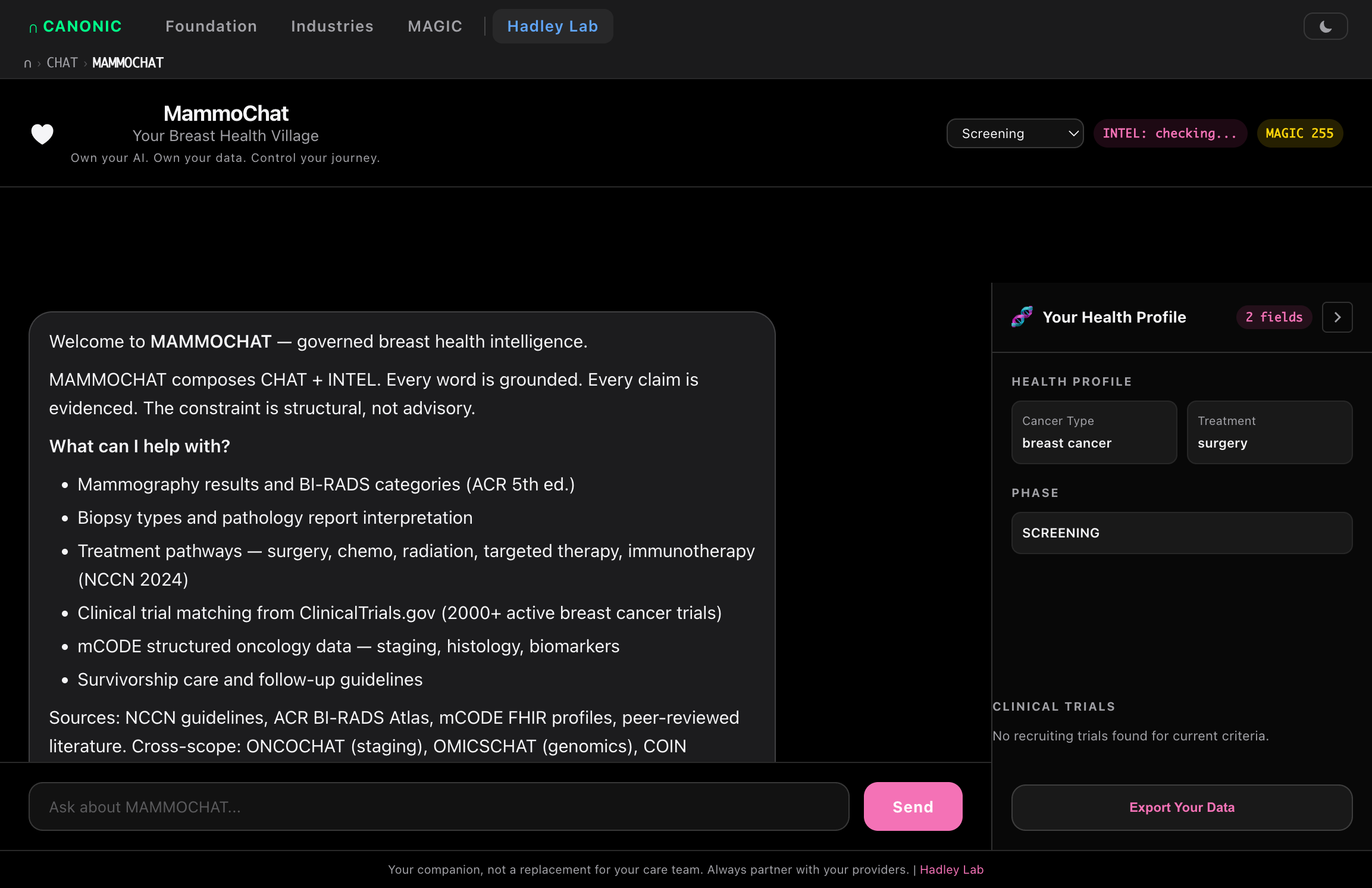
Now consider what happens when someone changes a color. In an ungoverned design environment, a designer opens Figma, changes the accent to purple, exports a PNG, emails it to a developer, who updates a CSS file, pushes to production. No audit trail. No approval chain. No record of who changed what, when, or why. The CMO who approved the original pink branding never knows it changed. The compliance officer who verified WCAG contrast ratios never re-verified. The patient who sees the new color has no idea the change was unreviewed.
In CANONIC, design is governed. The DESIGN service — validated to 255, like every other service — uses Penpot as its visual authoring tool. Penpot is open-source (MPL-2.0). It is self-hosted — no Figma subscription, no vendor dependency, no data leaving your infrastructure. It outputs SVG, CSS, and HTML — web standards, not proprietary formats. It has an official AI integration (MCP — Model Context Protocol) that lets governed Claude agents inspect and compose design files programmatically.
But here is what matters to a governor: when a designer changes --accent from #ec4899 to #8b5cf6 in Penpot, the change does not reach production. It reaches a diff gate. The gate compares the proposed change against the authoritative token file. If the values diverge, the pipeline blocks. A governor must review and approve the change. If approved, the token update is recorded on the LEDGER — a DESIGN:TOKEN_UPDATE event with the old value, the new value, the approver, and the timestamp. Permanent. Auditable. Attributable.
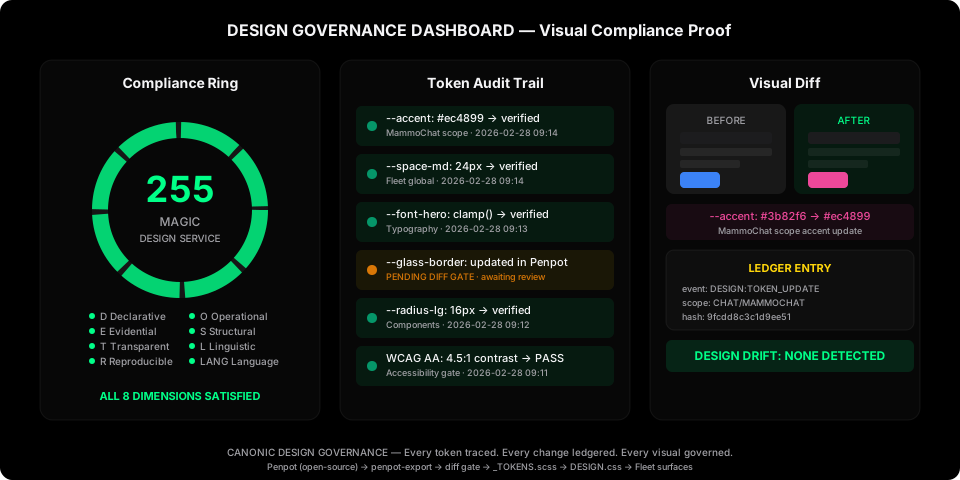
For a HIPAA compliance officer, this means the patient-facing interface of every clinical AI tool is governed with the same rigor as the clinical recommendation itself. The text contrast ratio (4.5:1 minimum, WCAG AA) is not a guideline — it is a constraint in CANON.md, enforced by the validator, gated at 255. If the contrast drops below the threshold, the build fails. The ungoverned pixel does not reach the patient.
For a hospital board member, the competitive proof is definitive. No other AI governance framework governs the design layer. Figma is proprietary — the design files live on Figma’s servers, not yours. Sketch is proprietary. Adobe XD is proprietary. None of them produce audit trails. None of them integrate with a governance validator. None of them record design changes on an immutable ledger. Penpot does — because it is open-source, self-hosted, and governed by the same 255-bit standard that governs everything else in CANONIC.
The fleet does not just govern what the AI says. It governs what the AI looks like. Every token traced. Every visual change ledgered. Every pixel governed 11 28.
Fleet Governance Metrics: The CIO’s Dashboard
For a hospital CIO managing the CHAT fleet across the institution, fleet-level governance metrics provide operational intelligence that individual channel metrics cannot:
Fleet Coverage Rate: The percentage of the institution’s clinical, legal, and financial AI interactions that occur through governed CHAT channels versus ungoverned alternatives. A hospital where 85% of clinical AI interactions flow through governed channels has strong fleet coverage. A hospital where 40% of interactions flow through ungoverned alternatives has a governance gap.
Fleet Governance Velocity: The aggregate COIN minting rate across all channels in the fleet — measuring how quickly the fleet’s governance posture is improving. A fleet with high velocity is advancing multiple channels toward 255 simultaneously. A fleet with low velocity has stalled governance work across its channels.
Fleet DEBIT:DRIFT Rate: The aggregate rate of governance decay events across the fleet — measuring how effectively the fleet’s governance is being maintained. A fleet with zero DEBIT:DRIFT events is maintaining perfect governance hygiene. A fleet with rising DEBIT:DRIFT events has governance maintenance issues.
Fleet Utilization Pattern: The distribution of governed interactions across channels — which channels are serving the most users, which are underutilized, which are experiencing peak demand. A fleet where MedChat serves 60% of interactions while MammoChat serves 5% may indicate that the general medicine channel is compensating for specialty-specific channels that have not yet been deployed.
These fleet-level metrics enable the CIO to manage the AI governance program as a portfolio — allocating resources to channels that need governance advancement, monitoring channels that risk drift, and identifying opportunities for new channel deployment based on utilization patterns. The fleet is not a collection of independent channels. It is a managed portfolio with portfolio-level metrics, portfolio-level strategy, and portfolio-level accountability 11 24.
The Fleet and Clinical Workflow Integration
The CHAT fleet’s clinical value depends on workflow integration — the channels must be accessible at the point of care, within the clinician’s existing workflow, without requiring the clinician to context-switch to a separate application. The fleet achieves this through the governed TALK service, which provides a unified API for all CHAT channels.
When a radiologist reviews a mammogram in the PACS workstation, MammoChat is accessible through an embedded panel — the radiologist can query BI-RADS evidence without leaving the imaging workflow. When an oncologist prepares for tumor board, OncoChat is accessible through the tumor board preparation interface — NCCN guideline queries return governed evidence within the clinical context. When a hospitalist manages a complex patient at 3 a.m., MedChat is accessible through the clinical decision support module of the EHR — drug interaction checks, differential diagnosis support, and clinical guideline queries are available within the clinical workflow.
The governance of these workflow integrations follows the same 255-bit standard. The EHR integration scope inherits from both the clinical channel scope (MammoChat, OncoChat, MedChat) and the EHR vendor scope (access controls, data governance, HIPAA technical safeguards). The integration governance is not a separate compliance project. It is a scope in the governance tree — inheriting constraints from both parent branches, validated to 255, LEDGER-recorded.
For a hospital’s clinical informatics team, the fleet’s workflow integration model means that adding a new governed channel to the clinical workflow is not an EHR integration project. It is a scope inheritance operation — the new channel inherits the existing integration governance, adds its domain-specific INTEL, and is immediately available in the clinical workflow. The integration governance was built once for the first channel. Every subsequent channel inherits it 11 19.

The MammoChat Proof — From Vercel to Governed
You are looking at mammochat.com. The marketing page for a clinical AI product deployed across 51 enterprise hospitals. A product backed by a registered clinical trial (NCT06604078). A product grounded in NCCN guidelines, BI-RADS classification, and mCODE structured oncology data.
Before governance, this page lived on Vercel. Custom Next.js. Custom CSS. No evidence trail. The landing page had partner logos — NIH, UCF, AdventHealth, Florida Department of Health — but zero clinical citations. Not one NCT number. Not one guideline reference. The institutional logos were doing the work that sourced evidence should do.
The governance port took the page from ungoverned to 255 in a single session:
-
Eight closure artifacts — CANON.md, MAMMOCHAT.md, README.md, VOCAB.md, COVERAGE.md, ROADMAP.md, LEARNING.md, INTEL.md. The INTEL.md bridges clinical evidence from the chatbot scope (
CHAT/MAMMOCHAT/INTEL.md) to marketing claims. Every statistic — 51 hospitals, 20K+ interactions, 40+ metro areas — traced to ClinicalTrials.gov NCT06604078. -
Domain proxy — mammochat.com now routes through a Cloudflare Worker to the governed surface at
hadleylab.org/SERVICES/TALK/MAMMOCHAT/. The DNS records went from grey-cloud (Vercel passthrough) to orange-cloud (Worker intercept) in one API call. Same domain. Different governance posture. -
Two governed domains, one evidence chain — mammo.chat serves the chatbot. mammochat.com serves the marketing surface. Both governed. Both traced. Both compiling from the same governance tree.
The radiologist who evaluates mammograms sees the same governance standard in the AI chat interface as the hospital administrator who evaluates the marketing page. That is the point. The governance is structural, not cosmetic. The Next.js site is gone. The CANONIC surface compiles from evidence 11 28.
Fleet Vignette: The Multi-Specialty Tumor Board
You are the director of the cancer center at a 700-bed academic medical center. Every Thursday at 7:00 a.m., the multidisciplinary tumor board convenes — radiation oncologists, surgical oncologists, medical oncologists, pathologists, radiologists, oncology pharmacists, oncology nurses, and social workers. The case list includes twelve patients. Each case requires synthesis across multiple clinical domains — imaging, pathology, genomics, treatment guidelines, clinical trial eligibility, and supportive care.
Before the CHAT fleet, tumor board preparation consumed approximately six hours of physician time per week. The medical oncologist reviewed NCCN guidelines independently. The radiologist reviewed imaging correlates independently. The pharmacist checked drug interactions independently. Each professional prepared in isolation, arriving at tumor board with siloed intelligence that had to be verbally integrated during the conference.
With the CHAT fleet deployed, the preparation workflow transforms. The medical oncologist queries OncoChat for the NCCN category 1 evidence supporting pembrolizumab plus chemotherapy for the patient’s PD-L1-positive stage IV non-small cell lung cancer — and receives a governed response citing NCCN Non-Small Cell Lung Cancer Guidelines v3.2026, evidence category 1, with the specific trial reference (KEYNOTE-189). The radiologist queries MammoChat for BI-RADS concordance on the breast imaging case — and receives a governed response citing the ACR BI-RADS Atlas 5th Edition with the precise assessment category definition. The pharmacist queries MedChat for drug interaction analysis between the proposed nivolumab-ipilimumab regimen and the patient’s existing metformin and lisinopril — and receives a governed response with interaction severity classification, mechanism of action, and monitoring recommendations sourced from clinical pharmacology databases.
Each query is governed. Each response is sourced. Each interaction mints COIN. The LEDGER records twelve tumor board preparation sessions that month — 144 governed clinical queries across three CHAT channels. The governance is not an impediment to clinical preparation. It is the substrate that makes clinical preparation faster, more reliable, and auditable 11 15.
Fleet Resilience and Failover Governance
The CHAT fleet operates under a governance model that addresses a concern every hospital CIO raises: what happens when a channel goes down? Clinical AI availability is a patient safety issue. A MammoChat outage during breast screening hours affects clinical workflow. An OncoChat outage during tumor board preparation affects clinical decision-making.
The fleet’s resilience model is governed. Each channel declares its availability constraints in CANON.md — uptime requirements, failover procedures, degradation protocols, and escalation pathways. MammoChat’s CANON.md declares: “MUST: maintain 99.5% availability during scheduled screening hours (0700-1700 weekdays). MUST: degrade gracefully to evidence-only mode (no conversational interface) if the CHAT engine is unavailable. MUST NOT: present ungoverned evidence during degraded operation.”
The failover is not just technical — it is governance-compliant. When MammoChat enters degraded mode, the LEDGER records the event: CHAT:DEGRADE with timestamp, duration, and affected user count. When MammoChat returns to full operation, the LEDGER records the recovery: CHAT:RESTORE. The compliance officer can audit every availability event. The CIO can report fleet-level availability metrics to the board with the same governance rigor that governs the clinical content itself.
The fleet’s availability governance extends to the INTEL layer. When a clinical evidence source experiences an outage — when the NCCN guidelines API is temporarily unavailable, when a drug database update is delayed — the CHAT channel continues operating with the last governed INTEL snapshot. The channel does not hallucinate evidence. It does not fabricate guidelines. It serves the last validated INTEL and discloses the evidence currency: “Evidence current as of [timestamp]. Source update pending.” The disclosure is a governance constraint, enforced by the validator, gated at 255 11 28.
The Fleet and Institutional Knowledge Management
The CHAT fleet serves a governance function that extends beyond clinical decision support: institutional knowledge management. Every governed interaction — every clinical query, every legal research session, every financial coding decision — produces a LEDGER record. The aggregate of these records is not just an audit trail. It is an institutional knowledge asset.
Consider the aggregate LEDGER data for a hospital system’s first year with the CHAT fleet: 47,000 governed clinical queries across MammoChat, OncoChat, and MedChat. 12,000 governed legal research queries through LawChat. 23,000 governed coding queries through FinChat. Each query is categorized by clinical domain, evidence source, user role, and response type.
The institutional knowledge patterns that emerge from this data are governance gold. The hospital discovers that 34% of MedChat queries relate to antibiotic dosing — suggesting an unmet need for an antimicrobial stewardship CHAT channel. The hospital discovers that 22% of LawChat queries relate to informed consent for AI-assisted procedures — suggesting a need for standardized AI consent language. The hospital discovers that FinChat’s denial prevention rate is highest for cardiology coding — suggesting that the cardiology coding team should be the model for other departments.
These institutional knowledge patterns are governed because they emerge from governed interactions. The patterns are on the LEDGER. The patterns are attributable to specific channels, specific time periods, specific user populations. The hospital’s chief learning officer can use these patterns to direct educational resources. The chief quality officer can use them to identify clinical knowledge gaps. The CFO can use them to optimize revenue cycle operations. The knowledge is not locked in individual clinician memories. It is on the LEDGER, governed, permanent, and institutionally accessible 11 24 15.
Chapter 39: ATULISMS
The memorial that proved CONTRIBUTE — 48 transcripts, 66 contributors, 255.
ATULISMS is a governed memorial book — The Quotable Atul Butte. 48 YouTube transcripts. Two memorial recordings. 66 contributors from the Atul Butte Mafia WhatsApp group. Every word sourced. Every contribution governed. Every contributor minting COIN 11.
ATULISMS proved the CONTRIBUTE service — the mechanism by which external contributors submit work, have it curated at bronze or gold level, and mint COIN for their contribution. It proved that governance can handle not just AI outputs but human inputs — that the same 255-bit standard applies to the memorial of a beloved colleague as it does to the deployment of a clinical AI service.
ATULISMS matters for healthcare governance because it proves the governance model extends to collaborative content production — clinical guidelines authored by multiple contributors, research protocols developed by multi-site teams, quality improvement initiatives led by interdisciplinary committees. The CONTRIBUTE model that ATULISMS proved is the model by which clinical teams can collaboratively produce governed content, with every contribution attributed, every contribution minting COIN, and every contribution on the LEDGER.
ATULISMS is BOOK 1 in the CANONIC library. Priced at 255 COIN. The first governed memorial. The proof that INTEL + CHAT + COIN composes into anything — clinical AI, legal research, financial compliance, and yes, even love 11.
The CONTRIBUTE Service in Practice
ATULISMS was not created by a single author. It was created by a community — 66 contributors from around the world, each offering memories, anecdotes, photographs, and reflections about a colleague they loved. The governance challenge was unprecedented: how do you accept 66 independent contributions, from people with no governance training, no technical background, and no familiarity with CANONIC — and produce a 255-validated governed artifact?
The answer is the CONTRIBUTE service. The service defines a governed workflow for external contributions:
Step 1: Submission. A contributor submits their content through a governed intake form. The form captures the content (text, image, audio transcript), the contributor’s identity (name, affiliation, relationship to the subject), and the contributor’s consent (permission to include the content in the governed publication, permission to attribute the contribution, acknowledgment of the LEDGER recording).
Step 2: Curation. The editorial team reviews each submission and assigns a curation level — bronze (included with basic attribution) or gold (included with enhanced attribution and editorial recognition). The curation decision is governed: the criteria are defined in the ATULISMS scope’s CANON.md, the decision is recorded on the LEDGER, and the contributor is notified of the curation outcome.
Step 3: Integration. The curated contribution is integrated into the governed publication. The contributor’s content becomes part of the evidence chain — cited with attribution, versioned in the governance tree, and permanently recorded in the version control history. The integration is a governance event: a new LEARNING.md entry documents the contribution, and the scope’s MAGIC score is recomputed to verify that the new content does not degrade any governance dimension.
Step 4: COIN minting. The contributor’s governance work — the act of contributing content that strengthened the governed publication — mints COIN on the LEDGER. The COIN is attributed to the contributor via IDENTITY. The contributor has a permanent, auditable record of their governance contribution 11.
This four-step workflow was tested, validated, and proven at scale through ATULISMS. Sixty-six contributors, each following the same governed workflow, each minting COIN, each recorded on the LEDGER. The workflow worked for a memorial book. It works for any collaborative governance artifact.
Why ATULISMS Matters for Healthcare Governance
The skeptical hospital CMO might wonder: what does a memorial book have to do with clinical AI governance? The answer is that ATULISMS proved a governance mechanism that healthcare desperately needs — governed collaborative content production.
Consider the clinical governance artifacts that healthcare organizations must produce collaboratively:
Clinical practice guidelines. A hospital’s clinical practice committee develops institution-specific clinical practice guidelines — protocols for sepsis management, pathways for stroke care, algorithms for chest pain evaluation. These guidelines are produced by committees of physicians, nurses, pharmacists, and quality officers. Each contributor adds content. Each contribution needs attribution. Each guideline needs version control, evidence sourcing, and regulatory traceability. Today, these guidelines are produced in Word documents, reviewed in committee meetings, and stored in shared drives — ungoverned, unversioned, and unauditable.
Quality improvement reports. Healthcare quality improvement projects produce reports — root cause analyses, PDSA cycle documentation, outcome measurements, action plans. These reports involve multiple contributors across multiple departments. The contributions need attribution. The evidence needs sourcing. The reports need version control for regulatory submission. Today, these reports are produced in PowerPoint presentations and PDF documents — ungoverned.
Research protocols. Multi-site clinical research protocols involve contributions from investigators, biostatisticians, IRB reviewers, regulatory affairs specialists, and study coordinators. Each contribution modifies the protocol. Each modification needs attribution and version control. Today, these protocols are managed through track-changes in Word documents — ungoverned.
Institutional policies. Hospital policies — HIPAA compliance policies, AI governance policies, informed consent policies — are produced by committees, reviewed by legal, approved by administration, and distributed to staff. The policy development process involves multiple contributors. Today, the process is managed through email threads and committee meeting minutes — ungoverned.
The CONTRIBUTE service proved by ATULISMS addresses all of these use cases. Every collaborative governance artifact — clinical guidelines, quality reports, research protocols, institutional policies — can be produced through the same governed workflow: submission, curation, integration, COIN minting. Every contributor is identified. Every contribution is attributed. Every version is controlled. Every evidence source is cited. Every governance event is on the LEDGER 11 14.
The 48 Transcripts: Governance of Oral History
ATULISMS includes 48 YouTube transcripts — lectures, presentations, and informal talks given by Atul Butte over the course of his career. Each transcript is a governed INTEL unit with provenance: the YouTube URL, the event title, the date, the duration, and the transcript text. The transcripts are not AI-generated summaries. They are full transcripts, sourced to the original recordings, with timestamps that allow verification against the source material.
The governance of oral history — capturing spoken words as governed text with provenance — has direct applications in healthcare. Grand rounds presentations, tumor board discussions, M&M conference proceedings, quality committee deliberations — all are oral events that generate institutional knowledge. Today, this knowledge is captured in meeting minutes (abbreviated, subjective, and often incomplete) or not captured at all.
The ATULISMS model shows how oral knowledge can be governed: transcribe the recording, source the transcript to the original, govern the transcript as an INTEL unit with provenance, and record the governance on the LEDGER. The institutional knowledge captured in a grand rounds presentation about a novel surgical technique is now governed — traceable to the original recording, attributed to the presenter, versioned in the governance tree, and permanently available to the institution.
For a hospital’s chief academic officer, this oral history governance model transforms ephemeral institutional knowledge into permanent, governed institutional intelligence. The grand rounds that changed how the surgical department approaches liver transplantation is no longer a memory in the minds of the attendees who happened to be present. It is a governed INTEL artifact — sourced, attributed, and on the LEDGER 11 14.
The Two Memorial Recordings
ATULISMS includes two memorial recordings — audio captured at memorial events held in honor of Atul Butte. These recordings are governed as INTEL units with the same provenance standard applied to the YouTube transcripts: source recording, event title, date, location, speakers, and full transcript.
The memorial recordings proved something that the 48 YouTube transcripts could not prove alone: that CANONIC governance handles emotional content with the same rigor and the same respect that it handles clinical content. The memorial recordings are governed. They are on the LEDGER. They mint COIN. And they are treated with the care that a memorial deserves — not as data to be processed, but as human expression to be preserved, governed, and honored.
This matters for healthcare governance because healthcare generates emotional content that deserves governance. Patient testimonials about their cancer journey. Clinician reflections on difficult cases. Family expressions of gratitude or grief. These artifacts are currently ungoverned — captured in marketing materials, shared informally, or lost entirely. ATULISMS proved that emotional content can be governed without diminishing its humanity. The governance adds permanence, attribution, and provenance. It does not add bureaucracy or cold formalism. The memorial is more meaningful because it is governed — because every contributor is named, every word is sourced, and every contribution is permanently recorded 11.
The Economics of CONTRIBUTE
ATULISMS also proved the economics of the CONTRIBUTE service. Sixty-six contributors, each minting COIN for their contribution. The COIN is not a token of appreciation — it is an economic unit on the LEDGER. The contributor’s governance work has measurable value. The aggregate COIN minted by 66 contributors represents the total governance value of the collaborative effort.
For healthcare applications, the CONTRIBUTE economics have specific implications. When a clinical practice committee produces a new clinical guideline, each committee member’s contribution mints COIN. The committee chair’s contribution mints COIN. The evidence reviewer’s contribution mints COIN. The COIN trail on the LEDGER documents not just who contributed, but how much governance value each contributor created.
This COIN trail transforms committee work from uncompensated institutional service into quantified governance contribution. The physician who spends 40 hours developing a new sepsis protocol has a LEDGER record showing the governance value of that work — COIN minted, governance improvement achieved, evidence sourced. The department chair can cite that COIN trail in the physician’s annual review. The institution can include COIN metrics in its academic promotion criteria. The governance work is valued because it is valued — on the LEDGER, in COIN, permanently 11 15.
ATULISMS as Governance Proof
ATULISMS is the smallest, most personal, and most emotionally resonant proof in the CANONIC ecosystem. It is not a clinical AI deployment serving 20,000 patients. It is not a financial governance tool recovering $47 million in denied claims. It is a memorial book — 66 people remembering a colleague they loved.
And yet ATULISMS proves something that the clinical deployments cannot prove alone: that CANONIC governance is universal. Not universal in the sense of “applicable to many industries” — that was proved by the thirteen sectors of the CHAT fleet. Universal in the deeper sense: applicable to anything humans create together. A memorial book. A clinical guideline. A research protocol. A quality improvement report. A institutional policy. A song. A poem. A eulogy.
If the governance framework can handle a eulogy with rigor and respect — sourcing every word, attributing every contributor, minting COIN for every act of remembrance — it can handle a clinical AI deployment. The governance is not the constraint. The governance is the container that gives form to what matters. ATULISMS proved that 11.
The Governance of Attribution: Why Names Matter
ATULISMS is, at its core, a book of names. Sixty-six names. Each name is a person who contributed something — a memory, a photograph, a transcript, a reflection — to the memorial of a colleague. In traditional publishing, these names would appear in an acknowledgments page. In governed publishing, each name is an IDENTITY on the LEDGER — a permanent, verifiable, attributed record of who contributed what and when.
The governance of attribution matters far beyond memorial books. In healthcare, attribution is a governance requirement with legal and regulatory consequences. Who authored this clinical guideline? Who approved this treatment protocol? Who reviewed this quality improvement report? Who contributed data to this research study? In ungoverned collaborative processes, attribution is informal — an author list on a document, a committee membership roster, a co-investigator listing on a grant. These informal attributions are fragile. They can be disputed. They can be incomplete. They can be lost when documents are revised, when committees are restructured, when projects transition to new leadership.
CANONIC’s IDENTITY service — proved through ATULISMS — provides permanent, verifiable attribution for every contributor to every governed artifact. When a clinical practice committee produces a sepsis management guideline with contributions from twelve physicians, four nurses, two pharmacists, and a quality officer, each contributor’s contribution is attributed via IDENTITY, recorded on the LEDGER, and permanently associated with the governance artifact. The attribution is not a name on a document. It is a cryptographically verifiable record of a governance action — who contributed, when they contributed, what they contributed, and how their contribution affected the governed artifact’s MAGIC score.
For academic medical centers, where attribution drives promotion, tenure, and professional recognition, governed attribution through IDENTITY transforms committee work from invisible service to documented, quantified, and verifiable institutional contribution. The physician who spends sixty hours developing a clinical guideline has a LEDGER record of that governance work. The promotion and tenure committee can verify the contribution independently — not from a self-reported CV entry, but from the LEDGER. The attribution is honest because the system is honest 11 15.
The ATULISMS Governance Architecture
ATULISMS follows the same governance architecture as every other CANONIC scope — CANON.md, VOCAB.md, README.md, LEARNING.md. The architecture is identical. The content is entirely different. This structural identity across radically different content types is itself the proof of universality.
The ATULISMS CANON.md declares the governance constraints for a memorial publication:
- INTEL: All content must trace to a verified source — a YouTube recording with a URL, a contributor submission with a consent form, a memorial recording with a date and location.
- CONSTRAINT: No content may be included without the contributor’s explicit consent. No content may be attributed to a contributor who did not authorize the attribution. No AI-generated content may be included without disclosure.
- CHAIN: Every editorial change — every addition, revision, or correction — is hash-linked to its predecessor. The editorial history is immutable. The evolution of the memorial from first submission to final publication is permanently recorded.
- IDENTITY: Every contributor is identified by name and relationship to the subject. The identification is verified through the submission process. The IDENTITY is recorded on the LEDGER.
- LEDGER: Every governance event — submission received, curation decision made, content integrated, COIN minted — is recorded with timestamp and attribution.
- LEARNING: The editorial process generates LEARNING entries — NEW_PATTERN signals about collaborative content governance, EVOLUTION signals about editorial workflow improvements, and DRIFT_RESOLVED signals about content corrections.
The eight governance dimensions that serve a clinical AI deployment at a hospital also serve a memorial publication for a beloved colleague. The dimensions do not change. The content within each dimension changes completely — clinical evidence becomes personal memory, regulatory compliance becomes editorial integrity, clinical accuracy becomes emotional truth. But the architecture holds. The governance compiles to 255. The universality is not claimed. It is demonstrated 11 12.
Clinical Vignette: The Quality Committee’s CONTRIBUTE Workflow
You are the chief quality officer at a 400-bed community hospital. Your quality committee has just completed a root cause analysis of a serious safety event — a medication error that resulted in a patient receiving ten times the intended dose of a blood thinner. The root cause analysis involved contributions from twelve team members: the attending physician, the pharmacist who dispensed the medication, the nurse who administered it, the unit charge nurse, the pharmacy director, the CPOE system administrator, the risk manager, the patient safety officer, two quality improvement specialists, a human factors engineer, and the chief nursing officer.
Under the traditional model, the root cause analysis is documented in a Word document. The team members are listed on the cover page. The analysis is stored in a shared drive. When the Joint Commission surveys the hospital next year and requests root cause analyses, the quality team retrieves the document and hopes that the versions are consistent, that the contributors are correctly listed, and that the analysis has not been inadvertently modified since completion.
Under the CONTRIBUTE model proved by ATULISMS, the root cause analysis is a governed artifact. Each team member’s contribution is submitted through the CONTRIBUTE workflow — their specific findings, their analysis of contributing factors, their recommendations for corrective action. Each contribution is curated (verified for accuracy and completeness), integrated into the governed document, and recorded on the LEDGER with IDENTITY attribution. The final root cause analysis has a complete provenance trail — who contributed what, when the contributions were integrated, how the analysis evolved from initial submissions to final document, and what COIN was minted for each contributor’s governance work.
When the Joint Commission surveyor requests the root cause analysis, the quality team does not retrieve a document from a shared drive. The team produces a governed artifact with a complete CHAIN-verified history, IDENTITY-attributed contributions, and a LEDGER trail that demonstrates the rigor and completeness of the analysis process. The surveyor does not need to trust the document’s integrity. The surveyor can verify it — the CHAIN hashes confirm that the document has not been modified since certification, the IDENTITY records confirm the contributors, and the LEDGER trail confirms the analytical process 11 12 15.
The SHOP Economics of ATULISMS
ATULISMS is priced at 255 COIN in the SHOP — the CANONIC marketplace for governed artifacts. The price is not arbitrary. It represents the total governance work invested in creating the memorial — the 66 contributor submissions, the editorial curation, the transcript governance, the evidence sourcing, the MAGIC validation. The price is the governance cost of creation, denominated in the universal unit of governance work.
The SHOP pricing model has implications that extend beyond memorial books. When a hospital’s clinical practice committee produces a governed sepsis management guideline and publishes it in the SHOP at 180 COIN, the price reflects the governance work invested — the evidence curation, the expert contributions, the editorial review, the MAGIC validation. Another hospital can acquire the governed guideline for 180 COIN — receiving not just the guideline text but the complete governance artifact: the evidence citations, the CHAIN-verified editorial history, the IDENTITY-attributed contributions, and the LEARNING entries from the development process.
The SHOP economics create a governance marketplace where governed artifacts have quantifiable value. The value is not determined by a publisher’s pricing model or a consultant’s fee schedule. The value is determined by the governance work invested, measured in COIN, recorded on the LEDGER. The marketplace is transparent because the currency is transparent — every COIN was minted by real governance work, every price reflects real governance investment, and every transaction is recorded on the LEDGER.
ATULISMS — priced at 255, governed to 255, created by 66 contributors, sourced from 48 transcripts and two memorial recordings — is the smallest, most personal proof that the SHOP economics work. A memorial book and a clinical guideline are priced in the same currency, governed by the same standard, and traded in the same marketplace. The universality is economic as well as architectural. The COIN does not distinguish between a eulogy and a clinical protocol. It measures the governance work. The governance work is real in both cases. The COIN is honest in both cases 11 2 48.
Chapter 40: The Molecular Clock
From Fatima 1989 to MAGIC 2026.
In evolutionary biology, the molecular clock is the technique of using the rate of molecular change to estimate the time of divergence between species. In CANONIC, the molecular clock traces the rate of governance evolution — from the first code on a TANDY TRS-80 in Trinidad in 1989 to the current 255-bit standard in 2026 32.
The trajectory spans 37 years: BASIC on a TANDY TRS-80 in Trinidad → PowerStat tropical disease GUI → CLIPS expert system at Yale → systems engineering education at Penn → clinical informatics research → OPTS-EGO four-dimensional assessment framework → the compiler insight → eight binary dimensions → MAGIC → three primitives (INTEL + CHAT + COIN) → 14 services → 255-bit governance standard → HadleyLab production deployment → 19 organizations → 185+ repositories → 20,000+ patients served → CANONIC CANON and CANONIC DOCTRINE published.
The molecular clock is not just a historical narrative. It is a governance proof. Every step in the trajectory is documented. Every decision is traceable. Every evolution is logged. The molecular clock IS the LEARNING dimension of the CANONIC framework itself — the accumulated intelligence of a governance system that learned from its own operation across 37 years of development.
For healthcare governors evaluating CANONIC, the molecular clock answers the question: “How do we know this framework is mature enough for clinical deployment?” The answer: 37 years of continuous development, from a ten-year-old teaching himself BASIC in Trinidad to production deployment, with every step governed, every evolution logged, and every claim traceable to its source. The framework that governs your AI was itself governed from the beginning. The proof is the trajectory 32 9.
1989 — Trinidad. Fatima College. BASIC on a TANDY TRS-80. The first code. The first lesson: systems respond to logic.
1994 — Trinidad. PowerStat — a tropical disease incidence GUI selected by the Caribbean Examination Council as best in the country.
1999 — Penn. Systems Engineering. The intersection of engineering and biology. The academic seed.
2013 — Stanford. The first commit. GenomicPython. The first governed ledger, though the word “governed” would not arrive for another twelve years.
2018 — UCSF. HadleyLab. 43,000 patterns. $38 million in research. The Marcus Award. Medical AI research governed by academic rigor but not yet by CANONIC.
2024 — UCF. Chief of AI, College of Medicine. MammoChat. 20,000+ patients. The Casey DeSantis Award. The deployment that proved AI could work in clinical practice — and revealed that governance was missing.
2025, December 29 — The compiler insight. Writing DIVIDENDS. Governing chapters. Realizing that governance IS compilation. OPTS-EGO became MAGIC in one night. Four dimensions became eight. The 255-bit standard emerged 10 6.
2026, January — The Cambrian explosion. 19 organizations. 185+ repositories. 255-bit validation across the entire ecosystem. The GALAXY goes bright. The books are written. The proof is deployed 24.
2026, February — Production hardening. 14 services (NOTIFIER, MONITORING, DEPLOY ship). CORS restriction, rate limiting, CSP headers, retry with backoff, structured JSON logging, graceful SIGTERM shutdown, Ed25519 key rotation, Prometheus /metrics endpoint, encrypted backup/restore, Dockerfile containerization. CI pipeline: 18-step magic-build.yml with PRIVATE leak gate, compiler integration tests, freeze enforcement. The runtime catches up to the governance.
2026, March — OPERATION. GitHub launch. Public/private split enforced: GOV tree public (canonic-canonic, hadleylab-canonic on GitHub), runtime closed (VaaS). Production hardening: 11 of 12 gates CLOSED (sole remaining: RATE_LIMIT, Q2 2026). Governance freeze — ROOT surface locked. FEDERATION live: 4 ORGs (canonic-canonic, hadleylab-canonic, canonic-apple, RunnerMVP). WITNESS protocol operational: cross-ORG countersigning via Ed25519 DIGEST. Patent portfolio: 6 provisionals, 90 claims, $10K total cost. Runner-canonic: 15 task types, 503 COIN minted, Stripe + Ed25519 live. FRESHNESS: incremental compilation, 134s → 3s. 380 governed scopes across 3 ORGs.
The Clock Rate: Measuring Governance Evolution
In molecular biology, the clock rate is calibrated from known divergence events — fossils with radiometric dates that anchor the molecular timeline. The CANONIC molecular clock is calibrated from known governance events — milestones with version control timestamps that anchor the governance timeline 32.
The clock rate is not constant. It has phases:
The slow phase (1989-2012). Twenty-three years from first code to first commit. The molecular clock ticks slowly during this phase — one governance “mutation” every few years. BASIC to PowerStat to CLIPS to systems engineering to clinical informatics. Each transition is a governance divergence event, but the intervals are long. The population is small (one researcher). The mutation rate is low. The governance framework is pre-conscious — the work is governed by academic rigor, institutional review boards, and publication standards, but not by an explicit governance framework.
The acceleration phase (2013-2024). Eleven years from first commit to MammoChat production. The clock rate increases dramatically. GenomicPython generates thousands of commits. HadleyLab produces 43,000 patterns across multiple research projects. The population grows (research team, collaborators, clinical partners). The mutation rate accelerates (daily commits, weekly releases, quarterly publications). The governance is implicit — version control, code review, peer review, IRB oversight — but not yet unified under a single standard.
The Cambrian explosion (December 2025 - January 2026). Five weeks from the compiler insight to full ecosystem deployment. The clock rate reaches its maximum. The 255-bit standard emerges. Eight dimensions crystallize from four. Three primitives are identified. Fourteen services are defined. Nineteen organizations are scaffolded. One hundred eighty-five repositories are governed. The governance “speciation” rate during this period is orders of magnitude higher than any preceding phase — analogous to the Cambrian explosion in biology, when the majority of animal phyla appeared in a geological instant 32 24.
The stabilization phase (February 2026 - present). The clock rate decreases from Cambrian explosion speed to a sustainable operational cadence. The governance framework is established. The services are deployed. The production hardening continues — operational improvements at a steady rate. The clock ticks regularly: weekly service updates, monthly evidence refreshes, quarterly governance reviews. The population is stable. The framework is mature. The clock rate reflects operational governance, not revolutionary innovation.
The Clock and Governance Maturity Assessment
The molecular clock provides a governance maturity assessment tool that no traditional framework offers. By measuring the clock rate of a governance scope — the frequency of governance changes over time — a governor can assess whether the scope is healthy, stagnant, or unstable.
A scope with a clock rate that matches the expected cadence for its operational environment is healthy. A MammoChat deployment that averages 8 governance changes per month — evidence updates, LEARNING entries, validation events — is ticking at the expected rate for a clinical AI scope under active governance.
A scope with a clock rate that has dropped to zero is stagnant. A clinical AI deployment with no governance changes in six months is not stable — it is neglected. The evidence base has not been updated. The LEARNING file has no new entries. The validation has not been run. The molecular clock has stopped. The scope is governmentally dead, even if it is technically operational 32 12.
A scope with a clock rate that has spiked dramatically is under stress. A scope that normally averages 8 governance changes per month but suddenly logs 40 changes in a single month is experiencing a governance disruption — a major regulatory change, a significant drift event, an evidence base overhaul. The spike itself is informative: it tells the governor when the disruption occurred, how large it was, and how long the remediation took.
The Clock Across Scopes: Governance Tempo
When you measure the molecular clock across multiple scopes in a health network, a pattern emerges: governance tempo. Different scopes tick at different rates, and the distribution of rates across the network characterizes the network’s governance rhythm.
A healthy governance tempo has three characteristics:
Variation by clinical risk. High-risk clinical scopes (MammoChat, OncoChat) should have faster clock rates than low-risk administrative scopes (patient portal chatbot, appointment scheduler). The clock rate reflects the governance attention allocated to each scope — and governance attention should correlate with clinical risk.
Consistency within risk tiers. Scopes at the same clinical risk level should have similar clock rates. If one MammoChat deployment ticks at 8 changes per month while another ticks at 2, the discrepancy indicates inconsistent governance attention. The governor should investigate the slow-ticking scope.
Seasonal patterns. Governance tempo should show seasonal patterns that correlate with the institution’s operational rhythm. Clock rates may increase in Q1 (annual regulatory updates, Joint Commission preparation) and Q3 (evidence base updates from summer medical society meetings). A scope that shows no seasonal variation is either uniformly excellent or uniformly neglected 32 30.
The Founder’s Clock
The molecular clock of CANONIC governance is also the founder’s clock — the personal trajectory of the system’s creator, from a ten-year-old in Trinidad to the architect of a 255-bit governance standard. This personal dimension is not incidental to the governance framework. It is integral.
Every governance framework has a lineage. ISO standards trace to the International Organization for Standardization, founded in 1947. HIPAA traces to the United States Congress, enacted in 1996. Joint Commission standards trace to the American College of Surgeons, founded in 1913. Each lineage tells you something about the governance framework’s DNA — its priorities, its assumptions, its strengths, and its blind spots.
CANONIC’s lineage traces to Trinidad. To a ten-year-old writing BASIC. To a Caribbean island where tropical disease epidemiology was not an academic abstraction but a daily reality. To a systems engineering education at Penn that taught the intersection of engineering rigor and biological complexity. To clinical informatics research at UCSF that produced 43,000 patterns from real patient data. To a clinical AI deployment at UCF that served 20,000 real patients.
This lineage tells you something about CANONIC’s governance DNA. The framework was not designed by a standards committee in a conference room. It was built by a clinician-engineer who wrote his first code in a developing country, who studied tropical disease epidemiology before studying AI, who deployed clinical AI in community hospitals before theorizing about governance. The framework’s priorities — clinical evidence, patient safety, institutional learning, economic accountability — reflect the founder’s trajectory. The 255-bit standard was not designed from first principles. It emerged from 37 years of accumulated experience — each year a tick on the molecular clock, each tick an evolutionary step toward the governance framework you are holding 32 9.
The Clock Moving Forward
The molecular clock does not stop at 2026. The governance framework continues to evolve. New services will be deployed. New sectors will be governed. New organizations will join the ecosystem. The phylogenetic tree will grow. The GALAXY will brighten. The LEARNING dimension will accumulate new patterns. The COIN will continue minting.
For a hospital board member considering CANONIC governance, the molecular clock provides a unique assurance: this framework has 37 years of continuous development behind it. It is not a startup’s minimum viable product. It is not a consultant’s governance template. It is not a standards body’s theoretical framework. It is a 37-year molecular trajectory — from first code to production deployment, from a single programmer to 19 organizations, from zero governance to 255.
The clock ticks. The governance compiles. The COIN mints.
Clinical Vignette: The Board’s Due Diligence Question
You are a hospital board member, and you have just heard a ninety-minute presentation on CANONIC governance. You have one question: “How do I know this is not another governance fad — here today, gone in two years when the next framework appears?”
The presenter opens the molecular clock. The first tick: 1989. BASIC on a TANDY TRS-80 in Port of Spain, Trinidad. A ten-year-old writing code on a machine with 48 kilobytes of RAM. The second tick: 1994. PowerStat — a tropical disease surveillance tool selected by a national examination board as best in the country. The third tick: 1999. Penn. Systems engineering. The intersection of engineering rigor and biological complexity that would define every subsequent contribution. The fourth tick: 2013. Stanford. GenomicPython. The first governed commit. The fifth tick: 2018. UCSF. HadleyLab. 43,000 patterns, $38 million in research, the Marcus Award — a governed research laboratory operating at the frontier of clinical AI. The sixth tick: 2024. UCF. Chief of AI, College of Medicine. MammoChat. 20,000 patients. The Casey DeSantis Award. Production clinical AI serving real patients in real time. The seventh tick: 2025, December 29. The compiler insight. Four dimensions become eight. OPTS-EGO becomes MAGIC. 255 emerges. The eighth tick: 2026, January through March. Cambrian explosion. 19 organizations. 185+ repositories. 14 services. Production hardening. The books you are reading right now 32 9.
The molecular clock has thirty-seven ticks. Each tick is documented in version control. Each tick is verifiable. The board member who asked the question does not need to trust a marketing claim. The board member can examine the fossil record — the git history, the publication record, the clinical deployment data, the research outputs, the version-controlled governance evolution from the first commit to the present moment. The molecular clock does not argue. It demonstrates. The trajectory is the proof. The proof spans thirty-seven years. No governance fad survives thirty-seven years of continuous evolution. Only a governance framework rooted in real clinical experience, real deployment data, and real patient outcomes endures across that span. The clock ticks forward because the work continues. The work continues because the governance is real 32 9 11.
The Clock and Institutional Memory
The molecular clock has one final implication for healthcare governors that warrants explicit statement. In healthcare, institutional memory is fragile. Key personnel retire. Leadership turns over. Compliance officers change positions. The governance knowledge accumulated by a generation of hospital leaders — their understanding of regulatory nuances, their relationships with auditors, their institutional awareness of which AI deployments need the most attention — walks out the door when they leave. The molecular clock, encoded in version control and LEARNING.md files across the governance tree, is immune to personnel turnover. The governance memory is not in anyone’s head. It is in the clock — every tick, every commit, every LEARNING entry, every COIN event. A new chief compliance officer inheriting a CANONIC-governed AI portfolio does not start from zero. She starts from the accumulated intelligence of every governance action that preceded her arrival. The molecular clock does not forget. The institutional memory is permanent, structured, and governed. This permanence is not a feature of the software. It is a property of the governance architecture itself — because the clock IS the governance, and the governance persists as long as the tree exists 32 12 14.
BACK MATTER
Appendix A: The Evolutionary Mapping
Biology maps to CANONIC. The parallel is structural, not metaphorical.
| Biology | CANONIC |
|---|---|
| Genome | Governance tree |
| Gene | Scope |
| Allele | Scope version |
| Mutation | Commit |
| Neutral drift | Ungoverned change |
| Natural selection | 255-bit validation |
| Fitness | MAGIC score |
| Species | Organization |
| Ecosystem | Federation |
| Phylogenetic tree | GALAXY topology |
| Molecular clock | Governance evolution rate |
| Fixation | Scope reaching 255 |
| Extinction | Scope failing to maintain fitness |
| Horizontal gene transfer | Cross-organization inheritance |
Source: 30 Code Evolution Theory, 31 Neutral Theory, 32 Evolutionary Phylogenetics.
Appendix B: The Compliance Matrix
Every standard maps to the eight dimensions.
| Standard | All Eight Questions Answered? | Key Governance Mechanisms |
|---|---|---|
| HIPAA | Yes — 255 | Axiom, PHI evidence, timeline, access chain, audit trail, pattern detection, controlled vocabulary |
| GDPR | Yes — 255 | Purpose, provenance, processing, consent chain, data mapping, auto detection, explanation |
| SOX | Yes — 255 | Controls, audit evidence, decision timeline, responsibility, financial structure, anomaly detection |
| FDA 21 CFR 11 | Yes — 255 | Records, ALCOA, timestamps, signatures, system structure, change control, legibility |
| HITRUST | Yes — 255 | Risk assessment, evidence, monitoring, access control, framework, continuous, documentation |
| Operational | Yes — 255 | Deploy gate, audit logs, uptime, key rotation, metrics, drift detection, CSP vocabulary |
Source: 3 The $255 Billion Dollar Wound, 12 DESIGN.md.
Appendix C: The Vertical Map
13 sectors, three primitives, one governance.
| Sector | INTEL | CHAT | COIN |
|---|---|---|---|
| Medicine | Clinical evidence | MammoChat, OncoChat, MedChat | Patient COIN |
| Law | Case precedent | LawChat | Litigation COIN |
| Finance | Regulatory filings | FinChat | Audit COIN |
| Real Estate | Public records | Realty (Blandford, Bryanston, Sloane) | Transaction COIN |
| Defense | Classified INTEL | Clearance-gated CHAT | Custody COIN |
| Security | Threat INTEL | SecChat | Incident COIN |
| Education | Curriculum INTEL | EduChat | Learning COIN |
| Energy | Grid INTEL | EnergyChat | Consumption COIN |
| Government | Policy INTEL | GovChat | Compliance COIN |
| Agriculture | Yield INTEL | AgriChat | Production COIN |
| Transportation | Route INTEL | TransChat | Logistics COIN |
| Manufacturing | Process INTEL | MfgChat | Quality COIN |
| Technology | Code INTEL | DevChat | Build COIN |
Source: 11 What Is MAGIC, 24 GALAXY.
Appendix D: References
Blogs [B-XX]
| ID | Title | Source |
|---|---|---|
| B-1 | What Is MAGIC | BLOGS/2026-02-18-what-is-magic.md |
| B-2 | MAGIC GALAXY | BLOGS/2026-02-19-magic-galaxy.md |
| B-3 | COIN Is Work | BLOGS/2026-02-03-coin-is-work.md |
| B-4 | Your First 255 | BLOGS/2026-02-23-your-first-255.md |
| B-5 | Three Files One Truth | BLOGS/2026-02-23-three-files-one-truth.md |
| B-6 | Inherits The Trust Chain | BLOGS/2026-02-23-inherits-the-trust-chain.md |
| B-7 | SHOP Your Work For Sale | BLOGS/2026-02-23-shop-your-work-for-sale.md |
| B-8 | COIN For Humans | BLOGS/2026-02-23-coin-for-humans.md |
| B-9 | The 255-Bit Promise | BLOGS/2026-02-18-255-bit-promise.md |
| B-10 | The Compiler Insight | BLOGS/2025-12-29-the-compiler-insight.md |
| B-11 | Governance First | BLOGS/2026-01-05-governance-first.md |
| B-12 | Three Files | BLOGS/2026-01-10-three-files.md |
| B-13 | One User, 19 Organizations | BLOGS/2026-02-12-one-user-19-organizations.md |
| B-14 | One Person, Many Scopes | BLOGS/2026-02-13-one-person-many-scopes.md |
Whitepapers [W-XX]
| ID | Title | Source | URL |
|---|---|---|---|
| W-1 | Code Evolution Theory | PAPERS/code-evolution-theory.md | https://hadleylab.org/papers/code-evolution-theory/ |
| W-2 | The Neutral Theory | PAPERS/neutral-theory.md | https://hadleylab.org/papers/neutral-theory/ |
| W-3 | Evolutionary Phylogenetics | PAPERS/evolutionary-phylogenetics.md | https://hadleylab.org/papers/evolutionary-phylogenetics/ |
| W-4 | OPTS-EGO | PAPERS/opts-ego.md | https://www.mammochat.com/docs/MammoChat-OPTS-EGO-Ledger.pdf |
| W-5 | CANONIC Whitepaper | PAPERS/canonic-whitepaper.md | https://hadleylab.org/papers/canonic-whitepaper/ |
| W-6 | The $255 Billion Dollar Wound | PAPERS/the-255-billion-dollar-wound.md | https://hadleylab.org/papers/the-255-billion-dollar-wound/ |
| W-7 | Governance as Compilation | PAPERS/governance-as-compilation.md | https://hadleylab.org/papers/governance-as-compilation/ |
| W-8 | Economics of Governed Work | PAPERS/economics-of-governed-work.md | https://hadleylab.org/papers/economics-of-governed-work/ |
| W-9 | Content as Proof of Work | PAPERS/content-as-proof-of-work.md | https://hadleylab.org/papers/content-as-proof-of-work/ |
Governance Sources [G-XX]
| ID | Source | Description |
|---|---|---|
| G-1 | FOUNDATION/LANGUAGE.md | LANGUAGE spec |
| G-2 | MAGIC/DESIGN.md | Tier algebra, naming, eight questions |
| G-3 | MAGIC/CANON.md | MAGIC constraints |
| G-4 | MAGIC/SERVICES/CANON.md | Services constraints |
| G-5 | MAGIC/GALAXY/CANON.md | Galaxy visual language |
| G-6 | MAGIC/COMPLIANCE/CERTIFICATION/CANON.md | Certification |
| G-7 | MAGIC/TOOLCHAIN/TOOLCHAIN.md | Toolchain |
| G-11 | MAGIC/SERVICES/LEARNING/CANON.md | LEARNING service |
| G-12 | MAGIC/SERVICES/TALK/CANON.md | TALK service |
| G-8 | MAGIC/SERVICES/NOTIFIER/CANON.md | NOTIFIER service |
| G-9 | MAGIC/SERVICES/MONITORING/CANON.md | MONITORING service |
| G-10 | MAGIC/SERVICES/DEPLOY/CANON.md | DEPLOY service |
| G-13 | MAGIC/TOOLCHAIN/RUNTIME/RUNTIME.md | Runtime |
| G-22 | FOUNDATION/PROGRAMMING/ | Neofunctionalization |
Glossary
See VOCAB.md for controlled terminology.
Colophon
THE CANONIC CANON The MAGIC Governance Standard CANONIC Series | 1st Edition | March 2026
Written under MAGIC 255-bit governance. Every chapter is a knowledge unit. Every claim is cited. Every word is COIN.
Governed by: hadleylab-canonic/BOOKS/CANONIC-CANON/CANON.md
Validated by: magic validate
Compiled by: build
WORK = COIN = PROOF.
References
1. [I-1] Author CV.
2. [B-3] COIN = WORK.
3. [W-6] The $255 Billion Dollar Wound.
4. [X-17] ACR/NBCF/FDA MQSA — annual mammogram volume.
5. [B-11] Governance First.
6. [W-7] Governance as Compilation.
7. [X-18] HITECH Act tiered penalty structure; 42 USC 1320d-5.
8. [X-19] HHS OCR annual report 2023 — HIPAA cases.
9. [W-4] MammoChat OPTS-EGO Ledger.
10. [B-10] The Compiler Insight.
11. [B-1] What Is MAGIC.
12. [G-2] MAGIC/DESIGN.md.
13. [B-9] The 255-Bit Promise.
14. [B-4] Your First 255.
15. [W-8] Economics of Governed Work.
16. [G-4] MAGIC/SERVICES/CANON.md.
17. [G-11] MAGIC/SERVICES/LEARNING/CANON.md.
18. [B-6] Inherits: The Trust Chain.
19. [G-12] MAGIC/SERVICES/TALK/CANON.md.
20. [G-13] MAGIC/TOOLCHAIN/RUNTIME/RUNTIME.md.
21. [B-5] Three Files One Truth.
22. [B-12] Three Files.
23. [B-13] One User, 19 Organizations.
24. [B-2] The GALAXY.
25. [G-5] MAGIC/GALAXY/CANON.md.
26. [G-6] MAGIC/COMPLIANCE/CERTIFICATION/CANON.md.
27. [G-8] MAGIC/SURFACE/SURFACE.md.
28. [G-9] MAGIC/SURFACE/DESIGN/CANON.md.
29. [G-10] MAGIC/SURFACE/JEKYLL/DESIGN.md.
30. [W-1] Code Evolution Theory.
31. [W-2] The Neutral Theory of CANONIC Evolution.
32. [W-3] Evolutionary Phylogenetics of CANONIC.
33. [X-20] DPC enforcement decision, May 22, 2023 — Meta fine.
34. [X-34] SOX Section 906 (18 USC 1350).
35. [X-21] HITRUST CSF specification — control references.
36. [X-22] HITRUST r2 assessment cost estimate.
37. [X-24] AHA Regulatory Overload Report — compliance spending.
38. [X-25] CMS NHE data 2023 — healthcare finance.
39. [X-26] Congressional Research Service / DHA — MHS beneficiaries.
40. [X-27] VA VHA 2023 Survey of Veteran Enrollees.
41. [X-28] IBM/Ponemon Cost of Data Breach 2023 — healthcare.
42. [X-29] HHS OCR breach portal 2023 — records affected.
43. [X-30] Verizon DBIR — credential-based attack vectors.
44. [X-31] FedRAMP baseline security controls.
45. [B-7] SHOP: Your Work for Sale.
46. [G-7] MAGIC/TOOLCHAIN/TOOLCHAIN.md.
47. [X-32] NCI/CDC breast density data.
48. [W-9] Content as Proof of Work.
CANONIC-CANON · SERVICE CONTRACT · CANONIC ∩